
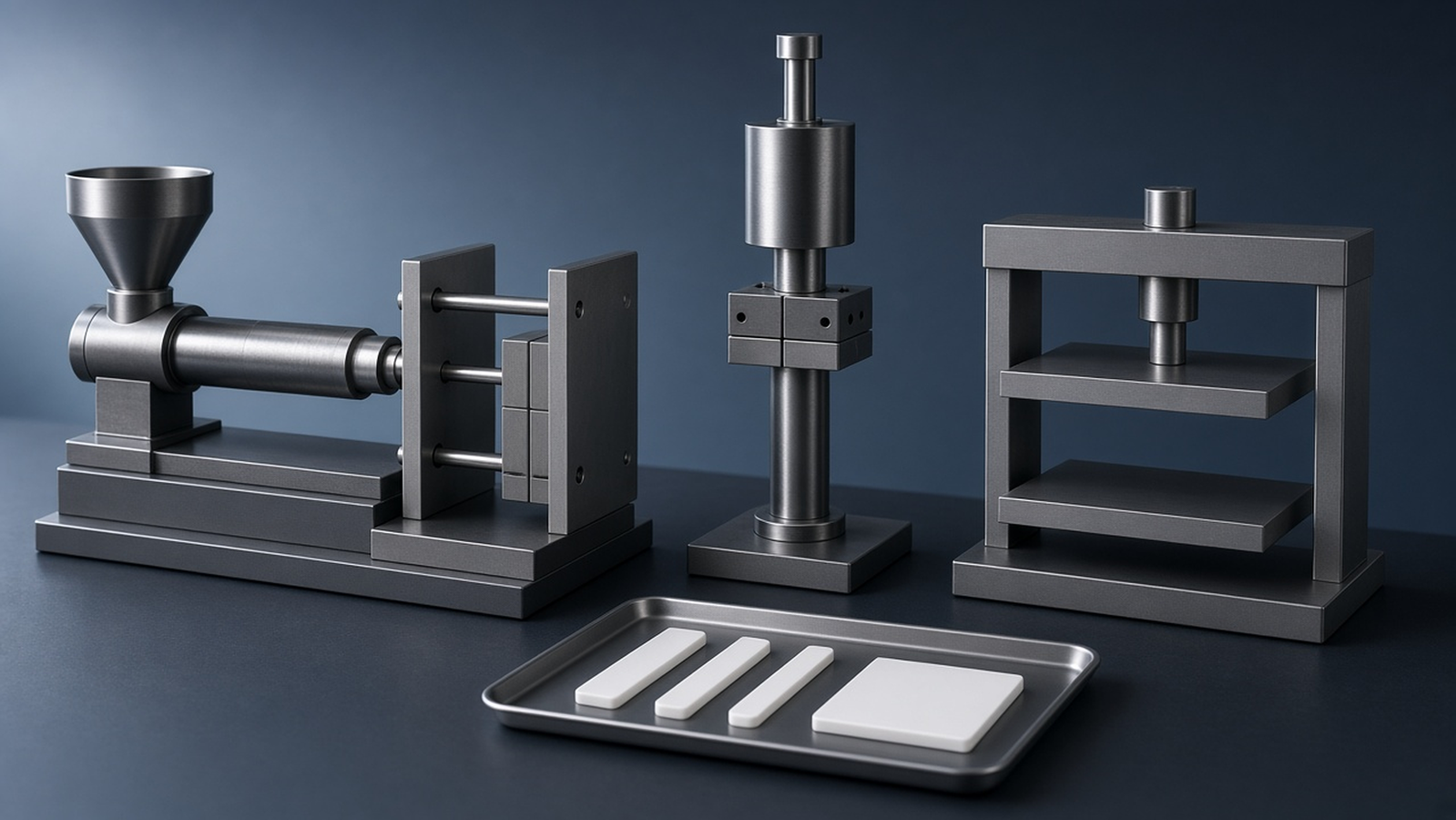
A molded test specimen is the end of a short chain: a compound, a way of getting it into a mold, and a history that the specimen carries into every test. This guide maps the three routes used for plastic test specimens, injection, transfer and compression molding, by what each asks of the material, the specimen and the record, and sets out what four Polytevo Series by ACS Material pages say about the machines for each route.
1. The short answer: choose the route by what the specimen must represent
This guide compares injection, transfer and compression molding as routes to plastic test specimens. The choice depends on the specimen’s intended use, available material, required geometry and preparation conditions.
- What must the specimen represent? A bar molded the way a part is molded, or a flat plaque pressed under a controlled thermal history from which specimens are cut.
- How much compound do you have? A route that needs a runner or a first-shot allowance uses more material than the specimens themselves.
- What geometry does the test need? Bars from a mold cavity, or a plaque of one thickness to be cut or punched.
- What history can you record? Each route has its own settings. The record helps assess comparability; it does not establish it by itself.
Section 2 explains why the route matters, using studies and two test method references. Sections 3 to 5 take the injection, transfer and compression routes in turn, section 6 reports what four Polytevo pages say, section 7 turns the four questions into a decision table, and section 8 lists what travels with a specimen. The three guides in the hub block at the end of this page take one decision each further.
| Route | How the material enters the mold | Specimen form discussed here | Read next |
|---|---|---|---|
| Injection | Melt is forced into a closed mold through a gate | Bars and small plates from a cavity | \1 |
| Transfer | Transfer arrangement described on the product page: a softened charge is forced from a heated barrel through a runner into a preheated mold | Bars and plaques from a split mold | \1 |
| Compression | Material is pressed in a mold or frame between heated plates | Plaques and sheets to be cut or punched | \1 |
The table is a working summary of the routes as used in this guide.
2. Why the route matters to the specimen
Specimen preparation is a source of variation that test methods try to remove by standardizing it. A European round robin on a draft injection-molding method for test specimens had five companies mold styrenic specimens; despite large differences in molds and molding conditions the results agreed well, particularly when specimens molded in different laboratories were tested in a single laboratory.1 Test method reference: ISO 294-1:2017 and ASTM D3641-24 for injection molding, and ISO 293:2023 and ASTM D4703-24 for compression molding.2,3,4,5
The route and the settings leave a structure in the specimen. In injection-molded polypropylene tensile bars, the melt temperature and the injection pressure changed the skin, intermediate and core layers, and the tensile yield strength, the impact strength and the shrinkage rose with the combined thickness of the two oriented outer layers.6 The orientation and the residual stresses that injection molding leaves behind have a chapter of their own in the molding literature.7 A difference of temperature between the two mold surfaces changed the morphology and the distribution of the mechanical modulus through a polypropylene sample.8 For a high-density polyethylene, the crystalline morphology of a micromolded part and of a larger conventional part differed: the larger part showed a skin-core morphology, and the micromolded part had no spherulites at the center of its thickness.9
For compression molding, the ISO method states that the main steps of the procedure, including eight different cooling methods, are standardized so that moldings are obtained in a reproducible state, that the required molding temperature and cooling method are given in the standard for the material or agreed between the parties, and that it does not apply to reinforced thermoplastics.4 The ASTM practice for compression molding thermoplastics into test specimens, plaques or sheets states that ISO 293:2023 is no longer equivalent to it and differs in detail, so a record should name which document was followed.5 Compression molding of polymers and composites is treated at chapter length in the molding literature.10
Transfer molding has its own chapter in a book on custom molding of thermosets, a different field from test specimens.11 This guide cites no study that compares transfer molding with injection or compression molding for laboratory test specimens, so the comparison in section 7 rests on what the routes require and what the pages say, not on measured differences between the routes.
3. The injection route
Injection molding suits a specimen that must be molded the way a part is, in a closed cavity under controlled filling, holding and cooling. Its strength for specimen work is repeatability: once a mold and a set of conditions are fixed, the same cavity can be filled again and again, and the conditions can be recorded in the uniform way the practices describe.3,2 Its material overhead is the runner, the first shots and the purge, which matter when the compound is scarce.
\1 compares the two models on the Polytevo injection page by their listed figures and by what each needs on site.
4. The transfer route
The Polytevo Series Vertical Transfer Molding Machine page describes a particular transfer arrangement: compound is softened in a heated barrel and forced through a runner into a preheated mold to prepare specimens.
\1 compares it with the injection route for a small batch and describes the record that has to travel with the specimens. If the compound comes from an extruder, How to Choose a Laboratory Extruder: Types, Scale and Duty sets out how to choose the machine that makes it.
5. The compression route
This guide focuses on the compression-molded plaque or sheet route, from which specimens are cut or punched. The physics of the press cycle, the choice between heated dies and heated platens, and the general method are covered by guides already on this site: the Laboratory Hot Pressing Guide: Equipment, Variables and Limits and Heated Dies vs Heated Platens: Choosing a Laboratory Hot Press. Those guides were written around other presses on this site, so use them for the method and the Polytevo pages for Polytevo figures. The record that belongs beside a plaque is the subject of \1.
6. What four Polytevo pages say
This section reports what four Polytevo pages say on 15 November 2026, and no literature appears in it. The figures are quantities of different kinds, a machine temperature, a charge, a plate size, and they are not converted into one another or compared across the machines. Specifications are as published on each page, and final configurations are confirmed on quotation.
| Polytevo page | Route as the page describes it | Figures as published |
|---|---|---|
| Polytevo Series Precision Injection Molding Machine | Pair of compact precision injection molding machines: ACS-7003 pneumatic and ACS-7003H hydraulic | 20 mm screw; zones 1/2/3 up to 360°C; the mold is optional (specimen mold or customized) |
| Polytevo Series Vertical Transfer Molding Machine | Laboratory vertical transfer molding machine with direct pneumatic pressing | Barrel up to 300°C; mold up to 150°C; charge ≈20 g (depends on compound and specimen) |
| Polytevo Series Plate Vulcanizing Press Machine | PLC-controlled vulcanizing platen press for the compression molding of test specimens | 30 T and 50 T; RT to 300°C; double space: upper space heating, lower space cooling |
| Polytevo Series Vacuum Plate Vulcanizing Press | PLC program-controlled 30 T laboratory vacuum plate vulcanizing press with a fully enclosed vacuum hood | Vacuum degree 0 to −0.08 MPa; RT to 300°C; plate size 300 × 300 mm |
Figures are copied from the pages and keep each page’s labels. The row order is not a ranking.
The transfer page describes the specimens it prepares as dog-bone (tensile), flexural, impact and color plaque specimens, selected by the mold, and says that the machine is used together with internal mixers, two-roll mills and twin-screw extruders. The injection page lists specimen types of stretch, impact, light transmittance, electric breakdown, shrinkage, fluidity, thermal deformation and color plate.
The two press pages describe their machines in their own words: the plate vulcanizing press page describes forming the material in a mold between the heating plates under controlled pressure and temperature, and the vacuum press page describes placing the raw material in a mold between electrically heated plates and pressing it at the rated temperature to form material for testing.
7. Choosing by question
| If this is true | Start with | Why |
|---|---|---|
| The test needs bars from a cavity and you will mold many of them | Injection route, then \1 | A fixed mold and fixed conditions make repeat filling and a uniform record possible |
| You have a small compounded batch and need a few standard specimens | Assess both molding routes using a material budget; then read \1. | Compare the material required for setup, startup, each molding cycle, retained material and the intended specimens; a single nominal charge figure does not decide the route. |
| The test needs a flat specimen of one thickness, or a plaque to cut from | Compression route, then \1 | Specimens share a molding-run record, but their positions, orientations and local material states can differ; retain a specimen map. |
| The material takes up moisture | Any route; follow the material-specific preparation and conditioning requirements, and record drying when performed. | The cited studies concern moisture during processing or testing in particular materials; they do not prescribe one drying procedure for every polymer.12,13 |
| You are comparing results from two routes | Keep the route in the record and compare cautiously | The route and its settings change the structure of the specimen |
Not every row is tied to a cited study; the last two rows are cautions drawn from the literature in section 2 and from the guides linked above.
The test that the specimen is for decides the geometry before it decides the route, and Mechanical Testing of Plastics: Match the Test to the Question sets out how to choose that test. The drying caution rests on studies that molded or processed polyamide 6 and polylactide, which are only two of many polymers, so treat it as a reason to check the material’s own drying advice rather than as a rule.12,13
8. What travels with a specimen
A specimen without its history is a number waiting to be misread. Whatever the route, write down the material, lot and form; any drying, subsequent storage and conditioning; how the compound was made, including the machine and its settings; the route and the machine; the mold or plate set; the settings of the cycle as run; the cooling and release; the date and operator; and the test the specimen is for. This is a guide to what is worth writing down, not a published checklist, and the practices cited in section 2 are the places to look for the fields a method expects. The three guides in the hub block turn this list into the fields of each route.
9. FAQ
What is the difference between injection, transfer and compression molding for test specimens?
In injection molding melt is forced into a closed mold through a gate; in compression molding material is pressed between heated plates, usually to make a plaque from which specimens are cut. The route and its settings leave a structure in the specimen, so the route belongs in the record.6,4
In transfer molding, as the Polytevo transfer page describes it, a softened charge is forced from a heated barrel through a runner into a preheated mold cavity.
Which route is used for tensile bars?
Test method references exist for injection molding of thermoplastic test specimens and for compression molding of thermoplastic test specimens, plaques or sheets, so a tensile specimen can come from either route; the standard for your material and test is where the required conditions are given or agreed.2,5,4
The Polytevo transfer page lists a dog-bone tensile bar mold, a split transfer mold with replaceable cavity inserts.
What do the Polytevo press pages say the presses make?
The plate vulcanizing press page describes a platen press for the compression molding of test specimens, and the vacuum press page describes pressing raw material in a mold between heated plates to form material for testing. Specifications are as published on each page and final configurations are confirmed on quotation.
Can I compare specimens made by different routes?
Compare specimens from different routes only with a defined purpose and a documented preparation history. The cited injection studies report changes in structure or properties under particular molding conditions. The micro/conventional comparison reports different morphologies, but does not isolate part size as the sole cause. Do not assume results from different preparation routes are interchangeable.6,8,9,4
Where do I start if I only have a few grams of compound?
Start with the quantity per run that each route needs, including first shots, runners and loss, and read \1 for the comparison of the transfer and injection routes for a small batch.
10. Keep exploring the Lab-Scale Polymer Processing Knowledge Hub
This guide is the entry point to the molding-specimens cluster of the Lab-Scale Polymer Processing and Testing: A Workflow Guide. The three guides below take one decision each further, and the last two links lead to neighboring clusters:
- \1. The pneumatic and hydraulic models on one product page, compared by the figures and units each lists.
- \1. Two ways to mold a small compounded batch, and the record that travels with the specimens.
- \1. What to write down beside a plaque, and how the two Polytevo presses differ in setup.
- Mechanical Testing of Plastics: Match the Test to the Question. Choosing the test that the molded specimen is for.
- How to Choose a Laboratory Extruder: Types, Scale and Duty. Where the compound to be molded often comes from.
To discuss a configuration, describe the material and its form, the specimen types and the number of specimens you need, the utilities available in your laboratory, and the mold or plate size you plan to use, then send it through Request a Quote. Specifications are as published on each product page, and final configurations are confirmed on quotation.