
Five tonnes on a 10 mm die is more than six hundred megapascals. Five tonnes on a 150 mm square of polymer is about two. The first number is enough to densify some ceramic powders with a little help from heat and a trace of liquid; the second is the kind of pressure a platen press puts on a film. Both jobs are called hot pressing and both are done on a laboratory press with a heater, but they are done on two different machines, and the machine that is right for one is nearly useless for the other. This guide is about telling them apart before the order is placed: what a heated die does, what heated platens do, and which samples belong to which.
In one paragraph: choose by the pressure the sample needs and the shape it must have. A heated die gives hundreds of megapascals on a pellet a few millimeters to 40 mm across, which is what powders need: warm compaction, cold sintering, glassy and soft solid electrolytes. Heated platens give a few megapascals to a few tens over a wide flat area, which suits films, sheets, laminates and bonded layers. A platen press can also heat an ordinary die placed between its plates, slowly and within its daylight (the opening between the platens); a heated die cannot make a film. Decide the temperature class afterward, because it brings cooling requirements with it, and decide manual or automatic last.
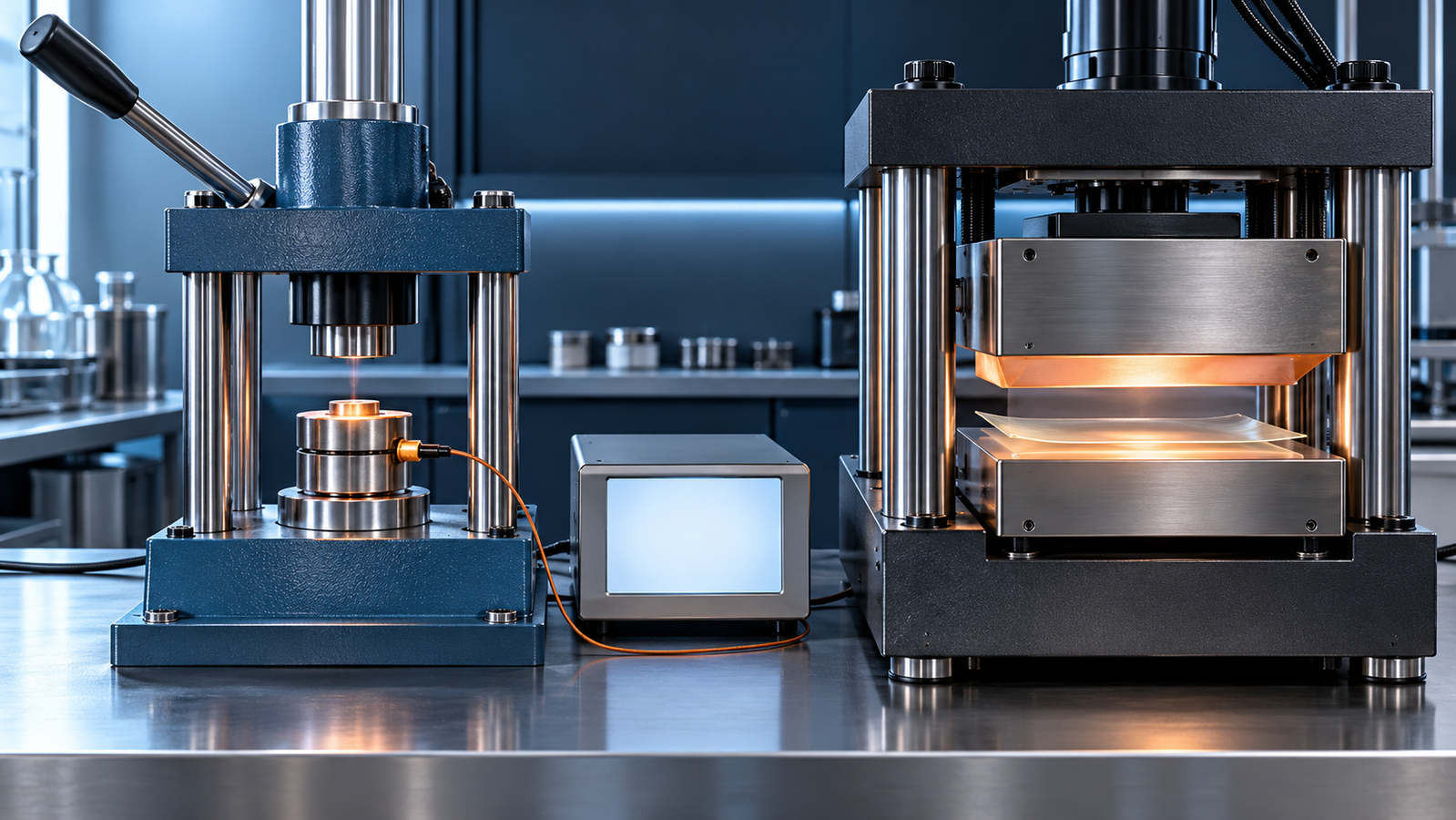
1. The same force, two very different pressures
Everything else follows from the area the force acts on.
| Machine and sample | Force | Loaded area | Pressure on the sample |
|---|---|---|---|
| Heated die, Ø10 mm pellet | 5 t | 79 mm² | 624 MPa |
| Heated die, Ø20 mm pellet | 15 t | 314 mm² | 468 MPa |
| Heated die, Ø40 mm pellet | 24 t | 1257 mm² | 187 MPa |
| Platens, 50 × 50 mm sample | 25 t | 2500 mm² | 98 MPa |
| Platens, 150 × 150 mm sheet | 10 t | 22,500 mm² | 4.4 MPa |
| Platens, 400 × 400 mm sheet | 40 t | 160,000 mm² | 2.5 MPa |
Forces are within the ratings of PressPro™ heated-die presses (15 and 24 T) and platen presses (10 to 40 T). PressPro™ steel dies are intended for use below 800 MPa of sample pressure at room temperature, which on a 10 mm bore is 6.4 t. The pressures here are nominal, from force and loaded area; they do not determine the allowable pressure of heated tooling.
Two orders of magnitude separate the top and bottom of that table. No setting on a platen press closes the gap for a full-size sheet, and no heated die opens up to take one. The question to ask of a sample is therefore: does it need to be squeezed hard, or does it need to be kept flat?
2. What a heated die is for: powder, hard
The PressPro™ manual electric-heating hot press is a manual pellet press with a heated die and a temperature controller. One die set is included, chosen between 3 and 20 mm on the 15 T model or between 21 and 40 mm on the 24 T model, and round, square and flat heated dies are made to order. The die is heated directly by its own heater, so the heat has a short path to the powder. Three kinds of work fit it.
Warm compaction
Some powders press better warm than cold. In metal powders, heating lowers the yield strength of the particles and makes the lubricant more effective, and porosity below 2 % has been reached this way; the compacts spring back more, and the tooling has to be designed for the temperature.1 In an instrumented die, preheating to as much as 140 °C improved green density, die-wall friction and ejection behavior across iron, titanium, aluminum and stainless-steel powders, with the non-ferrous powders responding differently from the ferrous ones.2 Ceramic granules give a related example. With a polyvinyl alcohol binder plasticized with polyethylene glycol, densification was enhanced when the glass-transition temperature of the binder lay below the pressing temperature. In that study the glass transition was lowered by adding plasticizer, and the added plasticizer also lowered the green strength of the compact.3 A heated die approaches the same condition from the other side, by raising the pressing temperature; that step is an inference and was not tested in the paper.
Cold sintering
Cold sintering densifies a ceramic powder at temperatures far below a furnace by adding a small amount of a transient liquid, water in the work that named the process, and pressing in a heated die. Densification is described as a dissolution and precipitation process mediated by that liquid, and the process was introduced with densification between room temperature and 200 °C,4 is defined by the combination of a transient transport phase with an applied uniaxial force,5 and is generally carried out at up to about 300 °C under hundreds of megapascals.6 Zinc oxide has been brought above 90 % of theoretical density below 100 °C in this way,7 and the lithium-ion conductor LATP has been cold-sintered at 140 to 280 °C under 510 to 600 MPa to 90 to 98 % density, though with lower conductivity than conventionally sintered material.8
Those conditions are a description of a heated die on a small press: 600 MPa on a 10 mm bore is 4.8 t. They also show what the work asks of the equipment. The LATP work held each pellet at its peak temperature for an hour under constant pressure,8 which on a manual press means topping up the load as the compact shrinks. A press built for cold-sintering studies holds constant pressure unattended and, when it computes densification from platen displacement, accounts for the thermal expansion of the metal die.9 Check the die steel against the liquid you intend to use, and expect hot vapor to leave the die as the liquid boils off. The pressure a heated die can take can depend on its temperature: in the LATP work the pressure was lowered from 600 to 510 MPa for the runs at 200 °C and above, because of the limit that the maker of that die set for its mechanical stability.8 That figure belongs to their die and their study; it is not a rating for other heated tooling.
Glassy and soft inorganic solids
Some materials flow near a glass transition that lies inside the range of a laboratory hot press. A sulfide glass electrolyte hot-pressed at 200 °C, its glass-transition temperature, reached 98 % of theoretical density, against about 89 % for the same powder pressed cold at 360 MPa.10 The solid-state electrolyte pellet guide goes into this class of material.
At the other end of the scale stands the ceramic hot press proper, which works at furnace temperatures. In hot-pressed alumina the final stage of densification was attributed to diffusion enhanced by the applied stress,11 and for hot-pressed lead zirconate–titanate, densified between 700 and 1100 °C, grain-boundary sliding and stress-directed diffusion of vacancies were proposed as the mechanisms.12 That is the same principle in a different machine. A 500 °C die does not reach it.
3. What heated platens are for: flat things, evenly
PressPro™ platen hot presses come as manual dual-platen, fixed-upper-platen, automatic and vacuum machines, with platens from 100 to 400 mm square. The plates supply heat from both faces and the press supplies a modest, even pressure. The typical jobs:
Films and sheets from a melt
A thermoplastic is laid between polished plates inside a frame, heated above its softening or melting point, pressed and cooled. Compression molding of plaques and sheets for testing is an established practice with its own standard.13 The result depends on the whole thermal cycle and not only on the peak temperature. In carbon-fiber laminates with a polyphenylene sulfide matrix made by hot compression molding, three cooling rates gave crystallinities of 51, 58 and 62 %, and the slower-cooled laminates were stiffer and stronger in interlaminar shear.14 That is the argument for programmed cooling, or at least for cooling the same way every time.
Bonding layers together
Membrane electrode assemblies for fuel cells are usually made with a hot-pressing step, and the pressing conditions affect performance and durability.15 The pressures are low, and there can be an optimum inside the range: in one study of titanium-mesh assemblies for direct methanol cells, peak power density rose and then fell as the pressure went from 0 to 10 MPa and as the temperature went from 115 to 155 °C; with the pressing time fixed at 180 s, the conditions judged appropriate were 5 MPa and 135 °C.16 A few megapascals, held accurately over the whole area, is platen work. The same field also has a counterexample, in which hot-pressed and non-hot-pressed assemblies performed alike,15 so the step should be tested and not assumed.
Solvent-free polymer electrolytes
Homogeneous dry mixtures of polyethylene oxide, a lithium salt and a ceramic filler have been hot-pressed directly into plasticizer-free composite polymer electrolytes, in a procedure that avoids any step involving liquids.17 When such an electrolyte is pressed as a film, its thickness is set by a frame or spacer, as for any pressed film.
A die between the platens
An unheated die, a flat-plate mold or a frame can be placed between heated platens and brought to temperature by conduction. This is how powders are pressed into plates and bars in a platen press. Two limits apply: the tooling has to fit the daylight, which is 55 to 65 mm on the fixed-upper-platen and automatic presses and 140 to 160 mm on the manual dual-platen presses; and a block of steel heated only through its end faces takes time to become uniform, so the hold at temperature must be long enough for the middle to catch up.
4. Hot-press route check
Describe the sample: its form, its size, the pressure you want on it, the process temperature and the temperature of your room. The tool works out the force each route needs, and checks it against the die range, platen size, force rating and heating range of the PressPro™ hot presses. The calculation gives nominal sample pressure from force and loaded area. It does not determine the allowable pressure of heated tooling or establish a validated pressing cycle, so the heated-die route is never shown as fully passed: its die-limit line is Confirm at best.
5. Side by side
| Heated die | Heated platens | |
|---|---|---|
| Sample that goes in | Powder or granules | Granules, film, sheet, laminate, stack; or a filled mold |
| Shape that comes out | A pellet of the die’s diameter | A flat piece whose thickness is set by a frame or shims |
| Pressure range | Tens to hundreds of MPa | Under 1 to a few tens of MPa; about 100 MPa on small samples |
| Size range | Ø3 to 40 mm | Platens 100 to 400 mm square |
| Force | 15 or 24 T, manual | 10 to 40 T, manual or automatic |
| Heat path | From the die wall, around the sample | From the two plates, through the sample’s faces |
| Temperature program | 30 segments on every model: ramps at a set rate, holds of any length, natural cooling | |
| Force program | None; hand pump | None on manual models; 5 segments, upgradeable to 30, on automatic models |
| Atmosphere | Air | Air; vacuum to −0.1 MPa or inert gas in the vacuum press |
| Supplied tooling | One heated die set | None; frames and plates are made to the sample |
| Maximum power | 600 W | 1300 to 5500 W, by model |
The figures for each family, with daylight, power and cooling, are in the range table of the laboratory hot pressing guide.
6. Then the temperature class
Both kinds of machine are sold to 300 °C and to 500 °C, and the higher class is more than a bigger number on the controller.
- On the heated die the 300 °C version has an aluminum heater core and the 500 °C version a copper one. Above 300 °C a water-cooled insulation plate is listed as an option, to keep the heat out of the press.
- On most platen presses a water chiller must be connected for work above 300 °C. The compact 24 T manual models (EPHBMC01, EPHBMCG1) have stainless-steel water-cooled insulation plates; air- and water-cooling accessories are listed as options.
- On the vacuum press 300 °C is standard and 500 °C is built to order.
Buy the class the process needs. The warm-compaction and cold-sintering work cited above was done at or below about 300 °C. For polymer films, check the molding temperature of your polymer before settling on the 300 °C class.
7. Which to choose
A heated die when
- the sample is a powder and the product is a pellet between 3 and 40 mm across;
- the pressure wanted on it is tens to hundreds of megapascals;
- working in air, with the force applied and held by hand, is acceptable.
Heated platens when
- the sample is a film, a sheet, a laminate or a stack of layers;
- the pressure is a few megapascals and has to be even over the whole area;
- the work needs vacuum or inert gas, or a programmed force, which only the platen presses offer.
Platens with a die between them when
- powder is pressed into plates or bars in a mold that fits the opening of the press, and a slower heat-up is acceptable.
Manual or automatic comes last. The heated-die press is manual. Among the platen presses the automatic models add a force program of 5 segments, upgradeable to 30; the manual, electric and automatic comparison explains what that changes.
8. Four mistakes worth avoiding
- Expecting die pressures from platens. A recipe that says 300 MPa is a die recipe. On a 180 mm platen, 25 t over the full plate is under 8 MPa.
- Quoting force without area. “Pressed at 10 t” describes nothing until the footprint is given. Write the pressure, or the force and the dimensions.
- Forgetting the daylight. The fixed-upper-platen and automatic presses, which give the best parallelism, also have the smallest opening. Measure the mold, the plates and the sample together before choosing between 55, 65 and 140 mm.
- Treating the set temperature as the sample temperature. The controller regulates the die or the platen. The sample follows with a delay that depends on its thickness and on the tooling around it. Allow a soak, and find its length by experiment.
9. Related guides and equipment
- Laboratory Hot Pressing Guide — the full range, platen pressure, vacuum, and how to press a film.
- Solid-State Electrolyte Pellet Pressing — cold, warm and hot pressing of sulfide, oxide and polymer electrolytes.
- Manual vs Electric vs Automatic Laboratory Presses — what the automatic hot presses program.
- CIP vs WIP vs HIP — heat with pressure from all sides.
- Pellet Press Die Selection — hot-pressing dies, flat plates and frame molds.
- How to Choose a Laboratory Hydraulic Press — the whole PressPro™ range by purpose.
- Vacuum vs Ambient Hot Pressing — what a sealed chamber changes, what it does not, and when room air is enough.
- Hot-Pressed Film Defects — why films stick, bubble, wrinkle, yellow or turn hazy, defect by defect.
- Equipment: heated-die press; manual dual-platen, fixed-upper-platen, automatic and vacuum hot presses.
10. FAQ
What is the difference between a heated die and a heated platen press?
A heated die presses powder inside a small bore and reaches hundreds of megapascals. A heated platen press closes two flat hot plates on a film, sheet or laminate and applies a few megapascals over a large area. They are different machines for different samples.
Can a platen hot press make pellets?
Yes, with a die standing between the platens, as long as the die fits the daylight. The die is heated by conduction from the plates, which is slower than a die with its own heater, and the force rating of the platen press still limits the pressure.
Can a heated die make films?
Not in the usual sense. It makes pellets of its own diameter. A thin disc can be pressed in it, but films and sheets are platen work.
What equipment does cold sintering need?
A uniaxial press, a die that can be heated to about 300 °C, and a way to hold several hundred megapascals constant for the length of the cycle. A heated-die press covers the first two; on a manual press the operator maintains the load.
Can I add a heated die to a press I already have?
Possibly. Hot-pressing dies are also made as separate tooling, round, square or flat, with built-in heating, for 300 or 500 °C. Such a die needs a temperature controller and a press with enough working space and force for it, so send the details of your press with your inquiry.
Do I need a 500 °C hot press, or is 300 °C enough?
300 °C is enough unless the process itself runs hotter. The 500 °C versions need the cooling provisions listed for the model, usually a water chiller on platen presses.
Can I hot-press in vacuum or inert gas?
On platens, yes: the vacuum hot press encloses them in a chamber that reaches −0.1 MPa gauge and can be back-filled with inert gas. The heated-die press works in air.
Which is easier to keep at an even temperature?
A small heated die reaches a uniform temperature quickly because the heater surrounds the sample. A platen heats a wide sample from two faces and is most even away from its edges, so the sample should sit well inside it; anything thick between the platens needs time to heat through.