
CIP, WIP and HIP are not three sizes of one machine. Cold isostatic pressing (CIP) takes loose powder in a rubber mold and squeezes it in liquid at room temperature until it holds together. Hot isostatic pressing (HIP) takes a part that is already nearly solid and holds it in argon at furnace temperature until its last pores close. One starts a process and the other finishes it. Warm isostatic pressing (WIP) sits between them in temperature and beside the cold process in everything else. Knowing which is which answers the question a laboratory asks most often: whether its own cold or warm isostatic press can do what a paper did.
In one paragraph: all three apply pressure equally from every direction through a fluid, and that is where the resemblance ends. CIP and WIP are forming steps. They work on powder, in liquid, through a soft mold or bag, and what comes out is a green compact that still has to be sintered, or a bonded laminate. WIP adds enough heat to soften a binder, a polymer layer or a soft electrolyte so that it flows under the pressure. HIP is a densifying step. It works in gas at temperatures high enough for the solid itself to bond by diffusion, and it closes internal pores in castings, sintered parts and printed metals, or consolidates powder sealed in a can. A laboratory isostatic press is a CIP or a WIP. If the result you want requires HIP, no setting on a cold or warm press will produce it.
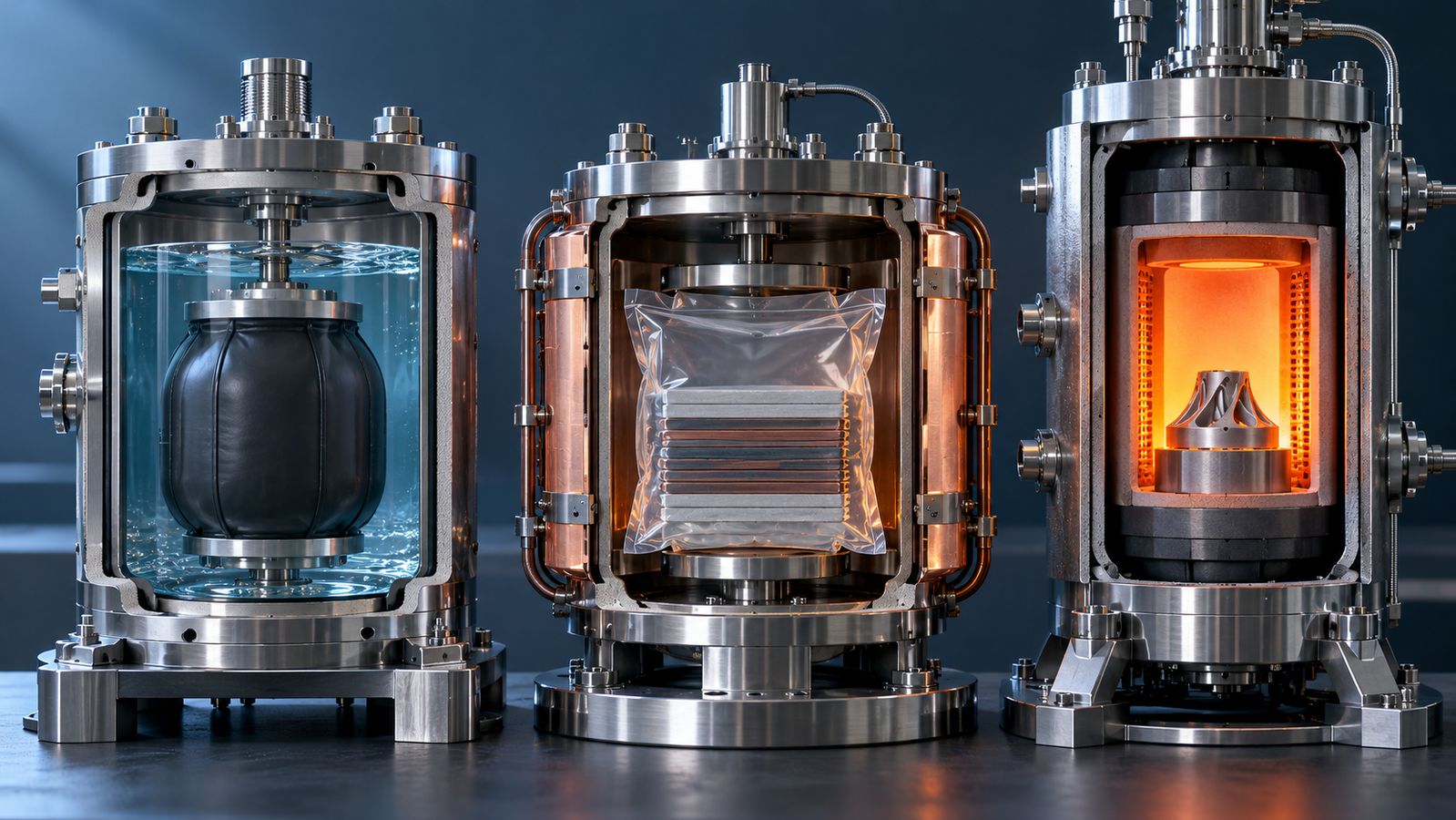
1. What the three have in common
Isostatic means the same pressure in every direction. A fluid delivers that naturally: it pushes on every surface it touches with equal force per unit area, so a part surrounded by pressurized fluid is squeezed toward its center without being pushed sideways or bent. There is no die wall, so there is no wall friction, and no direction in which the material is pressed harder than another.
One condition comes with it. The fluid must not get into the pores it is supposed to close, or the pressure inside and outside the part is the same and nothing happens. Every isostatic process therefore needs a barrier: a rubber mold or bag for powder in liquid, a welded can for powder in gas, or a part whose pores are already sealed off from the surface. Most of the practical differences between the three processes are differences in the fluid, the temperature and that barrier.
2. Cold isostatic pressing: a forming step
The powder is filled into an elastomer mold, sealed, immersed in liquid and pressurized at room temperature. The mold follows the powder as it shrinks. What comes out is a green compact: it holds its shape and can be machined, but its particles are only packed and interlocked, not bonded. It still has to be sintered. Cold isostatic pressing is long established for ceramics and is used for near-net-shape metal parts.1 The handbook treatment of the process covers the pressure vessel, the tooling materials, the influence of part shape and parameters such as dwell time and depressurization rate.2
Its strengths are uniform density and freedom of shape, set out against die pressing in the uniaxial and isostatic comparison. Laboratory chambers of the PressPro™ type are rated to 300 MPa, with 500 MPa chambers made to order. Research has gone a good deal higher where it paid: zirconia nanopowders pressed at 300 to 1000 MPa,3 steel powders consolidated at 800 MPa to about 95 % of full density.4
The method is not confined to ceramics and metals. In one study, slurry-cast composite electrode sheets for sulfide solid-state batteries, made with a positive-electrode material chosen because it does not change its dimensions, were densified by cold isostatic pressing and cycled stably under a stack pressure below 0.5 MPa.5
3. Warm isostatic pressing: the same, with something that softens
Heat the liquid and the sample and the process becomes warm isostatic pressing. On the PressPro™ warm isostatic press an electric jacket around the chamber heats the chamber, the liquid and the sample by conduction, from room temperature to 200 °C under a 30-segment temperature program. The chamber is rated to 200 MPa warm and 300 MPa cold.
Two hundred degrees does not sinter alumina or steel. Warmth matters when the sample contains a phase that softens in that range. The usual reasoning is that a softened phase flows under pressure and fills gaps that cold pressing leaves. Three published uses fit that picture.
- Ceramic green tapes. Multilayer ceramic substrates are built by laminating tapes of ceramic powder in a polymer binder. Thermo-compression, which is heat and pressure applied together, at up to 80 °C and 30 MPa for 2 to 15 minutes is described as the most common way of bonding such tapes, and as one that seals well but distorts internal channels.6 A study of isostatic lamination examined how lamination pressure and temperature affect channel geometry, starting from the observation that the settings tape suppliers recommend for plain multilayer circuits do not suit structures with channels and cavities.7
- Polymer parts. Polyamide parts made by powder bed fusion were treated in a warm isostatic press. Heat alone raised their tensile strength but lowered their elongation, which the authors attributed to higher crystallinity with no reduction in porosity; heat and pressure together raised the strength further and made up the lost elongation.8 In that study the pressure is what made the difference.
- Solid-state battery cells. In a widely cited all-solid-state pouch cell with a sulfide electrolyte, warm isostatic pressing was used to improve the contact between electrode and electrolyte,9 and isostatic pressing in general is being developed as a processing route for solid-state battery components.10
What comes out of a warm isostatic press is still a green compact or a bonded laminate. Nothing has sintered. In equipment it is a cold isostatic press with a heated chamber, and it belongs with CIP on one side of the line. In handling it differs in one respect: the chamber, the liquid and the sample are hot at the end of a cycle and have to cool before they are touched.
4. Hot isostatic pressing: a densifying step
Hot isostatic pressing applies gas pressure and high temperature together in a purpose-built vessel. The gas is usually inert, typically argon;11,12 a gas is used because no pressure liquid can be taken to furnace temperature. Under those conditions pores and defects inside a solid body collapse and bond by diffusion,11 and the conditions a material needs can be laid out as pressing diagrams.13 A study of four alumina powders, for example, covered 1100 to 1400 °C, 5 to 200 MPa and half an hour to four hours, and found density rising with each.14
Its main uses are to heal porosity in castings, to bring sintered components to full density, and to consolidate powder sealed in a container; it is also used to bond materials to each other.11,15 In industry the first two dominate: a 2012 overview put about a quarter of capacity on powder-metallurgy products and more than half on the densification of cast and sintered parts.16 Additively manufactured metals are a more recent use: hot isostatic pressing is applied after printing to reduce porosity and cracking.12
What HIP closes and what it does not
X-ray tomography of printed titanium before and after a standard cycle makes the rule visible. Internal porosity shrank below the resolution limit of about 5 µm; defects connected to the surface did not close, because the gas was inside them as well.17 Near-surface pores can even break through and leave new notches.18 And pores that held argon are compressed, not removed: in electron-beam-melted titanium studied by the same group, they reappeared and grew during a later high-temperature heat treatment.19
That is the barrier condition again. A part goes into HIP without a can only if its pores are closed to the surface. Powder, and anything with open porosity, has to be encapsulated first.
Sinter, then HIP
In ceramics a common sequence is to sinter until the pores are closed and then use HIP to remove what is left. Several transparent ceramics have been made this way. Neodymium-doped YAG was sintered to 98 % density to limit grain growth and then hot isostatically pressed; tape-cast samples reached more than 80 % transmission at 1064 nm with pressing below 1750 °C.20 For transparent zirconia made by hot isostatic pressing of presintered material, a scattering model put the residual porosity needed for high transparency below 100 ppm.21 Sintered and hot isostatically pressed alumina reached a relative density above 99.9 % with grains of 0.4 to 0.6 µm and a bending strength of 600 to 700 MPa.22 The starting compact still matters: in the YAG work the tape-cast samples, unlike the dry-pressed ones, were free of large agglomerate-related pores after sintering, and that is what allowed high transparency to be reached with hot isostatic pressing below 1750 °C.20
5. One process chain, start to finish
The clearest way to see how the three relate is a route that uses two of them. In one study of water-atomized steel powders, the powder was first consolidated by cold isostatic pressing at 800 MPa to about 95 % of full density. It was then sintered at 1250 °C, which was enough to close the porosity at the surface. With the surface sealed, the parts could be hot isostatically pressed without a capsule, to full density.4
Cold isostatic pressing is at the front of that chain and hot isostatic pressing at the back. They are not alternatives. Each does a job the other cannot.
6. Side by side
| CIP | WIP | HIP | |
|---|---|---|---|
| Pressure medium | Liquid | Heated liquid | Inert gas, usually argon |
| Temperature | Room temperature | Warm; to 200 °C on PressPro™ | High; in the sintering range of the material |
| Barrier | Rubber mold or bag | Mold or bag that withstands the temperature | Welded can, or closed porosity |
| What goes in | Loose or pre-formed powder | Powder with a softening phase; laminates; layered cells | Castings, sintered or printed parts; canned powder; solid parts to be bonded |
| What happens | Particles rearrange and deform | The same, and the soft phase flows | Internal pores collapse and bond by diffusion |
| What comes out | A green compact, to be sintered | A green compact or a bonded laminate | A dense part, or parts bonded to each other |
| Place in the process | Forming, before the furnace | Forming or laminating, before the furnace | After sintering or casting, or as the consolidation step |
| Equipment | Liquid-filled chamber and a press or pump | The same, with a heated chamber | Gas pressure vessel with an internal furnace |
| PressPro™ | Yes: 20 to 200 T, 300 MPa | Yes: 20 to 60 T, 200 MPa at 200 °C | No |
7. Isostatic process map
Say what goes in, what should come out, how hot and at what pressure. The map shows which of the three processes fits each answer and why, and checks the pressure and temperature against the ratings of PressPro™ cold and warm isostatic presses.
8. Five confusions worth clearing up
- Warm is not a mild form of hot. A warm isostatic press softens binders and polymers. It does not sinter anything and does not approach the temperatures of HIP.
- CIP does not densify a fired part. At room temperature a sintered ceramic or a casting is rigid; liquid pressure will not close its pores. That is HIP’s job.
- HIP does not shape. A nearly dense part shrinks only a little; powder in a can shrinks much more, and not always evenly.11 The shape has to be made first, by pressing, casting or printing.
- Hot isostatic pressing is not hot pressing. A hot press pushes on a sample between platens or punches in one direction. The comparison of heated dies and heated platens covers that family.
- The pressure numbers are not interchangeable. Three hundred megapascals of liquid on powder and a hundred of argon at furnace temperature do different things. Compare processes by what they do, not by which has the larger figure.
9. What a laboratory isostatic press covers
| PressPro™ series | Process | Frames | Chambers | Rating |
|---|---|---|---|---|
| Manual (EPSM) | CIP | 20, 30, 40, 60 T | Ø22 × 70 to Ø50 × 150 mm | 300 MPa |
| Electric (EPSBE) | CIP | 20, 30, 40, 60 T | Ø22 × 70 to Ø50 × 150 mm | 300 MPa |
| Automatic (EPSPA) | CIP | 20 to 100 T | Ø22 × 70 to Ø60 × 150 mm | 300 MPa |
| Large-tonnage automatic (EPSA) | CIP | 65 to 200 T | Ø50 to Ø90 × 150 mm | 300 MPa |
| Warm automatic (EPSXA) | WIP and CIP | 20, 30, 40, 60 T | Ø22 × 70, Ø30 × 120, Ø40 × 120, Ø50 × 150 mm | 200 MPa to 200 °C; 300 MPa cold |
On the cold series, chambers rated to 500 MPa are built to order. On two configurations the full 300 MPa works out slightly above the nominal tonnage of the frame; the isostatic press selection guide gives the figures for both.
All of these are wet-bag machines: each mold is filled and sealed outside the chamber and lowered into the liquid, which suits research because every mold can be a different shape. Choosing among them is a matter of chamber size, operating mode and whether heat is needed, and the selection guide and its chamber check go through it step by step.
10. Related guides and equipment
- Isostatic Press Selection Guide — chambers, molds, ratings and a chamber check for your part.
- Uniaxial vs Isostatic Pressing — when pressure from all sides is worth it.
- Heated Dies vs Heated Platens — heat with pressure along one axis.
- Solid-State Electrolyte Pellet Pressing — where isostatic pressing enters battery work.
- Manual vs Electric vs Automatic Laboratory Presses — the operating modes of the isostatic series.
- How to Choose a Laboratory Hydraulic Press — the whole PressPro™ range by purpose.
- Isostatic Molds, Bags and Sample Recovery — mold materials, sizing for shrinkage, filling, sealing and getting the part out.
- Equipment: manual, electric, automatic and large-tonnage cold isostatic presses; warm isostatic press.
11. FAQ
What is the difference between CIP and HIP?
Cold isostatic pressing compacts powder in liquid at room temperature and produces a green part that still has to be sintered. Hot isostatic pressing applies gas pressure at high temperature and produces a dense part. They sit at opposite ends of a process and are often used in the same one.
What is warm isostatic pressing used for?
For samples that contain something which softens with moderate heat. Published examples are laminated ceramic green tapes, polymer parts and layered solid-state battery cells. The usual explanation is that the heat lets the soft phase flow under pressure.
Can a warm isostatic press replace a HIP?
No. A warm press reaches 200 °C in liquid. Hot isostatic pressing works in gas at temperatures in the sintering range of the material. The two do different jobs.
Why does HIP use gas and CIP use liquid?
A liquid is simple to pressurize at room temperature but cannot be taken to furnace temperatures. An inert gas such as argon can, and it does not react with the part. Both are high-pressure media and need equipment rated for them.
Does a part need to be sealed for isostatic pressing?
The fluid must be kept out of the pores. Powder is sealed in a rubber mold for CIP and WIP, or in a welded can for HIP. A sintered or cast part with closed porosity can be hot isostatically pressed as it is; surface-connected pores do not close.
What pressure does each process use?
PressPro™ cold isostatic chambers are rated to 300 MPa, with 500 MPa chambers made to order, and research has used up to 1000 MPa. PressPro™ warm chambers are rated to 200 MPa at 200 °C. Hot isostatic pressing conditions depend on the material; one alumina study covered 5 to 200 MPa at 1100 to 1400 °C.
Is cold isostatic pressing enough to make a dense ceramic?
Not by itself. It makes a uniform green compact, which then has to be sintered. A uniform compact makes the sintering more predictable.
Does ACS Material supply HIP equipment?
No. The PressPro™ isostatic line is cold and warm: 300 MPa cold, and 200 MPa at up to 200 °C.