
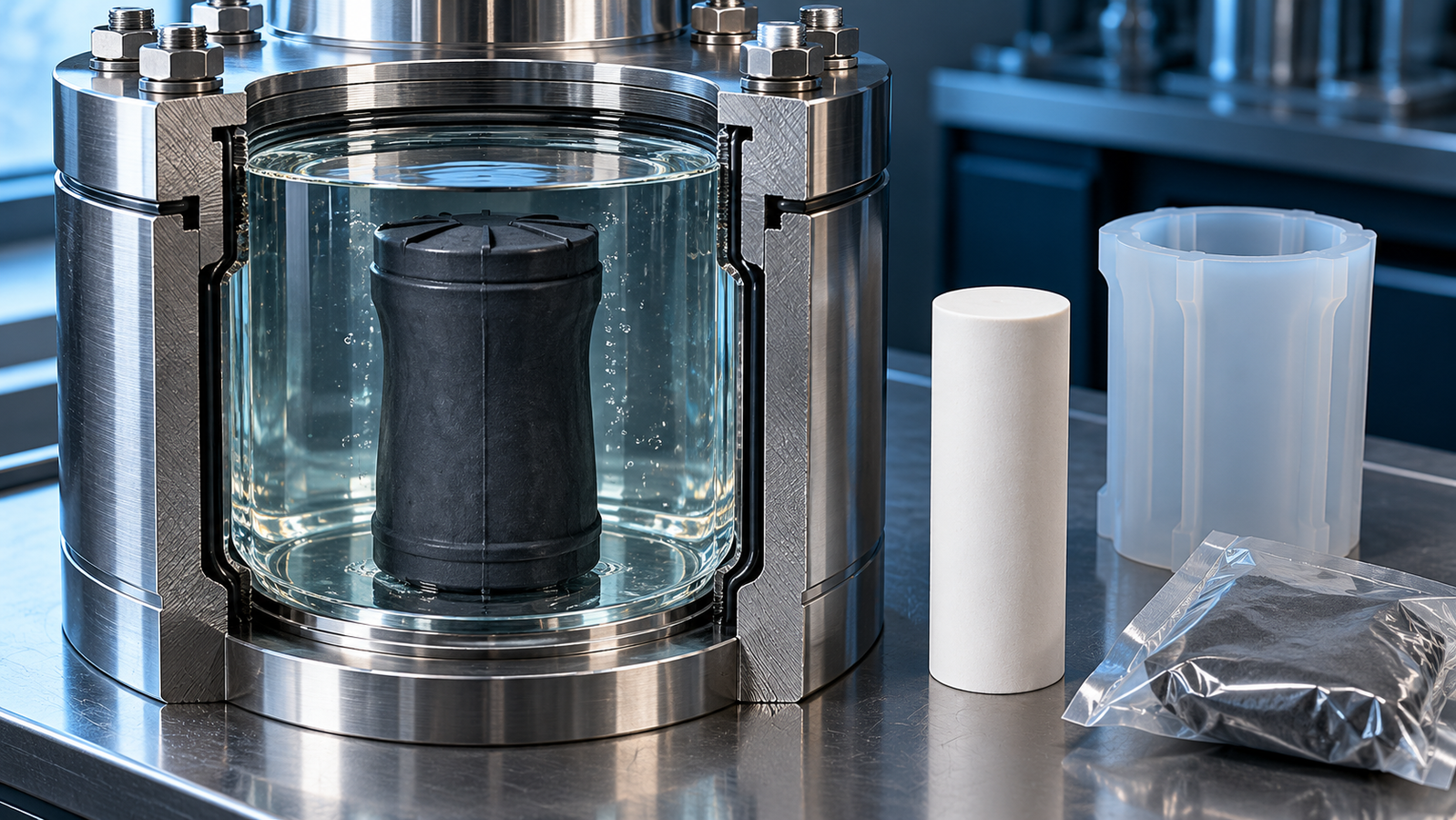
In a laboratory isostatic press, the press supplies the pressure, and in warm pressing the heat. Much of the rest depends on what goes inside the chamber: the mold or bag, how the powder was filled into it, how it was sealed, and how the part is taken out. This guide is a checklist for those steps, with what the literature shows about each and where it is silent.
In one paragraph: make the mold larger than the part, by the shrinkage from fill density to green density, and confirm the dimensions with a test part. Real parts do not shrink uniformly, and the mold itself affects the shape. Fill the mold evenly. Evacuate ultrafine and nanosized powders before sealing. In one study, iron powder in an evacuated copper tube reached 92 % of theoretical density at 500 MPa, against 82 % without evacuation. Seal so the pressure liquid cannot reach the powder. Release the pressure slowly and record how. Choose mold and bag materials for the pressure liquid and, in warm pressing, for the temperature, from their own data. Several of these steps are established practice rather than measured findings, and this guide says which.
The isostatic press selection guide covers chambers, pressure ratings and how to check that a mold fits. The comparison of uniaxial and isostatic pressing covers when isostatic pressing is worth it. This page is about the tooling and handling in between.
1. Wet bag: the mold is the tool
Cold isostatic pressing comes in two forms.
- Wet-bag. The mold is surrounded by liquid. Parts of many sizes and shapes can be pressed, but dimensional control is poor and parts often need finishing.
- Dry-bag. The mold is built into the press. It is easier to automate and is used for high-volume parts such as spark plugs, but suits new designs less well.1
A handbook chapter on the process covers tooling materials, part shape, dwell time and depressurization rate.2 A review covers tool design and fabrication, and post-processing.3 A laboratory press whose liquid-filled chamber takes a sealed mold for each part works in the wet-bag way. Every part has its own mold, so the mold can change from part to part.
2. Mold and bag materials
The literature read for this guide documents several materials.
- Rubber and polyurethane bags are the general case.1
- Silicone. In one study, molds were cast from a PDMS silicone described as “a widely used silicon rubber material that transfers water pressure efficiently.”4
- Fluoroelastomer. For warm pressing with a rubber mold, a fluoroelastomer was characterized at warm temperatures.5
- Polyurethane for elastic tooling. In quasi-isostatic pressing, a polyurethane grade was identified as the best material for the elastic press components.6
What the mold does to the part:
- The bag shapes the part. For loose refractory powder, the stiffness of the bag affected the final compacted shape.7 Simulations closely matched the measured shapes, and showed that the elastomeric bag must be included in the model.8
- Not always. For a pre-shaped porous part made by laser sintering, the bag had little effect on shape or size.9
- Thickness and friction. Mold thickness, and the friction between die wall and mold, have been studied for cold and rubber isostatic pressing of an aluminum-alloy powder.10 A densification model for cold isostatic pressing includes the adhesion and friction of rubber molds.11
- A metal container behaves differently. A copper tube with brazed end caps buckled under pressure. The authors attribute this to the end caps constraining the deformation of the tube.12
No study read for this guide gives hardness or wall-thickness figures against dimensional accuracy, and none gives temperature limits for mold materials. Choose the material from its manufacturer’s data for three things: the pressure liquid; the temperature, in warm pressing; and enough elasticity to follow the powder and recover.
3. Sizing the mold for shrinkage
The mold is not the size of the part. In isostatic pressing the bag usually differs in size and shape from the green body it produces.8,1 The first estimate comes from the densities. If the powder fills the mold at relative density ρfill and is pressed to ρgreen, the volume of the part is ρfill/ρgreen times the volume of the cavity. If the shrinkage is uniform, every length is multiplied by the cube root of that ratio:
The densities can be taken from a published example. For the finest stainless-steel powder in one study, the apparent density was 41.4 % of theoretical, and the density after cold isostatic pressing at 60 MPa was 54.1 %.4 If the mold were filled at the apparent density and the shrinkage were uniform, every dimension of the part would be about 8.5 % smaller than the mold. A cavity for a 20 mm rod would then be about 21.9 mm across. That is our arithmetic from the study’s densities, not a figure from the study. The molds in that study were filled on a vibratory table, so the real fill density may have been higher than the apparent density, and the shrinkage smaller.
Real parts do not shrink uniformly.
- A copper compact, first die-pressed at 52 MPa around a rigid spherical insert and then pressed isostatically at 300 MPa, came out barrel-shaped, with non-flat ends. Simulation predicted its final dimensions to within fractions of a millimeter.13
- Zirconia pressed in a die and then isostatically had final dimensions that varied by nearly 400 µm.14
- Laser-sintered steel parts shrank slightly more in the build direction than in the plane. Simulation matched the in-plane dimensions to within 1 to 3 %, but the height only to within 6 to 9 %.15
- Finite-element methods have been used to predict the shapes of isostatically pressed ceramic parts.16,17 Simulation has also been used to optimize the shape of the rubber mold in rubber isostatic pressing, where the mold sits in a rigid die.18
For laboratory work the practical route is simpler. Make a mold from the density estimate, press a test part, measure it, and correct the mold from the measured shrinkage in each direction. The sizing tool below accepts either the densities or your measured shrinkage.
4. Filling, de-airing and sealing
- Filling. Fill evenly. In the stainless-steel study the molds were filled on a vibratory table “to achieve a good packing density.”4 What is poured in matters too: the granule size and its distribution have been studied for isostatically pressed alumina.19 Even filling is established practice. No study read for this guide compared vibrated with unvibrated filling, or measured how uneven filling changes the shrinkage.
- De-airing. Ultrafine and nanosized powders are often evacuated before sealing.1 The clearest number found comes from iron powder pressed at 500 MPa. It reached 82 % of theoretical density without removing the air, and 92 % after the container was evacuated to 10−2 torr. That container was a copper tube rather than an elastomer bag.12
- Sealing. The seal is what keeps the pressure liquid out of the powder. In the stainless-steel study the filled mold, closed with a silicone lid, was sealed inside a rubber bag before pressing.4 No study read for this guide measured how often seals fail. The stainless-steel study sealed its mold inside a second, rubber bag. Checking the seal before every run is a simple precaution. A damp surface or liquid marks on the part show that liquid got in.
- Laminates and cells. Laminating ceramic tape stacks under heat and pressure, isostatically or otherwise, changes the geometry of channels inside the stack.20,21 Warm isostatic pressing is used on composite cathodes for solid-state batteries22 and on a pouch cell.23 The packaging used in those studies was not described in the parts read. A laminate or a cell has to be sealed against the pressure liquid. This guide does not evaluate packaging materials or methods.
5. Pressure, hold and release
After the hold, the pressure “is slowly relieved to the ambient value to allow relaxation of stresses.”1 Depressurization rate is one of the process parameters in the handbook literature.2 In quasi-isostatic pressing, the elastic after-effect of the compressed tooling is identified as a cause of failure of the compacts.24 No experiment read for this guide measured how release rate affects cracking in wet-bag pressing. Treat a slow, controlled release as the recommended practice, and record it.
In warm pressing, both temperature and hold time count. In warm isostatic pressing of composite cathodes, a higher temperature left fewer voids.22 A hold of 1 s and holds of 60 to 1800 s gave different results.25 For a polyamide, heat and pressure together did more than heat alone.26
6. Getting the part out
- Demolding. No study read for this guide covers demolding practice, mold wear or cleaning.
- Finishing. Wet-bag parts often need finishing.1 Green machining is widely used to shape compacted ceramic blanks before sintering. In one study of pressed alumina rods, surfaces free of damage were obtained at a removal rate of 10,000 mm³/min, and above a speed limit the specimens ruptured.27
- Check the part. Weigh and measure it, compare with the expected shrinkage, and look for liquid marks or a damp surface. Isostatic pressing gave the most uniform densification of porous alumina among the methods compared in one study.28 In another, zirconia nanopowders were pressed isostatically at 300 to 1000 MPa. Only homogeneous green bodies, with pores below 10 nm, sintered without pressure to above 99 % density with grains below 100 nm.29 Uniform density is a main reason to press isostatically, so it is worth checking.
7. Mold sizing
Enter the green part you want, either the fill and green densities or your measured shrinkage, and the mold’s wall and end plugs. The tool gives the cavity, the mold’s outer size, the powder to fill (when you give the theoretical density), which PressPro™ chambers the mold fits, and the force each needs for your pressure.
8. Compatibility checklist
| Check | What to confirm | Basis |
|---|---|---|
| Mold material | Suits the pressure liquid and, warm, the temperature; elastic enough to follow and recover | Material data; materials in use1,4,5 |
| Mold size | Cavity larger than the part by the shrinkage; checked with a test part | Shrinkage and distortion8,13 |
| Mold in chamber | Outer diameter and length fit the chamber with room for liquid | Chamber dimensions (tool above) |
| Filling | Even, at a recorded fill density | Practice;4 granule properties19 |
| Air | Ultrafine and nanosized powders evacuated before sealing | Density gain with evacuation12,1 |
| Seal | Closed against the liquid; a second bag for valuable samples | Practice;4 no failure-rate data found |
| Pressure | Within the chamber rating, cold or warm, and within the frame’s rated force for that bore | Specification |
| Release | Slow and controlled, recorded | Recommended practice;1 a process parameter2 |
| Recovery | Part measured; no damp surface or liquid marks | Practice |
9. Chambers and presses
The standard PressPro™ chambers are rated to 300 MPa cold.
- Chamber sizes. Ø22 × 70 mm, Ø30 × 120 or 150 mm, Ø40 × 150 mm, Ø50 × 150 mm and Ø60 × 150 mm, with Ø80 and Ø90 × 150 mm on the large-tonnage series. Chambers rated to 500 MPa are built to order.
- Warm pressing. The warm isostatic press heats its chamber to 200 °C, with a 30-segment temperature program, and is rated to 200 MPa warm and 300 MPa cold. Its chambers are Ø22 × 70, Ø30 and Ø40 × 120, and Ø50 × 150 mm.
- Molds. Rubber molds are made to the part on request and are not included with the press.
- Handling. On the manual isostatic press, the chamber is moved by hand for each sample. The electric and automatic presses pump by motor, and the automatic models run programs that include the release.
The selection guide has a tool that checks a mold against every chamber and frame.
10. Related guides and equipment
- Isostatic Press Selection Guide — chambers, ratings and the chamber-fit tool.
- Uniaxial vs Isostatic Pressing — when isostatic pressing is worth it.
- CIP vs WIP vs HIP — what each process means.
- Solid-State Electrolyte Pellet Pressing — isostatic pressing of battery materials.
- How to Specify a Pellet-Press Cycle — writing a pressing cycle as numbers.
- How to Choose a Laboratory Hydraulic Press — the whole PressPro™ range by purpose.
- Equipment: manual, electric, automatic and large-tonnage isostatic presses; warm isostatic press.
11. FAQ
How much bigger than the part should an isostatic mold be?
By the shrinkage from fill density to green density. With uniform shrinkage, each dimension scales with the cube root of the density ratio. From an apparent density of about 41 % of theoretical to a green density of about 54 %, as in one study, that makes the mold about 9 % larger than the part, so the part is about 8.5 % smaller than the mold. Parts shrink unevenly, so confirm with a test part.
What material should an isostatic pressing mold be made of?
Rubber, polyurethane and silicone are all in use, and fluoroelastomers have been studied for warm pressing. Choose one that suits the pressure liquid and, for warm pressing, the temperature, and that is elastic enough to follow the powder and spring back.
Should I evacuate the powder before isostatic pressing?
For ultrafine and nanosized powders, yes; they are often evacuated before sealing. In one study, iron powder in a copper tube evacuated to 10−2 torr reached 92 % of theoretical density at 500 MPa, against 82 % without evacuation.
How fast should the pressure be released?
Slowly and in a controlled way, which is the recommended practice. No experiment was found that sets a rate, so record the release you use and keep it the same.
How do I stop the pressure liquid getting into the sample?
Seal the filled mold carefully and, for valuable samples, put it inside a second bag. Check the seal before each run. A damp surface or liquid marks on the part show that liquid got in.
Can I press battery cells or laminates isostatically?
Yes. Warm isostatic pressing has been used on composite cathodes for solid-state batteries and on a pouch cell, and isostatic lamination on ceramic tape stacks. The part has to be sealed against the pressure liquid. This guide does not evaluate packaging, so stay within the temperature and pressure that the package and the cell can take.