
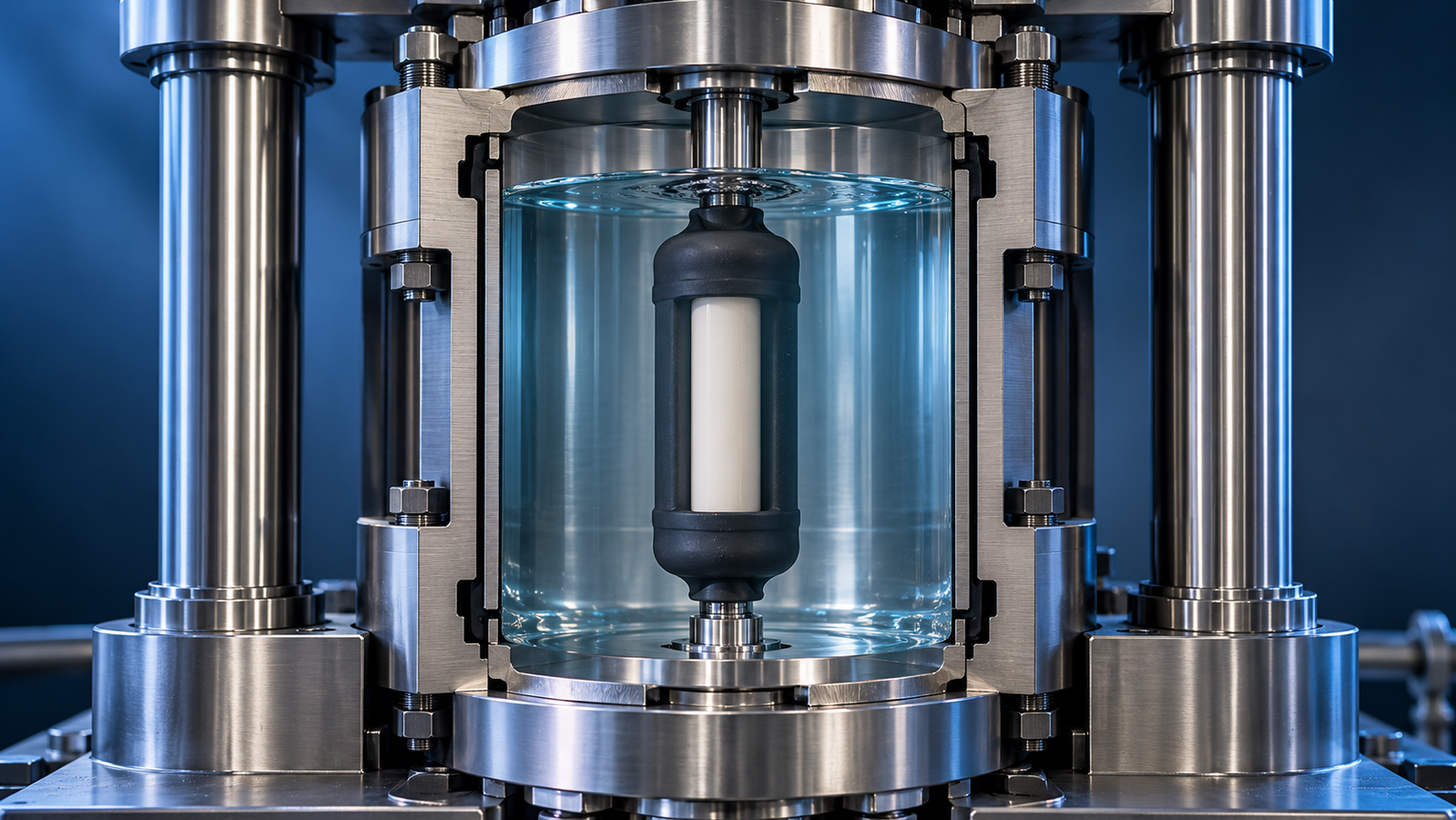
A ceramic tube 8 mm across and 100 mm long cannot be pressed in a die. The punch would have to push powder down a bore twelve times deeper than it is wide, and friction against the wall would leave the far end as loose as when it was poured. Put the same powder in a rubber sleeve, seal it, lower it into a chamber of liquid and raise the pressure to 200 MPa, and the tube comes out evenly compacted along its whole length, because the liquid pushes on every part of the sleeve equally. That is isostatic pressing. This guide explains when a laboratory needs it, how cold and warm isostatic presses are specified, and how to match a PressPro™ chamber to a part.
In one paragraph: choose isostatic pressing for shapes a die cannot make or cannot make evenly: rods, tubes, irregular parts, and discs that must have uniform density before sintering. Then size the press by its chamber, not its tonnage. The sealed mold has to fit inside the chamber bore and height; the pressure rating, 300 MPa cold on standard PressPro™ chambers and 200 MPa warm, sets how hard the powder is pressed; and the tonnage of the frame is simply what it takes to generate that pressure in a chamber of that bore. Manual, electric and automatic versions differ in how the pressure is raised, held and released, and the warm press adds programmed heating to 200 °C.
1. Why press isostatically
In a rigid die, friction between the powder and the die wall takes up part of the punch force, so the pressure and with it the density fall away from the moving punch.1,2 For a thin pellet the loss is small. For a tall or slender part it is the whole problem. An isostatic press removes the die wall. The mold is a soft membrane that follows the powder as it shrinks, and the fluid outside it has the same pressure everywhere.
Three things follow.
- Shape is no longer limited by ejection. Rods, tubes formed over a mandrel, spheres and irregular bodies can be pressed, because the mold is peeled off rather than the part pushed out.
- Density is more uniform. Fine silica powders isostatically pressed at up to 1 GPa reached more than 78 % of theoretical density with a uniform pore structure, with the particles themselves deforming under the pressure.3 In metal powders compacted isostatically at up to 770 MPa, densification was governed first by the yield stress of the metal and then by its work-hardening capacity and hardness.4
- Sintering can be more predictable. Green density affects the rate of densification,5 and in one study more homogeneous green bodies sintered at lower temperature and to finer grain size.6 A compact of even density tends to shrink evenly. In a direct comparison on barium zirconium titanate, a lead-free piezoelectric ceramic, samples compacted by cold isostatic pressing showed better dielectric and ferroelectric properties after sintering than samples compacted by uniaxial pressing.7 That result belongs to that composition and firing schedule and is not a general guarantee.
The price is speed and precision of shape. Every part has to be loaded into a mold, sealed, pressed, recovered and stripped; a flexible mold does not give the sharp edges and exact dimensions of a steel die; and the surface usually needs green machining. For flat pellets a die is faster and cheaper. A common compromise is to shape a disc in a die at low pressure and then press it isostatically to even out its density.
2. How a laboratory isostatic press works
Industrial isostatic presses pump fluid into a large vessel. Laboratory machines of the PressPro™ type work more simply. The pressure chamber is a thick-walled steel cylinder with a precision bore, filled with liquid and closed by a sealed plunger. It stands on the worktable of a hydraulic press. When the press pushes the plunger into the bore, the liquid is compressed and its pressure rises; the sealed mold sits in the liquid and is squeezed from all sides. This is the wet-bag method, in which each mold is filled and sealed outside the chamber and immersed in it. Because every mold can be a different shape, it suits research. Cold isostatic pressing is long established for ceramics and increasingly used for near-net-shape metal parts.8
The arrangement explains how these presses are rated. The pressure in the chamber is the press force divided by the area of the chamber bore:
A 22 mm bore reaches 300 MPa at 12 t. A 30 mm bore needs 22 t, a 40 mm bore 39 t, a 50 mm bore just over 60 t, a 60 mm bore 87 t, an 80 mm bore 154 t and a 90 mm bore 195 t. That is why chamber size and frame tonnage rise together through the range: a larger chamber is the reason for a larger press, not an option on a small one.
Fitting the chamber and having the force are two separate checks. The 80 mm chamber is listed on the 150 T frame, while 300 MPa in that bore works out to 154 t, above the listed 150 T rating. The 50 mm chamber on the 60 T models is a smaller case of the same kind: 300 MPa works out to 60.1 t. These are ideal bore-area calculations; they do not establish a permitted operating pressure for either configuration. The chamber check below shows both results side by side for every chamber.
On the manual and electric models the chamber lifts off the worktable, and the frame can then be used as an ordinary pellet press with a die.
3. Sizing the chamber to the part
Start from the green part and work outward.
- Powder shrinks as it compacts. The filled mold is larger than the pressed part, in every direction. It is the filled mold that must fit.
- The mold has a wall. Add twice its thickness to the diameter.
- The mold has ends. Plugs, clamps or ties close it; add them to the length.
- The liquid needs room. The mold must slide in freely and be covered.
The standard PressPro™ chambers are Ø22 × 70 mm, Ø30 × 120 or 150 mm, Ø40 × 150 mm, Ø50 × 150 mm and Ø60 × 150 mm, and on the large-tonnage series Ø80 and Ø90 × 150 mm. Enter the part and mold dimensions below to see which chambers the mold fits into, what force each needs for your target pressure, and how that force compares with the rated tonnage of each frame.
Rubber molds are made to the part and are not included with the press. Other chamber sizes and chambers rated to 500 MPa are built to order.
4. Pressure and temperature ratings
Cold: up to 300 MPa
All standard PressPro™ chambers are rated to 300 MPa. That covers the usual working range for ceramic and metal powders; the pressure for a given powder is taken from the literature or found by pressing a short series and measuring density, as in die pressing. Unlike die pressing, the number needs no conversion: the chamber pressure is the pressure on the sample, whatever its size.
Warm: to 200 °C at up to 200 MPa
The PressPro™ warm isostatic press wraps the chamber in an electric heating jacket. Heat is conducted through the chamber wall into the liquid and the sample. The temperature range is room temperature to 200 °C, set to 0.1 °C through a 30-segment program of ramps and holds, and the pressure program has 5 segments, upgradeable to 30. The chamber is rated to 200 MPa when warm and 300 MPa when cold.
Warmth matters when the powder contains something that softens: a polymer binder, a wax, a plasticized tape, a soft solid electrolyte. Warmed, these flow under pressure and close gaps that cold pressing leaves. Isostatic pressing is being developed as a processing route for solid-state battery components and their integration, where full, uniform contact between layers is the goal.9
Hot isostatic pressing is something else
HIP applies a gas, usually inert, at high pressure and elevated temperature at the same time, so that internal pores collapse and bond by diffusion.10,11 It is used to upgrade castings, densify pre-sintered components and consolidate powders into fully dense parts,10,12 and it is a furnace inside a gas pressure vessel. A warm isostatic press does not approach those temperatures and does not replace one. The PressPro™ isostatic line is cold and warm.
| CIP | WIP | HIP | |
|---|---|---|---|
| Temperature | Room temperature | To 200 °C on PressPro™ | Sintering range |
| Medium | Liquid | Heated liquid | Inert gas |
| What goes in | Loose or pre-formed powder in a rubber mold | Powder with a softening phase; laminates | A nearly dense or encapsulated part |
| What comes out | A green compact for sintering | A green compact or a bonded laminate | A fully dense part |
| PressPro™ | Yes: 20 to 200 T, 300 MPa | Yes: 20 to 60 T, 200 MPa at 200 °C | No |
5. Manual, electric or automatic
| Series | Frames | Chambers | How it is run | Suited to |
|---|---|---|---|---|
| Manual (EPSM) | 20, 30, 40, 60 T | Ø22 × 70, Ø30 × 120, Ø40 × 150, Ø50 × 150 mm | Hand pump and hand release; pointer or digital gauge | Small samples, occasional use, the lowest cost |
| Electric (EPSBE) | 20, 30, 40, 60 T | Ø22 × 70, Ø30 × 150, Ø40 × 150, Ø50 × 150 mm | Motor pressurizing with automatic compensation; hand release; 4.3-inch screen | More samples per day without pumping |
| Automatic (EPSPA) | 20, 30, 40, 60, 100 T | Ø22 × 70 to Ø60 × 150 mm | Programmed pressurize, hold, compensate and timed release; 5 segments (30 optional); 7-inch screen | Repeatable cycles; pressure or hold time as a variable |
| Large-tonnage automatic (EPSA) | 65, 100, 150, 200 T | Ø50, Ø60, Ø80, Ø90 × 150 mm | As automatic, with a separate control box; the chamber slides out to an unloading platform | Larger parts and several samples per run |
| Warm automatic (EPSXA) | 20, 30, 40, 60 T | Ø22 × 70, Ø30 × 120, Ø40 × 120, Ø50 × 150 mm | As automatic, plus programmed heating to 200 °C | Binder-containing powders, laminates, battery layers |
Handling is the practical difference at the small end. On the manual and electric presses the chamber is lifted on and off the worktable for every sample, which suits small chambers and a few samples a day. The automatic press has a swing-arm top plate so the chamber stays in place, and the large-tonnage series moves the chamber out on a slide. The powered models have a safety-glass door, a limit switch that releases pressure if the piston over-travels, and an emergency stop; the automatic models add an overpressure release and steel guarding.
How pressure is released matters here as it does in a die. The compact and the trapped air in it expand as the pressure falls, and a fast release can crack a part that pressed well. The timed release of the automatic presses makes that step the same each time.
6. Molds and what to check before pressing
- Material. The mold must be elastic enough to follow the powder and recover, and compatible with the pressure liquid and, on the warm press, with the temperature.
- Filling. Fill evenly and tap or vibrate to a consistent density. An unevenly filled mold gives a bent part, because the looser side shrinks more.
- Air. Remove as much air as possible before sealing. Air compressed inside the mold expands on release.
- Sealing. A leak lets liquid into the powder. Check the closure, and for valuable samples use a second bag.
- Support. Long rods are pressed in a perforated tube or cage that keeps the mold straight; tubes are formed over a rigid mandrel.
- Record. Powder mass, mold, pressure, hold time, release time, and the dimensions and mass of the part.
Isostatic Molds, Bags and Sample Recovery takes these checks further and sizes the mold for shrinkage.
7. Related guides and equipment
- How to Choose a Laboratory Hydraulic Press — pellet, hot and isostatic routes compared.
- Powder Compaction Guide — wall friction in a die, with a model of the pressure loss.
- Tonnage-to-MPa Calculator — force and pressure for dies.
- Laboratory Hot Pressing Guide — heat with uniaxial pressure, to 500 °C.
- Pellet Press Die Selection — for the pre-forming step before isostatic pressing.
- Uniaxial vs Isostatic Pressing — density gradients, geometry and the cost of each route.
- CIP vs WIP vs HIP — what each isostatic process does, and which one a laboratory needs.
- Isostatic Molds, Bags and Sample Recovery — mold materials, sizing for shrinkage, filling, sealing and getting the part out.
- Laboratory Press Installation and RFQ Checklist — bench, supply, guarding, isostatic safety and what to specify.
- PressPro™ series — all laboratory presses from ACS Material.
8. FAQ
What is the difference between CIP and HIP?
Cold isostatic pressing compacts powder at room temperature in liquid and produces a green part that still has to be sintered. Hot isostatic pressing applies gas pressure at sintering temperature and produces a fully dense part. They are used at opposite ends of the process.
What pressure does cold isostatic pressing use?
Laboratory work is mostly done between 100 and 300 MPa. Standard PressPro™ chambers are rated to 300 MPa, and 500 MPa chambers are available to order.
What size sample fits a laboratory isostatic press?
The sealed mold must fit the chamber. Standard chambers run from 22 mm bore and 70 mm height to 90 mm bore and 150 mm height, so parts range from a few millimeters across to roughly 80 mm across and somewhat under 150 mm long.
Why does a bigger chamber need a bigger press?
Because the press creates the pressure by pushing a plunger into the chamber. The force needed is the pressure times the bore area: 300 MPa takes 12 t in a 22 mm chamber and 195 t in a 90 mm chamber.
Can an isostatic press also press ordinary pellets?
The manual and electric models can. Lift the chamber off and the frame is a standard hydraulic press that takes a pellet die.
Do I need warm isostatic pressing?
Only if something in the sample softens with heat and you want it to flow: a binder, a polymer layer, a soft electrolyte. For plain ceramic or metal powders, cold pressing is the usual route.
Is isostatic pressing better than uniaxial pressing?
It gives more uniform density and far more freedom of shape. It is slower, needs a mold for each shape, and gives less exact dimensions. For thin flat pellets a die is the better tool.
Are molds included?
The pressure chamber is included with the press. Rubber molds are made to the part and ordered separately.