
A few granules of polymer between two polished plates, ten tonnes, 180 °C, three minutes: a film thin and even enough to put in an infrared beam. Change the granules for a ceramic powder and the plates for a heated die, and the same combination of heat and pressure makes a compact denser than cold pressing can. Hot pressing is one idea carried out on two kinds of machine, and most of the mistakes in buying one come from confusing them, or from asking a 300 °C press to do the work of a sintering furnace. This guide sets out what laboratory hot presses do, how to size one, and where their range ends.
In one paragraph: decide four things in order. Form: powder in a die, or a film or sheet between platens. Temperature: up to 300 °C covers most polymers and binders; the 500 °C versions draw more power and need cooling provisions that differ by family. Area: pressure on the sample is force divided by the footprint of the sample or mold, not by the platen, so a large platen at modest tonnage gives low pressure; check the platen size and the daylight between the platens against your tooling. Control: manual presses suit development work, automatic presses program pressure and temperature together, and a vacuum hot press keeps air away. Densifying ceramics to full density is a different equipment class.
1. What heat adds to pressure
At room temperature, pressure can only rearrange particles and deform them at their contacts. Heat opens other routes.
- Polymers soften and flow. Above its softening or melting temperature a thermoplastic fills a mold under a few megapascals and keeps the shape when cooled. This is how films for spectroscopy, tensile sheets and laminates are made.
- Binders and resins cure or fuse. Composite lay-ups, bonded electrodes and filled rubbers are consolidated under heat and pressure together.
- Powders densify by mass transport. In hot-pressed alumina, the final stage of densification was attributed to diffusion enhanced by the applied stress, with plastic flow contributing little.1 In hot-pressed lead zirconate–titanate, densification ran in two stages, a rapid initial stage that behaved viscously, with an activation energy of 36.7 kcal/mol, and a slower final stage; grain-boundary sliding and stress-directed diffusion of vacancies were proposed as the mechanisms.2 Densification mechanisms in hot-pressed ceramics are still worked out material by material, for example in ZrB2–SiC composites.3
The first two are the daily work of a laboratory hot press. The third begins there, with warm compaction and low-melting materials, and continues far above its range: the ceramic studies cited here were run in high-temperature hot presses, not on a 300 to 500 °C laboratory press.
2. Heated die or heated platens
| Heated die | Heated platens | |
|---|---|---|
| Sample | Powder, granules; a pellet of fixed diameter | Film, sheet, laminate, or powder in a frame mold |
| Where the heat is | In the die wall around the sample | In two flat plates above and below it |
| Pressure on the sample | High: force over a small bore | Low to moderate: force over the sample footprint |
| Size is set by | Die bore, 3 to 40 mm | Platen, 100 to 400 mm square |
| PressPro™ machines | Manual electric-heating hot press | Manual dual-platen, fixed-upper-platen, automatic and vacuum hot presses |
The heated-die press is a manual pellet press with a heated die and a temperature controller added: the same frame, the same hand pump, and the die takes the place of a cold die on the worktable. It is the tool for hot-pressing small amounts of powder or chemical raw material into a pellet of fixed size. The die is part of the order: one set is included, chosen between 3 and 20 mm on the 15 T press or between 21 and 40 mm on the 24 T press, and the die size is specified with the order.
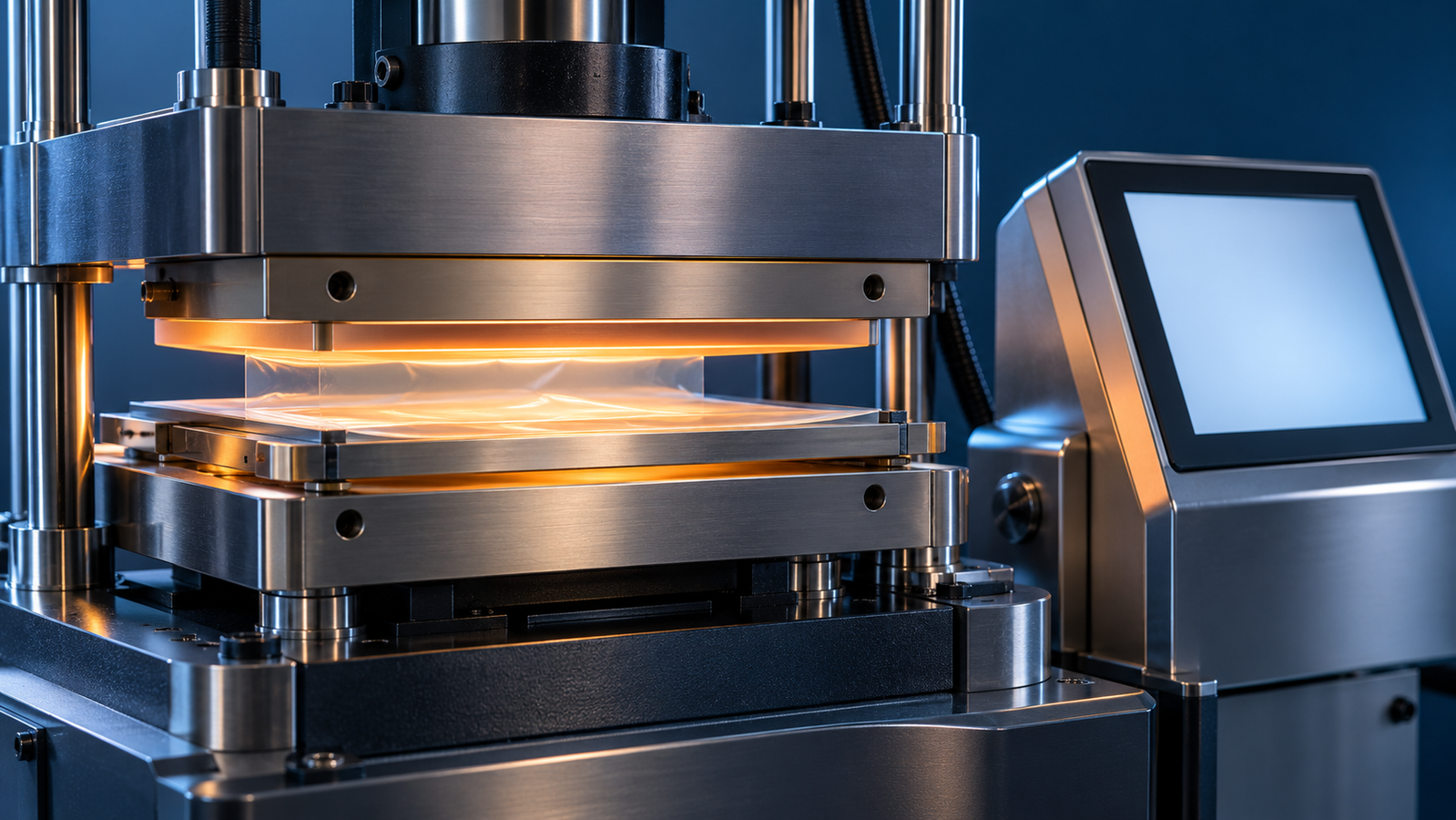
Platen presses are the tool for anything flat. The sample sits between polished plates, usually inside a frame mold or between shims that set its thickness, and the platens supply heat from both sides.
3. Temperature: the 300 °C and 500 °C classes
PressPro™ heated presses are offered to 300 °C and, in versions whose model code contains a G, to 500 °C. What the 500 °C version involves is not the same on every family, so read the row for the machine you are considering.
| Family | To 300 °C | To 500 °C | Cooling above 300 °C, as specified |
|---|---|---|---|
| Manual electric-heating hot press (heated die) | EPHBMA, EPHBMB; aluminum heater core | AG, BG versions; copper heater core | A water-cooled insulation plate is an option |
| Manual dual-platen, compact (EPHBMC) | 15 and 24 T models | EPHBMCG1, 24 T | Stainless-steel water-cooled insulation plates on the 24 T models; air- and water-cooling accessories listed as options |
| Manual dual-platen (EPHBMD) | Standard models | G versions | A water chiller must be connected |
| Fixed upper platen (EPHPME) | Standard models | G versions | A water chiller must be connected |
| Automatic dual-platen (EPHPAZ) | Standard models | G versions | A water chiller must be connected |
| Vacuum automatic (EPHXAZ) | Standard models | Built to order; the 180 mm version is listed as EPHXAZG1 | A water chiller must be connected |
The heated presses share a 7-inch touch-screen controller with a 30-segment temperature program that combines ramps at a set rate, holds of any length and natural cooling. Air or water cooling of the platens is an option when cycle time matters or when the sample must be cooled under pressure. The controller shows a burn warning whenever the tooling is above 50 °C.
Choose the temperature the process needs. Most thermoplastic film work is done below 300 °C. The 500 °C versions are for high-temperature polymers, some glasses and salts, and warm compaction of powders; on the largest platens they draw up to 5.5 kW.
4. Platen size, daylight and the pressure on the sample
Three dimensions decide whether a platen press fits the job.
- Platen size. PressPro™ platens are square: 100, 150, 180, 200, 300 and 400 mm depending on the family. The sample or mold should sit well inside the platen, where the temperature is most even.
- Daylight. The opening between the platens: 55 mm on the fixed-upper-platen presses, 60 to 65 mm on the automatic and vacuum presses, 140 to 160 mm on the manual presses whose upper platen hangs from a lead screw. A mold taller than the daylight cannot be loaded; extended daylight can be ordered.
- Force. 10 to 40 T, with 60 T available on the large manual press.
The pressure on the sample is the force divided by the area the force passes through, which is the footprint of the sample or frame mold. It is not the platen area unless the sample covers the platen.
Twenty-five tonnes on a 50 mm disc is 125 MPa. The same force on a 100 × 100 mm film is 24.5 MPa, and on a film that fills a 300 mm platen it is 2.7 MPa. A larger platen is therefore not a stronger press: for a given tonnage it is a gentler one. Size the platen to the sample and the tonnage to the pressure the material needs.
The calculator below gives the nominal pressure for your footprint. It then checks, as a separate result, whether the selected model covers the footprint, the tooling height, the force and the temperature. A set temperature has to lie above the temperature of your room and within the heating range printed for the model; pressing with no temperature control is a separate choice. A valid pressure figure does not mean the model suits the job.
5. Manual or automatic
On a manual hot press the temperature is programmed and the pressure is not. The operator pumps to the target, tops up as the sample softens and relaxes, and releases by hand. That is adequate, and often preferable, when a process is being developed and every sample is different.
On an automatic hot press both are programmed. The pressure program has 5 segments, upgradeable to 30, each with its own target and hold time; the press pressurizes, holds, compensates for relaxation and releases on a timer. Run alongside the 30-segment temperature program, this allows cycles such as contact pressure during heat-up, full pressure at temperature, and reduced pressure during cooling, repeated identically for every sample. A light-curtain guard is available for the automatic presses.
The guide to pressure stages and temperature programs shows how to write a cycle as segments, and what published studies and standards say about each part.
The way the upper platen is mounted also matters. On the fixed-upper-platen and automatic presses the upper platen is fixed to the frame and only the lower platen moves; the automatic press adds four-column bearing guides. This gives the best parallelism and is the right choice for thin samples such as plastic films, where a small tilt becomes a visible wedge in thickness. On the manual dual-platen presses the upper platen hangs from a lead screw, which gives a much larger opening for tall molds.
6. Vacuum and controlled atmosphere
Some samples cannot be heated in air: polymers that oxidize, moisture-sensitive salts, sulfide and halide battery materials, films that trap bubbles. The PressPro™ vacuum automatic hot press encloses the platens in a sealed chamber that is pumped down to −0.1 MPa gauge and can be back-filled with inert gas. It is an automatic hot press inside its own sealed chamber. Platens are 180, 200, 300 or 400 mm with 60 mm daylight, and force is 25, 25, 30 or 40 T. The standard temperature is 300 °C, with 500 °C built to order. The vacuum pump and the water chiller are options ordered with the press.
Vacuum also helps with ordinary film pressing. Air trapped between granules becomes bubbles in the film; pressing under vacuum, or releasing and re-applying the pressure once or twice as the polymer melts, lets it out. Vacuum vs Ambient Hot Pressing covers when a sealed chamber matters and what it does not change.
7. The PressPro™ hot press range
| Family | Force | Die or platen | Daylight | Pressure control | Maximum power |
|---|---|---|---|---|---|
| Manual electric-heating hot press (EPHBMA, EPHBMB) | 15, 24 T | Heated die, Ø3–20 or Ø21–40 mm | Workspace 80 × 150 or 112 × 160 mm | Manual | 600 W |
| Manual dual-platen hot press (EPHBMC) | 15, 24 T | 100 × 100 mm | 140, 160 mm | Manual | 1300 W |
| Manual dual-platen hot press (EPHBMD) | 30 T (60 T optional) | 180, 200, 300 mm | 140 mm | Manual | 1900 to 4200 W |
| Dual-platen hot press, fixed upper platen (EPHPME) | 10, 10, 10, 24, 30 T | 150, 180, 200, 300, 400 mm | 55 mm | Manual | 1300 to 5100 W |
| Automatic dual-platen hot press (EPHPAZ) | 25, 25, 30, 40 T | 180, 200, 300, 400 mm | 65 mm | Programmed, 5 segments (30 optional) | 2200 to 5500 W |
| Vacuum automatic hot press (EPHXAZ) | 25, 25, 30, 40 T | 180, 200, 300, 400 mm | 60 mm | Programmed, in vacuum or inert gas | 2200 to 5000 W |
| Automatic cold press (EPCPAZ) | 25, 25, 30, 40 T | 180, 200, 300, 400 mm, unheated | 65 mm | Programmed, 5 segments (30 optional) | 400 to 700 W |
All run on 220 V, 50/60 Hz. Each heated family is available to 300 °C and, in its G version, to 500 °C; the vacuum press is 300 °C as standard, with 500 °C built to order (the 180 mm version is listed as EPHXAZG1). Presses are supplied without frame molds or plates, which are made to the sample.
The cold press is the automatic platen press without heaters. It is used for room-temperature lamination, for pressing electrode sheets between flat plates, and for densifying a film that has already been formed.
8. Pressing a film: what decides the result
- Thickness is set by the mold, not the force. Use a frame mold or shims of the target thickness and enough material to fill the cavity with a small excess. Without a frame the film thins until the press reaches its set force.
- Plates and release. The film takes the surface of whatever it is pressed against. Polished plates give a clear film; a release sheet between plate and polymer stops sticking at high temperature.
- Heat first, then press. Close the platens to contact, let the material reach temperature, then apply pressure. Pressing cold granules traps air and can scratch the plates.
- Let the air out. Release and re-apply the pressure briefly once the material has melted, or press under vacuum.
- Cool under pressure when shape matters. A film released hot can warp or shrink unevenly. Holding pressure while the platens cool, with air or water cooling to shorten the wait, keeps it flat.
- Record the cycle. Temperature, time at temperature, force, footprint, cooling. The automatic presses store their programs in a built-in data-management system.
When a film comes out wrong, Hot-Pressed Film Defects goes through the defects one at a time.
9. Where a laboratory hot press stops
In ceramics, hot pressing usually means something else: densifying a powder to full density at well over a thousand degrees in a hot-press furnace. Platelet alumina has been hot-pressed to transparency at 1750 to 1825 °C,4 and transparent ceramics in general depend on high-purity powders and on sintering techniques that reach full density.5,6 Field-assisted sintering, also called spark plasma sintering, combines a pulsed direct current with pressure.7,8 The two approaches are closer than their reputations suggest: on a garnet solid electrolyte, induction hot pressing and spark plasma sintering both reached about 98 % density within five minutes when pressure and temperature were carefully controlled.9
None of that is in the range of a 300 or 500 °C press. What a laboratory hot press does well is everything below it: films and laminates, bonded and filled materials, warm compaction of powders with a binder or a low-melting phase, and pressed layers for battery research. For a part that must be uniform rather than hot, the alternative is pressure from all sides; warm isostatic pressing reaches 200 °C and is covered in the isostatic press selection guide.
10. Related guides and equipment
- How to Choose a Laboratory Hydraulic Press — pellet, hot and isostatic routes compared.
- Pellet Press Die Selection — hot-pressing dies, flat plates and frame molds.
- Tonnage-to-MPa Calculator — force and pressure for dies and platens.
- Powder Compaction Guide — what happens to powder under pressure before heat is added.
- Isostatic Press Selection Guide — cold and warm isostatic pressing.
- Heated Dies vs Heated Platens — which hot-press route fits a pellet, a film or a laminate.
- Solid-State Electrolyte Pellet Pressing — warm and hot pressing of electrolyte powders, with the limits of each press.
- Hot-Pressed Film Defects — why films stick, bubble, wrinkle, yellow or turn hazy, defect by defect.
- Vacuum vs Ambient Hot Pressing — what a sealed chamber changes, what it does not, and when room air is enough.
- Pressure Stages and Temperature Programs in Hot Pressing — writing a hot-press cycle as segments.
- PressPro™ series — all laboratory presses from ACS Material.
11. FAQ
What is the difference between a hot press and a heat press?
A laboratory hot press is a hydraulic press with temperature-controlled platens or a heated die, delivering tonnes of force with programmed temperature. A heat press for garment transfers applies far less force and has no pressure measurement.
What temperature do I need to press a polymer film?
Above the softening or melting point of the polymer and below the temperature at which it degrades. For most common thermoplastics that is under 300 °C. Take the value from the polymer data sheet or the method you are following.
How much pressure does film pressing need?
Much less than powder compaction: typically a few megapascals to a few tens of megapascals on the film. Work out the pressure from the force and the film footprint; the calculator above does it.
Why does the 500 °C press need a water chiller?
On the platen presses the hot platens are separated from the frame by water-cooled insulation plates, and on the EPHBMD, EPHPME, EPHPAZ and vacuum families a water chiller must be connected whenever the press runs above 300 °C. On the heated-die press a water-cooled insulation plate is an option above 300 °C. The requirement is specific to the family, so check it for the model you choose.
Can I press powder between heated platens?
Yes, in a frame mold or a die placed between the platens, as long as the tooling fits the daylight. For small pellets at high pressure a heated die is more effective because all the force goes through the bore.
Can a hot press replace a sintering furnace?
No. Laboratory hot presses reach 300 or 500 °C. Sintering oxides and other ceramics takes temperatures several times higher, in a furnace or a dedicated hot-press furnace.
How do I avoid bubbles in a pressed film?
Dry the polymer, let it melt before applying full pressure, release and re-apply the pressure once or twice, and cool under pressure. If bubbles persist, press under vacuum.
Which platen size should I choose?
The smallest that takes your mold with a margin all round. A larger platen costs more, heats more slowly, draws more power and, for the same tonnage, gives a lower maximum pressure on a full-size sheet.