
Pressing a polymer film between heated platens looks simple. Most of the defects come from three things: what the melt touches, what it carries into the press, and how it is cooled. Sticking and creases come from the surfaces. Bubbles come from air and water; yellowing is likely oxidation. Haze, warping and some voids come from cooling. This guide takes each defect in turn, with the evidence behind it and a note wherever that evidence comes from a neighboring process rather than from film pressing itself.
In one paragraph: dry the polymer before it goes in, because, in the studies cited, water broke PLA chains in extrusion and formed bubbles in nylon filament. Give trapped air a way out; in one laminate study, keeping pressure on during cooling left the fewest voids. Press against a release surface; by analogy with embossing, its surface also sets the finish of the film. Keep the time at temperature short, or exclude air, where the polymer oxidizes. Choose the cooling on purpose: in the studies it changed crystallinity and clarity, and in laminates the residual stress. Direct studies of neat pressed films are few. Much of the evidence comes from extrusion, filament printing, hot embossing and fiber composites, and this guide says where.
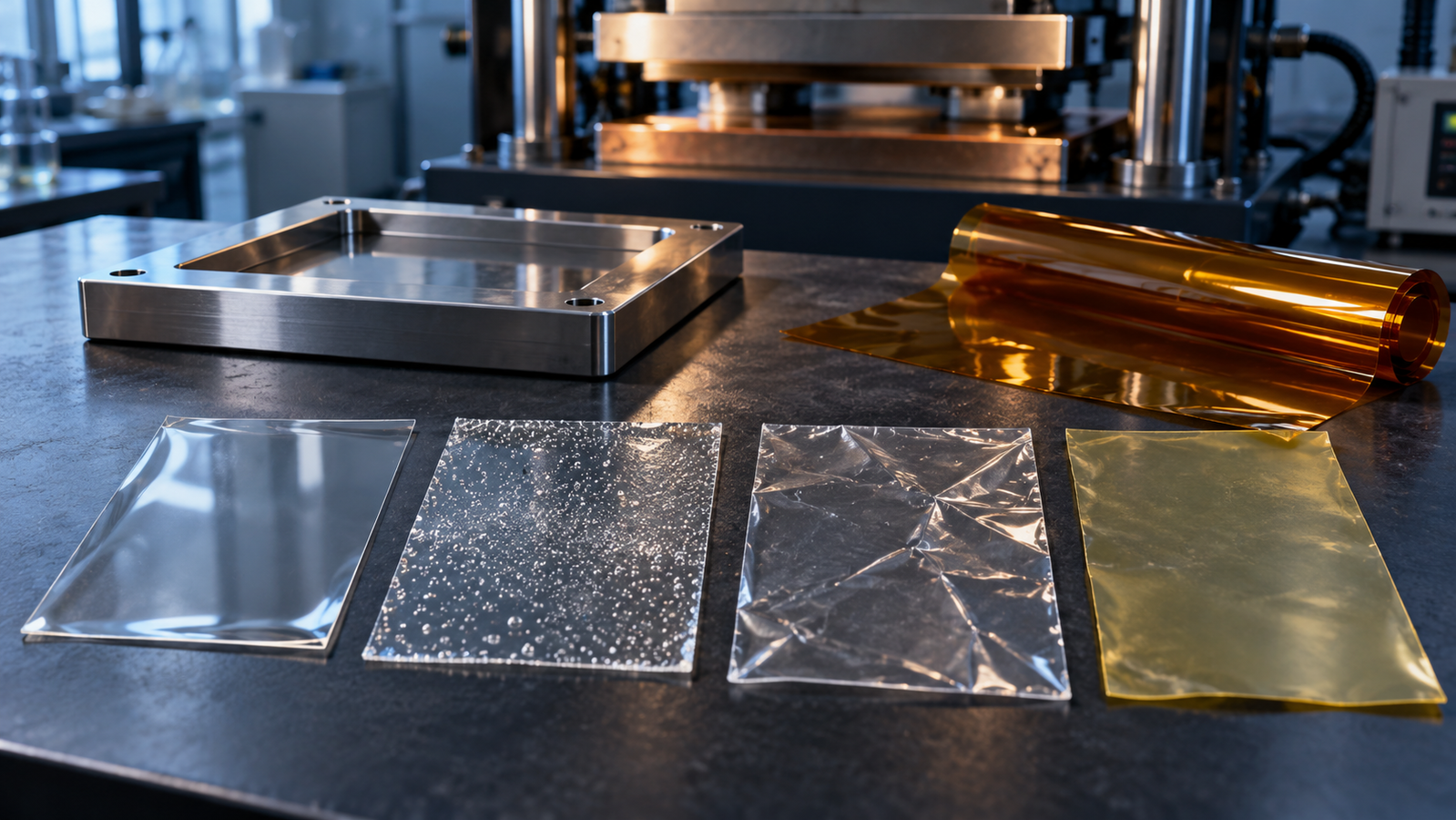
The laboratory hot pressing guide covers the presses and the basic film method. This page starts from the defect. The question is always the same: did the problem come in with the material, from the surfaces it touched, or from the way it was cooled?
1. Six defects, three causes
| Defect | Where it comes from | First thing to check |
|---|---|---|
| Film sticks to the plate | Adhesion of the melt to the tool surface | The release surface |
| Bubbles and voids | Trapped air, absorbed water, volatiles | Drying, the escape path for air, how the film was cooled |
| Wrinkles and creases | Release sheet, contraction mismatch with the tool, flow | The release sheet, the charge and the cooling |
| Uneven thickness | Charge placement, flow, frame, plates | The frame and the charge |
| Yellowing, brittleness | Likely oxidation and chain scission at temperature | Time at temperature and the atmosphere |
| Haze, warping | Crystallinity and residual stress from cooling | The cooling method |
2. What the standards cover
Compression molding of thermoplastic test specimens and sheets is standardized. ISO 293 sets out the general principles and the main steps, including eight different cooling methods. The molding temperature and the cooling method for each material are given in that material’s own standard, and reinforced thermoplastics are outside its scope.1 ASTM D4703 is a separate practice for thermoplastic specimens, plaques and sheets.2 For thermosetting molding compounds, ASTM D5224 notes that specimens with low-density areas caused by trapped gases are discarded. It allows a short “breathe” step to let the gas out, kept as brief as possible to avoid premature cure.3 When a film is a test specimen, follow the standard for the material. The rest of this page is about understanding what goes wrong.
3. Sticking
A hot polymer can adhere to the surface it is pressed against. No study read for this guide measured sticking in film pressing itself; the nearest are from hot embossing, where a polymer is pressed into a heated tool and then released. There, most of the difficulty comes from demolding, not filling. The demolding forces consist mainly of thermal stress, from the different shrinkage of tool and polymer, and adhesion. Adhesion and friction were lower against surfaces containing PTFE.4 Embossing also shows the other side of contact. Polycarbonate, PMMA and PVB replicated mold features of 90 to 3000 µm, with an accuracy that depended on the embossing conditions.5 By analogy, a release sheet likely does two jobs: it stops the film from sticking, and its surface is copied onto the film. No study read for this guide tested this in film pressing.
One composite study at 385 °C used polyimide sheets with a release agent between the carbon/PEEK stack and aluminum plates in a laboratory hot press.6 An electrolyte study pressed its films between stainless-steel plates.7 No study read for this guide compares release sheets with one another or measures adhesion to bare press plates. Choose the release surface for the temperature, the polymer and the finish you need, and keep it smooth and flat.
4. Bubbles and voids
The composite literature names three sources of voids: air trapped during lay-up, volatiles from the resin, and moisture dissolved in it.8 The same three are possible in a pressed film, but no study of neat pressed films measured them.
Water
Polyesters and polyamides absorb water. In the studies below, water broke the chains of PLA in extrusion and formed bubbles in nylon during printing.
- It breaks chains. Hydrolysis cuts the ester bonds of poly(lactic acid), and a review of PLA processing names moisture as one of four basic variables, with temperature, time and shear.9 In one extrusion study, poly(L-lactide) granules conditioned in humid air ended with a number-average molecular weight of 18,400 g/mol, against 33,600 g/mol for dried granules under the same conditions.10
- It boils. Nylon filament conditioned at 40 °C and 80 % relative humidity reached about 5.5 wt% water after 72 h, up from about 1 wt% as received. Printed, it bubbled severely, and its strain at break fell to 8 %.11 In composites processed under vacuum alone, the void fraction rose exponentially with moisture content.8
Drying is therefore routine. Published methods vacuum-dried PLA at 80 °C for 4 h before pressing,12 dried it at 55 °C for 24 h to about 210 ppm water before extrusion,13 and vacuum-dried hot-pressed PEO electrolyte films at 50 °C for 12 h, storing them under vacuum.7 Drying conditions belong to the polymer; take them from its data sheet or material standard.
Trapped air
Air between granules or powder particles has to leave before the melt closes around it. In carbon/PEEK laminates processed under vacuum, voids fell below 1 % when the edges were open. Significant voids stayed trapped when the edges were sealed, because the air escaped along the layers to the edges.14 A one-hour vacuum hold at room temperature greatly reduced the number and size of voids in prepreg laminates.8 Releasing and re-applying the pressure as the material melts (“bumping”) is common practice for thermoplastic films. No study of it was found; the thermoset standard’s breathe step is the closest documented equivalent.3 Pressing under vacuum is the other route; the vacuum versus ambient guide covers it.
Pressure while cooling
In one laminate study, the cooling step also changed how many voids stayed in. Carbon/PEEK laminates consolidated in a laboratory hot press at 385 °C were cooled four ways.
- Cooled in the press under pressure: 1.18 % voids.
- Cooled in the press without pressure: 3.23 %.
- Air-cooled outside the press: 6.05 %.
- Water-quenched: 8.22 %.
The faster-cooled laminates were also weaker.6 This is a fiber composite, and no comparable study of a neat film was found. In this study, the laminate that cooled in the press under pressure had the fewest voids.
5. Wrinkles and uneven thickness
The evidence on wrinkles comes from fiber laminates.
- In carbon/polysulfone, the cooling rate, the material of the tool plates and the length of the plates mattered most. The mechanism was the mismatch in thermal expansion between part and tool, which buckled the outer layers.15
- A review of thermoplastic composites adds that uneven temperature in press plates can induce warpage, and that surface layers suffer most from the mismatch with the tool.16
- In carbon-fiber sheet molding compounds, flow from thick into thin regions carried porosity into the thin regions, and fiber waviness and wrinkling also occurred there.17
- The temperature profile on a heated plate depends on where the heaters sit in it.18
For a neat film, no study was found on wrinkled release sheets, platen parallelism or how the charge is placed. These remain practical checks:
- a flat, uncreased release sheet;
- a charge spread evenly over the cavity;
- a frame of the target thickness, so that thickness is set by the frame rather than by the force;
- plates that close parallel.
6. Yellowing and degradation
Many polymers oxidize when held hot in air. In polyethylene extrusion, degradation started with radicals that auto-oxidized when oxygen was present. After the die it scaled mainly with the time of exposure to air, and melts above 280 °C showed surface oxidation that grew with exposure. Low-density polyethylene crosslinked at low melt temperature and broke down by chain scission at high temperature.19 Polyolefins are known to degrade during melt processing.20 In compression molding of ultra-high-molecular-weight polyethylene, filling the die under nitrogen instead of air was reported to reduce oxidation.21 For PLA, thermal degradation becomes effective above 100 °C.9 Even dried PLA lost molecular weight in extrusion, by about 2 to 9 %. At 180 °C the loss depended mainly on the time in the melt, not on the melt temperature or shear.13
Most of these are extrusion results, where the melt spends seconds at temperature. In a press it often spends minutes, so time at temperature is the variable to watch and to record. Where a polymer oxidizes, there are two options: keep that time short, or exclude air with a vacuum or inert atmosphere.
7. Haze, crystallinity and warping
For semicrystalline polymers, the cooling changes the crystal structure. In one polypropylene study, that structure also changed the opacity of the film. In laminates, the cooling also set the residual stress, which can warp a part.
- PLA. Sheets compression-molded at 200 °C and 10 MPa for 2 min and quenched under pressure at 25 °C showed no detectable crystallinity. In the calorimeter, only very slow cooling, at 1 °C/min, crystallized the polymer, to about 30 %.12
- Polypropylene. In films solidified between glass plates, slow cooling gave more of the α crystal phase and larger spherulites, and opacity rose with both.22 In a dilatometer, faster cooling shifted crystallization to lower temperatures and gave smaller spherulites, while total crystallinity stayed at about 55 %.23
- Laminates. In PPS laminates, three cooling rates gave 51, 58 and 62 % crystallinity.24 Faster cooling raised residual stresses and left the surface in compression and the core in tension.16
The standards recognize this by specifying the cooling method for each material.1 In these studies, the cooling decided whether PLA stayed amorphous, and in PP it changed the crystal phase, the spherulite size and the opacity. Choose the cooling on purpose and record it.
8. Electrolyte and separator films
- PEO electrolytes. Hot pressing is an established, solvent-free route to poly(ethylene oxide) electrolyte films.25,26 In one comparison, sodium-salt PEO films hot-pressed at 100 °C between steel plates had pore-free surfaces. Films cast from solution showed pores of 11 to 65 µm despite degassing. With sodium iodide, the pressed film was also more crystalline, 39.6 against 31.4 %.7 An extruded electrolyte with an ionic liquid was finished by hot pressing at 75 °C.27
- Separators. Hot pressing an electrospun PVdF-copolymer separator in a small heated die at 120 °C and 400 MPa, the highest temperature and pressure tested, made it about thirty times stiffer. It also cut its uptake of liquid electrolyte from about 410 to 250 %.28
- Fuel-cell electrode assemblies. In titanium-mesh assemblies for direct-methanol cells, pressed for 180 s, one study found an optimum at 5 MPa and 135 °C.29 Another found negligible difference in performance between hot-pressed and unpressed assemblies.30
For these films, the temperature, pressure and time differ from study to study.
9. Film press planner
Enter the frame or disc, the target thickness, the density of the polymer and the pressure you want on the film. The tool gives the charge to weigh, the force on the cavity, and which PressPro™ platen presses fit in size, force range and temperature. Pick a defect to see the causes linked to it.
10. Defect by defect
| What you see | What the evidence links to it | What to change |
|---|---|---|
| Film sticks or tears on release | Adhesion and shrinkage stress at the tool surface (embossing)4 | A release sheet or a low-surface-energy surface |
| Fine bubbles throughout | Water in the polymer (filament printing)11 | Dry to the polymer’s specification before pressing |
| Voids between former granules | Trapped air with no escape path (laminates)14,8 | A path out at the edges; vacuum; release and re-apply as the melt forms (common practice, not studied) |
| More voids after cooling | In carbon/PEEK laminates, pressure and cooling rate were varied together: fewest voids when cooled in the press under pressure, most when water-quenched6 | No cooling cycle for other polymers follows from this study; record whether the pressure stayed on and how fast the film cooled |
| Creases, waviness | Contraction mismatch with the tool; wrinkling in thin regions (laminates)15,17 | A flat release sheet; an even charge; the cooling |
| Yellow or brittle film | Not measured in the sources; oxidation and chain scission in air are documented for extrusion19 | Shorter time hot; vacuum or inert gas |
| Hazy film | Slow cooling: more α phase, bigger spherulites (PP)22 | Faster cooling, if clarity matters more than the crystal structure (PP) |
| Warped film | Residual stress from cooling; uneven plate temperature (laminates)16 | Even plate temperature; slower cooling (laminates) |
11. What to record
- Material. Grade, form (granule, powder, film), drying conditions and, if measured, water content.
- Tooling. Frame and thickness, release sheet, plate finish.
- Cycle. Temperature, time to melt with contact pressure only, any release and re-application, pressing pressure on the film area and time, atmosphere.
- Cooling. Method, rate where known, and whether pressure stayed on.
- Result. Thickness at several points, appearance, and any test of crystallinity or properties.
12. Presses
The PressPro™ platen hot presses come in four forms.
- Manual dual-platen presses. Compact models with 100 mm platens, and 30 T models with 180 to 300 mm platens.
- Presses with a fixed upper platen. Platens of 150 to 400 mm.
- Automatic dual-platen presses. Platens of 180 to 400 mm, running force and temperature programs.
- Vacuum automatic hot press. The same platen sizes inside a sealed chamber that can be evacuated to −0.1 MPa (vacuum pump optional) and filled with inert gas.
The standard temperature is 300 °C. Most models also come in a 500 °C version; on the vacuum press, 500 °C is built to order. Every heated model runs a 30-segment temperature program. Cooling arrangements differ from family to family, and the hot pressing guide lists them. The pressure on a film is the force divided by the area actually being pressed. A small film on a large platen therefore sees a high pressure at a modest force, and the planner above does that arithmetic.
13. Related guides and equipment
- Laboratory Hot Pressing Guide — presses, variables and the basic film method.
- Vacuum vs Ambient Hot Pressing — when air, moisture and trapped gas call for a sealed chamber.
- Heated Dies vs Heated Platens — which hot press suits which sample.
- How to Specify a Pellet-Press Cycle — writing a pressing cycle as numbers.
- Solid-State Electrolyte Pellet Pressing — pressing battery electrolytes.
- How to Choose a Laboratory Hydraulic Press — the whole PressPro™ range by purpose.
- Equipment: manual dual-platen, fixed upper platen, automatic and vacuum hot presses.
14. FAQ
Why does my pressed film have bubbles?
The likely sources are water in the polymer and air trapped between granules; the evidence comes from extrusion, filament printing and composites. Dry hygroscopic polymers such as polyesters and polyamides to their specification before pressing. Give the air a way out at the edges. In one laminate study, keeping pressure on during cooling left the fewest voids.
How do I stop a polymer film sticking to the hot plates?
Press against a release surface, such as polyimide sheet or a PTFE-coated surface, chosen for the temperature. In hot embossing the polymer copies the tool surface, so keep the release sheet smooth and flat.
Why is my film wrinkled?
Possible causes are a creased release sheet, an uneven charge that has to flow a long way, and contraction mismatch between film and tool during cooling. The last is documented for laminates; the first two are practical checks.
Why did my film turn yellow?
No study read for this guide measured yellowing of pressed films. In polyethylene extrusion, the melt oxidized in air, more with longer exposure. Shorten the time hot, check the temperature, or press under vacuum or inert gas.
How fast should I cool a pressed film?
That depends on what the film is for. Quenched PLA sheets showed no detectable crystallinity; only very slow cooling crystallized PLA in the calorimeter. In PP films, fast cooling gave smaller spherulites and lower opacity. For test specimens, the material standard specifies the cooling method.
Should the pressure stay on during cooling?
In the laminate study cited here, keeping pressure on through cooling gave the fewest voids: about 1 %, against 3 to 8 % otherwise. No comparable study of a neat film was found.