
A hot press heats and squeezes a sample. Around it is either room air or a sealed chamber that has been pumped down and, if needed, filled with inert gas. Three things in room air cause trouble at temperature: oxygen, which degrades many polymers; water, which hydrolyzes some and boils in others; and the air trapped in the sample itself, which leaves voids. This guide sets out what each does, what a vacuum chamber changes and what it does not, and when an ordinary press in room air is enough.
In one paragraph: press in a sealed chamber when the sample oxidizes at the pressing temperature or traps air that pressure alone does not remove. A vacuum also draws off volatile components. For such a sample an inert-gas fill is the alternative, but no study read for this guide compared it with a vacuum. Dry hygroscopic polymers before pressing in either case: a pressing cycle is not a drying step. By our arithmetic, a chamber pumped to −0.1 MPa gauge is in the rough-vacuum range. For materials that react with moist air, a sealed chamber is not enough on its own, because it is loaded and unloaded in room air. Plan the handling before and after pressing.
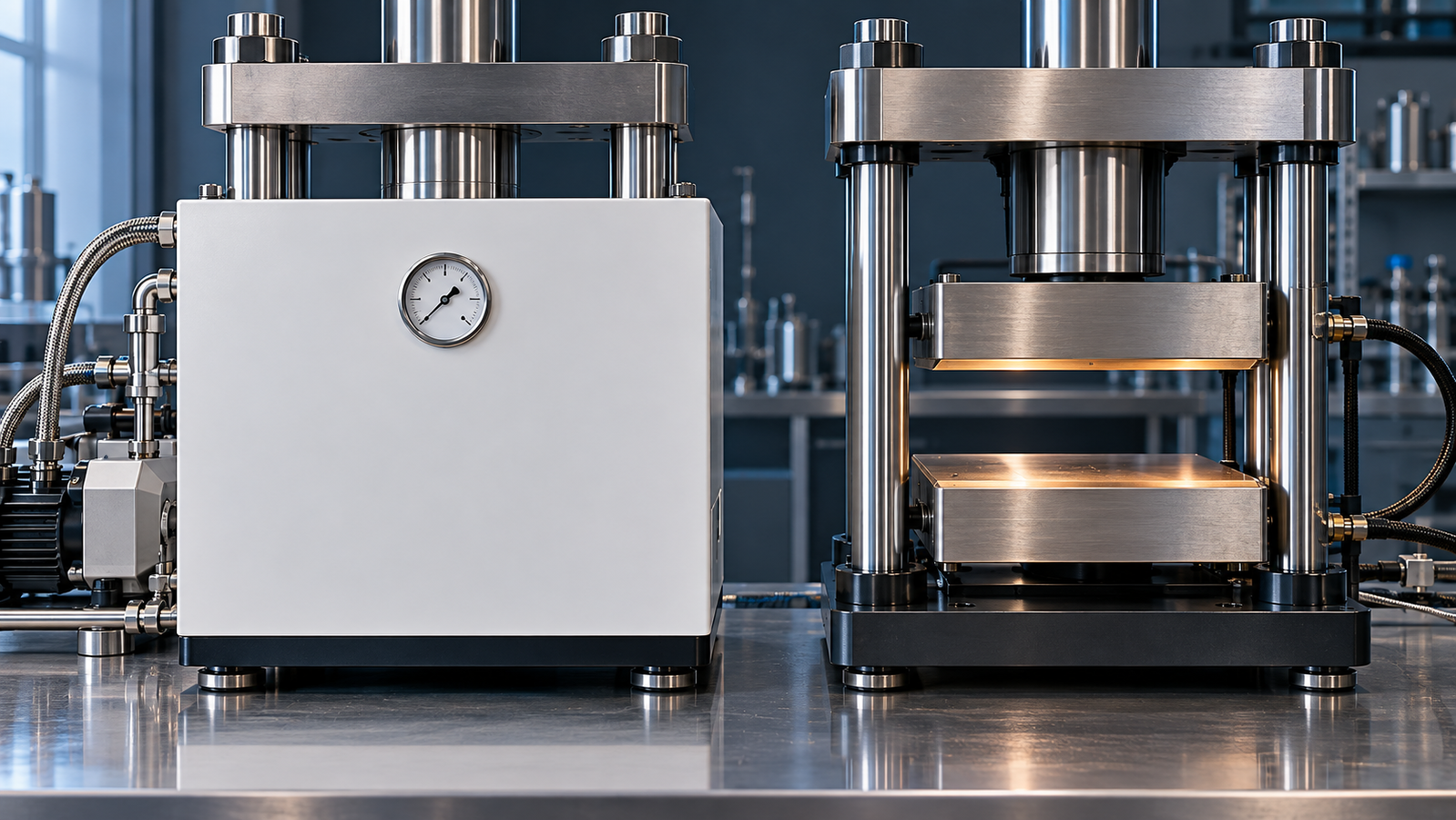
The laboratory hot pressing guide introduces the vacuum hot press in a paragraph. This page goes further: what the evidence says about air, water and trapped gas in hot processing, and how to decide between the two kinds of press. Much of that evidence comes from extrusion, printing and composite processing rather than from platen presses, and the text says so where it applies.
1. What the air does at temperature
Oxygen
For most polymers, degradation during processing and in service is oxidative.1 Examples of degradation in hot processing:
- Molten linear low-density polyethylene held in air in a rheometer grew stiffer, which the authors attributed mainly to crosslinking. The change increased with temperature and time.2
- Poly(ethylene oxide), the usual polymer of solid polymer electrolytes, is very sensitive to thermal, oxidative and mechanical degradation, mainly by chain scission. In kneading, the lithium salt LiTFSI intensified the degradation of PEO of 600,000 g/mol; in PEO of 100,000 g/mol it acted mainly as a plasticizer. The kneading atmosphere was not reported.3
- A review of solvent-free battery processing cites PEO degradation above about 135 °C, without stating the atmosphere.4
No study read for this guide gives side-by-side numbers for the same polymer pressed in air and under vacuum or inert gas. Removing oxygen is expected to slow oxidative degradation, but these sources do not say by how much for a given polymer.
Water
- It breaks PLA chains. Poly(lactic acid) extruded five times without drying fell from a weight-average molecular weight of 229,600 to 161,700 g/mol. Dried PLA fell from 223,400 to 184,000 g/mol. The undried material yellowed strongly, reaching a yellowness index of 20.4 after three extrusions.5
- It boils. In 3D printing, PLA filament stored at 10 to 90 % relative humidity gave parts whose porosity rose from 0.84 to 4.42 %. Above 70 % humidity, spherical voids appeared that the authors attribute to steam. In that short-residence process the PLA showed little or no degradation.6 Bubbles in printed PLA grew larger and more numerous with the humidity of storage.7
- It harms battery materials. Sulfide electrolytes release hydrogen sulfide with water.8 Even low levels of moisture have been reported to trigger their hydrolysis.9 LiTFSI is hydrophilic, which is why one group kept its extruder and printer in a dry room.4
Trapped air
In modern composite prepregs, air trapped during impregnation or lay-up is the main source of voids.10 In one study of epoxy prepreg cured under a vacuum bag, the laminate had 0.05 % porosity with a 4 h room-temperature vacuum hold. It had 0.81 % when that hold was skipped, 2.61 % after exposure to humid air, and 7.8 % when the edges were sealed so that air could not escape.11 In carbon/PEEK laminates processed in a vacuum bag in an oven at 380 °C, voids fell from 5 to 10 % to below 1 %. A 72-layer laminate reached that with open edges; with sealed edges, significant voids stayed trapped.12
2. What a vacuum chamber changes, and what it does not
- It takes the air away before the material closes around it. A continuous vacuum on a closed compression mold drew off entrapped air and vaporized volatiles from thermoset molding compounds.13 In rotational molding, vacuum significantly reduced porosity even at short holding times.14
- It removes most of the oxygen while the sample is hot. That is the reason to press oxidizing polymers in a chamber, with the caution above that no study read for this guide measured the size of the benefit in platen pressing.
- It does not replace pressure. A review reports one study in which vacuum without autoclave pressure gave the highest void content. Moisture-filled voids can grow when the water vapor pressure exceeds the hydrostatic pressure in the resin.10 Printed carbon/polyamide 12 preforms had 5.8 to 13.4 % voids. Pressing them in a heated mold without any vacuum brought this to 1.06 to 5.45 % at 210 °C and 2 to 10 MPa, and two samples pressed at 200 °C reached 0.26 and 0.61 %.15 Vacuum and pressure work together: pump the air out, then press while the material is soft.
- It draws off volatiles. Heat and vacuum are the usual way to drive residual solvent out of a battery electrolyte film.4 That is welcome when the volatile is an unwanted residue. If the sample contains a volatile component that has to stay, a vacuum works against it. The PressPro™ chamber can also be filled with inert gas. No study read for this guide compared an inert-gas fill with a vacuum for such a sample.
- It is not a drying step. Drying protocols for hygroscopic polymers run for hours; the guide to film defects gives examples. This guide does not evaluate how much water a vacuum removes during pressing. Dry first, then press.
3. What −0.1 MPa means
The PressPro™ vacuum hot press is specified to reach −0.1 MPa with a vacuum pump. That is a gauge reading: pressure relative to the surrounding atmosphere.
- Atmospheric pressure at sea level is 101.3 kPa.16 A reading of exactly −0.100 MPa would therefore mean about 1 kPa absolute at sea level. That is our arithmetic, not a specification.
- A specification given as −0.1 MPa does not say whether the absolute pressure is 1 kPa or several kilopascals.
- In the usual ranges of vacuum technology, “low vacuum” spans 105 to 102 Pa.16 By the arithmetic above, about 1 kPa absolute lies in that range. This guide does not evaluate the lowest pressure the PressPro™ chamber reaches.
The vacuum reached depends on the pump, the seals and what the sample gives off. Read the specification as “most of the air removed”, not as a figure in pascals. The molding study cited above drew off air and volatiles with a rough vacuum of 5 mm Hg, about 0.7 kPa.13 A rough vacuum is not the atmosphere of a glove box.
4. Air-sensitive battery materials
In the studies read for this guide, air-sensitive battery materials were handled in an argon glove box or in airtight holders.
- A chloride electrolyte was hot-pressed at 170 °C and 30 MPa for 1 h. All the work was done in an argon glove box with less than 0.1 ppm water, or in airtight holders.17
- PEO/LiTFSI electrolyte films were hot-pressed inside an argon-filled glove box, after all components were dried under vacuum.3
- An argyrodite electrolyte, handled in argon with less than 1 ppm water and oxygen, was spark-plasma-sintered under vacuum at 400 °C and 50 MPa, in a system used together with an argon glove box.18
- Laboratory work on sulfides typically uses glove boxes below 1 ppm water. Battery manufacturing uses dry rooms at a −40 °C dew point, and in one test a sulfide powder lost over half its conductivity after 30 minutes in such a room.8
A sealed press chamber changes the atmosphere during pressing. It does not change the atmosphere while the sample is weighed, loaded or taken out, because the chamber is opened in room air. This guide does not evaluate whether a rough vacuum or an inert-gas fill is dry enough for these materials. For materials that must not see room air, the options are an airtight holder or a press used inside a glove box. For materials that tolerate a short exposure, show first that the exposure is harmless for that material. No source found for this guide compares a press in a glove box with a sealed-chamber press. One recent sulfide electrolyte, Li3.6In7S11.8Cl, was reported to be stable in air.9 The solid-electrolyte pellet guide covers handling.
5. When room air is enough
An ordinary platen press in room air is the simpler tool. It is enough when all of the following hold:
- the material does not oxidize appreciably at the pressing temperature in the time it spends there;
- it has been dried, if it is hygroscopic;
- it does not react with air;
- trapped air can leave at the edges or is squeezed out by pressure.
In one study, pressure alone in a heated mold brought two samples below 1 % voids.15 Degradation grew with temperature and time in molten polyethylene held in air,2 and with the number of extrusion passes in PLA.5 Keeping the time at temperature short limits it. An ambient press also needs no pump-down. Its daylight, the opening between the platens, is 55 to 160 mm depending on the family, against 60 mm of working height in the vacuum chamber.
6. The PressPro™ vacuum hot press
The vacuum automatic hot press is an automatic platen press inside a sealed vacuum and atmosphere chamber.
| Model | Platens | Working space | Force range |
|---|---|---|---|
| EPHXAZ01 | 180 × 180 mm | 180 × 60 mm | 0.3 to 25 t |
| EPHXAZ02 | 200 × 200 mm | 200 × 60 mm | 0.3 to 25 t |
| EPHXAZ03 | 300 × 300 mm | 300 × 60 mm | 0.5 to 30 t |
| EPHXAZ04 | 400 × 400 mm | 400 × 60 mm | 0.5 to 40 t |
All four models share the following:
- Cycle. The touch screen reads force to 0.1 t. Automatic pressurizing, hold with compensation and timed release. Force programs of 5 segments, upgradeable to 30, and a real-time display of the pressure on the sample.
- Temperature. Room temperature to 300 °C, run from a 30-segment program; a 500 °C version is built to order. Above 300 °C the specification requires a water chiller.
- Cooling. Natural, with air or water cooling as options.
- Chamber. Pumped to −0.1 MPa with a vacuum pump (the pump is an option), and fillable with inert gas. The chamber is controlled by hand, with automatic control as an option.
- Safety. Overpressure release and an emergency stop.
Between them, the automatic, manual and fixed-upper-platen hot presses cover the same platen sizes in room air, and the hot pressing guide compares them.
7. Atmosphere and fit check
Switch on what applies to your sample, then enter the temperature, the footprint, the height of the stack between the platens and the pressure. The tool lists what each sensitivity says about room air, vacuum and inert gas. It then checks the four vacuum models for size, working height, force range and temperature, and shows the platen presses in room air that would also fit.
8. Which to choose
| Your sample | Room air | Vacuum | Inert gas fill |
|---|---|---|---|
| Oxidizes at the pressing temperature | Keep time at temperature short | Yes | Yes |
| Hygroscopic polymer, dried | Yes, if pressed promptly | Yes | Yes |
| Hygroscopic polymer, not dried | Dry it first | Dry it first | Dry it first |
| Traps air between particles or layers | If pressure and an escape path suffice | Yes: pump, then press | Does not remove trapped air |
| Contains a volatile component that must stay | Not evaluated | No: the volatile is drawn off | Not evaluated |
| Reacts with moist air (sulfide electrolytes, for example) | No | Not evaluated for this; loading and unloading are in room air | Not evaluated for this; loading and unloading are in room air |
9. Related guides and equipment
- Laboratory Hot Pressing Guide — all PressPro™ hot presses, variables and limits.
- Hot-Pressed Film Defects — bubbles, sticking, wrinkles and yellowing.
- Heated Dies vs Heated Platens — which hot press for which sample.
- Solid-State Electrolyte Pellet Pressing — handling air-sensitive electrolytes.
- How to Specify a Pellet-Press Cycle — writing a pressing cycle as numbers.
- How to Choose a Laboratory Hydraulic Press — the whole PressPro™ range by purpose.
- Equipment: vacuum hot press; automatic, manual dual-platen and fixed upper platen hot presses.
10. FAQ
When do I need a vacuum hot press instead of a normal one?
When the sample oxidizes at the pressing temperature or traps air that pressure and an escape path do not remove. For materials that react with moist air, a sealed chamber is not enough on its own, because it is loaded and unloaded in room air. For other materials, a press in room air with a dried sample and a short time at temperature is usually enough.
What does a vacuum of −0.1 MPa mean?
It is a gauge reading, 0.1 MPa below the surrounding atmosphere. That means most of the air has been removed. The absolute pressure reached depends on the pump and seals. By our arithmetic, a reading of −0.1 MPa at sea level is about 1 kPa absolute, in the low (rough) vacuum range.
Should I use vacuum or inert gas?
Vacuum removes trapped air as well as oxygen, and it also draws off volatiles: heat and vacuum are the usual way to drive solvent out of a film. An inert-gas fill keeps oxygen away without holding the sample under vacuum. No study comparing the two for a sample with a volatile component was found for this guide.
Does pressing under vacuum dry my polymer?
This guide does not evaluate how much water a vacuum removes during pressing, and a pressing cycle is not a drying step. Dry hygroscopic polymers beforehand according to their data sheet. In the studies read for this guide, undried PLA lost molecular weight over repeated extrusion and formed bubbles when printed.
Can I hot-press sulfide electrolytes in a vacuum hot press?
The chamber changes the atmosphere during pressing. This guide does not evaluate whether a rough vacuum or an inert-gas fill is dry enough for a sulfide. The chamber is also loaded and unloaded in room air. The sulfide studies read for this guide handled the material in an argon glove box. Plan the handling first.
Does vacuum change how the sample is heated?
This guide does not evaluate it. In both kinds of press the sample is heated by contact with the platens.