
One bench, three jobs. This week the group needs 13 mm KBr pellets for the infrared spectrometer. Next month a student starts pressing 20 mm oxide discs for a sintering study. By the end of the year someone will want a ceramic rod ten times longer than it is wide. A catalog sorted by tonnage suggests one large press solves all three. It does not: the first job needs about eight tonnes and a die that ships with the press, the second needs six tonnes and a die that does not, and the third cannot be made in a rigid die at any tonnage. This guide shows how to choose a laboratory hydraulic press by the route the sample needs — pellet, hot or isostatic — and which PressPro™ models from ACS Material fit each one.
In one paragraph: choose the route first, then the size. Uniaxial pellet pressing squeezes powder in a rigid die along one axis; it makes flat discs quickly and is the route for FTIR and XRF pellets and for most research compacts. Hot pressing adds heat, either through a heated die for small powder samples or through heated platens for films and laminates, with PressPro™ models rated to 300 °C or 500 °C. Isostatic pressing seals the powder in a flexible mold and pressurizes it in liquid, so pressure arrives from every direction; it is the route for long, thin or irregular parts and for compacts that must be uniform before sintering. Once the route is fixed, tonnage follows from the pressure you need and the area you press, and the rest of the choice is die fit, temperature rating and how much of the cycle you want automated.
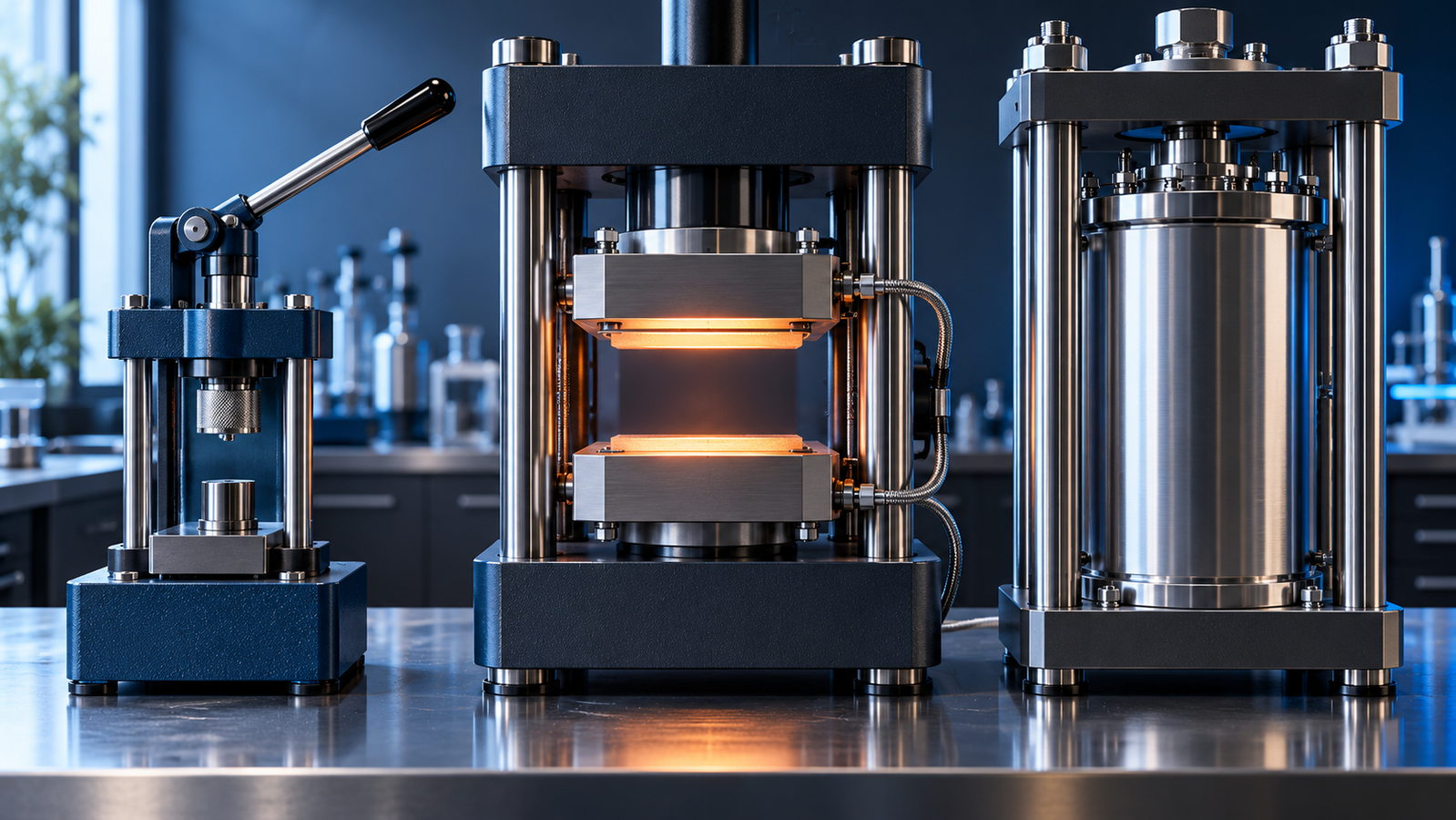
1. Three routes, one decision
Every laboratory press applies force to a sample, but the three routes differ in where the force comes from and what holds the sample. That difference decides which shapes can be made, how uniform they are, and what temperature the process can reach.
| Uniaxial pellet pressing | Hot pressing | Isostatic pressing (CIP / WIP) | |
|---|---|---|---|
| How pressure is applied | One axis, through punches in a rigid die | One axis, through a heated die or heated platens | All directions, through liquid around a flexible mold |
| What holds the sample | Steel or carbide die | Heated die, or film between platens or in a frame mold | Sealed rubber mold (bag) in a pressure chamber |
| Temperature | Room temperature | Room temperature to 300 °C, or to 500 °C on high-temperature models | Room temperature (cold); to 200 °C (warm) |
| Shapes | Discs, short cylinders, bars, rings | Films, sheets, laminates, small pellets | Rods, tubes, irregular shapes; discs that must be uniform |
| Main limit | Die-wall friction makes density uneven in tall parts | Platen size, daylight and temperature rating | Chamber diameter and height; slower cycle |
| PressPro™ force range | 2 to 200 T | 10 to 40 T (60 T optional) | 20 to 200 T machines; chamber pressure up to 300 MPa |
The physical reason for the split is friction. In a rigid die, part of the punch force is lost to friction between the powder and the die wall, so the powder far from the moving punch is pressed less than the powder next to it. Measurements and finite-element models of die compaction show the same result across ceramic and pharmaceutical powders: wall friction produces a density distribution inside the compact.1,2,3,4 In the simple force-balance picture the effect grows with the height of the part relative to its diameter. A thin pellet tolerates this. A long rod does not, which is why long parts are pressed isostatically, where there is no die wall.
The differences matter after pressing too. Flaws and density variations created when the powder is formed are carried into the fired part,5 and the density of the green compact changes how fast it densifies in the furnace.6 In one study of nanocrystalline zirconia, a forming method that produced more homogeneous green bodies lowered the sintering temperature by about 200 °C compared with uniaxial dry pressing.7 The press is the first step of the sintering process, not a separate purchase.
2. Press selection lab
The selector below checks every PressPro™ family against five answers, in the same order as this guide: purpose, temperature, atmosphere, operation, force. Temperature, operation and force are checked on the same model, so a family counts as a match only when at least one of its models meets all five answers. If you leave the force open, or a model is rated for only part of the range you pick, the family is listed for comparison with the load still to confirm. Anything else that needs a point confirmed, or that would change one of your answers, is labeled as such, and some combinations have no match in the current range.
3. Step 1: what is the pressing for?
Six purposes cover almost all laboratory pressing. Each one points to a route and to a short list of machines.
FTIR: KBr pellets
Transmission infrared spectroscopy of solids uses a thin, transparent disc of potassium bromide with a small amount of sample dispersed in it. The alkali-halide disc technique dates from the early 1950s,8 was established as a general sampling method soon after,9 and is used for quantitative work as well as identification: calcite and quartz have been quantified in geological samples from KBr pellets.10 A widely used instrument-maker method mixes 0.1 to 1.0 % sample into 200 to 250 mg of KBr, loads a 13 mm die and applies about 8 tonnes under vacuum for several minutes.11 Eight tonnes on a 13 mm die is about 590 MPa on the pellet, so a KBr press needs modest force and a good die, not a large frame.
PressPro™ direction: for 13 mm pellets, the PressPro™ infrared powder press in 12 T or 15 T manual, 20 T electric or 10 T automatic form; it ships with a 13 mm die set, agate mortar, spectroscopic-grade KBr and a sample scoop. For 7 mm or 3 mm pellets and occasional use, the 2 T PressPro™ mini infrared press weighs 4.8 kg and is turned by hand. The full method is in the KBr pellet preparation guide.
XRF: pressed pellets
X-ray fluorescence measures only a shallow layer of the specimen, so the surface must be flat, dense and representative of the bulk; the way the solid sample is prepared is chosen with that analytical depth in mind.12,13 A pressed pellet is ground powder, often with a binder, pressed into a 32 or 40 mm disc backed by boric acid or held in a steel ring, plastic ring or aluminum cup. The alternative is a fused glass bead, in which the sample is dissolved in a borate flux and cast; beads have been made from as little as 11 mg of sample.14 Fusion needs a fusion furnace, flux and platinum ware; pressing needs a press and a die. They are different purchases, so decide the preparation route before the press.
PressPro™ direction: the PressPro™ XRF press in 30 T or 40 T, manual or automatic, with one XRF die set of your choice; or the dedicated PressPro™ automatic XRF press in 30, 40 or 60 T with a boric-acid die, sample splitter and one-key demolding for routine work. See the XRF pressed pellet guide.
Research compacts: discs, bars and green bodies
Ceramic discs for sintering studies, pressed electrodes, catalyst pellets, test bars. These use general-purpose cylindrical or square dies in a general-purpose press. The variables that matter are the sample pressure, how it is held and released, and the height-to-diameter ratio of the part. Cracks that appear as the load comes off may be related to how it is released: in pharmaceutical tablets, where these defects have been studied most closely, the unloading conditions changed whether a tablet capped or laminated,15 and lamination has been studied in its own right, including a classification into types with different causes.16,17
PressPro™ direction: manual presses from 2 to 60 T in two-column, four-column and protective frames; the electric press from 20 to 60 T; the programmable automatic press from 10 to 100 T; and the large-tonnage automatic press from 65 to 200 T. Dies are ordered separately for these machines. Start with the powder compaction guide and the die selection guide.
Films, laminates and heated compacts
Polymer films for spectroscopy, laminated sheets, rubber and asphalt specimens, and powders that must be pressed warm. Heat changes what pressure can do: under load at temperature, ceramics densify by diffusion that the applied stress enhances, as shown for hot-pressed alumina,18 and in a classic study of hot-pressed lead zirconate–titanate the densification ran in two stages, a rapid initial stage that behaved viscously followed by a slower final stage.19 In the laboratory the practical questions are simpler: how hot, how large a platen, and whether the cycle must be programmed.
PressPro™ direction: a heated die on a manual press for small powder samples (manual electric-heating hot press, 15 or 24 T); heated platens for films in manual, fixed-upper-platen and automatic versions with platens from 100 to 400 mm; and a vacuum hot press for samples that must not see air. The heated families are offered to 300 °C, with G versions to 500 °C. For platen pressing without heat there is the automatic cold press. See the laboratory hot pressing guide.
Rods, tubes and uniform compacts: isostatic pressing
When the part is long, thin-walled or irregular, or when a disc must have the same density everywhere before it is sintered, the powder is sealed in a rubber mold and pressed in a liquid-filled chamber. Pressure reaches the mold from every side, so there is no die wall to rub against. Fine silica powders pressed this way at up to 1 GPa reached more than 78 % of theoretical density with a uniform structure,20 and when uniaxial and cold isostatic pressing were compared directly on one lead-free piezoelectric ceramic, the isostatically pressed samples showed better dielectric and ferroelectric properties after sintering.21 Laboratory cold isostatic presses work at up to 300 MPa; warm isostatic presses add heat to 200 °C.
PressPro™ direction: manual, electric and automatic cold isostatic presses from 20 to 100 T with chambers from Ø22 × 70 mm to Ø60 × 150 mm; a large-tonnage automatic series to 200 T with chambers to Ø90 × 150 mm; and the warm isostatic press rated to 200 °C. See the isostatic press selection guide.
Battery laboratory work
Battery groups use presses for several different jobs, and only some of them are powder pressing. Densifying a coated electrode is calendering: it changes the microstructure of the coating,22 including the way its particles touch one another,23 and for a given active material there is a compaction density that balances energy against rate capability.24 Cutting electrode and separator discs is punching. Closing and opening coin cells is crimping. Pressing a solid-electrolyte pellet is powder compaction again, often warm, and isostatic pressing is being developed as a processing route for solid-state battery components and their integration.25
PressPro™ direction: the PressPro™ battery material punching machine for discs from 0.01 to 0.5 mm sheet (12 and 16 mm punches included, 3 to 24 mm available), and the PressPro™ coin-cell sealing and disassembling machine for CR20-series cells, with CR16, CR24 and CR30 dies available. Both are hand-operated bench tools; if one is to go into a glove box, check its dimensions against the antechamber. Electrolyte pellets use the powder, hot and isostatic presses above. The bench tools are covered in Battery Lab Tools: Pressing, Punching and Coin-Cell Assembly, and electrolyte pellets in Solid-State Electrolyte Pellet Pressing.
4. Step 2: describe the sample
Five facts about the sample narrow the choice faster than any specification table.
- Shape and aspect ratio. In a rigid die, friction at the wall takes a growing share of the load as the part gets taller relative to its diameter, so tall parts are harder to press evenly. Long rods and tubes are normally made in an isostatic chamber.
- Size. The pressed area sets the force. Doubling the die diameter needs four times the force for the same pressure. Common PressPro™ cylindrical dies run from 3 to 40 mm.
- Powder behavior. Very fine powders, and powders that stick in the die, are easier to release from a split die whose inner segments open after pressing. Hard, abrasive powders call for a tungsten-carbide die.
- Sensitivity to air and moisture. KBr takes up water; sulfide electrolytes and lithium compounds react with air. The options are pressing inside a glove box, if the press fits it, an evacuable die, or a vacuum hot press.
- What happens next. A pellet that goes straight into a spectrometer needs flat, clean faces. A compact that will be sintered needs uniform density more than high density. A film needs a set thickness, which is a mold or shim question, not a press question.
5. Step 3: temperature, pressure and atmosphere
Three numbers that are all called pressure
Most confusion in press selection comes from three quantities that share a name.
- Force, in tonnes: what the piston delivers. This is the press rating, for example 15 T or 40 T.
- Gauge pressure, in MPa: the oil pressure in the cylinder, read on a manual press. It converts to force through the piston area, so the factor is different for every model. On PressPro™ manual presses 1 MPa on the gauge is 0.5 t on the 15 T frame, 0.7 t on the 24 T, 0.95 t on the 30 T, 1.33 t on the 40 T and 1.76 t on the 60 T.
- Sample pressure, in MPa: force divided by the area of the die bore. This is the number in the literature and the number that matters.
sample pressure (MPa) = gauge pressure (MPa) × piston area ÷ die area
A 30 MPa reading on a 15 T press is the full 15 tonnes. On a 13 mm die that is about 1100 MPa on the pellet, well beyond what the die should see. PressPro™ pellet dies are intended for use below 800 MPa of sample pressure. The electric and automatic PressPro™ presses display force directly, and the automatic models calculate the sample pressure on screen once the die size is entered. The tonnage-to-MPa calculator does the same arithmetic for any press and die.
None of this applies to an isostatic press. There the pressure on the sample is the pressure of the liquid in the chamber, whatever the size of the part.
Temperature
PressPro™ heated models are offered to 300 °C and, as G versions, to 500 °C. What a 500 °C version needs depends on the family: on most platen presses (EPHBMD, EPHPME, EPHPAZ and the vacuum press) a water chiller must be connected above 300 °C, while on the heated-die press a water-cooled insulation plate is an option. Temperature runs on a 30-segment program with ramps and holds, and cooling is natural unless air or water cooling is added. Warm isostatic pressing reaches 200 °C. Choose the temperature the work needs: a 500 °C platen draws more power and needs its cooling provisions.
These are not sintering temperatures. Hot pressing a ceramic to transparency is done at well over a thousand degrees, about 1800 °C for alumina, in dedicated hot-press furnaces,26,27,28 and field-assisted sintering combines a pulsed direct current with pressure.29,30 A direct comparison on a garnet solid electrolyte found that induction hot pressing and spark plasma sintering reached comparable density, about 98 %, within five minutes when pressure and temperature were controlled.31 That is a different equipment class. A 300 to 500 °C laboratory press serves polymers, laminates, binders, low-melting materials and warm compaction.
Atmosphere
Three ways to keep air away from the sample: press inside a glove box, if a manual press fits it; pull vacuum on the die itself, which is what the port on an evacuable pellet die is for; or use the vacuum hot press, whose chamber reaches −0.1 MPa gauge and can be back-filled with inert gas.
6. Step 4: manual, electric or automatic
Automation replaces specific actions in the pressing cycle. Knowing which ones tells you whether it is worth paying for.
| Action | Manual | Electric | Automatic |
|---|---|---|---|
| Raising the pressure | Hand pump | Motor | Motor, on a programmed ramp |
| Holding it | Operator tops up by hand | Automatic pressure compensation | Automatic compensation for a set time |
| Releasing it | Release valve, by hand | Release valve, by hand | Timed, automatic |
| Multi-step cycles | No | No | 5 segments, upgradeable to 30 |
| Readout | Pointer gauge to 1 MPa, or digital gauge to 0.01 t | 4.3-inch touch screen, 0.1 t | 7-inch touch screen, 0.1 t, sample pressure in MPa |
| PressPro™ families | Two-column, four-column, protective | EPPIE; EPIA; EPSBE | EPPA; EPPPE; EPIP; EPFA; EPFAX; EPSPA; EPSA |
An electric press is not an automatic press. On the PressPro™ electric models the motor pressurizes and compensates, and the operator decides when to release. On the automatic models the whole sequence of pressurize, hold, compensate and release runs from a program, and the demolding force can be set as well. What automation gives is the same pressure–time profile on every sample, which is what a comparison between samples needs. It does not correct a damp powder or a scored die.
Throughput decides the rest. A few pellets a week is a manual press. Dozens a day, or a study in which hold time is a variable, is an automatic one. The automatic powder, XRF and isostatic presses also add a safety door, a limit switch that releases pressure if the piston over-travels, and an overpressure release; the automatic platen presses list the overpressure release and an emergency stop, with a light-curtain guard as an option on the automatic hot press.
The comparison is taken further, family by family, in Manual vs Electric vs Automatic Laboratory Presses.
7. The PressPro™ map: which family fits which job
The table lists every PressPro™ family with the figures that decide the choice. Force is the maximum for each model in the family.
| Job | PressPro™ family | Models and force | What decides it |
|---|---|---|---|
| KBr pellets, 7 or 3 mm | Mini infrared press | EPIM02TH, 2 T | Hand-screw; 7 mm die set, mortar and KBr included; 4.8 kg |
| KBr pellets, 13 mm | Infrared powder press | EPIM12BH 12 T, EPIM15TH 15 T (manual); EPIA20TH 20 T (electric); EPIP10TH 10 T (automatic) | 13 mm die set, mortar and KBr included; die for pellets that stay in the ring or are pushed out |
| XRF pellets, general laboratory | XRF press | EPFM30TX, EPFM40TX (manual); EPFA30TX, EPFA40TX (automatic); 30 and 40 T | One XRF die set included: boric acid, steel ring, plastic ring or aluminum cup |
| XRF pellets, routine | Automatic XRF press | EPFAX30T, 40T, 60T | Ø40–32 mm boric-acid die and sample splitter included; one-key demolding |
| Small compacts | Two-column powder press | EPPM-2P / 2D; 2, 3, 5, 12, 15 T | Smallest frames, from 12 kg; pointer or digital gauge |
| General compacts, manual | Four-column powder press | EPPM-4P / 4D; 15, 24, 30, 40 T | Workspace 80 × 150 to 106 × 180 mm |
| Brittle samples, larger dies | Protective powder press | EPPM-PP / PD; 15, 24, 30, 40, 60 T | Safety-glass door; workspace up to 200 × 210 mm |
| Faster manual-style work | Electric powder press | EPPIE20T, 30T, 40T, 60T | Motor pressurizing and compensation; manual release |
| Programmed cycles | Automatic powder press | EPPA010T to EPPA100T; 10, 20, 30, 40, 60, 100 T | 5-segment program (30 optional); settable demolding force |
| Large dies, high force | Large-tonnage automatic press | EPPPE; 65, 100, 150, 200 T | Separate control box; workspace up to 350 × 260 mm |
| Platen pressing without heat | Automatic cold press | EPCPAZ01–04; 25, 25, 30, 40 T | Platens 180 to 400 mm; 65 mm daylight |
| Hot pressing powder in a die | Manual electric-heating hot press | EPHBMA 15 T; EPHBMB 24 T | 300 °C or 500 °C heated die; one die set included, Ø3–20 or Ø21–40 mm |
| Films, manual | Manual dual-platen hot press | EPHBMC 15 and 24 T; EPHBMD 30 T (60 T optional) | Platens 100, 180, 200, 300 mm; 140 to 160 mm daylight |
| Thin films, best parallelism | Dual-platen hot press, fixed upper platen | EPHPME / EPHPMEG; 10, 24, 30 T | Platens 150 to 400 mm; 55 mm daylight |
| Programmed hot pressing | Automatic dual-platen hot press | EPHPAZ / EPHPAZG; 25, 25, 30, 40 T | Platens 180 to 400 mm; pressure and temperature both programmed |
| Hot pressing without air | Vacuum automatic hot press | EPHXAZ01–04; 25, 25, 30, 40 T | −0.1 MPa chamber, inert-gas back-fill; platens 180 to 400 mm; 300 °C, with 500 °C to order |
| Cold isostatic, entry level | Manual isostatic press | EPSM; 20, 30, 40, 60 T | Chambers Ø22 × 70 to Ø50 × 150 mm; 300 MPa |
| Cold isostatic, motorized | Electric isostatic press | EPSBE; 20, 30, 40, 60 T | Same chambers; motor pressurizing, manual release |
| Cold isostatic, programmed | Automatic isostatic press | EPSPA; 20, 30, 40, 60, 100 T | Chambers to Ø60 × 150 mm; swing-arm top plate |
| Cold isostatic, large parts | Large-tonnage automatic isostatic press | EPSA; 65, 100, 150, 200 T | Chambers Ø50 to Ø90 × 150 mm; chamber slides out for unloading |
| Warm isostatic | Automatic warm isostatic press | EPSXA; 20, 30, 40, 60 T | To 200 °C at up to 200 MPa; 300 MPa cold |
| Electrode and separator discs | Battery material punching machine | EPBBMQ10 | Sheet 0.01 to 0.5 mm; punches Ø3 to 24 mm |
| Coin-cell sealing and opening | Coin-cell sealing and disassembling machine | EPBM; 2 T | Sealing at 0.7 to 1.2 t; CR16, CR20, CR24, CR30 dies |
Figures from the current PressPro™ specifications. Custom plate sizes, 500 MPa isostatic chambers and special dies are built to order. The whole range is on the PressPro™ series page.
8. How to read a press data sheet
PressPro™ data sheets use the same rows for every model. These are the ones that decide whether a press will do the job.
- Pressure range. The maximum force, and on automatic models the minimum as well: the 30 T automatic press controls from 0.3 T, the 100 T from 1 T. If the work needs half a tonne on a small die, the largest press is the wrong one.
- Pressure conversion. On manual models, tonnes per MPa of gauge reading. Write it on the press.
- Piston stroke. Less than 30 mm on the small frames, less than 50 mm on the large ones. The powder column shortens by its compaction, and the pellet must then be pushed out; both must fit within the stroke, with the lead screw at the top of the frame taking up the rest of the height.
- Worktable diameter and workspace. The table the die stands on, and the clear width and height between the columns. A 15 T four-column press has an 88 mm table and an 80 × 150 mm workspace; the 60 T protective press has a 168 mm table and 200 × 210 mm.
- Gauge type. Pointer gauges read to 1 MPa; digital gauges to 0.01 t or 0.01 MPa. That is the resolution of the display. The stability figure, a drop of no more than 1 MPa in ten minutes on the manual presses, says how well the pressure holds.
- Configuration. What is in the crate. General powder presses are supplied without dies. Infrared and XRF presses include a die set, and the heated-die press includes one hot-pressing die.
9. What tonnage cannot fix
A tall part in a rigid die
Wall friction takes a share of the pressure for every millimeter of die wall the powder touches. Past a height-to-diameter ratio of about one, the far end of the compact is noticeably softer than the near end, and no amount of extra force evens it out: more force raises both ends. Pressing from both ends with a double-action die halves the distance and helps. Beyond that, the part belongs in an isostatic press.
A pellet that cracks on release
When the load comes off, the compact relaxes while it is still held by the die. Capping, where the top face lifts off, and lamination, where the pellet splits into layers, have been studied most closely in pharmaceutical tablets. There, the way the tablet was unloaded changed the outcome: with one formulation prone to capping and one prone to lamination, keeping a small load on both faces until the end of ejection eliminated both defects.15 Lamination also has more than one mechanism, and a measure that worked against one type did not remove another.17 Pushing a pellet out against wall friction adds its own stress.32 So find out first at which step the crack appears and what may be causing it. Then change one condition at a time, such as how the load is released, the tooling or the pressure, and confirm the result by trial. No single change suits every powder, and a larger press does not settle it.
A die pushed past its limit
Small dies reach very high pressures at low force. Five tonnes on a 7 mm die is about 1270 MPa. PressPro™ dies are intended for use below 800 MPa; from 800 to 1200 MPa a die is being overloaded, and above 1200 MPa seriously so. Check the pressure before pressing, not the tonnage.
The wrong kind of isostatic press
Cold, warm and hot isostatic pressing share a principle and little else. Cold isostatic pressing compacts powder at room temperature in liquid. Warm isostatic pressing does the same at up to a few hundred degrees. Hot isostatic pressing applies high-pressure inert gas at elevated temperature, so that internal pores collapse and bond, and needs a purpose-built pressure vessel.33,34,35 The PressPro™ isostatic line is cold and warm. The three are compared in CIP vs WIP vs HIP.
Production tableting
Laboratory pellet presses are research and analysis instruments. They are not pharmaceutical tablet-production systems, and nothing in this guide establishes suitability for GMP manufacturing.
10. Three worked examples
13 mm KBr pellets, a few each week
Route: uniaxial. The instrument-maker method calls for about 8 t on a 13 mm die, which is 590 MPa on the pellet.11 A 12 T manual press covers it with margin: the EPIM12BH, on which 1 MPa of gauge reading is 0.4 t, so the target is 20 MPa on the gauge. The 13 mm die set, mortar, KBr and scoop come with it. If the same bench later needs 40 mm XRF pellets, this frame is too small; buy for the pellet you make every week.
20 mm oxide discs at 200 MPa, thirty a week
Route: uniaxial. A 20 mm bore has an area of 314 mm², so 200 MPa needs 200 × 314 ÷ 9800 = 6.4 t. A 15 T frame is the right size: the EPPM-4P15 manual press reads 12.8 MPa on the gauge at that load. If hold time is one of the variables in the study, the EPPA010T automatic press runs the same cycle every time. Order a 20 mm cylindrical die with it; these presses are supplied without one. Keep the disc thin: at 3 mm the height-to-diameter ratio is 0.15 and wall friction is a minor effect.
A 10 mm rod, as long as possible
Route: isostatic. In a rigid die a 10 mm rod 100 mm long has a height-to-diameter ratio of 10, and the far end would barely be pressed. In a chamber the pressure is the same along the whole length. The limit is the chamber: the EPSBE030 and EPSPA030 have a chamber Ø30 × 150 mm, so the filled and sealed mold must be shorter than 150 mm and slimmer than 30 mm. Reaching 300 MPa in that chamber takes 22 t from the press, which is why it sits on a 30 T frame. A longer rod means a custom chamber.
11. Before you request a quote
Send these eight lines and the reply will be a specific model, die and price instead of a catalog.
- Purpose: FTIR, XRF, sintering study, film pressing, cell assembly.
- Material: what the powder or sheet is, and whether it is air-sensitive.
- Sample size: diameter and thickness, or length for a rod, or platen footprint for a film.
- Target pressure: in MPa on the sample if you know it, or the paper or method you are following.
- Temperature: room temperature, or the maximum in °C.
- Atmosphere: air, glove box, vacuum or inert gas.
- Operation: manual, electric or automatic, and how many samples per week.
- Existing dies: outer diameter and assembled height of any die the press must accept.
Use the contact form, or copy the configuration from the selector above.
12. The PressPro™ knowledge hub
This guide is the entry point to the ACS Material library on laboratory pressing. Each section below collects the guide and the equipment for one branch; new articles are added here as they are published.
Powder compaction
- Powder Compaction Guide: Laboratory Uniaxial Pressing — what happens to powder in a die, why density is uneven, and how to press and release a pellet that survives.
- Manual vs Electric vs Automatic Laboratory Presses — which parts of the pressing cycle each mode takes over, family by family.
- Pellet Cracking, Capping and Lamination — where and when pellets cap, laminate or crack, and what the evidence links to each.
- How to Specify a Pellet-Press Cycle — the numbers that define a pressing cycle, and a method line another laboratory can follow.
- Green Density, Springback and Ejection — measuring density, springback and ejection force, and what compaction equations do and do not show.
- PressPro™ automatic powder press (EPPA), electric press (EPPIE) and the manual two-column, four-column and protective presses.
Dies and pressure
- Pellet Press Die Selection: Geometry, Ejection and Compatibility — cylindrical, square, split, ring, carbide, infrared and XRF dies, and how to check that a die fits a press.
- Tonnage-to-MPa Calculator for Pellet Pressing — force, gauge reading and sample pressure for any die, with the working limits marked.
Sizing, installing and looking after a press
- Small vs Large-Tonnage Laboratory Presses — how much force a method needs, and why a larger frame is not always better.
- Laboratory Press Installation and RFQ Checklist — bench, supply, guarding, isostatic safety and what to specify.
- Pellet Die Care — cleaning, contamination, salt corrosion, wear and overload.
- Pressure Gauge Resolution, Accuracy and Calibration — what the number on a press means, accuracy classes, and checking the force against a load cell.
Hot pressing
- Laboratory Hot Pressing Guide: Equipment, Variables and Limits — heated dies and heated platens, 300 and 500 °C classes, platen pressure, vacuum.
- Heated Dies vs Heated Platens — which hot-press route fits a pellet, a film or a laminate.
- Hot-Pressed Film Defects — why films stick, bubble, wrinkle, yellow or turn hazy, defect by defect.
- Vacuum vs Ambient Hot Pressing — what a sealed chamber changes, what it does not, and when room air is enough.
- Pressure Stages and Temperature Programs in Hot Pressing — writing a hot-press cycle as segments: thermal lag, when to load, cooling and release.
- Equipment: heated-die press, manual dual-platen, fixed-upper-platen, automatic and vacuum hot presses; automatic cold press.
Isostatic pressing
- Isostatic Press Selection Guide: CIP and WIP for Laboratories — chambers, molds, pressure and temperature ratings, and when isostatic pressing is worth it.
- Uniaxial vs Isostatic Pressing — density gradients, geometry and the cost of each route.
- CIP vs WIP vs HIP — what each isostatic process does, and which one a laboratory needs.
- Isostatic Molds, Bags and Sample Recovery — mold materials, sizing for shrinkage, filling, sealing and getting the part out.
- Equipment: manual, electric, automatic and large-tonnage cold isostatic presses; warm isostatic press.
FTIR sample preparation
- KBr Pellet Preparation for FTIR: A Practical Guide — quantities, grinding, pressing, and what a cloudy pellet is telling you.
- 7 mm vs 13 mm KBr Pellets — how much sample each size needs, and which press and die it takes.
- Cloudy or Cracked KBr Pellets — disc faults and spectrum faults, with the causes the sources link to each.
- Equipment: infrared powder press and mini infrared press.
XRF sample preparation
- XRF Pressed Pellet Sample Preparation: A Practical Guide — grinding, binders, backing and cups, pressing force, and pellets against fused beads.
- Manual vs Automatic XRF Pellet Presses — gauge resolution, hold time and repeatability when the pellet feeds a calibration.
- XRF Pellet Defects and Repeatability — visible and hidden pellet defects, and how to split the scatter into preparation and measurement.
- XRF Pressed Pellets vs Fused Beads — what fusion removes and loses, what dilution costs, and how laboratories divide the work.
- Equipment: XRF press and automatic XRF press.
Battery laboratory tools
- Battery Lab Tools: Pressing, Punching and Coin-Cell Assembly — disc sizes, crimping pressure and where a press is needed.
- Solid-State Electrolyte Pellet Pressing — fabrication pressure, stack pressure and the press that delivers them.
- PressPro™ battery material punching machine — burr-free electrode and separator discs from 3 to 24 mm.
- PressPro™ coin-cell sealing and disassembling machine — crimping and opening CR16 to CR30 cells with interchangeable dies.
13. FAQ
Is a laboratory press the same as a hydraulic press?
Nearly always. Laboratory presses in the 2 to 200 tonne range are hydraulic: a pump moves oil into a cylinder and the piston delivers the force. The exception at the small end is the hand-screw mini press used for 7 mm KBr pellets.
How many tonnes do I need for a 13 mm KBr pellet?
About 8 tonnes in the standard method, which is roughly 590 MPa on the pellet. A 12 or 15 tonne press is the usual choice. For 7 mm pellets the same pressure needs a little over 2 tonnes.
Do PressPro™ presses come with dies?
The infrared presses include a KBr die set with mortar, KBr and scoop. The XRF presses include one XRF die set. The heated-die press includes one hot-pressing die. General powder presses, platen presses and isostatic presses are supplied without dies or rubber molds, which are ordered to the sample size; isostatic presses include their pressure chamber.
Can one press make FTIR pellets, XRF pellets and research compacts?
A 30 or 40 tonne manual or automatic press with three dies can make all three. The compromise is at the small end: a 40 T frame is heavier to pump and reads less finely at the 8 t a KBr pellet needs. Laboratories that make pellets daily usually keep a small press for FTIR and a larger one for XRF.
How do I convert the gauge reading on my press to pressure on the sample?
Multiply the gauge reading by the tonnes-per-MPa factor for your model to get force, then multiply by 9800 and divide by the die area in mm². The calculator does both steps.
Why do my pellets crack when I release the pressure?
Often because the pellet springs back while the die still grips it, but trapped air and the stress of ejection can also be the cause. Note at which step the crack appears, then change one thing at a time: how the load is released, the hold, the pressure, the state of the die bore. A larger press is not the fix. Pellet Cracking, Capping and Lamination goes through the causes and the evidence.
When is an isostatic press worth it?
When the part is longer than it is wide, hollow or irregular; when a sintered part warps or cracks because the green compact was uneven; or when the work is on the forming process itself. For flat pellets a die is faster and cheaper.
What is the difference between cold, warm and hot isostatic pressing?
Temperature and pressure medium. Cold works at room temperature in liquid and compacts loose powder. Warm adds heat to about 200 °C. Hot isostatic pressing uses gas at sintering temperature to remove residual porosity from a nearly dense part. PressPro™ makes cold and warm.
Can a PressPro™ press go in a glove box?
The compact manual models are the candidates: the two-column powder presses, the mini infrared press, the punching machine and the coin-cell machine. Whether one fits depends on the antechamber and working height of your box, so check the dimensions on the product page first. For heated work without air, the vacuum hot press has its own sealed chamber.
Do I need the 500 °C version of a hot press?
Only if the process runs above 300 °C. The 500 °C versions draw more power and need cooling provisions that differ by family; on most platen presses a water chiller must be connected above 300 °C. Most polymer film work is below 300 °C.