
A pressed pellet can be described by three numbers: how dense it is, how much it grew when the load came off, and how hard it was to push out of the die. Each is easy to measure badly. A density computed with the wrong true density, a thickness taken at the wrong moment, or a yield pressure from a different kind of plot can make two laboratories disagree about the same powder. This guide explains how green density, springback and ejection are measured, what the common compaction equations do and do not tell you, and which conditions to record.
In one paragraph: measure mass and dimensions, divide by a true density measured on the same lot of powder, and say when the pellet was measured, because tablets in two pharmaceutical studies kept changing size for hours to days after ejection. Density rises with pressure with diminishing returns. The Heckel and Kawakita equations summarize that curve, but their parameters depend on the data route: values from heights under load and from ejected pellets differ systematically, and both change with die size, speed and lubrication. Springback is reported against the height at maximum load and the die bore. A residual pressure on the die wall remains after unloading, and lubrication changes the ejection force. Compare numbers only when they were measured the same way.
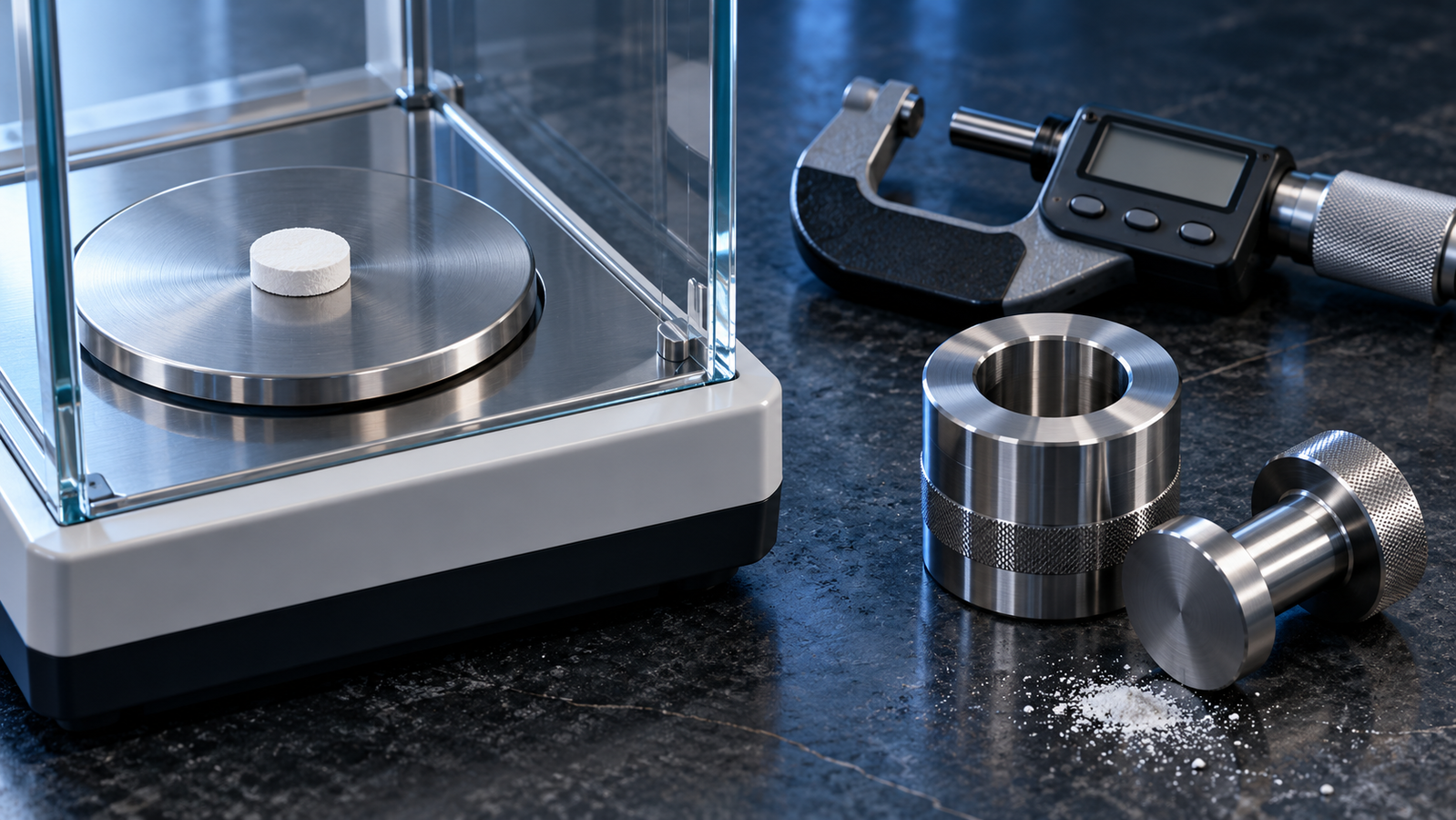
The powder compaction guide explains what happens to powder in a die, and the guide to cracking, capping and lamination covers what goes wrong when the load comes off. This page is about the measurements themselves.
1. Three numbers from one pellet
Every quantity on this page comes from a few readings: the mass, the height and diameter of the ejected pellet, the height of the compact at maximum load if the press or a gauge records punch travel, and the peak force during ejection.
| Quantity | Calculated as | Needs |
|---|---|---|
| Green density | mass ÷ (π × diameter² ÷ 4 × height) | Balance, micrometer or caliper |
| Relative density | green density ÷ true density | True density of the same powder lot |
| Axial springback | (ejected height − height at maximum load) ÷ height at maximum load | Punch travel under load |
| Radial springback | (ejected diameter − die bore) ÷ die bore | Diameter of the ejected pellet |
| Ejection stress (this guide’s tool) | peak ejection force ÷ (π × bore × ejected height) | Ejection force reading |
A study of steel powders pressed in a 35 mm die used both springback definitions, with the same reference height and diameter but written with the opposite sign.1 A tableting study of cellulose and calcium phosphate mixtures used the same axial definition.2 A tableting study of four excipients used the same radial definition and two axial ones, one in the die and one 24 h after compaction.3 Published work also normalizes the ejection force, as an “ejection pressure” or a “unit ejection force”.2,4 The cellulose and calcium phosphate study reported an ejection pressure without naming the area used.2 The tool on this page divides by π × bore × ejected height, the die-wall area of a pellet of that height. Compare ejection values only when they were normalized the same way.
2. Measuring green density
By mass and dimensions
For a flat cylinder, mass and two dimensions are enough. To first order, the relative error in the result is at most about the relative error in the mass, plus twice the relative error in the diameter, plus the relative error in the height. For an illustrative first-order calculation, assume absolute dimension errors of 0.01 mm in both diameter and thickness. On a 13 mm by 2.00 mm cylinder, these assumptions contribute about 0.15 % and 0.5 %, respectively. These are assumed errors, not uncertainties inferred from display resolution. The dominant contribution depends on the actual measurement method and instrument performance.
That error matters most when the pellet is nearly dense. In a study of Heckel analysis, a change of 0.001 in porosity, once porosity is below 0.05, already caused a significant change in the transformed value the equation uses. The authors advised caution with data below a porosity of 0.05.5 As an illustration, a 0.7 % error in density moves −ln(porosity) by about ±0.04 at 85 % relative density and by about ±0.17 at 96 %.
By immersion
Archimedes’ method is standardized for green and sintered powder-metallurgy compacts in ASTM B962. Because such parts usually have pores open to the surface, the pores are sealed first, for example by oil impregnation. The standard also notes that the volume of a complex part cannot be measured accurately with micrometers or calipers.6 Ceramic green tablets have also been measured by mercury displacement: in a study of a spray-dried tile powder, that is how the density of pressed tablets was found.7 For a flat laboratory pellet, mass and dimensions are usually simpler, provided the faces are flat and the edges intact.
True density
Relative density needs the density of the solid itself. Gas pycnometry gives the skeletal density; the ASTM method for metal powders bases its calculations on the ideal gas law and specifies how samples are outgassed.8 In one tableting study each true density was the mean of ten runs, with a deviation below 0.5 %.3 For a mixture, one study calculated the true density from those of its components.2
The true density of a powder is not always a constant. For one lot of microcrystalline cellulose stored at relative humidities from 0 to 84 %, it ranged from 1.42 to 1.46 g/cm³ with water content.9 For a pellet with a green density of 1.20 g/cm³, those two values give relative densities of 84.5 and 82.2 %. Measure the true density on the same lot, in the same condition, as the pellets.
3. Density against pressure
Density rises quickly at first and then more and more slowly. Some reported examples:
- Zircon: pressed at 45, 90 and 180 MPa, a fine zircon powder reached green densities of 55.5, 57.5 and 59.6 % of its powder density.10
- Alumina: spray-dried alumina granules reached about 57 to 58 % of theoretical density at 260 MPa in a 10 mm die.11
- Iron powders: a review of die-compaction equations notes that iron powders were hard to bring to full density even at 3000 MPa.12
- Sulfide electrolytes: five argyrodite electrolyte powders (four compositions, one of them both as received and ball milled) needed between 510 and 725 MPa to reach 97 % of theoretical density in one study.13
For one of them, Li6PS5Cl, other groups report about 82 % at 370 MPa in a 13 mm die and 97.8 % at 250 MPa.14,15 Powders, dies and methods differ, and an interlaboratory study of solid electrolytes named the densification procedure and the relative density among the sources of scatter in measured ionic conductivity.16 The solid-electrolyte pellet guide covers those methods.
The Heckel equation
A common summary of such a curve assumes a straight line between the logarithm of the inverse porosity and pressure:5,17
Here D is the relative density at pressure P. The slope k is usually reported as its inverse, the mean yield pressure Py = 1/k. A low Py is read as a powder that deforms plastically and easily; a high one as a harder or more brittle powder.18,13 Three limits apply:
- Linear over part of the curve only. A review of compaction equations found that most two-constant equations fit well up to about 0.9 to 0.95 relative density. Different equations agreed up to about 0.9 but diverged from one another when extrapolated toward full density. The review states that the Heckel form describes only the intermediate stage of compaction.12 Its plots are generally not linear over the whole pressure range.17
- Sensitive to true density. Because porosity is one minus relative density, a small error in the true density shifts every point, most of all near full density.5,17
- Disputed as a material property. A critical evaluation found great differences between published Heckel parameters from different data routes and questioned the general validity of yield pressures from Heckel slopes. In that study another equation, Walker’s, generally fitted better between 5 and 100 MPa, and for one excipient, a dicalcium phosphate dihydrate, the apparent yield pressure depended strongly on the maximum pressure applied.19
The Kawakita equation
The Kawakita equation uses the relative reduction in volume, C = (V0 − V) ÷ V0, from the volume of the loose powder in the die, V0:17
The constant a is the maximum degree of volume reduction, and 1/b is the pressure at which the powder reaches half of it. Because the starting volume enters the result, the equation depends on how the die was filled; in one study the powder was poured in without tapping for that reason.17 In a study of paracetamol size fractions, both Heckel and Kawakita parameters changed with the applied pressure, while two other equations, Walker’s and Adams’, were less affected.20
4. In-die or ejected data
A density curve can be built two ways:
- In the die (“at pressure”): one pellet, from the punch travel recorded during loading.
- Out of the die (“ejected”): one pellet per pressure, measured after ejection.
Under load the particles are compressed elastically as well as rearranged and deformed, so the in-die porosity is lower than what remains after the load is removed. One analysis concluded that the out-of-die method describes consolidation more accurately and that the in-die method gives yield strengths lower than the true values for most pharmaceutical powders.5 A later study of materials with a wide range of mechanical properties found the in-die yield pressure strongly correlated with three out-of-die measures. Against the out-of-die Heckel values the relation was linear but not one-to-one, with an average difference of about 38 %, and the study judged the in-die value a reliable plasticity parameter.18
In-die data also need a correction for the elasticity of the press itself. In a study of a ceramic tile powder, the deformation of the load cell and frame was corrected using a test on a steel sample.7 A study of battery electrolytes included the elastic shortening of the plunger rod in its calculation.13 The PressPro™ specifications list force readings, not punch travel, so an in-die height needs a separate displacement measurement.
Reported yield pressures, with their conditions
| Material | Data route | Mean yield pressure | Conditions |
|---|---|---|---|
| Microcrystalline cellulose | Ejected | 59 ± 11 MPa | 6.5 and 13 mm dies, 100 to 500 mg, 1 and 30 s dwell, about 10 to 200 MPa21 |
| Pregelatinized starch | Ejected | 54 ± 14 MPa | As above21 |
| Lactose monohydrate | Ejected | 117 ± 39 MPa | As above21 |
| A dicalcium phosphate grade | Ejected | 201 ± 43 MPa | As above21 |
| Microcrystalline cellulose blend | In-die / ejected | 94 / 106 MPa | 11.28 mm punches, compaction simulator, 100 to 500 MPa; linear region 100 to 150 MPa2 |
| Anhydrous calcium phosphate blend | In-die / ejected | 350 / 434 MPa | As above; 250 to 450 MPa also analyzed2 |
| Lactose-based fillers with paracetamol | In-die | 85 and 88 MPa | 11.28 mm punches, about 50 MPa maximum22 |
The ± values in the first four rows are standard deviations (n = 16). The 50 MPa maximum is calculated here from 5 kN on an 11.28 mm punch.
The authors of the first study judged die size, mass and dwell time minor next to the type of material.21 Even so, the standard deviation is 33 % of the mean for lactose and 21 % for the dicalcium phosphate. Other studies found that the loading speed raised the yield pressure of plastically deforming powders but not of carbonates, that the diameter of the tooling changed it, and that out-of-die measures were more sensitive to tableting speed than in-die ones.23,24,25 Report the die, the speed, the lubricant, the data route and the pressure range of the fit with every yield pressure.
5. Springback: how much the compact grows
When the load comes off, the compact expands: partly while it is still in the die, and partly after it leaves the bore. How much depends strongly on the material:
- Large for some ceramics. Tablets of a spray-dried aluminum silicate tile powder pressed at 5 to 80 MPa had about 90 % of the density they showed in the mold at the end of unloading.7 For a fine alumina granule, the density predicted from springback measured in the die differed by 19 % from the density of the ejected compact, attributed to hollow granules and trapped air.11
- Can rise with pressure. In mixtures of microcrystalline cellulose and calcium phosphate, axial recovery rose with the cellulose content and with pressure.2
- Axial and radial differ. Microcrystalline cellulose recovered more axially than lactose or calcium phosphate. Its radial recovery, measured against the die bore, fell to nearly zero once the solid fraction reached about 0.87, while the brittle materials stayed almost constant.3 An ejected pellet is therefore not always measurably wider than the bore.
When to measure
In tableting studies, springback continued after ejection. A study that pressed diluent powders in a 13 mm pellet die with a 60 s hold measured the tablets from 2 to 480 minutes after ejection. Microcrystalline cellulose tablets expanded continuously, while mannitol tablets expanded at once and then shrank in storage.26 In another study the expansion of several tableting materials went on for several days before reaching a steady state.27 A thickness taken immediately and one taken the next day are different measurements. Record the time between ejection and measurement, and the storage conditions in between.
6. Ejection: what the push-out force tells you
After unloading, the compact still presses on the die wall: a residual radial pressure remains after the punch is removed.28 Instrumented dies have been used to follow this pressure and to judge lubricant effects, but the readings have not been interpreted the same way in every study.29 In a simple friction picture, the push-out force is the friction on the die wall, which grows with the residual pressure and the friction coefficient. The studies below measured these quantities; they do not test that relation directly.
- Residual die-wall pressure rose with compaction pressure for five pharmaceutical excipients.30
- Instrumented dies have followed the radial stress through loading, unloading and ejection of iron powder.31
- For lubricated low-alloy steel powders the friction coefficient against the die wall was almost constant at about 0.2; for a stainless-steel powder it fell with density to about 0.15.1,32
Lubrication changes ejection, and the route matters. With granules pressed in 8 mm dies at 25 mm/min, the peak ejection pressure was highest without lubricant, lower with lubricant coated on the outside of the granules and lowest with lubricant mixed in. The mixed-in route also gave tablets 34 to 48 % softer.33 A comparison of metallic stearates used the unit ejection force as its measure of lubrication and found calcium stearate a poor lubricant.4 In the cellulose and calcium phosphate study, with a lubricant in the blend, the ejection pressure stayed at or below 3 MPa up to 300 MPa and rose with the share of calcium phosphate.2 On production presses, lubricant has also been sprayed onto punches and die instead of being mixed in, with the spray rate optimized using the ejection force.34
Ejection is also where damage can show; the guide to cracking, capping and lamination covers how cracks form during unloading and ejection. If the ejection force rises with the same powder and pressure, check for residue in the bore, a change in lubrication and the condition of the wall. The die care guide covers the die side.
On the automatic PressPro™ powder presses the demolding force can be set, in tonnes. A split die avoids the push-out; the die selection guide compares die types.
7. Compaction data tool
Enter the die bore, the true density and the pellet mass, which the tool uses for every row, then one row per pellet: the pressure, the ejected height and, where you have them, the ejected diameter, the height at maximum load and the ejection force. The tool calculates green and relative density, the relative density at maximum load, axial and radial springback and the ejection stress for each row. It fits a Heckel line to the ejected pellets over the pressure range you choose. When every row has a height at maximum load, it fits a second Heckel line through those heights, one pellet per pressure. That line is not the single-pellet in-die curve described above, so compare its yield pressure only with values obtained the same way. The tool fits the Kawakita line if you give the height of the loose powder. The example values are made up to show the format.
8. What to record with every result
| Item | Why it changes the number |
|---|---|
| Die bore, punch shape, lubricant and how it was applied | Tooling size changed yield pressure; lubrication changed ejection force and, for some materials, the in-die yield pressure24,33,18 |
| Pressure in MPa, loading time or speed, hold time | Speed changes yield pressure for plastically deforming powders23 |
| True density, its method and the condition of the powder | Moisture alone moved the true density of one cellulose lot by about 3 %9 |
| Data route: in the die or ejected | The two routes give systematically different yield pressures5,18 |
| Maximum pressure, and the pressure range of each fit | Heckel and Kawakita parameters changed with the maximum pressure applied;19,20 the Heckel form describes only part of the curve12 |
| Time from ejection to measurement, and storage | Tablets of several pharmaceutical materials kept expanding for hours to days; mannitol tablets shrank in storage26,27 |
| How the ejection force was normalized | One published “ejection pressure” was reported without the area used2 |
The guide to specifying a pressing cycle shows how to write the loading, hold and release in one line.
9. Related guides and equipment
- Powder Compaction Guide — density gradients, wall friction and the pressing cycle.
- Pellet Cracking, Capping and Lamination — when springback and ejection break the pellet.
- How to Specify a Pellet-Press Cycle — loading, hold and release in numbers.
- Pellet Press Die Selection — cylindrical, split and carbide dies, and getting the pellet out.
- Pellet Die Care — cleaning, contamination and wear of the die.
- Uniaxial vs Isostatic Pressing — when die pressing cannot give a uniform density.
- Solid-State Electrolyte Pellet Pressing — relative density of electrolyte pellets.
- How to Choose a Laboratory Hydraulic Press — the whole PressPro™ range by purpose.
- Equipment: automatic powder press, large-tonnage automatic press, four-column and protective manual presses.
10. FAQ
What is green density?
The density of a pressed compact before any firing or sintering: its mass divided by its volume. Divided by the true density of the powder, it gives the relative density.
How do I measure the density of a small pellet?
Weigh it and measure its diameter and thickness. For the same absolute error in both dimensions, a thinner pellet is more sensitive to the thickness error; choose the instrument on its actual measurement performance, not on its display resolution. In the ASTM immersion method for powder-metallurgy compacts, the open pores are sealed first, for example by oil impregnation.
What is springback?
The expansion of a compact when the load is removed: axially, against its height at maximum load, and radially, against the die bore. In tableting studies it continued after ejection, so note when the pellet was measured.
What does the mean yield pressure from a Heckel plot mean?
It is the inverse slope of the straight part of the plot, read as a measure of how easily the powder deforms plastically. It depends on the data route, die size, speed, lubrication, the maximum pressure and the pressure range of the fit, so compare only values obtained the same way.
Why is my ejection force rising?
A residual pressure on the die wall remains after unloading, and lubrication changes the ejection force. With the same powder and pressure, check for residue in the bore, wear or scoring of the wall, and a change in lubrication.
Can a PressPro™ press record the punch travel?
The specifications list force readings, not punch travel, and on automatic models stored cycle data. In-die heights need a separate displacement gauge.