
Press a disc 20 mm across and 3 mm thick in a steel die and, in a simple friction model with typical values, about 95 % of the pressure you apply at the top reaches the bottom. Press a cylinder 20 mm across and 40 mm tall in the same die with the same powder and the model gives only a little over half. Nothing about the press changed. The shape did, and the wall of the die took the difference. Isostatic pressing removes the wall by sealing the powder in rubber and squeezing it with a liquid from every side. It also removes what a die is good at: flat faces, sharp edges, an exact diameter and a pellet every two minutes. This comparison sets the two routes side by side and shows how to tell which one a part needs.
In one paragraph: in a die, friction against the wall carries part of the load, so the pressure, and with it the density, falls away from the moving punch. The loss grows with the height-to-diameter ratio of the part and with the friction between powder and wall. For thin, flat pellets it is small and a die is the faster, cheaper and more precise tool. For tall or slender parts, for shapes that cannot be ejected, and for compacts that must shrink evenly in the furnace, isostatic pressing is the remedy, at the cost of a mold for each shape, a slower cycle and looser dimensions. The two are often combined: shape the part in a die at low pressure, then press it isostatically. Published comparisons show real gains from the isostatic step, and also that it does not erase everything the die left behind.
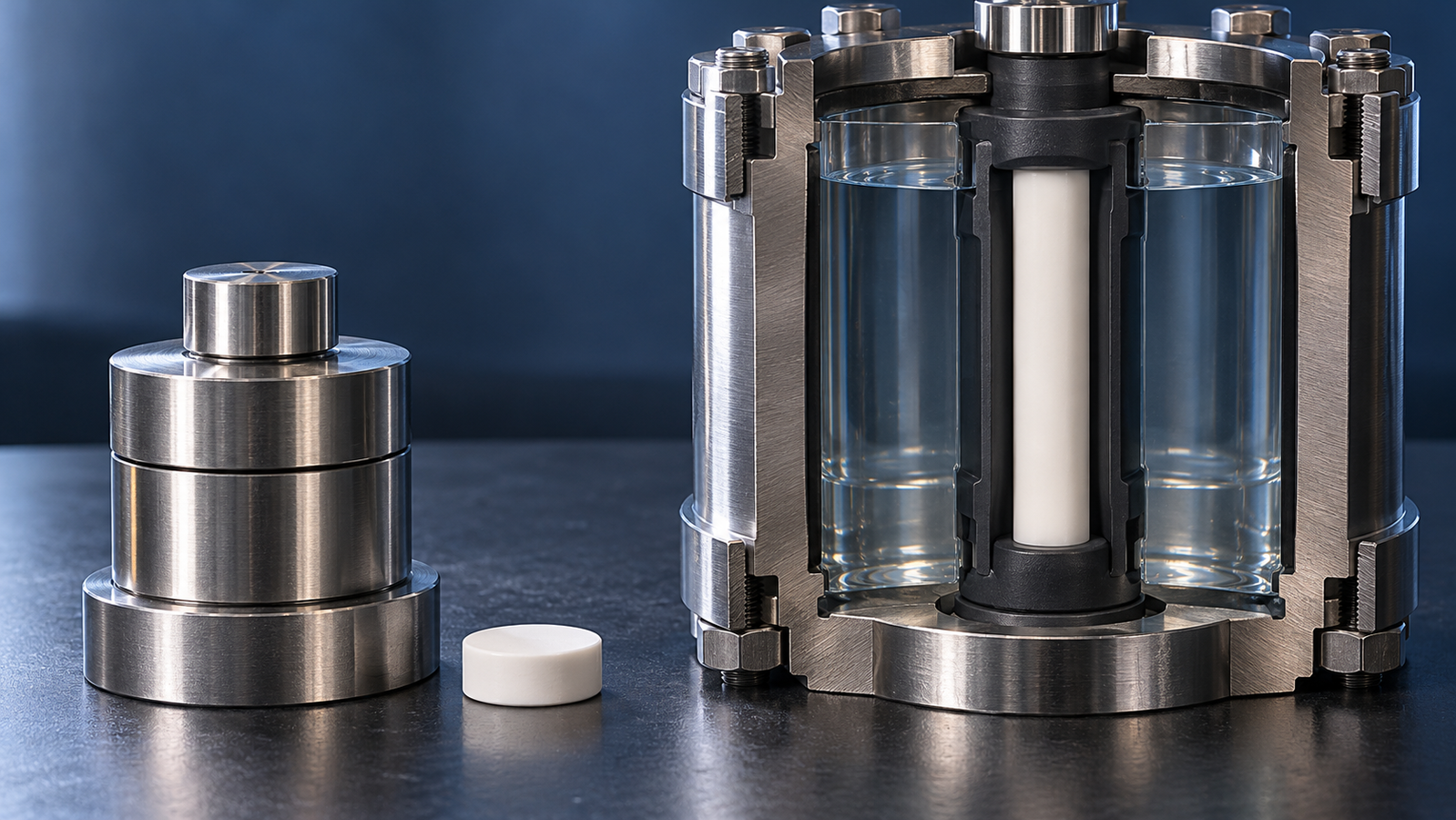
1. What the die wall costs
Powder under a punch pushes outward against the die, and the die pushes back with friction that opposes the powder’s movement. Each layer hands on a little less force than it received. The result is a pressure that decays with distance from the moving punch and a density that follows it, an effect that has been measured and modeled in ceramic and pharmaceutical compacts.1,2,3 A force balance on a thin slice of powder gives the scale; the powder compaction guide works through it and lets you vary the coefficients:
D is the die diameter, μ the friction coefficient at the wall, and K the share of the axial pressure that the powder passes sideways. Measurements on a spray-dried alumina powder in a steel die bear out both terms: stress was transmitted through the compact better when the die was lubricated and when the thickness-to-diameter ratio was smaller, and above about 10 MPa the ratio of radial to axial stress was about 0.4.4
With μ = 0.2 and K = 0.4 as illustrative values, the far face of a part receives the following share of the applied pressure.
| Height ÷ diameter | Example, 20 mm die | Pressed from one end | Pressed from both ends, at mid-height |
|---|---|---|---|
| 0.15 | 3 mm disc | 95 % | 98 % |
| 0.5 | 10 mm pellet | 85 % | 92 % |
| 1 | 20 mm cylinder | 73 % | 85 % |
| 2 | 40 mm cylinder | 53 % | 73 % |
| 4 | 80 mm rod | 28 % | 53 % |
Idealized model with constant μ and K; in real powders both change with pressure and density. The percentages are relative pressures, not densities.
The gradients are not only a calculation. X-ray computed tomography has mapped the density structure inside compacts pressed from spray-dried granules, and shown that conditions which raise the average density can make its distribution less uniform.5 A finite-element study of 316L stainless-steel powder, with friction at the die wall included, compared its calculations with experiments for both single-action and double-action pressing.6 Pressing from both ends moves the low-density zone to mid-height and halves the distance to a punch face,7 which is why the last column of the table is always better than the one before it and never reaches 100 %.
Why it matters after pressing
A compact shrinks in the furnace, and a region that started less dense shrinks more to reach the same final density. Green density affects the rate of densification,8 and in one study of nanocrystalline zirconia a forming route that gave more homogeneous green bodies sintered at lower temperature and to a finer grain size.9 In uniaxially pressed zirconia blocks, linear sintering shrinkage differed by position within one block, lowest at the top and highest at the bottom.10 A gradient in the green part becomes a distortion, or a crack, in the fired one.
2. What head-to-head comparisons found
The useful studies are those that took one powder and pressed it by both routes, or pressed it in a die with and without an isostatic step afterward. Most point the same way, and they differ a great deal in the size of the effect.
- Porous alumina. With the same powder, milling and firing schedule, isostatic pressing gave the highest and most uniform densification of the three routes compared (uniaxial pressing, isostatic pressing and gel casting), a relative density up to 85.3 %, the smallest mean pore size at 0.22 µm, and the highest characteristic strength at 186 MPa. Uniaxial pressing gave intermediate densification, which the authors attributed to compaction gradients and die-wall friction.11
- Cemented carbide. Adding a cold isostatic step before sintering reduced the tungsten-carbide grain size in one grade from 2.3 to 1.0 µm, raised the mean transverse rupture strength by 9 and 13 % in two grades, and cut tool wear rates by 67 and 44 %.12
- A lead-free piezoceramic. Barium zirconium titanate compacted by cold isostatic pressing showed better dielectric and ferroelectric properties after sintering than the same material pressed uniaxially.13
- Nanocrystalline zirconia, measured inside the compact. Density gradients were measured in compacts made by uniaxial pressing alone and by uniaxial pressing followed by isostatic pressing. The isostatic step formed a denser outer skin and narrowed the density distribution, but it did not remove the gradients; non-uniform sintering shrinkage remained, the high-density and low-density ends left by uniaxial pressing were reversed by the isostatic step, and final dimensions varied by nearly 400 µm.14
- Ferrite magnets. In a doped strontium ferrite, cold isostatic pressing raised the density of the green compact and of the sintered magnet and at the same time degraded the crystallographic alignment of the magnet, so the remanence was best at a compromise pressure while the coercivity rose steadily with pressure.15
Two lessons sit in that list. Isostatic pressing usually improves uniformity and what depends on it. And it is not automatically better: where a property depends on particle alignment, as in the ferrite magnets, pressure from all sides can undo part of it. Each of these results belongs to its material and schedule and none is a guarantee for another powder.
At the far end of the method, very high isostatic pressures show what uniform packing makes possible. Fine silica pressed at up to 1 GPa reached more than 78 % of theoretical density with a uniform pore structure,16 and zirconia nanopowders pressed isostatically at 300 to 1000 MPa sintered without pressure to more than 99 % density with grains under 100 nm, but only where the green body was homogeneous, with pores below 10 nm.17 Laboratory chambers work lower: standard PressPro™ chambers are rated to 300 MPa.
3. Shape and precision: what the die gives back
Uniformity is half of the comparison. The other half is geometry.
- A die defines the part. Diameter is the bore, the faces are the punch faces, edges are sharp, and one pellet matches the next to the tolerance of the tooling. Thickness is set by the fill and the force.
- A flexible mold follows the powder. The part comes out with the general shape of the mold, a surface that shows the rubber, rounded edges and dimensions that depend on how evenly the mold was filled. Critical surfaces are usually machined in the green state.
- A die limits the shape to what can be ejected. Discs, short cylinders, bars, rings. A long rod, a tube, a sphere or an undercut cannot be pushed out of a rigid bore.
- A mold does not. Rods, tubes formed over a mandrel and irregular bodies can be pressed isostatically, because the mold is peeled away from the part. Reviews of the process list freedom of shape among its advantages.18,19
4. Side by side
| Uniaxial, in a die | Cold isostatic, in a chamber | |
|---|---|---|
| Pressure acts | Along one axis, through punches | From all sides, through a liquid |
| Density | Graded along the height; worse as the part gets taller | More uniform; unevenness from filling the mold remains |
| Shapes | Discs, short cylinders, bars, rings | Rods, tubes, irregular bodies, and discs |
| Dimensions | Set by the tooling | Approximate; finished by green machining |
| Tooling | One die per diameter | One mold per shape, plus the chamber |
| Pressure limit | The die: PressPro™ steel dies are intended for use below 800 MPa | The chamber: 300 MPa standard, 500 MPa to order |
| Force needed | Pressure × area of the part | Pressure × area of the chamber bore, whatever the part |
| Pressure on the sample | Has to be calculated from force and die | Is the chamber pressure |
| Cycle | Fill, press, eject | Fill, seal, immerse, press, recover, strip |
| Contact with liquid | None | The mold must seal |
The force works differently
In a die the press pushes on the part, so a small part needs a small press: a 20 mm disc at 300 MPa takes 9.6 t. In a laboratory isostatic press the frame pushes a plunger into the chamber, so the force is set by the chamber bore and not by the part inside it: 300 MPa takes 11.6 t in a 22 mm chamber, 21.6 t in a 30 mm chamber and 38.5 t in a 40 mm chamber. The same 20 mm disc, sealed in a mold that needs the 30 mm chamber, takes a 30 T isostatic press. For larger flat parts the gap closes: a 30 mm disc at 300 MPa needs 21.6 t in a die and 38.5 t in the 40 mm chamber that its mold would call for, within the rating of a 40 T frame. The isostatic press selection guide covers chamber sizing.
5. Route comparison
Enter the size of the pressed part, the friction values you want to assume, and the pressure. The tool gives the modeled pressure at the far end of the part in a die, pressed from one end or both, and compares it with a threshold you set yourself. Beside it, it lists the force a die would need and the isostatic chambers large enough to be worth checking in detail.
6. Using both: shape in a die, then press in a chamber
The common compromise takes the die’s shape and the chamber’s uniformity. The powder is pressed in a die at low pressure, just enough to give a body that can be handled; the body is sealed in a thin bag and pressed isostatically at the full pressure. The die step is fast and sets the outline. The isostatic step does the densifying.
What this achieved, and what it did not, was measured in the nanocrystalline zirconia study: a narrower density distribution and a denser skin, with density gradients still present after the isostatic step.14 That was one powder at one length-to-diameter ratio, but the practical points it suggests are general ones.
- Press lightly in the die. The less the die step densifies, the less gradient it leaves for the isostatic step to work against.
- Expect the dimensions to move. The body shrinks in the chamber, by different amounts where its density differed. Leave stock for machining.
- Mind the particle alignment. If the property depends on particle orientation, look for the isostatic pressure that balances density against alignment, as the ferrite study did.15
On the manual and electric PressPro™ isostatic presses the chamber lifts off the table and the frame works as an ordinary pellet press, so one machine can do both steps.
7. Which route for which part
Stay with the die when
- the part is a thin disc or a short pellet, and the modeled loss for its shape and a realistic friction is small;
- dimensions, flat faces or sharp edges matter and there is no machining step;
- many identical pellets are needed;
- the powder must not meet a liquid, even through a bag;
- the pressure needed is above 300 MPa and below the limit of the die.
Go isostatic when
- the part is tall or slender, a rod, a tube or an irregular body;
- it must shrink evenly: sintering studies, parts that warp or crack in the furnace, large discs for property measurements;
- ejection damages the compact, and a split die has not solved it;
- one press should handle many shapes, each with its own rubber mold.
Use both when
- the part is a disc or a bar whose shape a die gives easily, and whose density must be more uniform than a die leaves it.
Before giving up on a die for a moderately tall pellet, try the cheaper measures first: a polished bore and a trace of wall lubricant, a double-action die, a split die if ejection is the problem. The powder compaction guide and the die selection guide cover them.
8. Related guides and equipment
- Powder Compaction Guide — what happens in a die, with the friction model in detail.
- Isostatic Press Selection Guide — chambers, molds, ratings, and a chamber check for your part.
- CIP vs WIP vs HIP — the three isostatic processes and where each belongs.
- Pellet Press Die Selection — double-action and split dies.
- Tonnage-to-MPa Calculator — force and pressure for any die.
- How to Choose a Laboratory Hydraulic Press — the whole PressPro™ range by purpose.
- Isostatic Molds, Bags and Sample Recovery — mold materials, sizing for shrinkage, filling, sealing and getting the part out.
- Equipment: uniaxial presses from the two-column to the automatic series; manual, electric, automatic and large-tonnage isostatic presses.
9. FAQ
Is isostatic pressing better than uniaxial pressing?
It gives more uniform density and more freedom of shape. It gives less exact dimensions and takes longer per part. For thin flat pellets a die is the better tool; for tall, slender or irregular parts, or where even sintering shrinkage matters, isostatic pressing is.
At what height-to-diameter ratio should I switch to isostatic pressing?
A common working rule is to keep the height below the diameter in a single-action die, but there is no single number, because the loss depends on friction as well as shape. With moderate friction the model gives about 85 % of the applied pressure at the far end when the height is half the diameter, and about half when the height is twice the diameter. Decide how much loss your part tolerates and check it with the tool.
Does pressing harder remove the density gradient in a die?
Not in the simple friction model. There, more force raises the pressure everywhere by the same factor, so the ratio of pressure between the ends stays the same; how that carries over to density depends on the powder. Shape, friction and pressing from both ends change the ratio.
Why press uniaxially first and then isostatically?
To get the shape from the die and the uniformity from the chamber. The isostatic step narrows the density distribution; in measurements on a nanocrystalline zirconia powder it did not remove the density gradients entirely.
Can a laboratory isostatic press reach the same pressure as a die?
Standard chambers are rated to 300 MPa, and 500 MPa chambers are made to order. PressPro™ steel dies are intended for use below 800 MPa. For pressures above the chamber rating, a die is the only route.
Does the sample get wet in a cold isostatic press?
Not if the mold is sealed. The powder sits inside a closed rubber mold or bag and the liquid stays outside. A leak spoils the sample, so closures are checked and valuable samples double-bagged.
Do I need a bigger press for isostatic pressing?
Often, for small parts. The force is set by the chamber bore: 300 MPa needs 11.6 t in a 22 mm chamber and just over 60 t in a 50 mm chamber, however small the part inside.
Can one press do both?
The manual and electric PressPro™ isostatic presses can. With the chamber lifted off, the frame is a standard hydraulic press that takes a pellet die.