
Presses are bought with care and dies as an afterthought, which is the wrong way round. The die decides the shape of the pellet, the highest pressure it can be given, whether it comes out in one piece, and whether the whole assembly fits between the columns of the press at all. Flaws made at this stage stay in the part through every later step.1 A 40-tonne press with the wrong die makes worse pellets than a 12-tonne press with the right one. This guide goes through the die types used in laboratory pressing, how to size one, how the pellet gets out, and how to check a die against a press before ordering either.
In one paragraph: pick the die by four questions. What shape and size is the sample: that fixes the bore. What pressure will it see: force divided by bore area must stay below about 800 MPa for a steel die, which caps a 13 mm die near 10.8 t and a 40 mm die near 102 t. How will the pellet come out: pushed through the bore, measured in the die ring, or released by a split die. And does the assembled die fit the press: its base must sit on the worktable, its height must clear the workspace, and the travel needed to compact and eject must be within the piston stroke. Infrared and XRF presses come with the die for their method; general powder presses do not.
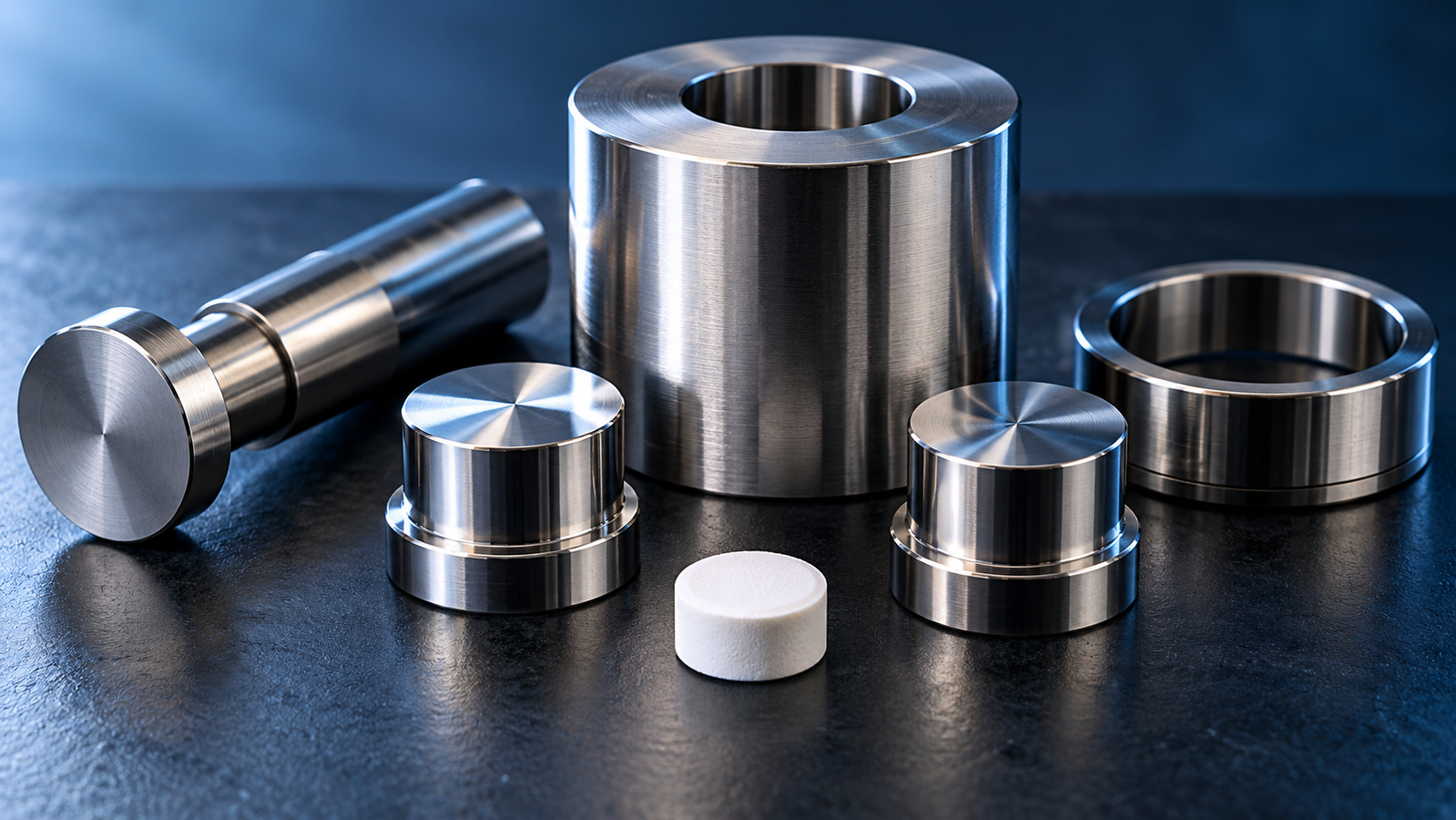
1. Die types and what each is for
Almost every laboratory pressing job is covered by one of the die families below. All of them are available for PressPro™ presses, and non-standard sizes are made to order.
| Die type | What it makes | Notes |
|---|---|---|
| Cylindrical | Round pellets and discs | Standard bores 3, 5, 7, 10, 13, 15, 20, 25, 30 and 40 mm. Sizes to 25 mm have a vacuum port. |
| Square and rectangular | Bars and plates for mechanical or electrical tests | Made to the specimen dimensions. |
| Split (segmented) | Pellets from powders that are hard to eject | Three inner segments for round pellets, four for square ones, held by an outer sleeve. Remove the sleeve and the segments come apart; nothing slides against the pellet. |
| Ring (annular) | Pellets with a central hole | Common for catalyst testing. |
| Spherical | Balls, hemispheres, capsule shapes | Shaped punch faces. |
| Double-action | Pellets that must be uniform in density | A spring-supported die body lets both punches move relative to the bore. Also made in split form. |
| Tungsten carbide | Pellets from hard, abrasive powders | Harder and more wear-resistant than steel; made to order. |
| Thick-wall and tall dies | High-pressure pellets; deep powder fills | A heavier body resists cracking; a tall body with a graduated plunger sets the fill height. |
| Infrared (KBr) | 13 mm (12.7 mm), 7 mm and 3 mm pellets | Two forms: the pellet is pushed out and mounted on a magnetic holder, or stays in its ring and goes straight into the spectrometer. |
| XRF | 32 to 40 mm pellets | Four forms: boric-acid backing, steel ring, plastic ring, aluminum cup. |
| Hot-pressing | Pellets pressed warm | Round, square or flat, with built-in heating and a controller; 300 °C or 500 °C. |
| Flat plates and frame molds | Films, sheets, tensile bars | Polished plates with or without handles; frame molds with one or many cavities set the thickness. |
| Coin-cell dies | Sealed or opened button cells | CR16, CR20, CR24 and CR30 series. |
When a split die earns its price
In a one-piece die the pellet is pushed along the bore to get it out, against the same friction that resisted compaction. Wall friction acts during ejection as well as during pressing,2 and ejection is when weak compacts often crack. A split die removes the step. It is the usual answer for ultrafine powders, for compacts with little green strength, and for any powder that sticks.
When to press from both ends
Friction at the die wall means the powder far from the moving punch is pressed less than the powder next to it, and the density of the pellet follows.3,4,5 In a double-action die the body floats on a spring, so the powder is compressed from both faces and the low-density zone moves to mid-height, half as far from a punch.6 Consider one when the pellet is thick relative to its diameter and even density matters; where the limit lies depends on the powder and its friction against the die. The powder compaction guide explains the effect and includes a model of it.
2. Sizing the die: bore, force and the 800 MPa line
The bore diameter is set by the sample holder, the specimen standard or the instrument. What follows from it is the force. Pressure on the sample is the force divided by the bore area, so the same pressure needs four times the force when the diameter doubles.
| Bore | Force for 200 MPa | Force for 400 MPa | Force at the 800 MPa limit |
|---|---|---|---|
| 7 mm | 0.79 t | 1.57 t | 3.14 t |
| 10 mm | 1.60 t | 3.21 t | 6.41 t |
| 13 mm | 2.71 t | 5.42 t | 10.84 t |
| 20 mm | 6.41 t | 12.82 t | 25.65 t |
| 30 mm | 14.43 t | 28.85 t | 57.70 t |
| 40 mm | 25.65 t | 51.29 t | 102.5 t |
From the PressPro™ die pressure chart: force (t) = pressure (MPa) × bore area (mm²) ÷ 9800.
The last column is the one to remember. PressPro™ steel dies are intended for use below 800 MPa of sample pressure. Between 800 and 1200 MPa a die is being overloaded, and above 1200 MPa seriously overloaded. Small dies cross the line at forces any laboratory press can reach: a 15 T press at full load puts more than 1100 MPa on a 13 mm die. The limit belongs to the die, not the press, so check it every time the die changes. The tonnage-to-MPa calculator marks the three zones for any bore.
Die material
Standard dies are made from hardened tool steels, of the cold-work and the high-speed type, and from hardenable (martensitic) stainless steels. For powders hard enough to score steel, including many carbides, nitrides and hard oxides, a tungsten-carbide die keeps its bore.
3. Getting the pellet out
There are three ways, and the choice changes the die.
- Push-through ejection. Remove the base, stand the die body on the ejection ring, and press the plunger until the pellet drops into the ring. This is the standard method. It needs enough piston stroke for the pellet and one anvil to travel clear of the bore.
- Measure in the die. For infrared work, a non-demolding die forms the KBr disc inside a thin ring that goes into the spectrometer as it is. No ejection, no handling of a fragile disc. The PressPro™ mini infrared press is supplied with a 7 mm die of this kind; the 13 mm infrared die is available in both forms.
- Open the die. A split die releases the pellet by taking the die apart around it.
Cracks that appear on ejection but not on release may come from the bore: look for residue from the last sample, corrosion, or score marks. Cracks that appear as the load comes off may be related to the release step: in pharmaceutical tablets, the way the tablet is unloaded has been shown to change whether it caps or laminates.7 The compaction guide covers them.
4. Will it fit the press?
Three dimensions of the press decide whether a die can be used on it, and all three are on the PressPro™ data sheet.
- Worktable diameter. The round table on top of the piston. The die base should sit fully on it. Tables run from 45 mm on the mini infrared press to 218 mm on the 100 T automatic press.
- Workspace. The clear width between the columns and the clear height above the table. The die with its plunger fully extended over loose powder must stand inside it; the lead screw at the top of the frame is then wound down to meet the plunger.
- Piston stroke. Under 30 mm on frames to 30 T and under 50 mm on larger ones. The stroke has to cover the compaction of the powder column and, on a second setting of the lead screw, the ejection travel.
Enter your die dimensions below to check them against any PressPro™ powder, infrared or XRF press.
The check is about dimensions. Whether the die may carry the load is the separate question answered by the 800 MPa line above.
5. Which dies ship with which press
| PressPro™ press | Die supplied | Also in the box |
|---|---|---|
| Mini infrared press, 2 T | 7 mm infrared die, in-ring type | Agate mortar, spectroscopic-grade KBr, sample scoop |
| Infrared powder press, 10 to 20 T | 13 mm infrared die | Agate mortar, spectroscopic-grade KBr, sample scoop |
| XRF press, 30 and 40 T | One XRF die: boric acid, steel ring, plastic ring or aluminum cup | — |
| Automatic XRF press, 30 to 60 T | Ø40–32 mm boric-acid die, built in | Boric-acid sample splitter |
| Manual electric-heating hot press | One hot-pressing die, Ø3–20 mm on the 15 T or Ø21–40 mm on the 24 T | Temperature controller |
| Coin-cell machine | CR20-series sealing or opening die | — |
| Battery punching machine | 12 mm and 16 mm punches | Anti-static collection box |
| General powder presses: two-column, four-column, protective, electric, automatic, large-tonnage | None; ordered to the sample | — |
| Platen presses, hot and cold | None; frame molds and plates ordered to the sample | — |
6. Looking after a die
- Clean it after every sample. Powder left in the bore becomes the next pellet's contamination and the next ejection's friction. Wipe the bore, plunger and anvils; do not use abrasives on the polished faces.
- Dry it. Salts such as KBr attract water, and salt left on steel can corrode it. Dry the parts after cleaning and store the set in a desiccator or a dry cabinet.
- Keep the faces polished. The anvil faces print onto the pellet. A scratch on an anvil is a scratch on every infrared disc and every XRF surface made with it.
- Keep the load on axis. Center the die on the worktable and make sure the plunger is square before pressing. A tilted plunger scores the bore.
- Respect the pressure limit. One overload can bell-mouth the bore, after which pellets stick and crack on ejection.
The die care guide sets out what is known about each of these: carry-over between samples, the metals a die can add, salt corrosion, wear and overload.
7. Related guides and equipment
- How to Choose a Laboratory Hydraulic Press — the route and the press, once the die is known.
- Tonnage-to-MPa Calculator — force, gauge reading and sample pressure for any bore.
- Powder Compaction Guide — wall friction, the pressing cycle and pellet defects.
- KBr Pellet Preparation for FTIR — using the infrared dies.
- XRF Pressed Pellet Preparation — choosing between boric acid, rings and cups.
- Laboratory Hot Pressing Guide — heated dies, plates and frame molds.
- 7 mm vs 13 mm KBr Pellets — the two infrared die sizes, and the press each one takes.
- Heated Dies vs Heated Platens — which hot-press route fits a pellet, a film or a laminate.
- Pellet Cracking, Capping and Lamination — where and when pellets cap, laminate or crack, and what the evidence links to each.
- Green Density, Springback and Ejection — measuring density, springback and ejection force, and what compaction equations do and do not show.
- Pellet Die Care — cleaning, contamination, salt corrosion, wear and overload.
- PressPro™ series — all laboratory presses from ACS Material.
8. FAQ
What is an evacuable pellet die?
A die with a side port for a vacuum pump. Pumping while pressing removes air and moisture from the powder, which gives clearer KBr discs and fewer capped pellets. PressPro™ cylindrical dies up to 25 mm have the port.
What size die do I need for FTIR and for XRF?
For FTIR, 13 mm is the common size and 7 mm is used when sample is scarce. For XRF, 32 and 40 mm are the common pellet diameters; check the sample cup of your spectrometer.
How much force can I put on a 13 mm die?
About 10.8 t brings a 13 mm bore to 800 MPa; the PressPro™ die pressure chart gives normal use for steel dies as below 800 MPa. A widely used KBr method applies about 8 t.8
Can I use a die from another manufacturer on a PressPro™ press?
Yes, if it passes the three fit checks: the base sits on the worktable, the assembled height clears the workspace, and the travel is within the stroke. Its pressure limit is the one its maker states.
Steel or tungsten carbide?
Steel for KBr, binders, polymers, most oxides at moderate pressure and nearly all routine work. Carbide when the powder is hard enough to scratch a steel bore.
Why does my pellet stick in the die?
Usually residue or corrosion in the bore, a damp powder, or a bore that has been stretched by overload. Clean and inspect the bore first. If the powder itself is the cause, move to a split die.
Do I need a different die for a heated press?
Yes. A hot-pressing die has its own heater and thermocouple and is rated for 300 °C or 500 °C. For films on heated platens the tooling is a pair of polished plates and a frame mold.