
A 13 mm KBr pellet takes about 200 mg of potassium bromide and a milligram of sample, and eight tonnes to press. A 7 mm pellet of the same thickness takes about 60 mg and a third of a milligram, and about two tonnes, which a hand press weighing less than five kilograms can deliver. If the two pellets hold the same proportion of sample they should give the same spectrum. The 13 mm size remains the standard for practical reasons, and one of them is the infrared beam: the pellet has to cover it, and not every spectrometer’s beam fits through a 7 mm disc without help. This guide compares the two sizes, and the 3 mm micro pellet below them, on sample, optics, handling and the press each one needs.
In one paragraph: a pellet’s spectrum depends on how much sample lies in the path per unit area, not on its diameter. A 7 mm pellet therefore does the work of a 13 mm one with 29 % of the material, and a 3 mm pellet with about 5 %. The price is optical and practical. The pellet must be at least as large as the beam at the sample position, or the beam must be masked, which costs light, or condensed onto the pellet with an accessory; a smaller mass is harder to weigh; and a small die needs a small press, because the force that gives the right pressure on 13 mm would overload a 7 mm die. Choose 13 mm when sample is plentiful and the pellet may be handled or stored; 7 mm when sample is scarce, pellets are occasional, or the press has to be portable; 3 mm when there are only micrograms and a beam condenser is available.
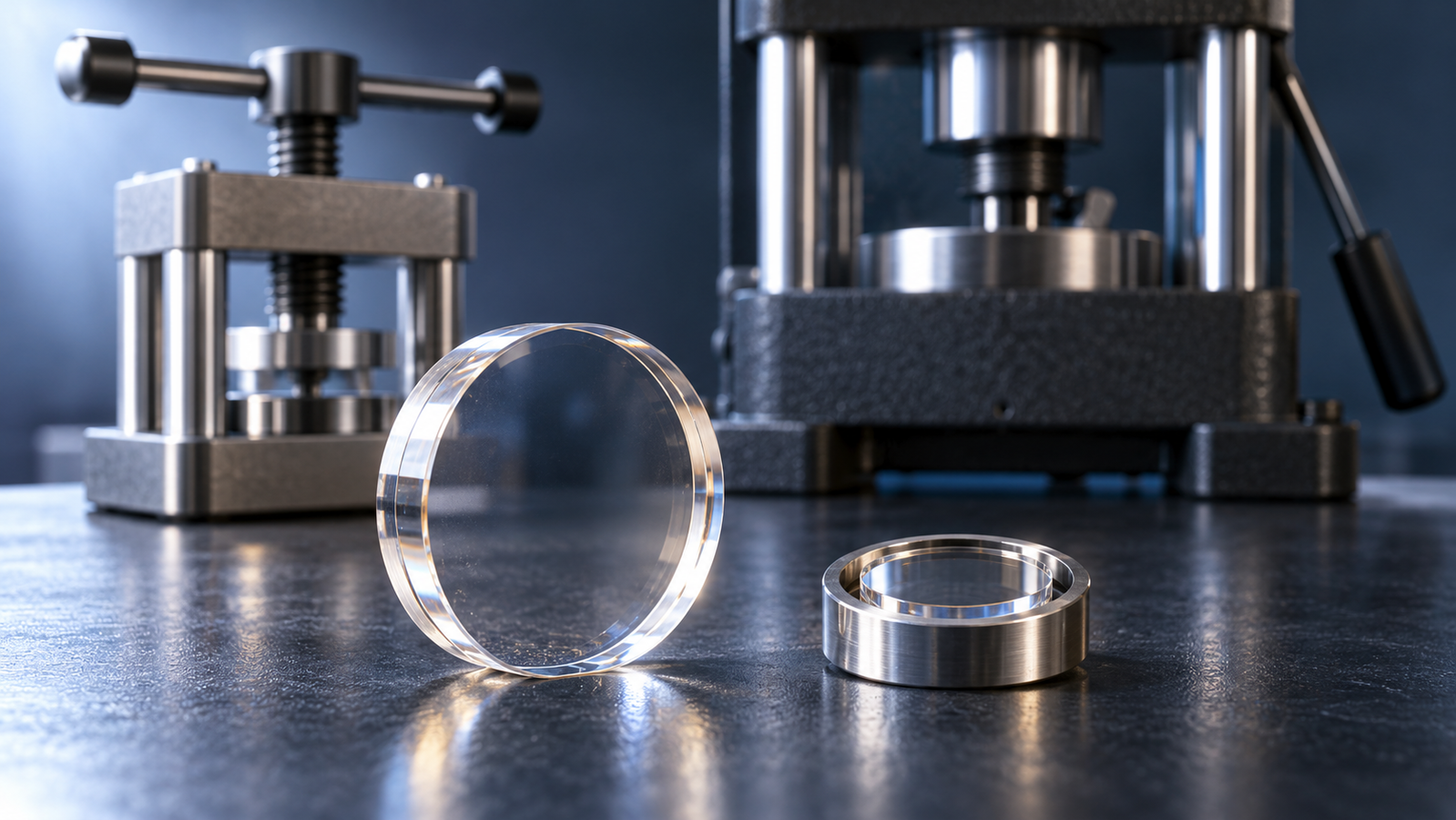
1. What stays the same: sample per unit area
Absorbance follows the amount of absorbing material the beam passes through. In a pellet that amount is the mass of sample per unit area of the disc, which is fixed by two things you choose: the concentration of sample in the KBr and the thickness of the pellet. Diameter does not enter. A 13 mm disc 0.55 mm thick with 0.5 % of sample and a 7 mm disc 0.55 mm thick with 0.5 % of sample both carry about 0.75 mg of sample per square centimeter, and wherever the beam passes entirely through pellet it sees the same thing in both.
That is why recipes transfer by area. The potassium bromide disc has been a general sampling method since the 1950s,1,2 and a widely used instrument-maker method for the 13 mm size calls for 0.1 to 1.0 % of sample in 200 to 250 mg of KBr.3 Keep the concentration, scale the KBr by the ratio of the areas, and the smaller pellet has the same thickness and the same loading. For quantitative work the scaling has to be done with numbers and not by eye: deriving an absorption coefficient from a pellet needs its mass and diameter as well as the mass fraction of the sample.4
| 13 mm | 7 mm | 3 mm | |
|---|---|---|---|
| Area | 133 mm² | 38.5 mm² | 7.1 mm² |
| Material, relative to 13 mm | 100 % | 29 % | 5.3 % |
| KBr for a 0.55 mm disc | 200 mg | 58 mg | 11 mg |
| Sample at 0.5 % | 1.0 mg | 0.29 mg | 0.05 mg |
| Force for 590 MPa on the pellet | 8.0 t | 2.3 t | 0.43 t |
| Force at the 800 MPa die limit | 10.8 t | 3.1 t | 0.58 t |
KBr mass from area × thickness × 2.75 g/cm³, the density of fully pressed KBr. 590 MPa is the pressure that the 13 mm method’s 8 tonnes produces. The 7 and 3 mm columns are that method scaled by area: starting estimates, not validated recipes.
2. What changes: the beam has to fit
The saving in material is only real if the light goes through the pellet. Two cases have to be told apart.
- The pellet is larger than the beam. Nothing changes. The spectrometer never sees the edge, and a 7 mm pellet performs like a 13 mm one.
- The beam is larger than the pellet. Light that misses the disc must be blocked, or it reaches the detector unabsorbed and makes every band look weaker than it is. A pellet left in its steel ring is its own mask: the ring blocks what the disc does not cover. A free-standing small disc needs a holder with a matching aperture. Either way the detector now receives only the part of the beam that fits through the opening.
Reducing the beam area with a small aperture has been described as the best way to examine a microsample, and it has a known price: energy is lost, and the aperture distorts the baseline, which can be corrected mechanically or digitally.5 Less energy means more noise for the same measurement time, and the usual remedy is to add scans. A beam condenser reduces the loss by focusing the beam onto the small pellet; it is the accessory commonly used with micro pellets.6
The size of the beam at the sample position is a property of the instrument and is stated in its manual. Find that number before choosing a die. If it is under 7 mm, the 7 mm pellet is a free saving. If it is larger, decide whether the lost light matters for your bands. The comparison tool below gives the share of a round beam that each pellet size intercepts, as a geometric estimate.
3. How small the method goes
Infrared identification of materials in the fractional-milligram range was being reported within a year or two of the pellet method itself.7 By the end of the 1960s a potassium bromide micro-pellet technique was being used to identify fractions trapped from a gas chromatograph in amounts down to a few micrograms. Below 3 to 4 µg the spectrum needed ordinate expansion, and the overall yield of the procedure was 60 to 90 %, depending on the compound.8 At that scale the practical difficulties are in handling the sample and in the optics. Small pellets are also ordinary practice today: a recent study of calcite in archaeological materials, for example, recorded its infrared spectra from 7 mm KBr pellets made with a hand press.9
4. Handling: in the ring or out of it
PressPro™ infrared dies are made in 13 mm (12.7 mm), 7 mm and 3 mm sizes, each in two forms.
- Push-out dies, also called demolding dies, make a free-standing disc. After pressing, the pellet is pushed out of the die and placed on a magnetic sample holder. The disc can be inspected against the light, weighed, stored in a desiccator and measured again later.
- In-ring dies, also called non-demolding dies, form the pellet inside a thin steel ring. The ring goes into the sample compartment as it is. Nothing fragile is handled, and the ring masks the beam around the pellet.
The 13 mm press is supplied with a 13 mm die, and both forms are available for it. The mini press is supplied with a 7 mm in-ring die, which is the sensible form at that size: a free 7 mm disc half a millimeter thick is awkward to pick up, and a 3 mm one more so. The die selection guide describes the die types in detail.
5. The press for each size
The pressure on the pellet is the force divided by the area of the die, so the same pressure on a smaller die needs proportionally less force. A small pellet can therefore be made on a small press, and a large press can easily overload a small die.
| Mini infrared press | Infrared powder press | |
|---|---|---|
| Models | EPIM02TH | EPIM12BH, EPIM15TH (manual); EPIA20TH (electric); EPIP10TH (automatic) |
| Rated force | 2 T | 12 and 15 T (manual), 20 T (electric), 10 T (automatic) |
| How the force is applied | Hand screw: clockwise to press, counterclockwise to release | Hand pump, motor, or program |
| Die supplied | 7 mm, in-ring; a 3 mm die is available | 13 mm |
| Also in the box | Agate mortar and pestle, spectroscopic-grade KBr, sample scoop; infrared drying lamp optional | |
| Piston stroke; working space | Under 5 mm; 54 mm wide, 55 mm high | Up to 30 mm; from 80 mm wide, 150 mm high |
| Size and weight | 100 × 220 × 220 mm; 4.8 kg | From 225 × 155 × 380 mm; 28 to 85 kg |
| Other dies | Its own small infrared dies only | General pellet dies as well, within the working space |
Three consequences follow from the numbers.
- The mini press is a 7 mm press. Its 2 tonnes give about 510 MPa on a 7 mm die. On a 13 mm die the same 2 tonnes would give 148 MPa, a quarter of what the 13 mm method uses, and the press, with under 5 mm of stroke, is built around its own small dies.
- A large press overloads a small die easily. PressPro™ steel dies are intended for use below 800 MPa of sample pressure. That is 10.8 t on 13 mm, 3.1 t on 7 mm and 0.58 t on 3 mm. A 12 T press reaches the 7 mm limit at a quarter of its range.
- A large gauge reads a small load poorly. On the 12 T manual press one megapascal on the gauge is 0.4 t. The 2.3 t for a 7 mm pellet is 5.8 MPa on a 30 MPa scale, and the 0.43 t for a 3 mm pellet is about 1 MPa, at the very bottom of the dial. Use a small die on a large press only with the digital gauge option, which on the manual powder presses of the same ratings reads to 0.01 t, or on the automatic model, whose screen reads to 0.1 t from 0.1 t upward. One such step is 25 MPa on a 7 mm die and 139 MPa on a 3 mm die, so 3 mm work belongs on the mini press.
If both sizes are needed, the pairing that covers them without compromise is the standard press with its 13 mm die and the mini press with its 7 mm die. The mini press is also the one that travels: pressure is generated mechanically by hand, and the press is described as suited to use inside a glove box, subject to the antechamber of your box.
6. Pellet size comparison
Set a 13 mm recipe and a target pressure. The tool scales it to 7 and 3 mm at the same thickness and pressure, and checks each size against the die limit, the presses and, if you enter it, the beam diameter of your spectrometer.
7. Weighing a third of a milligram
The awkward part of a small pellet is the balance. At 0.5 % a 7 mm pellet wants 0.29 mg of sample and a 3 mm pellet 0.05 mg. On a balance that reads to 0.1 mg the first is a guess and the second is invisible.
The way around it is to weigh at the 13 mm scale and press at the 7 mm scale. Grind 1.0 mg of sample with 200 mg of KBr, as for a standard pellet, and then weigh out 58 mg of the mixture for the small die. The concentration is known as well as it would be for the large pellet, and the rest of the mixture makes two more pellets, or a repeat if the first is cloudy. This uses the sample a 13 mm pellet would have used, so it helps with accuracy and not with scarcity. When the sample really is limited to a fraction of a milligram, a microbalance is part of the method.
8. What pellet size does not change
Everything that makes a pellet good or bad is the same at every diameter. The KBr pellet preparation guide covers the method; the points most often behind a disappointing spectrum are these.
- Water. In one study of KBr pellets, most of the retained water was a layer on the surface of the KBr particles and some was in small clusters in micropores, which the authors believe are trapped when the pellet is made; the way the water came off on heating under vacuum suggested blocked pores.10 Dry the KBr and work quickly.
- Grinding. The sample has to be fine; the KBr does not. Severe grinding of potassium bromide can produce absorption bands of its own and larger water peaks, and blanks pressed from coarser powder transmitted better.2
- Band shapes. Where the refractive indices of sample and matrix are equal, a transmission peak appears and neighboring bands are often distorted. This is the Christiansen effect, and the distortion can be reduced by the way the sample is prepared, without resorting to overly severe grinding.11
- Reaction with the matrix. KBr is not always inert. Sodium saponite exchanged its sodium for potassium on being mixed with KBr, which changed its hydroxyl-stretching region,12 and a hydrochloride salt exchanged halide with KBr on grinding, which did not happen in KCl.13
- Pressure and time. Pressing changed the relative intensities of the hydroxyl bands of kaolinite by an amount that depended on the pressure and the pressing time.14 Keep both the same within a series; on a small die that means watching megapascals, not tonnes.
- Repeatability. With care the method repeats well, though not perfectly: day-to-day standard deviations of up to 1.5 cm−1 in peak position were reported for inorganic sulfates in KBr, part of which the authors thought was probably due to differences in preparation between operators.15
9. Which size to choose
Choose 13 mm when
- sample is not limited;
- the method, the library or a standard specifies it;
- pellets are weighed, stored or measured again, which is easier with a free-standing disc;
- the same press should also make other pellets.
Choose 7 mm when
- sample is scarce or valuable: scrapings, single grains, synthesis products in milligram yield;
- pellets are made a few at a time, and a press that lives in a drawer is more useful than one that owns a bench;
- the press must go into a glove box or out of the laboratory;
- the beam of your spectrometer fits, or the loss of light is acceptable.
Choose 3 mm when
- there are only micrograms;
- a beam condenser is available;
- a microbalance, or a method that does not need the exact concentration, is acceptable.
10. Related guides and equipment
- KBr Pellet Preparation for FTIR — the full method, with a calculator for quantities and thickness.
- Pellet Press Die Selection — push-out and in-ring infrared dies, and how to check that a die fits a press.
- Tonnage-to-MPa Calculator — gauge reading, force and pressure for any die.
- Manual vs Electric vs Automatic Laboratory Presses — what the electric and automatic infrared presses add.
- How to Choose a Laboratory Hydraulic Press — the whole PressPro™ range by purpose.
- Cloudy or Cracked KBr Pellets — disc faults and spectrum faults, with the causes the sources link to each.
- Equipment: PressPro™ mini infrared press and PressPro™ infrared powder press.
11. FAQ
Does a 7 mm KBr pellet give the same spectrum as a 13 mm pellet?
It should, if the concentration and thickness are the same and the beam passes through pellet only, because the spectrum depends on sample per unit area. If the beam is wider than the pellet and has to be masked, the bands are in the same places but the spectrum is noisier for the same number of scans, and a small aperture can distort the baseline.
How much KBr does a 7 mm pellet need?
About 58 mg for a disc 0.55 mm thick, which is 29 % of the 200 mg used for a 13 mm pellet of the same thickness. A 3 mm pellet needs about 11 mg.
How much force does a 7 mm KBr die need?
About 2.3 t gives the same 590 MPa that 8 t gives on a 13 mm die. A 2 T mini press reaches about 510 MPa. Stay below 3.1 t, which is 800 MPa on a 7 mm die.
Can I use a 7 mm die in a 12 or 15 T press?
It can be done, with care. The force needed is a small part of the range, the pointer gauge shows it coarsely, and the die limit is reached at about 3 t. Order the digital gauge option and pump slowly, or use the mini press the die was designed for.
Can the mini press make 13 mm pellets?
No. Two tonnes on 13 mm is under 150 MPa, a quarter of the usual pressure, and the press is built around its own 7 mm and 3 mm dies.
What is an in-ring pellet?
A pellet pressed inside a thin steel ring and measured without being removed from it. The ring protects the disc and blocks the beam around it. It is the form supplied with the mini press.
Do I need a beam condenser for a 7 mm pellet?
Often not. A 7 mm pellet in its ring can be measured directly, with some loss of light if the beam is wider than the disc. For 3 mm pellets a beam condenser is a common arrangement. Check the beam diameter in your instrument manual.
Is 12.7 mm the same as 13 mm?
For practical purposes, yes. 12.7 mm is half an inch, and PressPro™ infrared dies are listed as 13 mm (12.7 mm). The areas, and so the quantities, differ by about 5 %.