
A KBr pellet can fail in two ways: the disc itself comes out cloudy, patchy or cracked, or the disc looks fine and the spectrum does not. The two kinds of fault have some causes in common, chiefly water and particle size. The causes the sources name are water, particle size, the filling and pressing of the die, and reactions between the sample and the potassium bromide. This guide takes the faults one by one, with what the published methods and studies say about each.
In one paragraph: a method note lists six causes of a cloudy disc: uneven powder in the die, too much sample, too much KBr, a poorly dispersed sample, water, and too little pressure or time. A disc that breaks on removal is usually too thin. Water bands near 3400 and 1630 cm−1 showed in most spectra of one laboratory’s routine work, and KBr takes up water even after drying, so a blank pressed the same way at the same time is the reference. A sloping baseline and distorted bands come from scattering. Coarse particles are one cause, but grinding too long changes some spectra too. When a salt exchanges ions with KBr, or pressing changes the sample, the fix is a different matrix or a different sampling method rather than a better pellet.
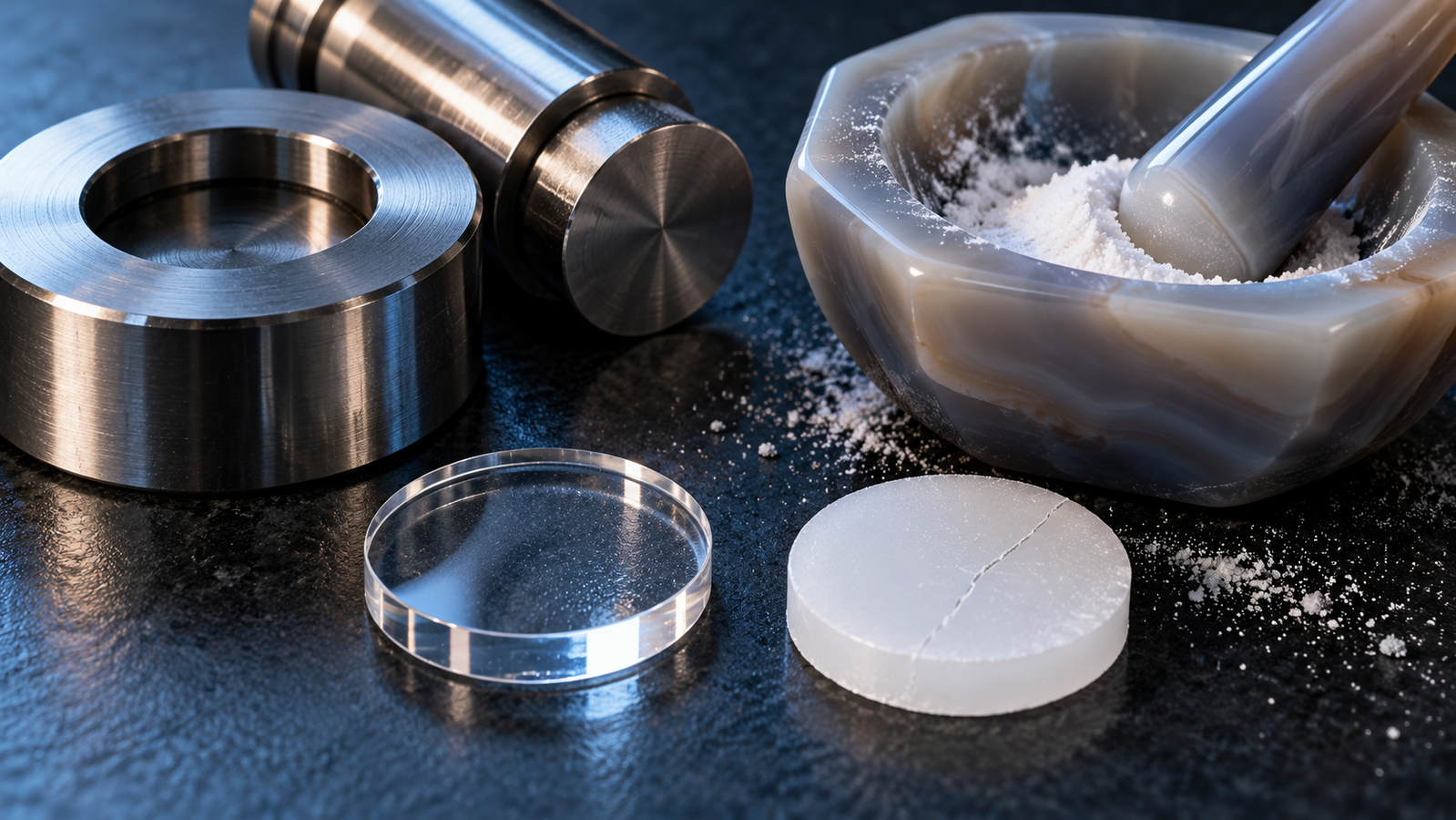
The KBr pellet guide gives the method step by step. This page starts from the other end: the pellet or the spectrum is wrong, and the question is why. The sources are the method papers of laboratories that make pellets routinely, a handful of studies that measured what happens inside a disc, and the literature on reactions between samples and alkali-halide matrices.
1. Two kinds of fault
| Fault | Where it shows | Main causes in the sources |
|---|---|---|
| Cloudy, white or patchy disc | The disc | Uneven fill, too much sample or KBr, poor dispersion, water, too little pressure or time |
| Disc breaks on removal | The disc | Too thin: too little powder, or too much pressure for too long |
| Bands near 3400 and 1630 cm−1 | The spectrum | Water in the KBr and on the sample |
| Baseline rising toward high wavenumber; asymmetric bands | The spectrum | Scattering from coarse particles or some ingredients; the Christiansen effect |
| Bands shifted or changed in intensity | The spectrum | Grinding, pressing, the matrix itself |
| New or missing bands | The spectrum | Ion exchange or reaction with KBr; changes in the sample under pressure |
2. How a clear disc forms
Potassium bromide deforms plastically under load. An early account noted that the plastic flow in KBr differs enough from that in KCl that a crystal can deform in one salt and not in the other.1 Below a threshold pressure the disc does not become transparent. In a study of blank alkali-halide discs 1 cm across, KBr pressed below the threshold was not transparent enough to measure. Pressing also left strain in the crystallites. In air it relaxed over several hours after release; in vacuum it hardly changed over 180 min.2 A practical method note lists “pressed at too low pressure or for too short a time” among the causes of a disc that is not translucent.3
Published methods press in very different ways. The table shows the spread, not a recommendation.
| Source | Die | KBr and sample | Pressing |
|---|---|---|---|
| Practical method note3 | 13 mm (16 mm method halved) | About half of 300 mg KBr and 2 mg sample | Evacuated about 2 min; 10 t (about 740 MPa) for about 1 min; released slowly |
| Mineral spectral library4 | 13 mm, disc 1 mm thick | 300 mg KBr, about 0.7 mg sample ground below 2 µm | Under vacuum for 5 min; pressure not quoted (the scanned copy is hard to read) |
| Laboratory test report5 | Evacuable KBr die | 300 mg KBr, 1 to 2 mg sample | Evacuated 3 min; 18,000 lb (about 8.2 t) for 5 min |
| Meteorite and mineral study6 | 7 mm | 0.5 to 1 % sample; dried 24 h at 110 °C | 1.7 t (about 430 MPa) for 3 min; each pellet weighed |
| Occupational-health method7 | 13 mm, evacuable | About 300 mg KBr dried overnight at 110 °C | “Standard technique”; pellet weighed to 0.1 mg |
Pressures in megapascals are calculated here from the load and the die area (force in tonnes × 9800 ÷ area in mm²), with 13.0 mm for a 13 mm die. A 12.7 mm bore gives about 5 % more. The KBr pellet guide uses about 8 t on a 13 mm die, about 590 MPa.
3. A cloudy or patchy disc
The method note lists six causes of a disc that is not translucent: uneven distribution of powder in the die; too much sample; too much KBr; poorly dispersed sample; water in the disc; and pressing at too low a pressure or for too short a time. All but the last can be put right by regrinding and repressing.3 The note does not link any cause to where the cloudiness sits in the disc.
A disc can also be clear at first and cloudy later. No source read for this guide measured how fast that happens. In the blank-disc study, discs pressed under vacuum and then kept in air took up water: in KBr, from about 58 to 157 ppm over 180 min. The same study attributed the change from transparent to opaque to a change in refractive index, which it put down to a pseudo-amorphous change in the crystallites or an air layer at their boundaries.2
4. A disc that cracks or breaks
The only cause of breakage stated in the sources read for this guide is thickness. “If the disk breaks on removal from the die, this indicates that the disk is too thin,” caused by too little powder, or too much pressure for too long.3 Three sources state a disc thickness: 0.7 mm for blank discs 1 cm across,2 about 0.5 mm for silicate dust pellets,8 and 1 mm in the mineral library, whose 13 mm discs held 300 mg of KBr.4 The method note’s 13 mm recipe uses about half that, about 150 mg, which is about 0.4 mm at the full density of KBr, 2.75 g/cm³.3 On a 13 mm die the sources use about 150 to 300 mg of KBr.
The method note evacuates the die and releases the pressure slowly,3 and the laboratory report evacuates the die.5 None of the sources measured whether skipping these steps, or an uneven fill, cracks a KBr disc. For pressed powders in general, the effect of unloading and ejection has been studied on pharmaceutical tablets; the guide to capping and lamination covers that work.
5. Water bands near 3400 and 1630 cm−1
Water bands appeared even in pellets pressed in an evacuated die,5 and KBr dried under vacuum soon takes up water again.4 None of the sources removed the water completely.
- KBr dried under vacuum “is so hygroscopic that this process quickly begins to reverse.” Water adsorbed on the sample grains adds to it, so the broad band near 3400 cm−1 should be used with caution to estimate the water content of a sample.4
- In one laboratory’s routine work, most spectra showed small amounts of moisture near 3420 and 1630 cm−1.5 Pellets made under vacuum to remove water and carbon dioxide still showed bands that may be due to water.9
- A freshly pressed disc keeps taking up water. In the blank-disc study, heating the disc to 200 °C for 2 h removed only a little of it.2 Water in microporous KBr pellets has been found in three forms. Under vacuum at 330 to 400 K it desorbed by diffusion, which suggests blocked pores.10
- Water held in the KBr lattice can hide the amide and hydroxyl bands of biological samples. One group corrected it mathematically rather than by preparation.11
What the sources do about it:
- Dry the KBr at 110 °C, overnight in one method.7 Another dried the mixed sample and KBr for 24 h at 110 °C.6
- Store calibration material in a desiccator, and handle KBr at low humidity.7
- Press a pure-KBr blank under identical conditions and ratio against it.4
How the KBr is ground matters too. Severe grinding of KBr can produce bands of its own, and blanks pressed from very fine KBr powder showed larger water peaks than blanks from coarser powder. Gently ground, coarser KBr was less likely to show these bands.12 Two of the methods above grind the sample and the KBr together.3,6
6. A sloping baseline and distorted bands
Particles comparable in size to the infrared wavelength scatter the beam. In one laboratory’s pellets, some spectra showed scattering at the high-wavenumber end. It came from inadequate grinding or from ingredients such as antimony sulfide, magnesium, aluminum or zirconium.5 A study of the mechanism, in terahertz spectra of coarse powders pressed in polyethylene, describes asymmetrically broadened bands and a rising baseline from coarse grains. Where the refractive indices of grain and host are equal, no scattering occurs.13 In KBr pellets of briefly ground lead apatites, the Christiansen effect was marked.14 It shows as an apparently anomalous transmittance peak where the refractive indices of sample and matrix are equal, and nearby bands are often deformed.15 Two methods grind the sample below about 2 µm.3,4 In silicate powders, grains below 10 µm gave sharp, well-defined bands. A 38 to 45 µm fraction showed much weaker features, and some bands appeared only below about 75 µm.6
Grinding has a cost, though.
- Prolonged grinding of lead apatites removed the Christiansen effect but changed the intensities and positions of their bands.14
- Milling kaolinite changed its OH band and crystallinity along with its particle size.16
- The matrix itself shifts strong bands. Silicate bands near 10 µm measured in KBr were shifted to longer wavelengths by up to 0.24 µm compared with the same particles measured as an aerosol.8
Grind enough to remove the scattering, not more. When an exact band position matters, compare with a spectrum taken without KBr.
7. When the sample changes in the pellet
Some faults are not preparation errors. The sample reacts with the matrix, or is changed by grinding and pressure.
- Ion exchange. One hydrochloride salt, metoclopramide hydrochloride monohydrate, exchanged ions with KBr when ground or heated with it. With KCl, which has the same anion as the salt, no exchange occurred.17 The method note warns that a base hydrochloride may exchange halogen with KBr.3 Sodium ions in saponite clays exchanged with potassium from the matrix.18
- Reactions on grinding. A review surveys mechanochemical reactions that take place when analytes are milled and pressed with KBr, for copper sulfate, ferricyanides and several silver, mercury and lead salts.19 In equimolar mixtures, some acid bifluorides reacted with KBr on hand grinding alone, forming bromides.20
- Structure. Pressing kaolinite into pellets changed the relative intensities of its OH bands. The change depended on the pressure, the pressing time and whether a salt matrix was used, and it was larger with KBr than for the clay pressed alone.21 Compression in KBr discs unfolded the proteins in dried bacteria.22 Polymorphic changes can be induced by compression in KBr,1 and grinding can change the polymorphic state of a sample.3
Pressing harder will not fix any of these. What the sources used instead:
- KCl as the matrix for a hydrochloride.17
- A mull, which avoids pressing.3,9
- A film dried on a calcium fluoride window.22
- ATR, chosen in one study of shale minerals to avoid some KBr preparation artifacts. The authors named particle agglomeration, water absorption and the difficulty of reproducible mixing.23
8. Too much or too little sample
The sources used between about 0.2 and 1 % of sample in KBr: 1:500 for silicate dust,8 0.7 mg in 300 mg,4 1 to 2 mg in 300 mg,5 and 0.5 to 1 %, with a few percent for coarse grains.6 “Too much sample” appears among the causes of a cloudy disc.3 To derive absorption coefficients from a pellet, its mass and diameter have to be known,24 and two of the methods weigh each finished pellet.7,6 KBr squeezed past the die during pressing means that a sample pellet and its blank do not always hold the same amount of KBr. In the mineral library this occasionally pushed transmittance above 100 %.4 Particle size matters too. In the silica method, “a mismatch of standards and sample particle sizes will result in an uncorrectable bias.”7
9. KBr pellet check
Enter the die, the masses and the force, and pick the fault. The tool calculates the pressure, the disc thickness and the sample concentration and compares them with the ranges of the published methods above. It then lists the causes the sources link to that fault.
10. Fault by fault
| What you see | Causes in the sources | What to change |
|---|---|---|
| Cloudy, white or patchy disc | Uneven distribution of powder; too much sample or KBr; poorly dispersed sample; water; too little pressure or time3 | Regrind and repress (all but the last cause); level the powder; dry the KBr; check the masses, the pressure and the hold |
| Clear, then cloudy later | Not measured in the sources; the disc takes up water after pressing2 | Measure promptly; keep the KBr dry7 |
| Breaks on removal | Too thin: too little powder, or too much pressure for too long3 | More powder for the die area, or less pressure or a shorter hold (the discs in the sources are about 0.4 to 1 mm thick) |
| Bands near 3400 and 1630 cm−1 | Water in KBr and on the sample4,5 | Dry KBr; a blank pressed the same way at the same time; do not over-grind KBr12 |
| Baseline rises toward high wavenumber | Scattering from coarse particles or some ingredients5,13 | Grind the sample finer |
| Asymmetric, distorted bands | Christiansen effect14,15 | Finer grinding, but not prolonged grinding |
| Band positions or intensities differ from a reference | Over-grinding;14,16 the KBr matrix8 | Compare with a spectrum taken without KBr (ATR, or a mull) |
| New bands, or bands of a different salt | Ion exchange or reaction with KBr17,20 | KCl matrix for hydrochlorides; otherwise a mull or ATR |
| Weak features from a coarse powder | Large grains absorb little in the pellet6 | Grind finer; a few percent of sample for coarse grains |
11. Press and die
Of the methods above that give a usable load, the highest is about 10 t on a 13 mm die;3 the 7 mm method uses 1.7 t.6 The choice of press is about die size, handling and how many pellets are made. The PressPro™ infrared presses come in three forms: manual, with a hand pump (12 and 15 T); electric, with motor pressurizing and automatic compensation (20 T); and automatic, which pressurizes, holds and releases on its own (10 T, from 0.1 t). The mini infrared press works by hand screw up to 2 T. Infrared dies are made in 13 mm (12.7 mm), 7 mm and 3 mm. Each comes in a push-out form, whose disc is mounted on a magnetic holder, or an in-ring form, whose disc stays in its ring and goes straight into the spectrometer. The in-ring form avoids handling a thin disc. Each infrared press comes with its die set, an agate mortar, a bottle of spectroscopic-grade KBr and a sample scoop; an infrared drying lamp is optional. The die set is 13 mm with the 10 to 20 T presses and 7 mm in-ring with the mini press. Keep the pressure on a KBr die below 800 MPa. On the 13 mm die that is about 10.3 t for a 12.7 mm bore and 10.8 t for 13.0 mm; on the 7 mm die it is 3.1 t.
12. Related guides and equipment
- KBr Pellet Preparation for FTIR — the method step by step, with a recipe calculator.
- 7 mm vs 13 mm KBr Pellets — sample size, beam and the press for each die.
- Pellet Cracking, Capping and Lamination — why pressed powders crack.
- How to Specify a Pellet-Press Cycle — writing the pressing conditions as numbers.
- Pellet Press Die Selection — push-out and in-ring infrared dies.
- Tonnage-to-MPa Calculator — force, gauge reading and pressure for any die.
- How to Choose a Laboratory Hydraulic Press — the whole PressPro™ range by purpose.
- Equipment: infrared pellet presses; mini infrared press.
13. FAQ
Why is my KBr pellet cloudy?
A method note lists six causes: uneven powder in the die, too much sample, too much KBr, a poorly dispersed sample, water, and too little pressure or time. All except the last can be fixed by regrinding and repressing. No source read for this guide links the pattern of cloudiness to one cause.
Why does my KBr pellet break when I take it out?
It is most likely too thin, from too little powder or too much pressure for too long. The discs in the sources are about 0.4 to 1 mm thick, and on a 13 mm die the methods use about 150 to 300 mg of KBr. An in-ring die avoids handling the disc at all.
How do I get rid of the water bands at 3400 and 1630 cm−1?
In the sources, drying and evacuation reduced the water bands but did not remove them. Dry the KBr at about 110 °C, keep it in a desiccator, work quickly and press a pure-KBr blank the same way at the same time. Use the 3400 cm−1 band only with caution to judge the water content of the sample.
What causes a sloping baseline in a KBr spectrum?
Scattering, which raises the baseline toward high wavenumber. In the sources it came from inadequate grinding, and in one laboratory also from ingredients such as antimony sulfide, magnesium, aluminum or zirconium. Grind the sample finer; two of the methods grind it below about 2 µm.
Can KBr react with my sample?
Yes. Hydrochloride salts can exchange halide ions with KBr, and a number of inorganic salts react on grinding or pressing. KCl avoided the exchange for one hydrochloride; a mull or ATR avoids KBr altogether.
How long can I keep a KBr pellet?
No source read for this guide gives a shelf life. A freshly pressed disc takes up water from the air within hours, so measure soon after pressing and keep pellets dry.