
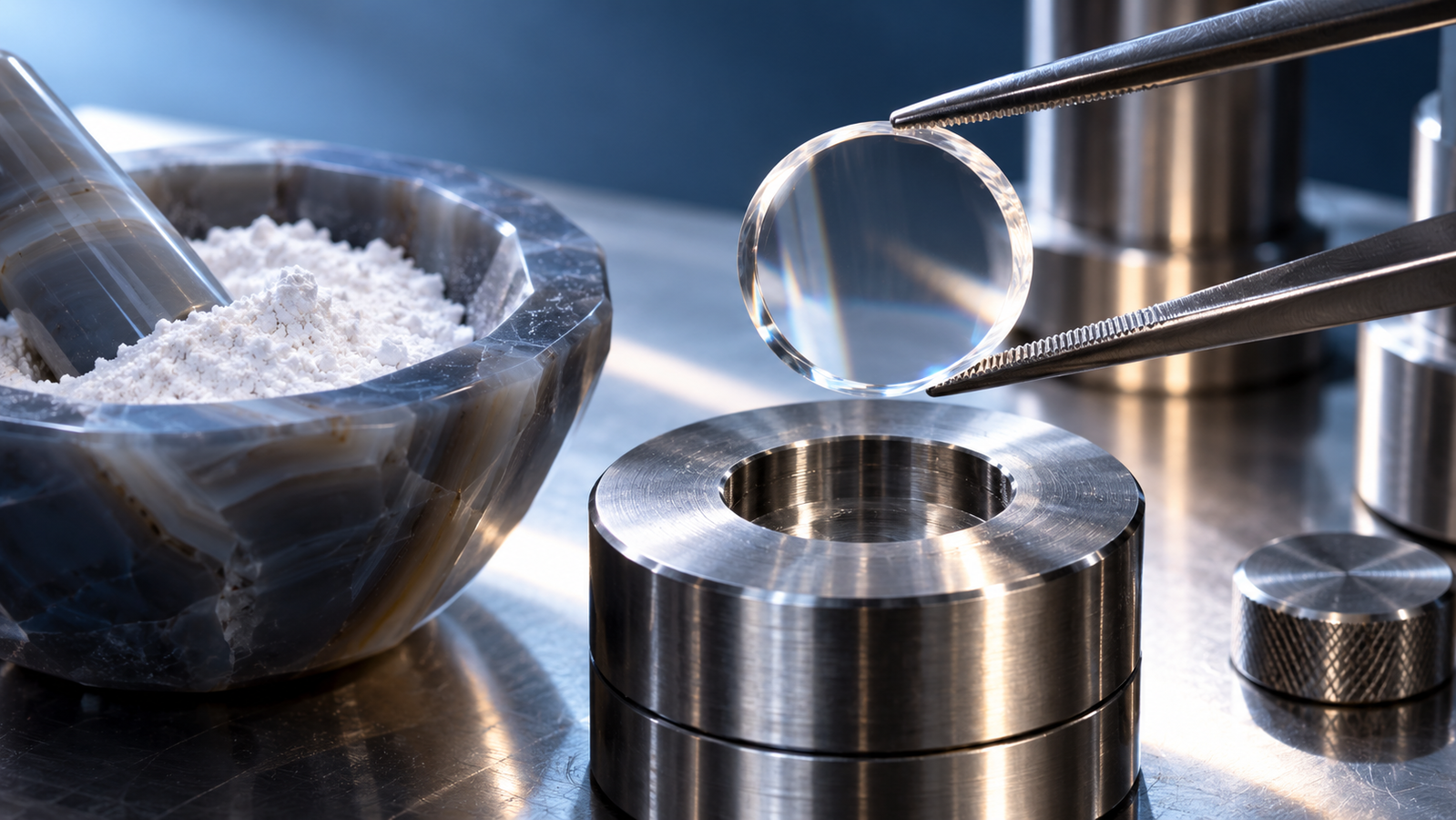
The pellet should be clear. Not white, not frosted, not clear in the middle with a cloudy rim: clear, like a small pane of glass, with the sample dispersed in it so finely that it cannot be seen. A pellet like that gives a flat baseline and sharp bands. A cloudy one scatters the beam, tilts the baseline and hides weak features under a broad water band. The difference between the two is rarely the press. It is how dry the potassium bromide was, how finely the sample was ground, how much of it went in, and whether the air was pumped out before the load went on. This guide goes through the method step by step, with the numbers, and then through the pellets that go wrong.
In one paragraph: dry the KBr; grind 0.2 to 2 mg of sample very finely and mix it with 200 to 250 mg of KBr; load a 13 mm die evenly; pump the air out; apply about 8 tonnes for a few minutes; release slowly. That is about 590 MPa on the pellet and gives a disc roughly half a millimeter thick. For a 7 mm die, scaling by area gives about 60 to 70 mg of KBr and about 2 tonnes as a starting estimate. Cloudiness usually points to moisture, coarse particles or trapped air; flat-topped bands to too much sample; cracks often to trapped air or to the way the load was released. A 12 to 15 tonne manual press is all the force the method needs.
1. Why the method works
An infrared beam can only pass through a solid if the particles in its path are smaller than the wavelength, or are embedded in something with a similar refractive index so that their surfaces do not scatter. Potassium bromide does both jobs at once. Ground with the sample, it separates the sample particles from one another. Pressed, it deforms plastically, closes around them and becomes a continuous transparent matrix.
Pressing solids into alkali-halide discs for infrared measurement was introduced in the early 1950s,1 and within a few years the potassium bromide disc had been characterized as a general sampling method.2,3 It remains the reference way to record a transmission spectrum of a solid: the spectrum is free of solvent and mulling-agent bands, it is directly comparable with library transmission spectra, and because the amount of sample in the beam is known, it supports quantitative work: calcite and quartz have been determined in geological samples from KBr pellets with a relative standard deviation below 5 %, in a study that also found uniform particle size to matter for accuracy.4
Attenuated total reflection has replaced it for quick identification, because ATR needs no preparation.5 The pellet keeps its place where a true transmission spectrum is wanted, where bands are weak and a longer path helps, where sample is scarce, and where a method specifies it.
2. How much sample, how much KBr
A widely used instrument-maker method gives the proportions: about 0.1 to 1.0 % of sample mixed into 200 to 250 mg of fine KBr powder for a 13 mm pellet.6 That is 0.2 to 2.5 mg of sample. Strong absorbers such as carbonates, silicates and many inorganic salts belong at the low end; weakly absorbing organics at the high end.
The amount of KBr sets the thickness. Fully pressed KBr has a density of 2.75 g/cm³, so 200 mg in a 13 mm die makes a disc about 0.55 mm thick, and 250 mg makes one about 0.7 mm thick. A much thinner disc is fragile to handle; a much thicker one is generally harder to make clear. For other die sizes, scale the mass by the area:
| Die | KBr for a 0.55 to 0.7 mm disc | Sample at 0.1 to 1 % | Force for about 590 MPa |
|---|---|---|---|
| 13 mm | 200 to 250 mg | 0.2 to 2.5 mg | 8 t |
| 7 mm | 58 to 72 mg | 0.06 to 0.7 mg | 2.3 t |
| 3 mm | 11 to 13 mg | 0.01 to 0.13 mg | 0.43 t |
KBr mass scaled from the 13 mm method by die area; force from pressure × area ÷ 9800. A 2 T mini press reaches about 510 MPa on a 7 mm die. Rows other than 13 mm are the published method scaled by area: estimates to start from, not validated recipes.
Small dies are the answer when sample is scarce: by area, a 7 mm pellet needs less than a third of the material of a 13 mm one, provided the beam fits through it. The calculator below works out the quantities, an estimated thickness and the nominal pressure for any combination. It does not predict clarity, which depends on dryness, grinding and evacuation.
3. The method, step by step
1. Dry the KBr
KBr takes up water from the air, and water absorbs strongly in the infrared: a broad band near 3400 cm−1 and another near 1640 cm−1, both in regions where samples have bands of their own. Use spectroscopic-grade KBr, dry it before use — the reference method dries it at about 110 °C for two to three hours6 — and keep it in a desiccator. Warm the die parts as well if the room is humid; a cold die condenses moisture onto the powder. An infrared drying lamp over the mortar and die helps on damp days.
2. Grind the sample
Grind the sample alone first, in an agate mortar, until it is a fine, smooth powder with no visible grains. Particles larger than the infrared wavelength, a few micrometers, scatter the beam; the spectrum then shows a baseline that slopes upward toward high wavenumber and bands with distorted, asymmetric shapes.5 This is the single most common cause of a poor spectrum from a pellet that looks acceptable.
3. Mix with KBr
Add the KBr and mix thoroughly, with light grinding. The aim is to disperse the sample, not to grind the KBr further: freshly ground KBr has a large surface and picks up water faster. Work quickly.
4. Load the die
Assemble the die with the lower anvil in place, polished face up. Tip in the mixture and level it by tapping and by turning the plunger gently on the powder. An uneven fill gives a pellet that is clear on one side and cloudy on the other. Place the upper anvil, polished face down, then the plunger.
5. Evacuate and press
Connect the die to a vacuum pump and pump for a minute or two before applying load, to remove air and surface moisture. Then apply the force: about 8 tonnes on a 13 mm die, held for several minutes with the vacuum still on.6 On a 12 T PressPro™ infrared press, 8 t is a gauge reading of 20 MPa.
6. Release and remove
Let the air back into the die, then open the release valve slowly: a sudden release can crack the disc. For KBr this is bench practice, not a measured result. The closest systematic work is on pharmaceutical tablets, where the way the tablet was unloaded changed whether it capped or laminated.7 With a demolding die, invert the body on the ejection ring and press the pellet out gently, then lift it with tweezers by the edge and mount it on the holder. With an in-ring die there is nothing to eject: the ring holding the pellet goes straight into the spectrometer.
7. Run a blank
Press a pellet of KBr alone, from the same bottle, under the same conditions, and use it as the background. It cancels residual water and any impurity in the KBr, and it shows at a glance whether the KBr itself is dry.
4. When the pellet is not clear
| What you see | Likely cause | What to change |
|---|---|---|
| Whole pellet cloudy or white | Damp KBr; too little pressure or time; no vacuum | Dry the KBr and die; evacuate; hold the load longer |
| Clear center, cloudy rim | Uneven fill; anvil faces not parallel | Level the powder; check the die is seated squarely |
| White specks in a clear pellet | Sample or KBr not ground finely enough | Grind the sample longer before adding KBr |
| Pellet cracks or splits | Trapped air; load released abruptly; pellet too thin | Evacuate; release gradually; use more KBr |
| Pellet turns cloudy within minutes | Taking up water from the air | Measure immediately; keep pellets in a desiccator |
| Bands flat-topped or below 10 % transmission | Too much sample | Halve the concentration and press again |
| Baseline slopes; bands distorted | Scattering from coarse particles | Grind finer |
| Broad bands near 3400 and 1640 cm−1 | Water in the KBr | Dry the KBr; run a fresh blank |
| Pellet sticks to the anvil | Dirty or scratched anvil face; damp powder | Clean and dry the faces; replace a scratched anvil |
One caution is chemical rather than mechanical. Under pressure, some samples react with KBr or exchange ions with it, and the spectrum then shows the product rather than the sample. Salts of organic bases are the usual suspects. If a pellet spectrum disagrees with an ATR spectrum of the same material, try a different halide matrix or a different sampling method. Cloudy or Cracked KBr Pellets takes each fault in turn, with its sources.
5. Choosing the press and die
The force is modest, so the choice is about die size, how the pellet is handled and how many are made.
| PressPro™ model | Force | Operation | Die supplied | Suited to |
|---|---|---|---|---|
| Mini infrared press, EPIM02TH | 2 T | Hand screw; pointer gauge | 7 mm, in-ring; 3 mm available | Occasional pellets, scarce sample; 4.8 kg |
| Infrared powder press, EPIM12BH | 12 T | Hand pump; 1 MPa on the gauge is 0.4 t | 13 mm | The standard KBr press for a teaching or research laboratory |
| EPIM15TH | 15 T | Hand pump; 1 MPa on the gauge is 0.5 t | 13 mm | KBr plus general pellets up to about 20 mm |
| EPIA20TH | 20 T | Motor pressurizing and compensation; hand release | 13 mm | Many pellets a day |
| EPIP10TH | 10 T | Programmed pressurize, hold and release | 13 mm | Identical cycles for quantitative series |
Each press is supplied with its die set, an agate mortar and pestle, a bottle of spectroscopic-grade KBr and a sample scoop; an infrared drying lamp is optional. The 13 mm die comes in two forms. The demolding type presses a free-standing disc that is pushed out and mounted on a magnetic holder. The in-ring type forms the disc inside a thin steel ring that is placed in the beam as it is, which avoids handling a fragile pellet and is the form supplied with the mini press. The die selection guide covers both, and the tonnage-to-MPa calculator converts gauge readings for any press.
Keep the pressure on a KBr die below 800 MPa: 10.8 t on 13 mm, 3.1 t on 7 mm. A 15 T or 20 T press can exceed that on a 13 mm die, so pump to the target and stop.
6. Looking after the die
KBr and steel do not get on. Moist KBr left on a die corrodes it within hours, and a pitted anvil prints its pits onto every later pellet. After each session wipe all parts clean, rinse off any salt, dry them thoroughly and store the set in a desiccator. Never touch the polished faces with anything harder than a lens tissue.
7. Related guides and equipment
- How to Choose a Laboratory Hydraulic Press — pellet, hot and isostatic routes and the full PressPro™ range.
- Pellet Press Die Selection — infrared dies and how to check a die against a press.
- Tonnage-to-MPa Calculator — force, gauge reading and pressure on the pellet.
- Powder Compaction Guide — why pellets crack on release.
- XRF Pressed Pellet Sample Preparation — the other analytical pellet.
- 7 mm vs 13 mm KBr Pellets — how much sample each size needs, and which press and die it takes.
- PressPro™ infrared powder press and mini infrared press.
- Cloudy or Cracked KBr Pellets — disc faults and spectrum faults, with the causes the sources link to each.
8. FAQ
What is the ratio of sample to KBr?
Between 0.1 and 1 % by mass: 0.2 to 2.5 mg of sample in 200 to 250 mg of KBr for a 13 mm pellet. Start near 0.5 % and reduce it if the strongest band bottoms out; it should stay above roughly 10 % transmission.
How much pressure is needed for a KBr pellet?
About 8 tonnes on a 13 mm die, which is roughly 590 MPa, held for a few minutes under vacuum. For a 7 mm die, about 2 tonnes as an estimate scaled by area.
Why is my KBr pellet cloudy?
Almost always moisture, coarse particles or trapped air. Dry the KBr, grind the sample finer, evacuate the die and hold the pressure longer.
How thick should a KBr pellet be?
About half a millimeter for a 13 mm pellet made from 200 mg of KBr. Thickness is set by the mass of KBr, not by the force.
Do I need a vacuum pump?
The standard method uses one, and it makes clear pellets much easier to obtain, especially in humid air. Dry KBr pressed promptly in a dry room often gives usable pellets without it.
Can I reuse a KBr pellet?
For a repeat measurement soon afterwards, yes, if it has been kept in a desiccator. Pellets take up water and turn cloudy on standing, so for anything quantitative press a fresh one.
7 mm or 13 mm?
13 mm is the standard and fits every spectrometer holder. 7 mm uses less than a third of the material and a much smaller press, and suits scarce samples, provided the instrument beam passes through the smaller aperture.
Why KBr and not another salt?
KBr is transparent across the whole mid-infrared, soft enough to fuse at moderate pressure, and inexpensive in spectroscopic grade. Other halides are used when a sample reacts with KBr or when a different spectral range is needed.