
A pellet that comes out of the die with its top lifted off, or in layers, may not have failed while the load was rising. In the studies cited here, the damage was traced to the moment the load came off and to the push-out that followed. This guide sorts the failures by where and when they appear, sets out what the published evidence says about each cause, and lists what to test, one change at a time.
In one paragraph: in the studies cited here, capping and lamination were traced to unloading and ejection. Energy stored in the compact shows up as elastic recovery and as residual die-wall pressure. In a tablet study on celecoxib, trapped air raised the elastic recovery. More pressure is not a cure. In another tablet study, the share of capped tablets rose from none to all within less than 50 MPa once an onset pressure was passed. What helped in those studies was removing air first, releasing the load more gently, and easing ejection. Almost all of this evidence comes from pharmaceutical tablets. On other powders, treat each finding as a mechanism to test.
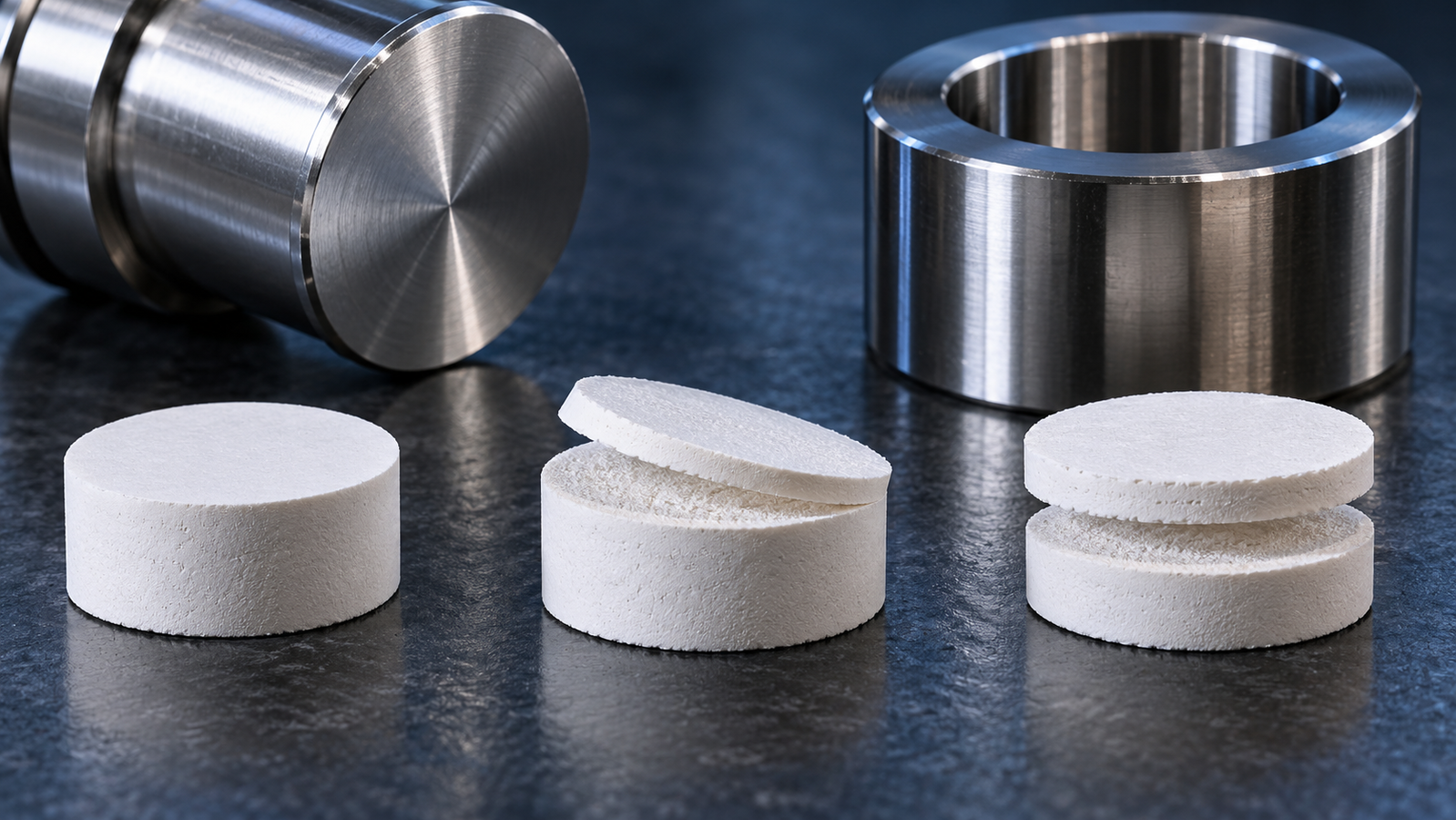
Most of what is known about these defects was learned on tablet presses, where a capped tablet costs a production batch. Laboratory pellets are usually flat-faced, pressed far more slowly and held for seconds or minutes rather than milliseconds, so not every finding transfers. What can be tested on a laboratory pellet are the mechanisms: the elastic energy a compact stores, the die that holds it in, and the release and ejection steps that the tablet studies found to matter.
1. When and where the pellet breaks
The first clue is the moment the damage appears. X-ray tomography of compacts made in straight and tapered dies found internal microcracks at high density as well as surface cracks. With finite-element analysis of the stress as the compact leaves the die, the authors proposed a two-step mechanism for capping and lamination: microcracks form during unloading inside the die, then grow into surface cracks as the compact emerges.1 Die-wall measurements on a compaction simulator showed tablets capping within a few milliseconds of unloading.2 A finite-element model of metal-powder die compaction was extended to capture crack formation during pressing, unloading and ejection.3
| Moment | What happens to the compact | What you see |
|---|---|---|
| Loading | Particles rearrange, deform and bond. Air has to leave through shrinking pores. | Rarely a visible defect at this point. The cause of later damage can start here. |
| Unloading in the die | The compact expands axially while the die wall still holds its sides. | A cap or layers already present before ejection starts (seen at once in a split die); sometimes only internal cracks. |
| Ejection | The compact is pushed along the bore against wall friction and expands as it emerges. | Cracks, chipped edges or a cap that appear only once the pellet is out. |
| Afterward | Handling, storage, firing. | Cracks found only on handling; warping or cracking in the furnace. |
2. Where the stored energy comes from
Elastic recovery and residual die-wall pressure
The radial pressure on the die wall rises and falls with the punch load in a characteristic cycle. A theory of that cycle, governed by the elastic properties and the yield shear stress of the material, predicted a residual radial pressure after the punch is removed. Its author linked this pressure to capping and laminar cracks.4 Later work measured it in pharmaceutical powders. For five excipients pressed on a tablet-press replicator, higher compaction pressure raised both the maximum and the residual die-wall pressure in every material.5
Two studies have linked this stress to capping. One proposed an index: the residual die-wall pressure divided by the binding strength of the compacted powder. Tablets capped when the index exceeded 1.6 The other ran acetaminophen formulations on a compaction simulator. Capping went together with high in-die elastic recovery, a high Poisson’s ratio, low tensile strength and the radial die-wall pressure.7
The two measures do not always move together. In the first study, the more elastic powders gave the lower residual die-wall pressure.6 A later study changed only how the punches lost contact with the tablet. That reduced capping, but residual die-wall pressure showed no clear trend.2 The accurate statement is that both elastic recovery and residual die-wall pressure are associated with capping. Neither one alone explains every case.
Trapped air
Air that cannot escape as the powder closes up stays inside the compact. In tablets, entrapped air can cause defects when the load comes off and the tablet is ejected.8 For the drug celecoxib, in-die elastic recovery without a precompression step jumped from about 4 % at 150 MPa to about 14 % at 200 MPa and above. A precompression step removed the jump and gave stronger, less porous tablets.8 Tablets of another compound capped on a high-speed press because air could not leave the granules fast enough. A slow degassing stage before precompression prevented it.9 Powder permeability may give an early warning. In one study, blends rich in acetaminophen let air through poorly, and their tabletability profiles suggested a tendency to cap or laminate; capping itself was not counted.10
Uneven density
Friction at the die wall means that the powder far from the moving punch sees less pressure than the powder next to it. In spray-dried alumina pressed in a steel die, more of the applied stress reached the far end when the die was lubricated and when the compact was thinner relative to its diameter.11 Finite-element models of die compaction that include wall friction have been checked against measured density distributions in pressed zirconia.12 In the biconvex-tablet study below, tablets with a thinner cylindrical band capped at a lower pressure.13 How the height of a flat-faced pellet affects capping was not evaluated in the studies read for this guide. The powder compaction guide has a model of the pressure drop along the pellet.
3. More pressure is not the fix
When a pellet falls apart, the first instinct is to press harder. For capping, the evidence points the other way.
- A model formulation was pressed into biconvex tablets on a compaction simulator at rising pressure. In a first test on one tablet shape, the share of tablets that capped rose along an S-shaped curve, from none to all, within less than 50 MPa. Across 16 biconvex tablet shapes, the pressure at which half the tablets capped ranged from 58 to 220 MPa. Large diameter and a thin cylindrical band brought the onset down.13
- The celecoxib study above found the jump in elastic recovery between 150 and 200 MPa.8
- A rotary-press study of an acetaminophen–starch blend concluded that a force beyond what strong bonding needs, applied quickly, led to capping. It recommended a main compression force just high enough for bonding.14
For a laboratory pellet, this suggests a pressure series. Press the same powder at a few pressures below the pressure that failed; in the biconvex-tablet study above, the change from no capped tablets to all of them spanned less than 50 MPa. Find where the defect starts. Then choose the lowest pressure that gives the density or strength the work needs. The step and the range depend on the powder; the defect map below converts each pressure to force for your die.
4. Getting the air out
The remedies tested in tablet studies act before the main load: a low first step, a release between the steps, or a slow first stage.
- A low first step. Precompression before main compression removed the elastic-recovery jump in celecoxib.8 A follow-up chose the precompression pressure that gave the lowest in-die elastic recovery. With it, a lamination-prone blend came out intact across a wide range of high main pressures, where tablets made without precompression laminated right after ejection.15
- Release between the steps. In one case study, tablets that capped without precompression still capped when the precompression load was held until the main compression. When the first load was released before the main compression, capping stopped completely. The authors explained it differently: they concluded that precompression works by separating the two compressions, and that the longer total time under load is not a sufficient explanation.16
- Slow first, then the target. A low precompression force with a long dwell, followed by a main force just high enough for bonding, was the most effective setting in the rotary-press study.14
These studies used tablet presses that cycle in fractions of a second. On a laboratory press the same idea takes the form of a short low-pressure step, a release, and then the main pressure. Whether it helps a particular powder has to be tested. The pellet-press cycle guide shows how to write such a cycle down. Cylindrical PressPro™ dies up to 25 mm have a vacuum port, so the die can also be evacuated before the load is applied. No study read for this guide tested evacuation against capping or lamination.
5. Unloading and ejection
The release. A compaction study that varied loading and unloading speeds independently concluded that changing those rates could improve strength and minimize capping.17 A two-step unloading phase was later built on a compaction simulator. Slowing the rate at which the punches lost contact with the tablet reduced capping.2 With one formulation prone to capping and another prone to lamination, holding the lower punch fixed during unloading suppressed lamination. Keeping a small load on both faces until the end of ejection eliminated both defects.18 On a laboratory press the release is the valve or the timed release of an automatic press. Opening it the same way every time turns the release into a controlled variable.
The ejection. In a one-piece die the pellet is pushed out of the bore, and wall friction acts on it during ejection.19 A tapered die gave compacts with smaller crack-tip openings and higher axial strength than a straight one.1 Lamination has been sorted into three types: one caused by trapped air, one by shear as the tablet leaves the die, and one specific to convex tablets. Slowing the press or adding precompression mitigated the first. Only a tapered die stopped the second. None of the measures tested fully solved the third.20 On production presses, spraying lubricant onto the punches and die instead of mixing it into the powder has been set up using the ejection force as the control signal.21 In the laboratory, a split die avoids the sliding step: its segments come apart around the pellet.
6. The hold: helpful, neutral or harmful
It is tempting to treat a longer hold as a safe remedy. The tablet studies do not support that as a rule.
- In 1:1 paracetamol–microcrystalline cellulose tablets at 80 and 160 MPa, a dwell of 0.26 s generally lowered tensile strength by 14 to 22 % compared with no dwell. Raising the dwell to 0.9 s raised it above the no-dwell level.22
- Holding the precompression load did not stop capping in the case study above, and releasing it did.16
- In unlubricated excipients at matched porosity, shortening the dwell from 150 to 15 ms caused no loss of strength.23
- Powders differ: raising the contact time from 0.17 to 10 s increased consolidation for time-dependent excipients but not for dicalcium phosphate.24
Most of these times are a second or shorter; the longest, in one study, was 10 s. All the materials are pharmaceutical. None of these studies measured how a hold of seconds to minutes on a laboratory press changes capping or lamination. A hold is therefore a variable to test, one value at a time, rather than a cure.
7. Defect map
Pick the defect you see and enter the die, the pellet thickness and the pressure at which it failed. The tool gives the force and the aspect ratio, lists the mechanisms the literature links to that defect, lists what to test first, and builds a pressure series below the failing pressure.
8. Symptom by symptom
| What you see | Mechanisms linked to it in the literature | What to test first, one change at a time |
|---|---|---|
| Top face lifts off as a cap | Residual die-wall pressure and elastic recovery;6,7 trapped air;8,9 pressure above the capping onset13 | A pressure series downward; a low first step with a release before the main load; a gentler, repeatable release |
| Pellet splits into layers | Trapped air; shear as the compact leaves the die; unloading conditions20,18 | A low first step; the release; the ejection (a split die avoids it; not tested in the studies cited) |
| Cracks or chips appear only after ejection | Crack growth as the compact emerges from a straight bore;1 wall friction during ejection19 | Clean the bore and check for score marks; push slowly and support the pellet; a split die |
| One end hard, the other crumbles | Stress lost to wall friction along the compact11 | A thinner pellet; a clean, smooth bore; a double-action die (not evaluated in the studies cited) |
| Intact out of the die, breaks on handling | Internal microcracks formed during unloading, a possible cause not tested against handling breakage;1 low green strength, which depends on the binder in ceramic powders25,26 | Look inside before changing anything (see the next sections); the pressure series; the binder |
| Warps or cracks in the furnace | Shrinkage that differed with position in a pressed block, and densification that depends on green density;27,28 firing conditions. These studies did not measure warping or cracking. | A thinner pellet or isostatic pressing; check the firing schedule separately |
The table is a map to the evidence, not a set of prescriptions. A change that removes a defect in one powder can do nothing in another, and the remedy depends on the mechanism. Note at which moment the defect first appears, change one condition at a time, and keep the result.
9. Ceramic powders and binders
Ceramic powders are often pressed as spray-dried granules with a polymer binder, and the binder changes how the compact holds together. In alumina granules bound with poly(ethylene glycol) or poly(vinyl alcohol), green strength depended on the binder-rich outer layer of the granules. Fracture moved from passing through the granules to running between them as the binder’s glass-transition temperature rose.26 In alumina–kaolin green bodies, the binder played a critical role in elastic modulus, tensile strength, strength variability and fracture morphology.25 In ceramic granules bound with poly(vinyl alcohol) plasticized with poly(ethylene glycol), densification was easier when the binder’s glass-transition temperature was below the pressing temperature, because the binder deformed more easily. Lowering the glass-transition temperature with more plasticizer also lowered the green strength.29 Storage humidity also changed the compacts. X-ray tomography of compacts from poly(vinyl alcohol)-bound granules stored at high humidity showed higher mean density but a less uniform density distribution.30
The studies read for this guide connect binder and humidity to strength, uniformity and fracture mode. None of them measured capping or lamination directly. Binder and humidity are therefore listed as factors to check, not as established causes of a cap.
10. Finding hidden cracks and measuring strength
- Look inside. X-ray computed tomography shows internal microcracks1 and density variations30,31 without cutting the pellet. A pellet that looks intact can hold internal microcracks.
- Diametral compression. Loading a disc across its diameter is used to measure the strength of tablets32 and of green ceramic bodies,25 and, as the Brazilian test, of rock. A modeling study of the test found the maximum tensile stress near the loading points rather than at the center of the disc. Note where your pellets break before comparing strengths.33
- A ranking test. Indentation to increasing depths until the surface cracks ranked the lamination susceptibility of pharmaceutical mixtures.34
11. Cracks after firing
A pellet that leaves the press sound and cracks or warps in the furnace may be showing its green-density pattern. In uniaxially pressed zirconia blocks, linear sintering shrinkage differed with position in the block: lowest at the top and highest at the bottom.27 Green density also affects how a compact densifies.28 Heating rate, binder burnout and the setter are other possible causes; this guide does not evaluate them. When a defect appears only after firing, test a thinner pellet or isostatic pressing, and check the firing schedule separately. The comparison of uniaxial and isostatic pressing covers the second option.
12. What the press and die can change
- The release. On a manual press the operator opens the release valve. The automatic powder presses release on their own at the end of a timed hold. They also run force programs of 5 segments, upgradeable to 30, which can hold a low first step before the main one. Whether a program can lower the force between segments is not covered here; a release between two steps can be run as two separate cycles.
- The hold. Electric and automatic presses compensate the force during the hold. On a manual frame the operator tops it up.
- The ejection. The automatic powder presses have a settable demolding force in tonnes. Split dies avoid push-out altogether.
- The air. Cylindrical dies up to 25 mm have a vacuum port.
- The die. In a double-action die both punches move relative to the bore, so the powder is pressed from both faces. How much this changes the density along a given pellet was not evaluated in the studies read for this guide. The die selection guide lists all die types.
- The force. Pressure on the pellet is force divided by die area. A pressure series is easier to set and repeat when the force can be read in small steps. The digital-gauge versions of the manual powder presses read to 0.01 t. The screen of the automatic presses reads force to 0.1 t, which is about 12.5 MPa on a 10 mm bore. The tonnage-to-MPa calculator covers every frame.
13. What to write down
- Powder. Material, batch, particle size or granule size, binder and its content, moisture or storage humidity.
- Die. Type, bore, condition of the bore.
- Cycle. Pressure in megapascals, loading time, any first step and whether it was released, hold time, how the load was released, how the pellet was ejected.
- Result. Defect type and the moment it was first seen, pellet thickness and mass, and strength or density where measured.
14. Related guides and equipment
- Powder Compaction Guide — what happens to powder in a die, and the pressing cycle.
- How to Specify a Pellet-Press Cycle — writing load, hold and release as numbers.
- Manual vs Electric vs Automatic Laboratory Presses — which part of the cycle each press controls.
- Pellet Press Die Selection — split, double-action and other dies.
- Uniaxial vs Isostatic Pressing — density gradients and how isostatic pressing changes them.
- Cloudy or Cracked KBr Pellets — the same questions for FTIR discs.
- XRF Pellet Defects and Repeatability — defects in pressed XRF pellets.
- How to Choose a Laboratory Hydraulic Press — the whole PressPro™ range by purpose.
- Equipment: two-column, four-column and protective manual presses; electric and automatic powder presses.
15. FAQ
What is the difference between capping and lamination?
Capping is the separation of the top or bottom face as a cap. Lamination is splitting into one or more layers parallel to the faces. In the studies cited here, both were traced to the moment the load comes off or the pellet leaves the die.
Why does my pellet crack only after I push it out?
Cracks started during unloading can grow as the compact emerges from a straight bore, and wall friction acts on it all the way out. Clean and inspect the bore, push slowly and support the pellet. A split die avoids the push-out; it was not tested in the studies cited.
Will pressing harder stop capping?
Not in the studies cited here. In one tablet study the share of capped tablets rose steeply once an onset pressure was passed. In another, a force beyond what bonding needed, applied quickly, led to capping. Press a short series below the failing pressure and use the lowest pressure that gives the density or strength you need.
Does a longer hold time prevent cracking?
Not as a rule. In tablet studies, short dwells sometimes reduced strength and sometimes raised it, and holding a first load did not stop capping where releasing it did. Test hold times one value at a time on your own powder.
How do I get air out of a fine powder before pressing?
One approach has evidence from tablet studies: a low first load before the main load, which removed the jump in elastic recovery from trapped air in a celecoxib study. The other is mechanical: PressPro™ cylindrical dies up to 25 mm have a vacuum port, so the die can be evacuated before the load is applied. No study read for this guide tested evacuation against capping. Test either on your own powder.
Can I see cracks inside a pellet without breaking it?
Yes. X-ray computed tomography shows internal microcracks and density variations. Diametral compression measures strength, but it destroys the pellet.