
Manual, electric and automatic laboratory presses all reach the same force. They differ in who holds that force and who lets it go: on a manual press the operator does both, an electric press holds the load by itself and leaves the release to the operator, and an automatic press holds for a set time and releases from a program. The difference shows at the bench. Two people press the same powder in the same die on the same manual press, and both write “10 t, 2 min” in the notebook. One pumps to 10 t, sets a timer and watches the needle sink to 9; the other keeps a hand on the lever and nudges the needle back every twenty seconds. One opens the release valve a crack and lets the load bleed away; the other spins it open. The entries are identical and the two pellets have not had the same treatment. This comparison goes through the cycle action by action and shows which of those decisions each kind of press takes over.
In one paragraph: the force is the easy part and every mode delivers it. The modes differ in the hold and the release. Powder under load can keep deforming, so a load that is not topped up can decay; how long and how steadily it is held, and how it is let go, can change the compact. A manual press leaves both to the operator, an electric press takes over the hold, and an automatic press takes over the hold and the release and repeats them from a program. Choose manual for occasional work, small budgets and glove boxes; electric when the load is the same all day and only the pumping is the problem; automatic when samples must be comparable with each other, when the cycle has more than one step, or when the hold time is itself a variable. Check the low end as well: powered presses have a lowest settable force, and on a small die that can already be a high pressure.
1. A pressing cycle has four actions
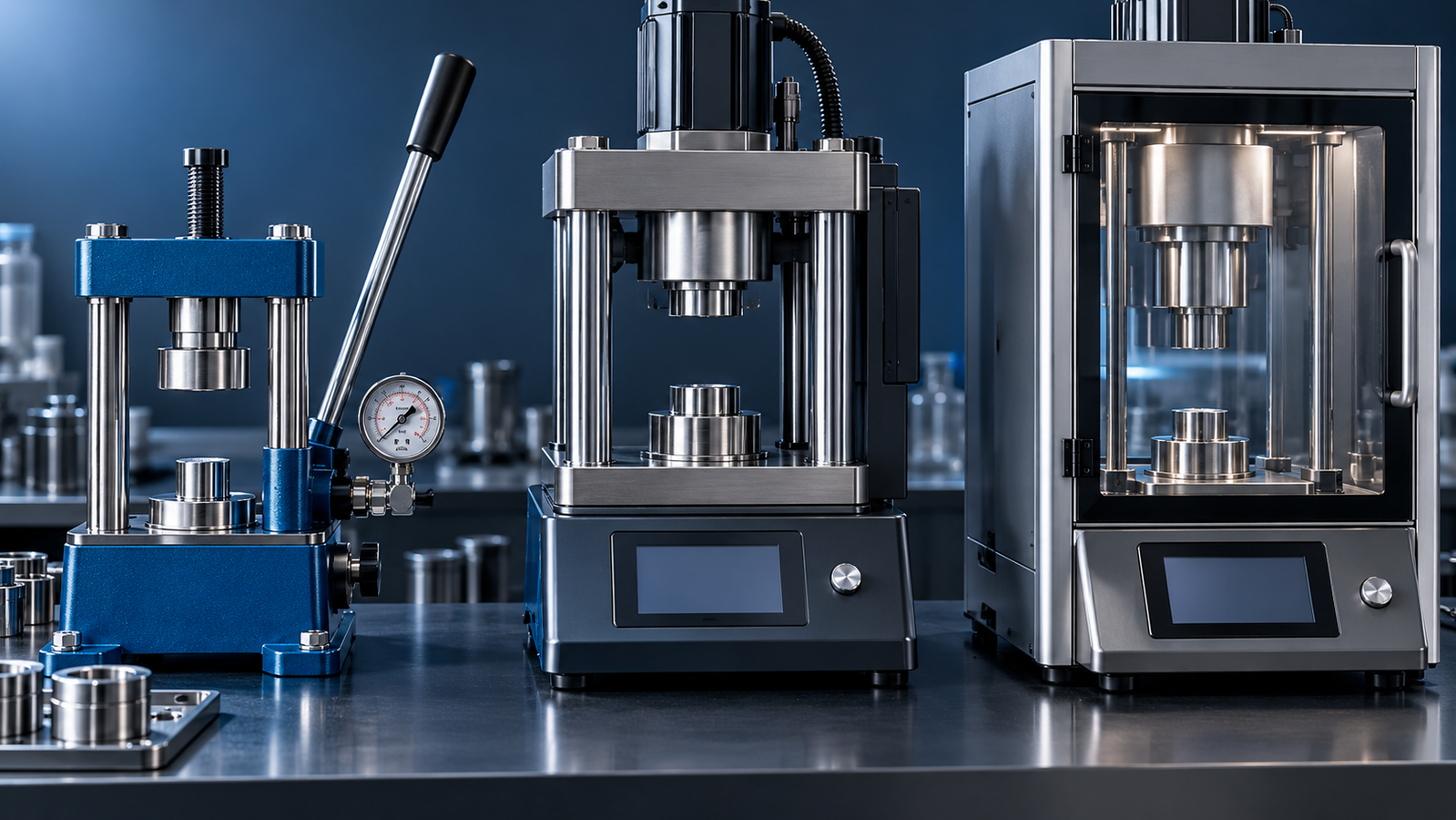
Every pressing cycle, whatever the machine, is the same four actions: the force is raised, it is held, it is released, and the part is taken out. The table shows who does the first three on PressPro™ presses, with the related differences that follow from the drive. The fourth, taking the part out, depends on the die more than on the drive; where the presses differ, the automatic powder presses accept a set demolding force and the dedicated automatic XRF press ejects the pellet with one key.
| Manual | Electric | Automatic | |
|---|---|---|---|
| Raising the force | Hand pump; a slow final approach by feel | Motor | Motor, to the set-point of each program step |
| Holding it | Operator tops up by hand | Automatic pressure compensation | Automatic compensation for the set time |
| Timing the hold | Operator, with a clock | Operator, with a clock | Set on the screen; no limit on the length |
| Releasing | Release valve, by hand | Release valve, by hand | By the machine when the hold ends |
| More than one force step | By hand, one after another | By hand, one after another | 5 program segments on most models, upgradeable to 30 |
| Lowest force | From zero; limited by what the gauge can show | 0.2 to 1 t, by model | 0.1 to 1 t, by model |
| Readout | Pointer gauge, or digital gauge; on the powder frames these read to 1 MPa and 0.01 t | 4.3-inch touch screen, reading to 0.1 t | 7-inch touch screen, reading to 0.1 t on the models that state it, with the pressure on the sample in MPa |
| Power | Manual force; manual hot presses need 220 V for the heater and controller | 220 V | 220 V |
Functions as listed for PressPro™ presses; the tool below gives the program details model by model. On the manual presses force generation is manual. Power requirements of an optional or fitted digital gauge are outside this comparison.
Two rows deserve a closer look, because they are where the result can change: the hold and the release.
2. The hold: a load left alone does not stay put
When the pump stops, the powder does not. Particles keep rearranging and deforming under the load, and the compact gives way a little. In a press that simply stops moving, that shows up as a falling force. Relaxation tests on pharmaceutical powders make the point directly: with the powder held at constant strain in the die, the axial pressure decreases with time, whether the material behaves viscoelastically or viscoplastically,1 and in one study every powder tested relaxed stress when a dwell was introduced, even after slow compression, which the authors confirmed in tests lasting ten hours.2 The press adds its own share. The specification for the manual PressPro™ powder frames and the electric powder press gives a pressure stability of within 1 MPa on the gauge in 10 minutes, and one tableting study concluded that the axial stress relaxation it measured was affected by deformation of the machine itself.3
The time under load changes the compact for some materials and not for others. When the time under compression was lengthened from 0.17 s to 10 s, four of five excipients consolidated further: least for sodium chloride, then lactose, then cellulose, and most for starch. The fifth, dicalcium phosphate dihydrate, did not respond at all.4 The same pattern appears when speed is the variable. Maize starch and polymeric materials, which deform plastically, showed a higher yield pressure as the punch moved faster, while magnesium and calcium carbonates, which consolidate by fragmentation, did not;5 and a recent study found dicalcium phosphate dihydrate insensitive to speed, with the sensitivity rising from lactose to microcrystalline cellulose to cornstarch.3 The effect is not universal and should not be overstated. In a study that kept the porosity inside the die the same, cutting the dwell from 150 to 15 ms cost unlubricated powders no strength at all.6 All of these results are for pharmaceutical powders and, in the last case, for millisecond times. Comparable published measurements for ceramic or battery powders were not found for this guide, so where your material sits on that scale has to be found by experiment.
For a laboratory the practical conclusion is modest and firm. Whether a longer hold helps your powder has to be found by experiment. What is not in doubt is that the hold must be the same for samples you intend to compare. And “the same” means the load as well as the minutes.
- Manual. The load decays between top-ups, so the pellet sees a sawtooth. Two operators with different habits produce different sawteeth.
- Electric. The motor compensates, so the load stays at the set-point for as long as the operator leaves it. The length of the hold is still a person and a clock.
- Automatic. Compensation and timing are both in the program. The hold has no upper limit on PressPro™ automatic presses and can be different for each segment.
3. The release: the step nobody writes down
A compact stores elastic strain while it is loaded and gives it back when the load comes off. Bench experience is that a pellet can split if the load comes off unevenly or abruptly; for most laboratory powders that is practice, not a measured result. In pharmaceutical tablets, where the defect has been studied most closely, the way the load was removed decided whether tablets failed: changing the unloading conditions suppressed lamination in one formulation, and ejecting the tablet while it was still under load removed both capping and lamination in the two formulations tested.7 Lamination has since been sorted into types with different causes, and slowing the press or adding a precompression step helped with only one of them.8 So there is no universal “release slowly” rule. There is a variable that matters for some powders, and on a hand-operated valve it is set by the wrist.
On manual and electric presses the release valve is opened by hand. On automatic presses the machine releases when the timed hold ends, the same way each cycle. A program of several segments also lets the force be held at more than one level, each with its own hold time.
4. Does the operator matter?
For pellets that are compared with one another, probably yes, though the evidence is indirect: no published trial appears to set a manual press against an automatic one on the same samples, so the argument has to be made from its parts. Two findings from infrared sample preparation suggest that the way a pellet is prepared and pressed reaches the measurement. In a study of the reproducibility of KBr pellets for inorganic sulfates, peak positions varied from day to day with standard deviations of up to 1.5 cm−1. A deviation of about 1 cm−1 was traced to changes in band shape, which the authors thought were probably caused by differences in preparation between operators. They still judged the technique reproducible enough for computerized spectral matching.9 And pressing kaolinite into pellets changed the relative intensities of its hydroxyl bands by an amount that depended on the pressure, the pressing time and whether a salt matrix was used.10 Pressure and time are exactly the two settings that a manual press leaves to the person at the lever.
A program does not make a pellet better. It removes two sources of difference between one pellet and the next. Whether that is worth paying for depends on what the pellets are for: an identification spectrum tolerates a lot; a calibration series, a density study or a comparison between formulations tolerates less.
5. Operating-mode check
Choose the kind of press, enter the force you need and tick the functions the work requires. The tool goes through the PressPro™ range and shows, for manual, electric and automatic in turn, which models reach the force and which of the selected functions each one lists. Only listed functions count toward a match.
6. The low end: where automatic is not automatically better
Powered presses are specified with a force range, and the bottom of the range is not zero. On the PressPro™ automatic powder press it is 0.1 t on the 10 T model, 0.2 t on the 20 T, 0.3 t on the 30 T, 0.4 t on the 40 T, 0.5 t on the 60 T and 1 t on the 100 T. On a large die that is nothing. On a small one it is a great deal: 0.2 t on a 5 mm die is already 100 MPa, so a 20 T automatic press cannot be set to press a 5 mm pellet more gently than that.
A manual press has the opposite limitation. It starts from zero, but a pointer gauge marked in steps of 1 MPa cannot show a small load well: one division on a 15 T frame is 0.5 t, which is 37 MPa on a 13 mm die. The digital gauge option reads to 0.01 t.
The rule in both cases is to size the press to the die. Small dies want small frames, whatever the drive. The tonnage-to-MPa calculator converts between force, gauge reading and pressure on the sample for any die.
7. Line by line: what is offered in each mode
| Line | Manual | Electric | Automatic |
|---|---|---|---|
| Powder and pellet dies | Two-column 2 to 15 T; four-column 15 to 40 T; protective 15 to 60 T | EPPIE 20, 30, 40, 60 T | EPPA 10 to 100 T; EPPPE 65 to 200 T |
| FTIR, KBr pellets | Mini press 2 T, hand screw; EPIM 12 and 15 T | EPIA20TH 20 T | EPIP10TH 10 T |
| XRF pellets | EPFM 30 and 40 T | — | EPFA 30 and 40 T; EPFAX 30, 40, 60 T |
| Cold isostatic | EPSM 20 to 60 T | EPSBE 20 to 60 T | EPSPA 20 to 100 T; EPSA 65 to 200 T |
| Warm isostatic | — | — | EPSXA 20 to 60 T |
| Heated die | EPHBM 15 and 24 T | — | — |
| Heated platens | EPHBMC / EPHBMD 15 to 30 T; EPHPME 10 to 30 T | — | EPHPAZ 25 to 40 T; vacuum EPHXAZ 25 to 40 T |
| Unheated platens | — | — | EPCPAZ 25 to 40 T |
Four things in this table are easy to miss.
- An electric press is not an automatic press. The EPPIE series carries the word automatic in its product name; its cycle is the electric one described here: motor pressurizing and compensation, with the hold timed and the valve opened by the operator. The fully programmed powder press is the EPPA series.
- The infrared and XRF lines offer the modes as single models. For KBr work that is one 20 T electric and one 10 T automatic model beside the manual ones. For XRF there is no electric model: the choice is manual or automatic, and the XRF press comparison takes it up in detail.
- On hot presses the temperature is programmed in every mode. Manual and automatic hot presses share a 30-segment temperature controller. The mode refers to the force. See heated dies and heated platens.
- On isostatic presses the mode also decides the handling. On the manual and electric models the chamber is lifted on and off the table for every sample; the automatic press has a swing-arm top plate, and the large-tonnage series slides the chamber out. The isostatic press selection guide covers this.
8. Guards and interlocks
The safety provisions rise with the drive, and they are part of the comparison.
- Manual. The protective series has a safety-glass door; on the infrared and XRF manual presses a safety-glass guard is an option. The two-column and four-column frames are open, without a guard. The specification asks the operator to watch the rise of the piston and never run it past its stroke: nothing stops it automatically.
- Electric. On the electric powder and isostatic presses a limit switch releases the pressure if the piston over-travels. The 30, 40 and 60 T electric powder presses have a safety-glass door, leakage protection and an emergency stop; the 20 T model has the leakage protection and the emergency stop. On the electric infrared press, watch the piston travel as on a manual press and keep it within its stroke.
- Automatic. The automatic powder, XRF and isostatic presses list the limit switch, an automatic release if the system pressure exceeds its safe value, a safety-glass door, leakage protection and an emergency stop. The automatic platen presses (hot, vacuum and cold) list the overpressure release and an emergency stop; a light-curtain guard is an option on the automatic hot press, and no guard door is listed for them.
9. Which one to buy
Manual is right when
- the press is used a few times a week, for teaching, for sample checks, or by many people for many small jobs;
- it has to go where there is little room, or where there is no supply for a motor-driven press. The two-column frames weigh from 12 kg and the mini infrared press 4.8 kg, and both are described as suited to glove-box use; check the antechamber of your box against the dimensions on the product page;
- the forces are low and the dies small, where a small frame with a digital gauge reads better than a large powered press can be set.
Electric is right when
- the same die is pressed to the same force many times a day and the pumping is the bottleneck;
- the hold should not sag, but its length does not need to be recorded to the second;
- the budget does not reach a programmed press. Note the weight: the 20 T electric powder press is 75 kg against 42 kg for the 15 and 24 T four-column manual frames.
Automatic is right when
- pellets are compared with each other: calibration standards, density series, formulation screening;
- the hold time or the force is the variable under study;
- the cycle has more than one step, or the demolding force needs to be set, which the automatic powder presses allow;
- cycle data should stay on the machine;
- several people use the press and the method should not depend on who is pressing.
10. What automation does not fix
A program repeats what it is given. It does not dry a damp powder, mend a scored die or even out a badly filled one. Friction between powder and die wall carries part of the load in every mode, so a tall pellet has a density gradient on an automatic press exactly as on a manual one; the powder compaction guide explains why and the uniaxial and isostatic comparison shows where a die stops being the right tool. And no drive turns the wrong pressure into the right one: the die diameter, not the press, converts tonnes into megapascals.
11. Related guides and equipment
- How to Choose a Laboratory Hydraulic Press — the full selection path: purpose, sample, conditions, operation.
- Powder Compaction Guide — what happens in the die during load, hold and release.
- Manual vs Automatic XRF Pellet Presses — the same question for routine XRF pellets.
- 7 mm vs 13 mm KBr Pellets — the mini hand press against the standard infrared press.
- Heated Dies vs Heated Platens — manual and automatic hot presses.
- Tonnage-to-MPa Calculator — force, gauge reading and pressure for any die.
- How to Specify a Pellet-Press Cycle — the numbers that define a pressing cycle, and a method line another laboratory can follow.
- Pellet Cracking, Capping and Lamination — where and when pellets cap, laminate or crack, and what the evidence links to each.
- Equipment: manual two-column, four-column and protective presses; electric press; automatic press; large-tonnage automatic press; the whole PressPro™ series.
12. FAQ
What is the difference between an electric and an automatic laboratory press?
On an electric press a motor raises the force and keeps it topped up, and the operator times the hold and opens the release valve. On an automatic press the hold time and the release are part of a program, and most models can run several force steps in sequence.
Is an automatic press more accurate than a manual one?
It is more repeatable, which is a different thing. Any mode reaches the set force. The automatic press also holds it for the same time and releases it the same way on every sample. Accuracy of the force itself depends on the gauge or sensor; on the manual powder presses the digital gauge option reads to 0.01 t.
Why does the pressure drop while I hold it on a manual press?
Partly because the powder keeps rearranging and relaxing under load, so the same piston position needs less force, and partly because of the press itself: the manual powder frames, for example, are specified to hold within 1 MPa on the gauge over 10 minutes. Topping up with the pump restores it. An electric or automatic press does this by itself.
Does a longer hold time make a stronger pellet?
It can make a denser one. In studies of pharmaceutical powders, materials that keep deforming under load consolidated further when the time under compression was longer, and a brittle one did not change. Those studies measured consolidation, not strength; the one study cited here that measured strength, at millisecond dwell times, found no loss at the shorter dwell for unlubricated powders. Find out for your powder with a short series, and then keep the hold the same.
Can I use an automatic press for very small dies?
Check the lowest settable force. On a 20 T automatic press it is 0.2 t, which is about 100 MPa on a 5 mm die. For small dies choose the smallest frame that reaches the pressure you need.
What is pressure compensation on a laboratory press?
The press restores the load by itself as the powder relaxes, so the force stays at the set-point for the whole hold. Electric and automatic PressPro™ presses do this; on a manual press the operator tops up with the pump. On the manual presses force generation is manual. Power requirements of an optional or fitted digital gauge are outside this comparison; the manual hot presses need 220 V for the heater and controller.
Is the EPPIE press automatic?
Its drive is motorized and it compensates the pressure by itself, but the hold is timed and the valve opened by the operator. In the terms of this guide it is an electric press. The programmed powder presses are the EPPA and EPPPE series.
Which mode is best for a glove box?
Usually manual, because of size and weight, and because force generation is manual. Power requirements of an optional or fitted digital gauge are outside this comparison. The compact two-column presses and the mini infrared press are the usual candidates. Check the dimensions against your antechamber before ordering.