
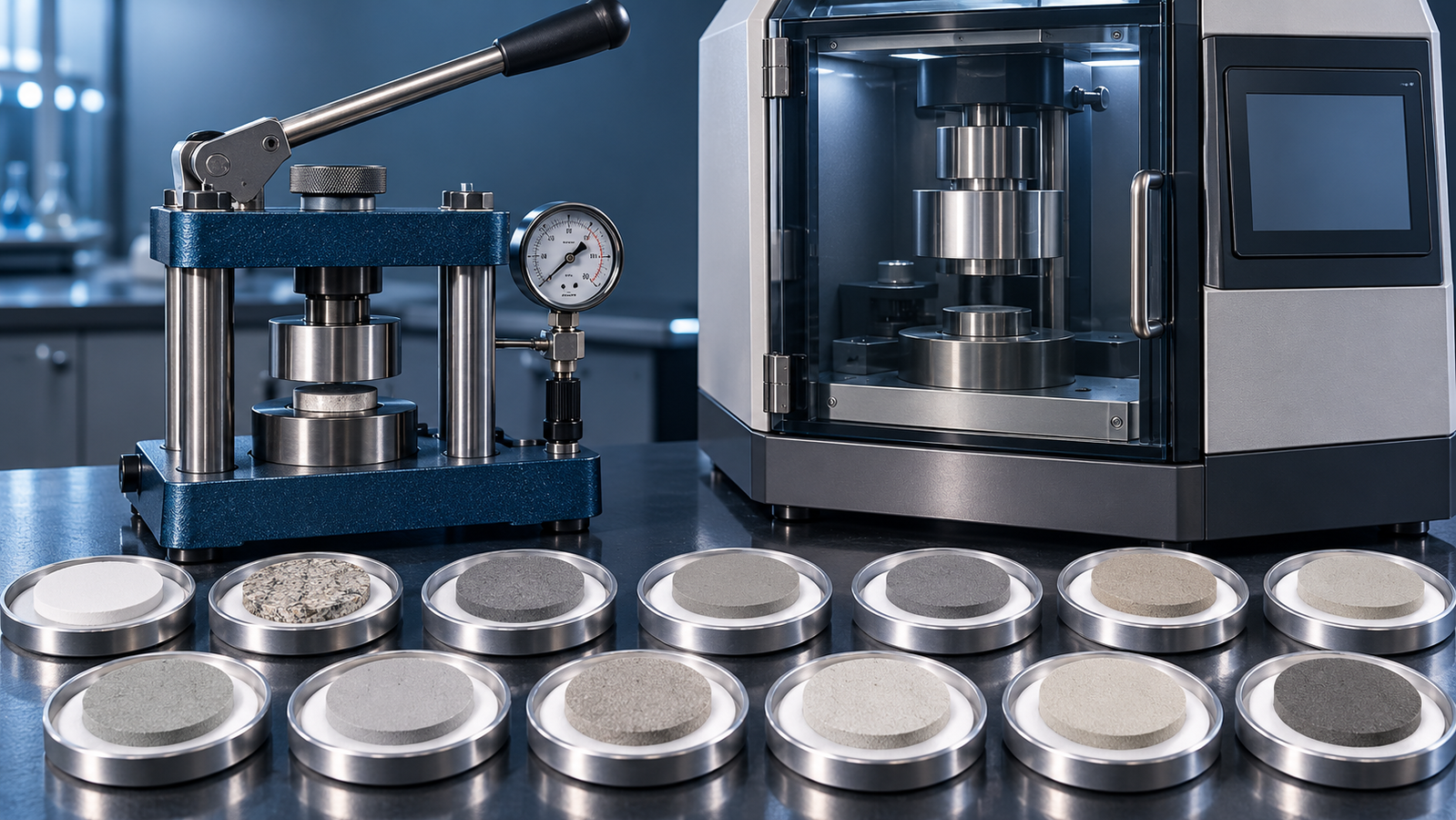
A manual and an automatic XRF pellet press both reach thirty or forty tonnes. The difference between them is how much of the pressing (the force, the hold and the release) depends on the person at the lever, and how many pellets that person has to make in a day. It matters because a calibration for pressed pellets rests on a quiet assumption: that every unknown was prepared exactly like the standards. The spectrometer cannot check it. If the counts for calcium are two percent higher today, the instrument has no way of knowing whether there is more calcium or whether this pellet was ground a little finer, pressed a little harder or held a little longer than the one it was calibrated on.
In one paragraph: the X-ray signal comes from a thin surface layer, so how a pellet is packed is part of the measurement. Particle size is the preparation effect documented with the largest numbers in the studies cited here, and no press corrects it; the press’s job is not to add scatter of its own. That means the same force, the same hold and the same release for standards and unknowns. On a manual press these are read from a gauge and timed by hand, which is adequate for a few pellets a day and a careful operator. An automatic press shows the force to 0.1 t and times the cycle itself. The dedicated automatic press also removes most of the handling: the die is part of the machine and the pellet is ejected with one key. Choose by pellets per day, by how tight the method’s tolerance on force is, and by which die types you need.
1. Why pressing conditions are part of the method
X-ray fluorescence measures a shallow layer of the specimen, and the preparation of a solid sample is chosen with that analytical depth in mind.1,2 Within that layer the detector responds to how the grains are arranged as well as to what they are made of. Characteristic X-ray intensity has long been known to vary with the degree of packing of a powder, and with particle size.3 The pressure used to make the pellet is one of the things that sets the packing. When powders of four compounds were pressed at four pressures between 1.91 and 7.63 tons per square centimeter, roughly 190 to 750 MPa, their measured X-ray absorption parameters agreed with theory at low pellet pressure, and the authors concluded that the pressure applied to form the pellet changes the values measured.4 That was a transmission experiment on pure compounds, not a fluorescence calibration, and it gives no rule for how much pressure is right. It shows that the number matters.
The depth a line is measured from depends on its energy and on the composition and density of the specimen, and the specimen has to be thicker than that depth for the intensity not to depend on how much material was weighed in.1 In soils measured both as pressed pellets and as loose powder, cadmium Kα, which the authors describe as having a larger critical depth, gave a slightly smaller calibration slope for the loose powder than for the pellet; they attributed the difference to optical shading.5 A pellet that is too thin for the line being measured is a separate problem with its own literature.6
Keep the press in proportion
None of this makes the press the main source of error. The effect documented with large numbers is particle size, which is set by the grinding. In a classic treatment of heterogeneous samples, fluorescence intensity excited with monochromatic radiation rose or fell by a factor of a few as grain size was reduced, and by a factor of twelve, the theoretical value, in one experiment; the effect could usually be removed by intensive grinding, although for light elements measured at long wavelengths fine grinding was called disastrous.7 In pressed cement pellets, intensities differed by up to about 17 % between particle-size fractions from under 32 µm to 106–150 µm,8 and in copper ores and slags the dependence of intensity on particle size was clear enough to be corrected with an internal standard.9 A press cannot repair a grinding problem. It can only avoid adding to it, by doing the same thing to every pellet. The XRF pressed pellet guide covers grinding, binders and backing; this page is about that last step.
2. Who does what in the cycle
| XRF press, manual EPFM30TX, EPFM40TX | XRF press, automatic cycle EPFA30TX, EPFA40TX | Dedicated automatic XRF press EPFAX30T, 40T, 60T | |
|---|---|---|---|
| Force range | 0 to 30 t; 0 to 40 t | 0.3 to 30 t; 0.4 to 40 t | 0.3 to 30 t; 0.4 to 40 t; 0.5 to 60 t |
| Setting the force | Hand pump, read on a pointer gauge with tonne and MPa scales; digital gauge optional | On the touch screen, which reads to 0.1 t | On the touch screen, which reads to 0.1 t |
| Holding it | Operator tops up and times | Automatic hold with pressure compensation; time set on the screen | Automatic hold with pressure compensation; a time for each segment |
| Releasing it | Release valve, by hand | By the machine | By the machine, timed |
| Program | — | Programmable 7-inch touch screen | 5 segments, upgradeable to 30 |
| Die | One XRF die of your choice | One XRF die of your choice | Ø40–32 mm boric-acid die built in, with a sample splitter; other types optional |
| Getting the pellet out | By hand, with the pump | With a separate die, the die is rearranged by hand and the pellet pushed out | One key; the top plate swings aside |
| Pressure on the pellet | Calculated by the user | Shown in MPa | Shown in MPa |
| Guarding | Safety-glass guard optional | Safety-glass door, limit switch, overpressure release, emergency stop | Safety-glass door, limit switch, overpressure release, emergency stop |
| Weight | 58 and 78 kg | 85 and 120 kg | 100, 150 and 180 kg |
| Power | Manual force | 220 V | 220 V |
As listed in the current PressPro™ specifications. On the manual models force generation is manual. Power requirements of an optional or fitted digital gauge are outside this comparison.
The two automatic lines are easy to confuse because their names are so close. On the product pages the EPFA models are listed with the manual ones as the XRF press, and the EPFAX series is the one called the automatic XRF press; this guide calls EPFAX the dedicated automatic press to keep them apart. EPFA is the general XRF press with an automatic cycle: it takes any of the four die types, and with other dies it can press other things. EPFAX is a single-purpose machine built around the XRF workflow.
3. How finely the force can be set
A method states a force, and sooner or later someone has to decide how close is close enough. Put the tolerance in the units the press displays and the difference between the machines becomes concrete.
Take 20 t with a tolerance of ±5 %, which is ±1 t. On the manual 30 T press, one megapascal on the gauge corresponds to 0.95 t; on the 40 T press it is 1.33 t. The larger the frame, the coarser the same tolerance looks on its gauge.
| Press and readout | 20 t is shown as | ±1 t is |
|---|---|---|
| Manual 30 T, pointer gauge | 21 MPa | about 1 MPa either side |
| Manual 40 T, pointer gauge | 15 MPa | about 0.75 MPa either side |
| Automatic cycle (EPFA) and dedicated automatic (EPFAX), touch screen | 20.0 t | 10 steps of 0.1 t either side |
The specification of the manual XRF models names the gauge type (pointer, with tonne and MPa scales; digital gauge optional) without giving a graduation. On the manual PressPro™ powder presses of the same ratings the pointer gauge reads to 1 MPa and the digital gauge to 0.01 t; if the XRF gauges are the same, the window is about one mark either side on the 30 T pointer gauge, less than one on the 40 T, and 100 steps either side on a digital gauge.
Resolution is not accuracy. A fine display does not make the force true, and a pointer gauge read consistently by one careful person can serve a method well. But a tolerance that is narrower than one mark on the gauge cannot be held by eye. The tool below does this conversion for your own force, die and tolerance, and lists what each press’s specification says about the rest of the cycle. It also checks both edges of the tolerance window against the force range of each model: a set-point at the rating of a press leaves no room above it, whatever the method allows.
4. 30, 40 or 60 tonnes
The force a method quotes only means something together with the die. The same tonnage is a quite different pressure on a 32 mm and a 40 mm pellet.
| Force | On a 32 mm pellet | On a 40 mm pellet |
|---|---|---|
| 20 t | 244 MPa | 156 MPa |
| 30 t | 366 MPa | 234 MPa |
| 40 t | 487 MPa | 312 MPa |
| 60 t | 731 MPa | 468 MPa |
Pressure (MPa) = force (t) × 9800 ÷ die area (mm²). PressPro™ steel dies are intended for use below 800 MPa of sample pressure.
Published pressing conditions cover a wide span. The soil study mentioned above reports pellets pressed into an aluminum ring of 23 mm internal diameter with 300 kgf/cm² (about 29 MPa, if that figure is the pressure on the pellet), after grinding to a modal particle size under 12.5 µm.5 The absorption study, which was not an XRF preparation, pressed at 1.91 to 7.63 tons/cm², roughly 190 to 750 MPa.4 There is no single correct value; the method for your material sets it. Choose a press rated above the working force, so that routine pressing is not done at the limit of the frame.
5. Handling: where the time goes
Pressing itself takes the same time on every machine, because the hold is the hold. What changes is everything around it.
- On a manual press the operator assembles the die on the table, pumps to the mark, times the hold, opens the valve, rearranges the die for ejection, pumps the pellet out and cleans the parts. Every step is simple and every step is a place where two pellets can be treated differently.
- On the XRF press with an automatic cycle (EPFA) the pumping, the hold and the release are done by the machine. The die is still assembled and emptied by hand.
- On the dedicated automatic press the die stays in the machine. The boric-acid splitter that ships with it places the sample in the center and the backing around it; the top plate swings aside for loading; the cycle runs from the stored program; and one key ejects the pellet.
For a laboratory that presses a handful of pellets a week, the manual sequence is no burden and the press doubles as a general 30 or 40 T frame. For a laboratory whose analysts press pellets all day, the handling is the cost, and it is also where differences between operators come from. The broader argument, including what is and is not known about hold time and release, is in the manual, electric and automatic comparison.
6. Dies and backing
The four XRF die types are boric-acid backing, steel ring, plastic ring and aluminum cup. The manual (EPFM) and automatic-cycle (EPFA) XRF presses are supplied with one of them, chosen at order. The dedicated automatic press (EPFAX) is built around the boric-acid die, Ø40–32 mm, with steel-ring, aluminum-cup and plastic-ring dies as options. If your procedure uses rings or cups for every sample, say so when ordering the dedicated press; if it uses boric acid, the standard configuration is already the right one.
Binder and dilution are decided before the press. Published routines differ: a phenolic resin binder for thirty elements in silicate rocks,10 10 % cellulose for soils,11 and wax, cellulose, starch and urea compared directly for urinary-stone samples measured by energy-dispersive XRF, with wax judged the best of the low-cost commercial candidates.12 One of those studies is a useful caution as well: with a portable spectrometer, predicting exchangeable potassium and calcium in 58 soils, pellets gave only a slight gain over loose powder.11 How much preparation a result needs depends on the result.
7. Which to choose
A manual XRF press when
- the laboratory presses a few pellets a day or fewer;
- one or two trained people do all the pressing;
- the frame should also serve as a general-purpose press;
- there is no supply at the bench for a motor-driven press, or the budget is tight. Order the digital gauge if the method’s tolerance on force is narrower than a mark on the dial (its power requirements are outside this comparison), and decide on the safety-glass guard, which is an option on the manual models.
The XRF press with an automatic cycle (EPFA) when
- the force, hold and release should be the same on every pellet without depending on the operator;
- you want to choose the die type, or change it later;
- the press will also be used with other dies.
The dedicated automatic press (EPFAX) when
- pellets are pressed all day, by several people;
- the routine uses boric-acid backing, or rings or cups ordered as options;
- a multi-step cycle is part of the method;
- 60 T is needed, which only this series offers among the XRF presses.
8. Related guides and equipment
- XRF Pressed Pellet Sample Preparation — grinding, binders, backing, force, and pellets against fused beads.
- Manual vs Electric vs Automatic Laboratory Presses — what each mode controls, across the whole range.
- Pellet Press Die Selection — the four XRF die types and how to check that a die fits a press.
- Tonnage-to-MPa Calculator — force, gauge reading and pressure on the pellet.
- How to Choose a Laboratory Hydraulic Press — the whole PressPro™ range by purpose.
- XRF Pressed Pellets vs Fused Beads — what fusion removes and loses, what dilution costs, and how laboratories divide the work.
- XRF Pellet Defects and Repeatability — visible and hidden pellet defects, and how to split the scatter into preparation and measurement.
- Equipment: PressPro™ XRF press (EPFM manual and EPFA automatic cycle) and PressPro™ automatic XRF press (EPFAX, the dedicated machine).
9. FAQ
Does an automatic press make better XRF pellets than a manual one?
It is built to make them more alike. The pellet itself is not denser or flatter for having been pressed by a motor. What an automatic press removes is the variation in force, hold time and release between one pellet and the next, and between one operator and another.
How much force is needed for an XRF pellet?
Typically 20 to 40 t on a 32 or 40 mm die, which is about 150 to 500 MPa on the pellet and the range that 30 and 40 T XRF presses are built for; the method sets the exact value. Use the same force for standards and unknowns.
Does pressing pressure affect XRF results?
It can. Packing density influences characteristic X-ray intensity, and measured absorption parameters of pressed powders have been shown to change with pelletizing pressure. The studies cited above put numbers on the particle-size effect, up to about 17 % in one set of cement pellets; none of them puts a number on the pressure effect in XRF. Both are handled the same way: prepare every pellet identically.
What is the difference between the EPFA and EPFAX presses?
EPFA is a general XRF press with an automatic cycle and a separate die of your choice, in 30 and 40 T. EPFAX is a dedicated XRF machine in 30, 40 and 60 T with a built-in boric-acid die, a sample splitter, a multi-segment program and one-key ejection.
Can a manual XRF press hold a tight force tolerance?
Within the limits of its gauge. On a 30 T frame one megapascal on the gauge is about one tonne. If the method allows less than that, order the digital gauge option, which on the manual powder presses of the same ratings reads to 0.01 t, or use an automatic press.
Which die comes with the press?
The manual (EPFM) and automatic-cycle (EPFA) XRF presses come with one XRF die of your choice: boric acid, steel ring, plastic ring or aluminum cup. The dedicated automatic press (EPFAX) has a Ø40–32 mm boric-acid die built in, with the other types as options.
Can an XRF press be used for other pellets?
The manual (EPFM) and automatic-cycle (EPFA) XRF presses are standard frames and take other dies that fit their working space. The dedicated automatic press (EPFAX) is built for XRF pellets.
Should I choose a 30 T or a 40 T XRF press?
Choose by the pressure the method needs on your die. Thirty tonnes is 366 MPa on a 32 mm pellet and 234 MPa on a 40 mm pellet; forty tonnes is 487 and 312 MPa. Take the rating that leaves the working force below the top of the range. On a manual press the larger frame reads more coarsely: one megapascal on the gauge is 1.33 t on the 40 T frame against 0.95 t on the 30 T frame.