
For X-ray fluorescence, a powder can be pressed into a pellet or dissolved in a molten borate flux and cast as a glass bead. The pellet keeps everything in the sample, including the grain-size and mineral effects that disturb the measurement. The bead removes those effects, at the cost of diluting the sample and losing what evaporates in the furnace. This guide sets out what each route removes, what it costs, and how laboratories that run both divide the work.
In one paragraph: fusion is the route for accurate major elements across samples of different mineralogy, because the glass removes grain-size and mineral effects. Pressed pellets suit trace elements and volatile elements such as sulfur and the halogens, because the sample is not heated and is diluted, if at all, only by a binder. Low-dilution beads at 1:2 now reach trace levels of a few ppm for many elements, and several laboratories run both routes. The choice belongs to the analytical method and comes before the choice of press. A press makes pellets; it does not make beads.
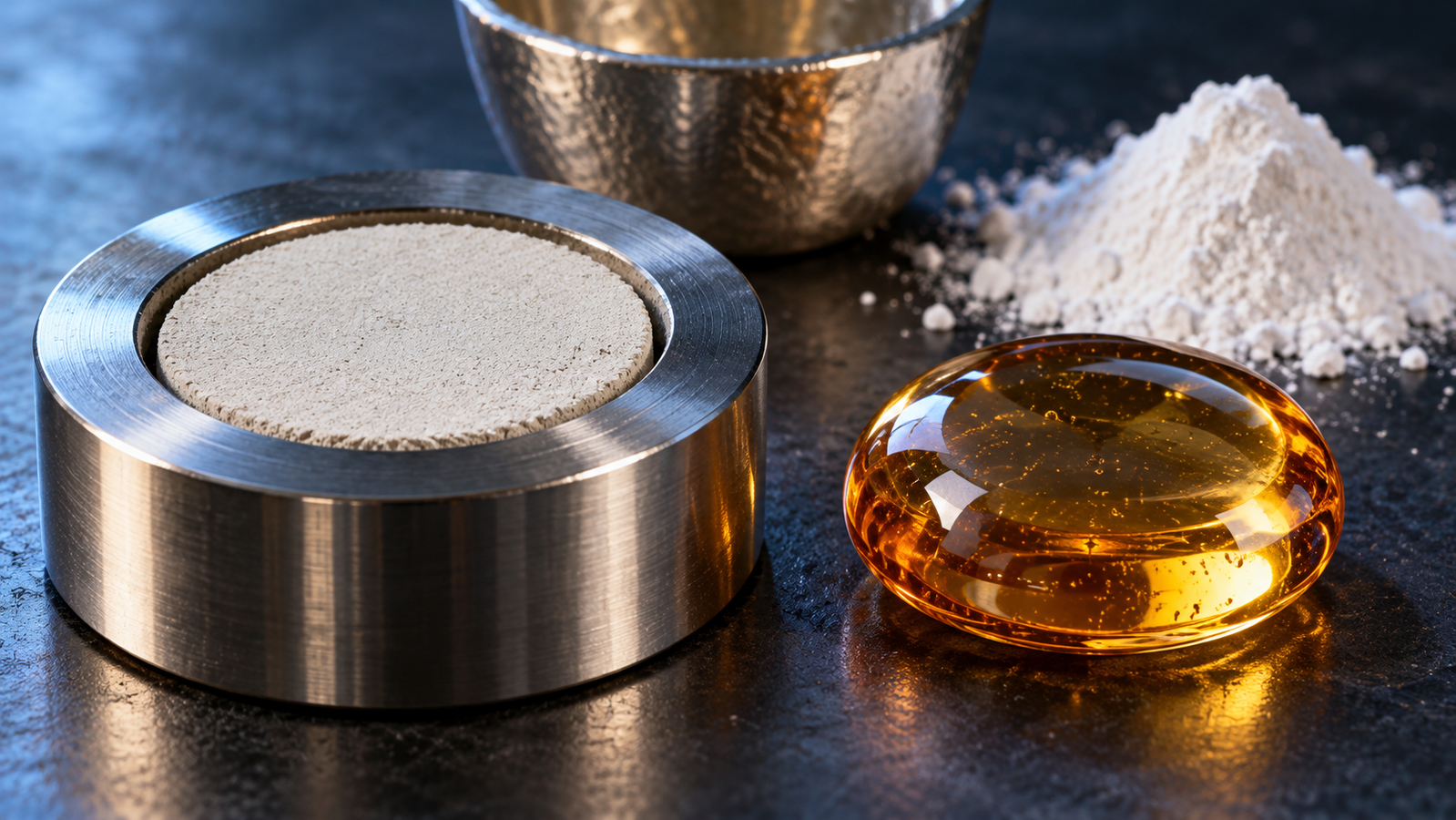
The XRF pellet guide sums up the trade-off in one table. This page looks at the evidence behind each row. It draws on the published methods of geological surveys, university laboratories and the studies that tested fusion and pressing side by side.
1. Two routes, in practice
A pressed pellet is ground sample, with or without a binder, pressed in a die. A fused bead is weighed sample mixed with a lithium borate flux, often with an oxidant and a release agent. It is melted at about 1000 to 1200 °C, usually in a platinum–gold crucible, and cast into a disc. The methods below show the range.
| Laboratory or study | Route | Ratio and conditions |
|---|---|---|
| US Geological Survey, major elements1 | Bead | 0.8 g sample, ignited at 925 °C for 40 min first; lithium tetraborate to give 8.0 g after fusion, about 1:9; fused at 1120 °C for 35 min |
| Geological Survey of Japan, major elements2 | Bead | 1:10; about 1070 °C in an automated bead sampler |
| Washington State University laboratory3 | Bead | 1:2; fused at 1000 °C in graphite crucibles, reground and fused again |
| Japan Atomic Energy Agency, Tono4 | Bead | 1:2 (changed from 1:10 to reach trace elements); oxidant and release agent added |
| University of Pisa, traces5 | Bead | 1:9; sample ignited at about 1000 °C for 1 h first |
| US Geological Survey, 30 trace elements6 | Powder | 2 to 3 g lightly pressed into a 32 mm cup; no weighing needed |
| Ceramic raw materials, traces7 | Pellet | Stearic acid binder; 100 kN in a 40 mm die |
2. What fusion removes, and what it does not
Borate fusion has been used in XRF for decades, because it eliminates many of the problems of particle size and matrix effects in powders.8 The authors of a 1969 method wrote that any fusion greatly reduces absorption effects and eliminates particle-size effects.9 A study of lithium borate fusion found by microscopy that minerals dissociate in the bead, supporting the view that beads carry no mineralogical effects.10 Two limits apply.
- Matrix effects are reduced, not gone. The 1969 authors wrote that fusion “drastically reduces, but does not entirely remove” absorption and enhancement effects, so matrix corrections are still needed.9
- The sample has to dissolve completely. Materials rich in chromite, sulfides or cassiterite, and slags, still lack easily reproduced routine fusion methods.10 For feldspars, melts shorter than about 25 min gave larger deviations from the certified values.11
3. What dilution costs
Flux dilutes the sample, and diluted analytes give weaker lines. How much that costs has been measured.
- Discs of 1 g sample and 6 g flux (1:6, with lithium nitrate as oxidant) were, in detection limits, “only 3-5 times less sensitive” than pellets of 85 % sample and 15 % cellulose.12 The sample is about six times more dilute in the disc than in the pellet, so the measured loss was smaller than the dilution alone suggests.
- In one laboratory, discs at 1:30 gave noticeably larger errors than its 1:9 discs, attributed to counting statistics, and made trace elements hard to determine. The high dilution needed only 225 mg of sample, which is its advantage.13
- Fusion can dilute some trace elements below their detection limits, while pressing avoids that and takes less time.14
Low-dilution beads for trace elements
Laboratories that want traces from beads use less flux.
- At 1:2 with a lithium nitrate oxidant, lower limits of detection for 18 trace elements were about 1 to 9 ppm.15
- Another study found the accuracy of 1:2 beads comparable to that of 1:5 beads for majors and of pressed pellets for traces.16
- A laboratory running about 5000 samples a year at 1:2 reports deviations below 5 % from reference values for all elements except yttrium and zirconium.3
Traces are also measured on beads at the dilutions used for major elements. At 1:9, trace-element errors were 3 to 10 % between 0 and 2300 ppm. Reproducibility was worse than 20 % below 20 ppm, and cerium and lanthanum had detection limits near 15 ppm.5
The limits of trace work on beads are specific:
- Fluorine remained poor at 1:2. The report suggested undiluted pressed briquettes for low-sensitivity elements such as fluorine.4
- One lot of flux showed clear lanthanum contamination, so each new lot has to be checked.17
4. What fusion loses
- Volatiles. “Inherent in any fusion technique is the loss of the volatile constituents.” The 1969 authors wrote that the volatile content must then be measured separately and the totals corrected.9 Some methods ignite the sample first,1,5 and one weighs the loss.1 Another treats the loss as the balance component of the calculation.4
- Sulfur and halogens. Losses grew with melting time. In a sulfate-bearing silicate glass, SO3 fell from a certified 0.135 to 0.056 wt% after 106 min of melting.11 A university laboratory found that its fusion tended to lose fluorine and sulfur.18 In a USGS method, sulfur above 0.3 wt% was not quantitatively oxidized.12
- The crucible. Sulfides react with platinum crucibles, forming a low-melting alloy, and metals can form eutectics that destroy them, so sulfides must be oxidized before fusion.10 Sulfide ores contaminated the platinum–gold crucible in one study. A pre-oxidation step in a boron nitride crucible then retained 99.6 to 104.9 % of the sulfur.19 The USGS major-element method does not prepare samples with more than 2000 ppm arsenic or lead, because of the risk to the crucibles.1 Reducing conditions extract iron, copper, lead, cobalt and manganese into platinum ware.20
- The flux itself. Above about 1050 °C the flux volatilizes. The author of one study recommends not exceeding that temperature.10
- What the release agent adds. Bromine from a release agent interfered with rubidium so that it could not be determined.12
5. What the pellet keeps, and what it cannot fix
A pellet is not heated, and it is diluted only by its binder, if any.
- A method for trace elements in ceramic raw materials chose pressed pellets for their lower detection limits, because “the sample does not suffer any significant dilution.” It also measured sulfur on them.7
- The USGS method for 30 trace elements packs undiluted powder into cups, with lower limits of detection from 1 to 10 ppm, including arsenic, selenium, bromine and cadmium.6
What a pellet cannot fix is the powder.
- Intensity depends on grain size and packing,21 and theory predicts that it also depends on the composition of the grains that carry the analyte.22 Across particle-size fractions of cement, intensities differed by up to about 17 %.23
- One laboratory describes the mineralogical and granulometric effects of pellets as barely correctable by calculation.5 Another notes that pellets need excellent micronization and care with aluminum and silicon.18
- Matrix effects in pressed disks can be very serious, though they can be calculated and compensated.14
- Twenty-five years of a geoanalytical proficiency test show a significant divergence between pressed-pellet and fused-disc results.24
The pellet defects guide covers what grinding and pressing can and cannot do.
6. Calibration
The two routes are calibrated differently.
- Beads. Because a bead is a homogeneous glass, its calibration can be extended with synthetic standards. The Geological Survey of Japan added four synthetic standards to its reference rocks to extend the ranges, for example SiO2 from 23 to 91 wt% and MgO up to 46 wt%.2 Techniques for preparing fused single- and multi-element standards have also been published.8
- Pellets. Unfused methods depend on matching the grain-size distributions of samples and standards, and on many standards.9 In practice that means reference materials of similar matrix, ground the same way.
7. Time and throughput
- The USGS fusion method handles 250 samples per analyst-month.1 Its pressed-cup method for traces runs up to 36 samples in 24 h.6
- One fusion took 39 min, plus 5 to 6 min of grinding per disc.12
- One government laboratory makes more than ten beads a day.4
- Measuring all major elements on a bead took about 13 min.2
Pressing is the faster preparation.14 Fusion needs a furnace or bead machine, crucibles and molds (usually platinum–gold), and flux. No independent source on these costs was found for this guide, so they are left out here.
8. Laboratories that use both
Some laboratories do not choose: they divide the work. Others have moved from two routes to one.
- The US Geological Survey ran fused discs for major elements1 and pressed powders for 30 trace elements.6
- A university geoscience laboratory added a fused-disc calibration to its pressed-pellet method and concluded that the two techniques are complementary.18
- A Geological Survey of Japan paper notes that trace elements were analyzed on pressed pellets until the late 1990s, when single glass beads became common, and that ICP-MS is now commonly used for traces.2
- One study determined majors and traces on a single 1:2 bead.16
9. What the standards say
Not every standard prescribes a route. The scope of ASTM C114 for hydraulic cement says that any test method of demonstrated acceptable precision and bias may be used.25 In a NIST interlaboratory study under that standard, the participating laboratories were split between fused beads and pressed powders.26 The method for X-ray analysis of lime and limestone covers rapid multi-element determinations with wavelength-dispersive instruments.27 A study of feldspars reports that the reference method BS EN ISO 12677 melts beads at 1200 ± 50 °C for 5 min.11 Where a standard governs the work, its text decides.
10. Route comparison
Enter the bead recipe and the binder share of your pellet to see how much each route dilutes the analyte. Then switch on the requirements that apply. The tool lists what each requirement says about the two routes. It does not pick one for you, because the choice depends on which requirements matter most.
11. Which route for which job
| Requirement | Favors | Why, in the sources |
|---|---|---|
| Major elements, highest accuracy, mixed rock types | Bead | Grain-size and mineral effects removed; synthetic standards extend calibration10,2 |
| Trace elements at a few ppm | Pellet, or a 1:2 bead | No dilution;7,6 low-dilution beads reach about 1 to 9 ppm for many elements15 |
| S, F, Cl, Br | Pellet | Losses of sulfate and halides grew with melting time;11 one laboratory’s fusion tended to lose F and S;18 F was too weak on diluted 1:2 beads;4 bromine from a release agent ends up in the bead12 |
| Sulfides, metals, As or Pb above 2000 ppm | Pellet; for sulfides, fusion with pre-oxidation | Sulfides and metals attack platinum ware, and roasting is often not enough;10 one method does not fuse samples above 2000 ppm As or Pb;1 a pre-oxidation step retained the sulfur of sulfide ores19 |
| Chromite, cassiterite, slags | Check the method first | No easy routine fusion10 |
| Few matrix-matched standards | Bead | Calibration can use synthetic standards2 |
| Only a few hundred milligrams of sample | High-dilution bead, or a small pellet | 225 mg at 1:30;13 0.1 g pellets for major elements in soils and sediments28 |
| Speed | Pellet | Less preparation time14 |
12. Presses and dies for the pellet route
A press makes the pellet route possible, and a fusion furnace or bead machine makes the bead route. The PressPro™ range covers the first.
- XRF pellet presses. Manual models with a hand pump and dual-scale gauge, and automatic models with timed hold and release, both at 30 and 40 T.
- Dedicated automatic XRF press. 30, 40 and 60 T, with a built-in boric-acid die and sample splitter.
- XRF dies. Made for boric-acid backing, steel rings, plastic rings and aluminum cups. At 30 t a 40 mm pellet sees about 234 MPa and a 32 mm pellet about 366 MPa.
The press comparison covers how finely each model sets the force.
13. Related guides and equipment
- XRF Pressed Pellet Sample Preparation — the pellet method step by step.
- XRF Pellet Defects and Repeatability — what goes wrong in pellets, and how to measure it.
- Manual vs Automatic XRF Pellet Presses — which press for which workload.
- How to Specify a Pellet-Press Cycle — the pressing conditions as numbers.
- Tonnage-to-MPa Calculator — force and pressure for 32 and 40 mm dies.
- How to Choose a Laboratory Hydraulic Press — the whole PressPro™ range by purpose.
- Equipment: XRF pellet presses; dedicated automatic XRF press.
14. FAQ
Is a fused bead more accurate than a pressed pellet?
For major elements across samples of different mineralogy, usually yes, because fusion removes grain-size and mineral effects. For trace elements, a pellet avoids dilution, and one method chose pellets for their lower detection limits; low-dilution beads have been reported as comparable in accuracy. For volatile elements, a pellet avoids the losses of fusion.
What sample-to-flux ratio is used for fused beads?
For major elements, the methods cited here use 1:6 to 1:10, and one study compares its beads with 1:5 beads. Low-dilution beads at 1:2 are used to reach trace elements. Very high dilution, such as 1:30, saves sample and gave good castings of high-melting materials in one laboratory, but makes traces hard to measure.
Can trace elements be measured on fused beads?
Yes. At 1:2, detection limits of about 1 to 9 ppm were reported for 18 trace elements. Fluorine remained difficult at 1:2, cerium and lanthanum had detection limits near 15 ppm at 1:9, and each lot of flux must be checked for contamination.
Why are sulfur and halogens a problem in fusion?
They volatilize, and the loss grows with melting time. Sulfides also attack platinum crucibles unless oxidized first, and roasting alone is often not enough. Measure these elements on pellets, or use a fusion method designed to retain them.
Do I still need to grind the sample for fusion?
Yes. The methods cited fuse ground powder; the USGS method, for example, uses minus-80-mesh sample. Grain size no longer affects the measurement once the sample is dissolved, but the fusion has to be complete.
Can a laboratory press make fused beads?
No. Fused beads need a fusion furnace or bead machine and crucibles, usually of platinum–gold. A press makes the pressed-pellet route, which some laboratories run alongside fusion.