
A pellet die touches every sample it presses. Powder left in the bore or on an anvil can go into the next pellet; the steel or carbide of the faces can rub off into it; salt left on a die can corrode it; and residue, corrosion or score marks in the bore are things to check when ejection gets harder. This guide sets out what is known about each of these, what published methods do between samples, and where the evidence stops. A calculator estimates how much a given residue adds to the next pellet and checks your pressure against the die chart.
In one paragraph: the die can add both the previous sample and its own metal to a pellet. One study of binder-free pressed tablets saw signs of molybdenum and tungsten, which it attributed to the press dies, without measuring how much. In the studies we found, contamination has been measured in numbers for grinding vessels but not for dies, so for trace work press a blank. Clean every part with a solvent that dissolves the residue, after every sample; remember that a wipe recovers only part of what is on a surface. Chloride salt on mild steel corroded at humidities far below those at which the salt dissolves, so remove salt from a die before storing it dry. In one wear study, tungsten carbide resisted abrasive wear far better than the two tool steels tested. In tableting studies, coatings and smooth punch faces changed sticking, and no coating was best in every case. Keep the sample pressure inside the die’s rating; the rating comes from the die’s maker.
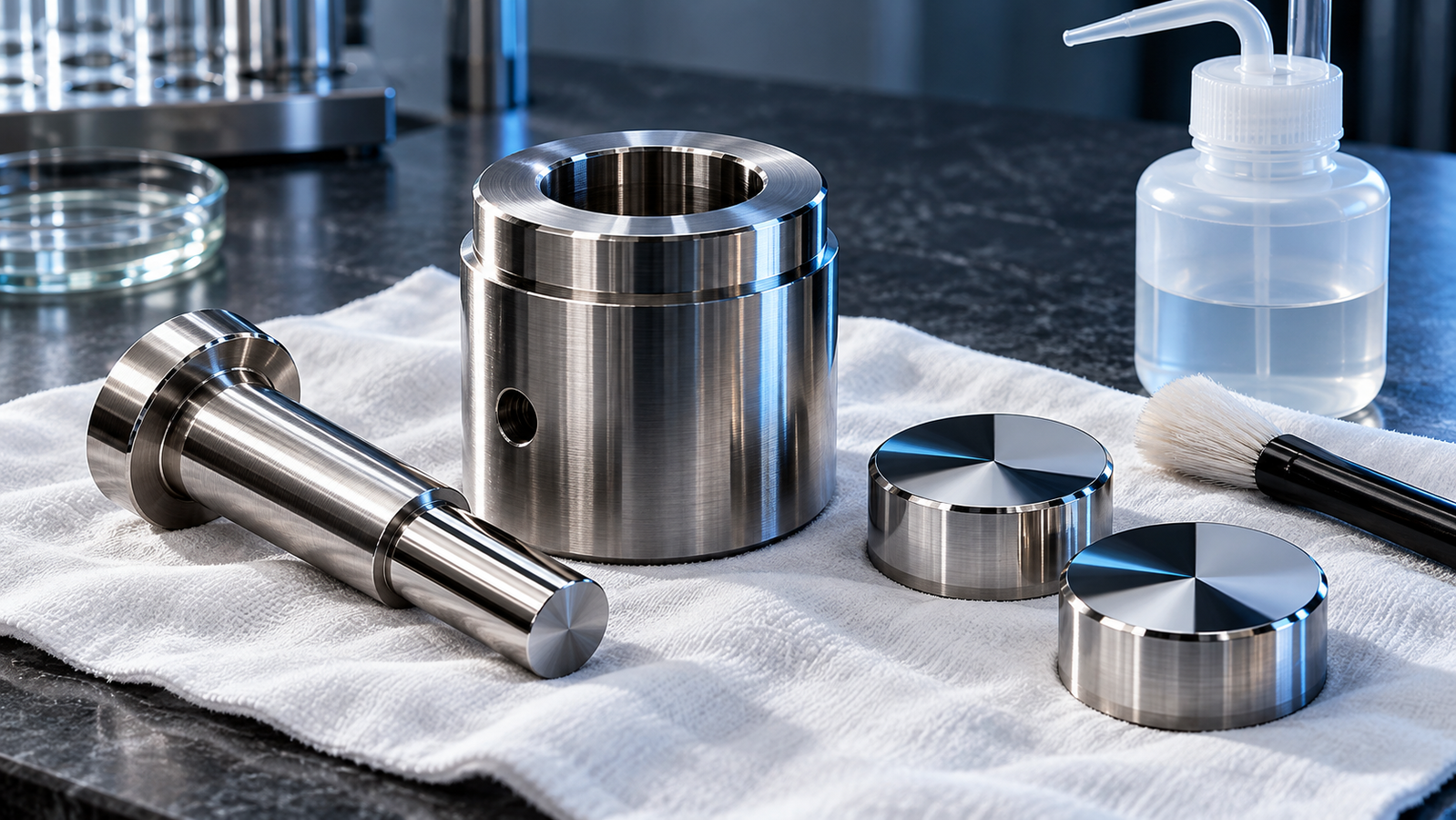
The die selection guide covers die types and sizes, and the XRF pellet defects guide covers contamination from grinding. This page is about the die as a source of contamination and as a part that wears.
1. Three ways a die contaminates a pellet
- Residue from the previous sample left in the bore, on the anvils or in the clearance between plunger and bore. In KBr pressing, salt can be squeezed past the die during pressing, which is one way it ends up in the clearance.1
- Material from the die itself, rubbed off the bore and anvil faces. In a study of undiluted, binder-free rock tablets for laser-ablation analysis, the authors saw signs of contamination with molybdenum and tungsten, which they attributed to the press dies. They noted that anvils and dies are usually made of alloyed steel or tungsten carbide. No concentrations were attributed to the dies.2
- Additives: binders, backing materials and lubricants. One museum laboratory presses rock powder into PVC rings without binder, expressly to avoid contamination from the binder.3 Binders for pressed-pellet XRF have been compared directly.4 In tablet formulations, lubricants reduce die-wall friction and protect tooling, but can weaken the tablet and slow its disintegration.5
In the studies we found, contamination of this kind has been measured in numbers for grinding vessels, not for dies. The XRF pellet defects guide gives those figures, including tungsten and cobalt from a carbide mill and copper carried over in an agate mortar. We found no study that measured iron, chromium, tungsten or cobalt picked up from a pellet die, or the carry-over from a die between samples. The grinding figures show the kind of effect to look for, not its size in a die.
2. What a die is made of, and what it can add
The PressPro™ specifications list three families of steel for plain cylindrical dies: high-carbon, high-chromium cold-work tool steels, high-speed steels and hardenable (martensitic) stainless steels. Dies in cemented carbide of the tungsten carbide, titanium carbide and cobalt type are made to order for hard powders. Which steel a given die is made of is not covered here.
| Die material | Main elements of the alloy | Notes |
|---|---|---|
| Cold-work tool steel | Fe, Cr, C, Mo, V | Listed for plain cylindrical dies |
| High-speed steel | Fe, W, Mo, Cr, V, C; Co in cobalt grades6,7 | Listed for plain cylindrical dies |
| Martensitic stainless steel | Fe, Cr, C; Mo in some grades | Listed for plain cylindrical dies |
| Cemented carbide | W, Ti, Co, C | Made to order for hard powders |
Main constituents of each alloy family, not measured pick-up; minor alloying elements are not listed. In one grinding study, the elements that marked contamination were W, Co and Ta from a tungsten carbide vessel, and Fe, Cr, Mn, Ni and Mo from a stainless steel vessel.8
If an element of your die is also an analyte, press a procedural blank. One method takes synthetic quartz through the whole procedure to measure blanks; another measures detection limits on a pure silica blank.9,3 As with grinding vessels, weigh your list of analytes when choosing between a steel and a carbide die.
3. Cleaning between samples
Published methods say less about cleaning dies than one might expect.
- A university XRF procedure cleans all metal parts with alcohol before starting and again after every pellet.10
- A US Geological Survey method pressed pellets against glass lenses to get mirror-like faces and stressed that the cleanliness of those lenses, to avoid contamination, could not be overemphasized.11
- Agate grinding vessels have been cleaned with a portion of the next sample, which was then discarded.2 We found no study that tested this on a die.
Pharmaceutical cleaning validation, where carry-over between products is regulated, adds three principles that carry over to a die:
- Set the limit by what can safely pass into the next batch. Health Canada’s guide bases cleaning limits on safe threshold values set by toxicological evaluation, and calls the result the maximum safe carry-over limit.12 A review lists the inputs of such a limit, including the permitted daily exposure, the batch size and the shared surface area.13 For a laboratory, the equivalent is the concentration that would not disturb the next result.
- Use a cleaning agent in which the residue dissolves.12 For KBr, which dissolves in water, that means water; for organic residues, a solvent that dissolves them.
- A wipe does not recover everything. In one study, swabbing recovered 64 to 71 % of a residue from stainless steel.14 A clean-looking wipe is not proof of a clean surface.
As bench practice, which the studies cited do not test:
- Take the die fully apart after each sample.
- Clean the bore, plunger and both anvils, including the clearance.
- After water, rinse with a solvent that dries quickly, and dry every part completely before reassembly.
- Never use abrasives on the polished faces.
4. Salt, moisture and storage
Salt residue on steel can corrode it, and humidity matters in a less obvious way than one might expect.
- Salts dissolve at a set humidity. A saturated NaCl solution sits at about 75.5 % relative humidity at 20 °C, and a saturated KBr solution at about 81.7 %.15 Above those humidities, a salt residue takes up enough water to become a brine film.
- Mild steel corrodes well below them. Carrying NaCl, it began to corrode at relative humidities as low as 33 %. At 53 % and above it was attacked about as fast as above the 76 % at which NaCl dissolves.16
- For one stainless steel, more humidity was not worse. Ground 304 stainless steel with sea-salt particles showed more corrosion damage at 40 % than at 76 % relative humidity, because the brine at the lower humidity was more concentrated.17
- One hardened stainless steel had weak spots. In a hardened martensitic stainless tool steel in a sodium chloride solution, the zones next to carbides were depleted in chromium and less noble than the rest. Dissolution was selective, at the carbide boundaries and between the martensite laths.18
These studies used chloride, not bromide. We found no study that tested a pellet die or the low humidity inside a desiccator. One of them shows that chloride on mild steel corroded at humidities well below those at which the salt dissolves, so keeping the air below that point is not enough by itself. Remove the salt first, then store the die dry. The KBr pellet guide covers handling KBr, and the KBr troubleshooting guide what moisture does to the pellet.
5. Wear, sticking and scoring
Abrasive wear: steel against carbide
In wear tests of die materials for powder metallurgy, tungsten carbide ranked far ahead of a tool steel with 10 % vanadium, which ranked ahead of a high-speed tool steel.19 Neither is one of the cold-work or stainless steels listed for PressPro™ dies. Silicone replicas of die bores, read on a profilometer, found no measurable wear in a carbide die over the first 70,000 compactions of an aluminum alloy powder, although aluminum built up in the die. A tool-steel die showed no change in roughness with the same powder but a clear change with an iron powder, which the authors attributed to hot compacts at ejection; the carbide die was not used with the iron powder. The replica method was well suited to spotting galling on the die wall.20 The PressPro™ carbide dies are made to order for hard powders; the die selection guide covers when one is worth it.
Sticking and surface finish
Powder that sticks to a punch or anvil is both a defect and a carry-over route. In tableting, and in one molding study:
- Punch roughness, compaction force and blend composition all affected sticking of ibuprofen–lactose blends. An old punch face with a roughness (Ra) of 0.33 µm was compared with a new one at 0.04 µm. Chrome plating increased sticking at the lowest force and reduced it at higher forces.21
- In a study of punch coatings, smooth, homogeneous surfaces reduced sticking. The author concluded that each coating has to be evaluated as an individual system.22 In a related thesis, hard chromium performed better than chromium nitride.23
- In injection molding, hard chromium nitride and chromium aluminum nitride coatings, as deposited, gave higher mean ejection forces than the uncoated mold core. The authors ascribed this to the rougher surface left by the coating. After the chromium aluminum nitride coating was mechanically polished, the ejection force was about 23 % lower than with the uncoated core.24
In the coating and molding studies, smoother tool surfaces gave less sticking or a lower ejection force. For a die, that points to keeping the anvil faces and bore polished and unscratched. We found no study that tested this, or any coating, on pellet-die anvils.
The anvil face and the pellet face
The analyzed face of a pellet is the one formed against the anvil. Rough surfaces lower XRF intensities, much more for the long-wavelength lines of light elements than for heavier ones. Crushed rock powders gave intensities up to 50 % lower than flat plates, the loss growing with grain size.25,26 Those surfaces were far rougher than a pressed pellet face, and we found no study that tested the anvil finish directly. Inspect the anvil faces for scratches; we found no study of whether a given scratch changes light-element results.
Scoring and ejection
A residual pressure stays on the die wall after the punch is removed, and it rises with compaction pressure; materials that relaxed more radially showed a greater tendency to friction.27,28 One study proposes that microcracks form during unloading in the die and grow at the surface as the compact leaves the bore.29 We found no study that measured how scoring of a laboratory die bore changes the ejection force. If ejection gets harder with the same powder and pressure, inspect the bore for residue, corrosion and score marks. The guide to green density, springback and ejection covers what the ejection force tells you.
6. Overload and service life
The PressPro™ die pressure chart gives three bands for steel dies: below 800 MPa of sample pressure for normal use, 800 to 1200 MPa as overload, and above 1200 MPa as severe overload. On a 10 mm bore, 800 MPa is only 6.4 t. Studies of tool materials and production dies add the following:
- Tool steels. Under a single rising load, cracking in two cold-work tool steels started when the stress exceeded the fracture strength of their primary carbides. Under repeated loading, fatigue cracks still started at the carbides, at stresses below that strength.30 These were test specimens, not dies, and the study is not a basis for a die’s pressure rating.
- Cemented carbide. In two tungsten carbide–cobalt grades, fatigue crack growth depended strongly on the peak load, which showed that static fracture modes were prominent.31 These grades were not of the tungsten carbide, titanium carbide and cobalt type used for PressPro™ carbide dies.
- Design. In production powder-metallurgy dies, liners of high-speed steel or cemented carbide are shrink-fitted into rings. The fit pressure is a design calculation against an assumed radial pressure from the powder.32 The rating of a laboratory die comes from its maker; we found no study that gives a general allowable pressure for pellet dies.
Check the pressure, not just the force, whenever the die size changes: a force that puts a 40 mm bore in the normal-use band can put a 10 mm bore in overload.
7. Die care calculator
Enter how much residue you think might remain, the concentration of an element in the previous sample and the mass of the next pellet. The calculator gives the concentration that residue would add, and the largest residue that keeps the addition at or below your limit. Choose the die material to see its main elements and compare them with your analytes. Enter the bore and force to see where the pressure on a steel die sits on the die chart; for a carbide die, the chart bands are not applied.
8. A die care checklist
| When | What | Basis |
|---|---|---|
| After every sample | Take the die apart; clean every part with a solvent the residue dissolves in; dry completely | Cleaning: published procedure and cleaning-validation principle10,12; taking apart and drying: bench practice |
| Before trace work | Press a procedural blank through the whole preparation | Published blank practice9 |
| After salt work | Wash off the salt before the die goes into storage | Chloride on mild steel corroded below the humidity at which the salt dissolves16 |
| Storage | Clean, dry and enclosed, for example in a desiccator | Bench practice |
| Inspection | Faces and bore for scratches, pits, galling and build-up | Galling seen on a tool-steel die wall20 |
| Every new die size | Recalculate the pressure from the force | Die pressure chart |
9. Related guides and equipment
- How to Choose a Laboratory Hydraulic Press — the whole PressPro™ range by purpose.
- Pellet Press Die Selection — die types, sizes and when carbide is worth it.
- XRF Pellet Defects and Repeatability — contamination from grinding.
- Cloudy or Cracked KBr Pellets — moisture, blanks and contamination in KBr work.
- KBr Pellet Preparation for FTIR — handling KBr and the die.
- Green Density, Springback and Ejection — what the ejection force tells you.
- Pellet Cracking, Capping and Lamination — cracks that start in the die.
- XRF Pressed Pellets vs Fused Beads — rings, cups and backing.
- Equipment: infrared presses with their die sets, XRF presses, four-column and automatic powder presses.
10. FAQ
How do I clean a KBr die?
Use a cleaning agent that the salt dissolves in, which for KBr is water. As common bench practice, which the cited studies do not test: take the die apart, wash every part, follow with a solvent that dries quickly, dry completely and store it dry. Salt left on steel may corrode it even in fairly dry air: mild steel carrying sodium chloride corroded at relative humidities as low as 33 % in one study.
Can a pellet die contaminate my sample?
Yes. Residue from the previous sample and material from the die faces can both reach the pellet, and so can anything added, such as a binder or lubricant. One study saw signs of molybdenum and tungsten in binder-free tablets, which it attributed to the press dies. Press a blank if your analytes include elements of the die.
Is a tungsten carbide die worth it?
PressPro™ carbide dies are made to order for hard powders. In one wear study, tungsten carbide resisted abrasive wear far better than the two tool steels tested, one of them a high-speed steel; the cold-work and stainless steels listed for PressPro™ dies were not tested. Tungsten, titanium and cobalt are main elements of a carbide die. Tungsten, and cobalt in cobalt grades, are also main elements of high-speed steel, one of the steels listed for PressPro™ dies.
Why is my die rusting in the desiccator?
Check it for salt or other residue. Mild steel carrying sodium chloride corroded at relative humidities as low as 33 % in one study; we found no study that tested the humidity inside a desiccator. Clean and dry the die before storing it.
What pressure can a steel pellet die take?
The PressPro™ die pressure chart, given for steel dies, marks normal use below 800 MPa of sample pressure, 800 to 1200 MPa as overload and above 1200 MPa as severe overload. Convert force to pressure for the bore in use.
Should I lubricate the die?
In tableting, lubricants reduce die-wall friction and protect tooling, but can weaken the tablet. On an analytical pellet, a lubricant is also material that can reach the sample, and we found no study of its effect on XRF, ICP or FTIR results. Weigh that against the analysis.