
A laboratory press can weigh from a few kilograms to nearly 1,000 kg. Most have a hydraulic system, many an electrical supply, some a heater, and some need a chiller or a vacuum pump, which are options; an isostatic press has a chamber rated to 300 MPa. The bench, the outlet, the doorway and the room can all be checked before the press is ordered. This checklist gives the machine data for the main PressPro™ families (the tool gives every model), what published codes and laboratory guidance say about supply, guarding and high pressure, and the information a request for quotation should carry. A tool further down checks a model against your site and writes the request.
In one paragraph: check the weight against the bench and the footprint against the space and the doorway; the largest frames weigh up to about 970 kg and have a separate control box. On the manual pellet and isostatic presses the force is generated by hand; the power of a digital gauge, where one is fitted, is not evaluated here. Every powered PressPro™ press, including the manual hot presses, is printed for 220 V at 50/60 Hz; where a maximum power is printed, it runs from 400 W on automatic pellet presses to 5.5 kW on the largest heated presses. A 120 V outlet does not match a press printed for 220 V; the circuit is for a qualified electrician to plan. The heated platen presses with 150 to 400 mm platens and the vacuum press require a water chiller above 300 °C. The vacuum press reaches −0.1 MPa, as printed, when used with a vacuum pump, which is optional and not included. OSHA’s rule for mechanical power presses excludes hydraulic presses; OSHA regulates their guarding under its general machine rule. An isostatic chamber works at up to 300 MPa, far above the high-pressure thresholds in one national laboratory’s pressure-safety manual. In the RFQ, describe what the press must do: sample, size, pressure, temperature, atmosphere, operation and tooling.
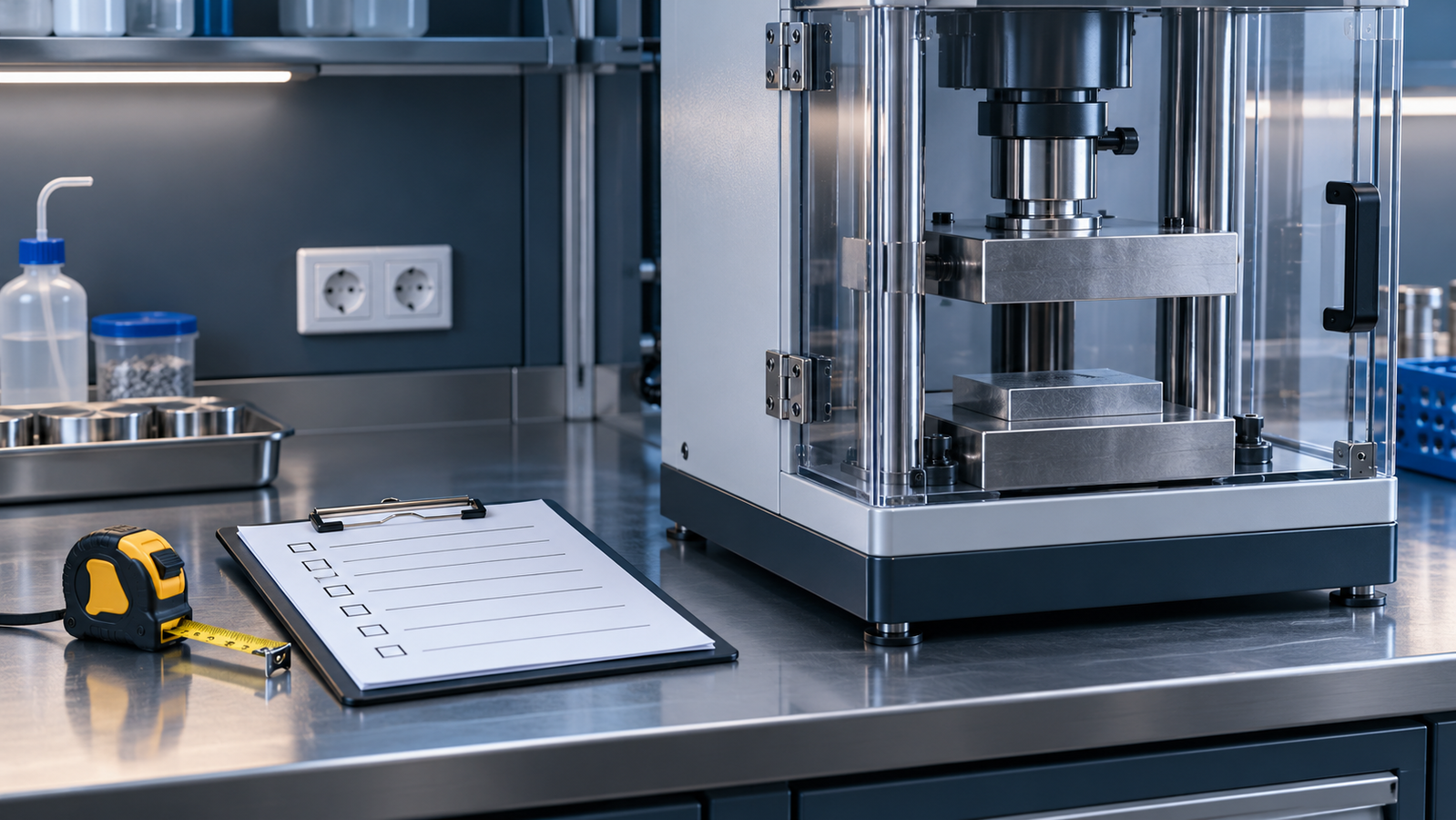
The tonnage guide covers how much force you need, and the press selection guide which kind of press. This page starts once you know roughly which press you want.
1. Space, weight and handling
Footprints and weights by family, as printed in the PressPro™ specifications:
| Family | Size range, W × D × H | Weight | Supply and maximum power |
|---|---|---|---|
| Mini infrared press | 100 × 220 × 220 mm | 4.8 kg | Manual (hand screw); supply not evaluated |
| Manual powder presses: two-column, four-column, protective | 205 × 170 × 370 to 440 × 240 × 530 mm | About 12 to 142 kg | Manual force; power of the digital-gauge models not evaluated |
| Electric powder press | 245 × 380 × 430 to 370 × 355 × 550 mm | About 75 to 185 kg | 220 V, 400 W |
| Automatic powder press | 230 × 405 × 470 to 320 × 560 × 640 mm | About 85 to 350 kg | 220 V, 400 to 700 W |
| Large-tonnage automatic press, 65 to 200 T | 330 × 400 × 860 to 480 × 650 × 950 mm, plus a control box | About 260 to 850 kg | 220 V, 400 to 700 W |
| Automatic cold press | 360 × 460 × 600 to 570 × 540 × 640 mm | About 155 to 420 kg | 220 V, 400 to 700 W |
| Heated-die and heated platen presses, manual and automatic | From 245 × 180 × 420 mm; widths up to 570 mm, depths up to 600 mm, up to 720 mm tall | About 45 to 420 kg | 220 V, 0.6 to 5.5 kW |
| Vacuum automatic hot press | 650 × 650 × 790 to 820 × 820 × 790 mm | About 290 to 540 kg | 220 V, 2.2 to 5 kW |
| Isostatic presses: manual, electric, automatic | Widths up to 440 mm, depths up to 560 mm, up to 750 mm tall | About 90 to 290 kg | Manual: manual force, power of the digital-gauge model not evaluated; electric and automatic: 220 V, 400 W |
| Automatic warm isostatic press | 370 × 460 × 630 to 400 × 560 × 750 mm | About 140 to 260 kg | 220 V |
| Large-tonnage automatic isostatic press | 330 × 400 × 930 to 480 × 650 × 1150 mm, plus a control box | About 330 to 970 kg | 220 V, 700 W |
Values as printed; “about” where the specification marks a weight as approximate; maximum power where printed. Heated-die and manual dual-platen presses: main unit; the separate temperature controller is not included. The tool below gives every model, including the infrared and XRF presses and the battery tools.
Three checks follow from the table.
- The bench. Casework has a rated load. One university’s master specification for laboratory furniture rates steel base cabinets at 500 lb per linear foot and four-legged utility tables at 300 lb.1 Those are one institution’s figures; read the rating of the bench you have.
- The floor. NIH’s design requirements for NIH-funded biomedical research facilities, in a 2012 bulletin, set a minimum live load of 5.0 kPa for laboratories and require specialized equipment loads to be verified with the equipment manufacturer.2 A frame of several hundred kilograms on a small footprint is a question for the building’s structural engineer.
- The route in. Compare the smaller of the width and depth with the narrowest door on the way, and plan the lift. The printed sizes are for the machine, not its packing. Lifting injuries are one of the more common injuries among trained laboratory personnel.3
Under the US general machine rule, machines designed for a fixed location must be securely anchored to prevent walking or moving.4
2. Electrical supply
On the PressPro™ range:
- Manual force: on the manual powder, infrared, XRF and isostatic presses, the mini infrared press and the coin-cell and punching tools, the force is generated by hand. Several of them are also offered with a digital gauge; how that gauge is powered is not evaluated in this guide or its tool.
- 220 V at 50/60 Hz: every powered model, including the manual hot presses, whose heaters and controllers need it. The cold press, the heated-die and heated platen presses and the vacuum press print the supply with an earth-leakage protector. The electric and automatic powder, XRF and isostatic presses list leakage protection among their safety devices; the electric and automatic infrared presses do not list it.
- Maximum power, where printed: 400 W on most electric and automatic pellet and isostatic presses, 700 W on the largest frames, 400 to 700 W on the cold press, and 0.6 to 5.5 kW on the heated presses.
At 220 V, 400 W is about 1.8 A and 5.5 kW is about 25 A, by our arithmetic, ignoring power factor.
The US case
North American 60 Hz circuits include 120 V, 208Y/120 V and 120/240 V systems.5 Laboratory guidance asks that 110 V receptacles in laboratories be of the standard design that accepts a three-prong plug.3 A press printed for 220 V does not match a 110 V or 120 V receptacle. Whether a particular model may run on a 208 V, 230 V or 240 V circuit is not covered by the printed specifications or by this guide. Some useful rules and guidance:
- OSHA requires electric equipment to carry markings giving voltage, current, wattage or other ratings, and listed or labeled equipment to be installed and used according to its instructions. It defines a qualified person as one trained in the construction and operation of electric equipment and its hazards.6
- Electrical installation in the US follows the National Electrical Code, NFPA 70, as adopted where you are. IEC 60038, the international standard for nominal supply voltages, lists 230 V among its standard values.7,8
- Prudent Practices in the Laboratory advises inspecting new electrical equipment for a certification mark on receipt; without one, an electrician should inspect it before it is put into service. It also reserves the installation and repair of high-current or high-voltage equipment for trained electrical workers, unless laboratory personnel are specially trained for that work.3
Leakage protection
Residual-current devices (RCDs) of the circuit-breaker type for household and similar uses are specified in IEC 61008-1 and IEC 61009-1, and ground-fault circuit interrupters (GFCIs) in UL 943; OSHA defines a GFCI as a device that de-energizes a circuit when current to ground exceeds a set value.9,10,5,6 UK guidance advises an RCD rated at no more than 30 mA and testing it regularly with its test button. It also notes that an RCD cannot protect against every type of shock.11
3. Heated and vacuum presses: chiller, pump and fumes
- Chiller. On the heated platen presses with 150 to 400 mm platens and on the vacuum hot press, the specifications require a water chiller for work above 300 °C. On the compact manual presses with 100 mm platens, air or water cooling is listed as an option. On the heated-die press, a water-cooled insulation plate is listed as an option above 300 °C. The chiller is an option, not part of the standard configuration.
- Vacuum. The vacuum hot press reaches −0.1 MPa, as printed, when used with a vacuum pump; the pump is optional and not included. The chamber can also be filled with inert gas.
- Hot surfaces. On the heated-die, heated platen and vacuum hot presses the temperature controller shows a “Caution: hot” sign above 50 °C. A high-temperature guard is listed as an option on the heated-die press, the manual heated platen presses and the automatic hot press. Laboratory guidance asks that any electrical heating device have a temperature controller or a cutoff that switches off power above a preset temperature.3
- Fumes. Heating plastics above their recommended upper process temperature can release fumes, for example hydrogen chloride from PVC and formaldehyde from acetals. Their immediate effects can include severe irritation of the eyes, nose and lungs. UK guidance for molding and extrusion asks for good ventilation in all cases, and local exhaust where the material maker recommends it and the user’s own assessment confirms it is needed.12 Read the polymer’s data sheet before setting the temperature.
The vacuum vs ambient hot pressing guide covers when the vacuum chamber is needed.
4. Guarding: what the standards cover
Press safety standards exist, and their scopes say which presses they cover.
- ISO 16092-1 and -3 cover presses that work cold metal, the second part for hydraulic presses. Part 1 lists compaction of metal powder among the machines it does not cover.13,14
- ANSI B11.2 covers hydraulic and pneumatic power presses. It excludes laboratory machines used to determine properties of materials, manually powered presses, powdered-metal presses and stand-alone platen presses, among others.15
- OSHA 1910.217, the US rule for mechanical power presses, excludes hydraulic presses.16 An OSHA interpretation states that guarding of hydraulic presses is regulated under the general machine rule, 1910.212.17 That rule requires the point of operation of a machine that exposes an employee to injury to be guarded; where no specific standard applies, the guard must keep every part of the operator’s body out of the danger zone during the operating cycle.4
- A national laboratory’s pressure-safety manual classes unmodified, commercially manufactured hydraulic systems up to 5,000 psig, such as hydraulic presses, as low-hazard pressure systems.18
What the PressPro™ presses provide, as printed:
- Open frames: the two- and four-column manual presses; a safety-glass guard is listed as an option on the manual infrared and XRF presses.
- Safety-glass guard door: the protective manual presses and the manual isostatic presses.
- Safety-glass door, leakage protection and emergency stop: the electric powder presses from 30 T, the electric isostatic presses, and the automatic powder and XRF presses. The automatic isostatic presses add steel guarding.
- Heated presses and the cold press: a high-temperature guard is optional on the heated-die press, the manual heated platen presses and the automatic hot press. The automatic hot press and the vacuum hot press have overpressure release and an emergency stop, and the automatic hot press lists a light curtain as an option. The cold press has the same overpressure release and emergency stop.
Personnel should know how to shut equipment down safely in an emergency, and hazardous moving parts should be enclosed with guards.3
5. Planning a large isostatic press
The large-tonnage automatic isostatic presses include the heaviest and tallest machines in the range:
- Chamber: 50, 60, 80 and 90 mm in diameter, 150 mm deep, for cold isostatic pressing to 300 MPa.
- Frame: 65 to 200 T; the main unit is 330 × 400 × 930 to 480 × 650 × 1150 mm and weighs about 330 to 970 kg.
- Control box: separate, 400 × 280 × 400 or 500 × 350 × 480 mm.
- Supply: 220 V, 700 W.
The specification of the warm isostatic press describes its chamber as filled with liquid; the pressure medium of the cold isostatic presses is not covered here. The isostatic press selection guide covers chamber sizes and the force each needs.
The chamber is where the safety questions are:
- Pressure. 300 MPa is about 43,500 psi by our arithmetic. That is far above both levels, 3,000 psig for gas and 5,000 psig for liquid, above which the national laboratory manual cited above treats systems as high pressure, to be installed only by qualified staff.18
- Stored energy. A compressed liquid stores much less energy than a gas at the same pressure and volume, but it still stores energy.19 The method one national laboratory uses for liquids makes it proportional to the compressibility of the liquid, the square of the pressure and the volume.20
- Codes. Section VIII Division 3 of the ASME Boiler and Pressure Vessel Code gives rules for the design, fabrication, inspection, testing and certification of vessels operating generally above 10,000 psi. In the EU, the Pressure Equipment Directive covers the design, manufacture and conformity assessment of pressure equipment with a maximum allowable pressure above 0.5 bar, with listed exclusions.21,22 Whether a laboratory isostatic press falls under either depends on the jurisdiction and the classification of the equipment; that question is not covered here.
- Inspection. For pressure vessels in general, Prudent Practices advises high-pressure work only in chambers equipped for it, records for each vessel, and periodic inspection. It also advises hydrostatic proof tests before first service, every 10 years, after significant repair and after any over-pressure event.3
Ask your institution’s pressure-safety officer early. The national laboratory manual cited above lists, among the exceptions in its pressure-safety chapter, commercially available instruments and equipment that are installed, operated and maintained entirely within the manufacturer’s stated specifications.18
6. What to put in a request for quotation
US federal procurement rules ask that needs be stated as the functions to be performed, the performance required or the essential physical characteristics, and they prefer performance specifications to brand names.23 For a press that means describing the job, not only the model.
| Item | Example | Why |
|---|---|---|
| Sample and purpose | KBr discs for FTIR; 40 mm XRF pellets; sulfide electrolyte pellets | Sets the kind of press and tooling |
| Size | Die bore, platen footprint or chamber size | With the pressure, sets the force |
| Pressure range | Lowest and highest, in MPa | Both ends matter: rating, lower limit, readout |
| Temperature | Room temperature, 300 °C or 500 °C | Heated versions; on most platen presses, a chiller above 300 °C |
| Atmosphere | Air, vacuum or inert gas; glove box | Vacuum chamber, evacuable die, size |
| Operation | Manual, electric or automatic; programs; stored data | Repeatability and records |
| Tooling | Dies or molds by size and type | Dies are optional on most presses |
| Site | Supply available, bench rating, door width | Installation |
| Quantity and delivery | Units, address, receiving dock or lift | Shipping and handling |
On tooling: on the PressPro™ powder presses, dies are optional and not included with the main machine. The infrared presses come with a die set, an agate mortar, a bottle of KBr and a sample spoon. The dedicated automatic XRF press has a boric-acid die built in, and the other XRF presses come with one XRF die of your choice. Put the die sizes in the request.
7. Site and RFQ tool
Choose a family and model to see its printed footprint, weight, supply and power. Add your bench rating, the supply you have and the narrowest door on the way in; each is checked separately. On a manual model the supply check is not evaluated, because the force is generated by hand and the power of a digital gauge is outside this check. The bench check compares the printed machine weight with the total rated load you enter, in kg; floor loading and ratings per length or area are not evaluated. Then fill in the requirements and copy the request for quotation, which also lists your site entries.
8. On delivery
- Read the rating plate and compare voltage and power with the circuit before connecting anything.6
- Check the electrical inspection route your institution uses for new equipment.3
- Place the press on a bench or floor rated for its weight, with access on the operating side and room to open the guard door.
- Connect utilities in the order the operating manual gives.
- Train the operators before the first sample to shut the press down safely in an emergency, with the emergency stop where one is fitted, and to release the pressure.3
- Keep the records: rating plate, delivery inspection, and for isostatic presses the inspection history your pressure-safety program requires.
9. Related guides and equipment
- Small vs Large-Tonnage Laboratory Presses — how much force you need.
- How to Choose a Laboratory Hydraulic Press — pellet, hot or isostatic.
- Manual vs Electric vs Automatic Laboratory Presses — what each kind of press controls.
- Isostatic Press Selection Guide — chamber sizes and the force each needs.
- Laboratory Hot Pressing Guide — heated dies, platens and temperature classes.
- Vacuum vs Ambient Hot Pressing — when the vacuum chamber is needed.
- Pellet Press Die Selection — what to specify for the tooling.
- Equipment: the PressPro™ series, large-tonnage automatic isostatic press, automatic hot press, vacuum hot press, automatic powder press.
10. FAQ
What power supply does a laboratory press need?
On the manual PressPro™ pellet and isostatic presses the force is generated by hand; the power of a digital gauge, where one is fitted, is not evaluated here. Every powered model, including the manual hot presses, is printed for 220 V at 50/60 Hz. Where a maximum power is printed, it runs from 400 W to 5.5 kW, depending on the model.
Can I plug a 220 V press into a US outlet?
Not into a 110 V or 120 V receptacle. It needs a suitable circuit, which a qualified electrician should plan from the rating plate. Operation on 208 V, 230 V or 240 V is not covered by the printed specifications.
How heavy is a laboratory press?
From 4.8 kg for the mini infrared press to about 970 kg for the largest isostatic press. Most automatic pellet presses weigh 85 to 350 kg.
Do laboratory presses fall under OSHA press rules?
OSHA’s mechanical power press rule excludes hydraulic presses, and OSHA has said that guarding of hydraulic presses falls under its general machine-guarding rule. Your institution’s safety office decides how they apply to your installation.
Does a hot press need a chiller?
The heated platen presses with 150 to 400 mm platens and the vacuum hot press require one for work above 300 °C. The chiller is an option, not part of the standard configuration.
What should a request for quotation include?
The sample and purpose, the size of the die or sample, the pressure range, temperature, atmosphere, operation, tooling, site data and quantity. The tool above writes it from your entries.