
A coin cell is three punched discs, a spacer, a spring and a few drops of electrolyte, closed with about a tonne of force. It is the cheapest experiment in battery research and the one most groups start with. It is also built almost entirely by hand, which means that the diameter of a disc, how well it was centered and how hard the case was crimped all travel with the data, usually unrecorded. This guide is about the tools on the bench that do that work, and the hydraulic presses beside them: what each one is for, what the published guides say about using it, and which numbers are worth writing down.
In one paragraph: punch the negative electrode (the anode) a little larger than the positive (the cathode) and the separator larger than both, so that small errors in centering do not leave part of an electrode facing nothing. Keep the edges clean. Use the same spacers and spring in every cell of a series, because together with the crimping force they set the pressure inside the cell, and keep the electrolyte volume the same. Crimp at a fixed force found on trial cells; for the PressPro™ coin-cell machine that is generally 0.7 to 1.2 t. Open cells with the opening die, not with pliers. And treat pressing as a separate set of jobs with their own machines: pellets of solid electrolyte, hot-pressed layers and isostatically densified cells are powder-press, hot-press and isostatic-press work.
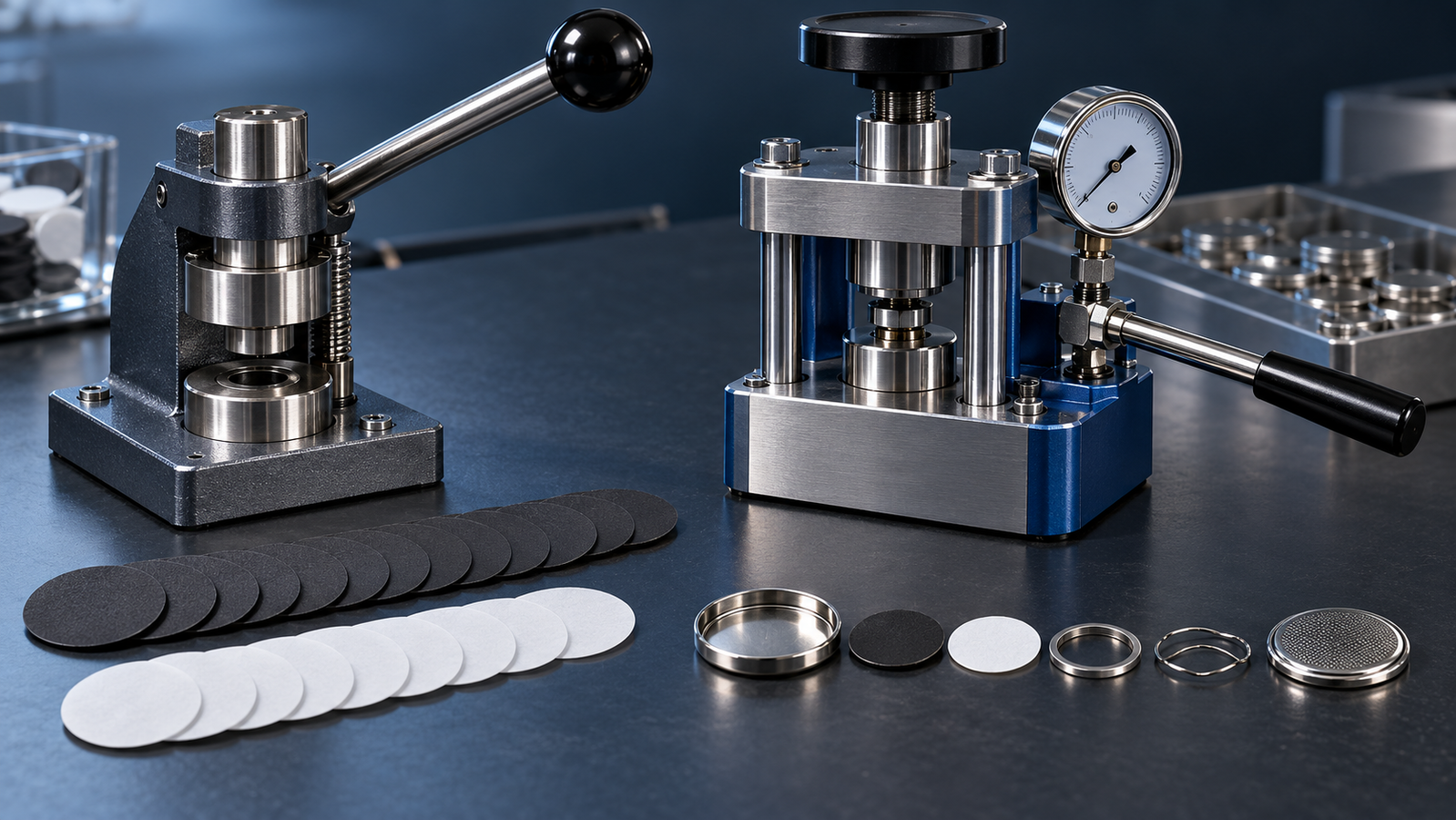
1. Which job needs which tool
| Job | Tool | In the PressPro™ range |
|---|---|---|
| Cutting electrode and separator discs | Disc punch | Battery material punching machine, EPBBMQ10 |
| Closing a coin cell | Crimper with a sealing die | Coin-cell sealing and disassembling machine, EPBM series |
| Opening a cycled cell | The same machine with an opening die | EPBM series |
| Pressing a powder into a pellet | Hydraulic press and pellet die | Two-column and other powder presses; see the electrolyte pellet guide |
| Pressing warm, or pressing layers and films | Hot press | Heated-die and platen hot presses; vacuum hot press |
| Flat pressing of a sheet without heat | Platen press | Automatic cold press |
| Densifying a sealed cell or sheet from all sides | Isostatic press | Cold isostatic press and warm isostatic press |
One job is missing from the table on purpose. Densifying a coated electrode is calendering, and it is done between rolls. Calendering changes the microstructure of the coating,1 including the way its particles touch one another.2 It affects porosity, adhesion, thickness, wettability and transport, and when it is done well it improves volumetric energy density, cycling stability and rate capability.3 For a given active material there is a compaction density that balances energy against rate.4 A flat press can compress a small coupon between plates for a single experiment, but it is not a substitute for a roll press.
2. Punching discs: diameter, overhang, edge
Which diameters
Published builds for 2032-size cells, which are 20 mm in diameter and 3.2 mm high,5 use a small set of sizes.
| Source | Positive electrode | Negative electrode | Separator |
|---|---|---|---|
| Good-practice guide for half cells6 | 14 mm | 15 mm lithium | Not reported |
| Reproducibility study, full cells5 | 14 or 16 mm | 16 mm | 16.5 mm |
| Cell-format comparison7 | 14.8 mm | 15.0 mm | — |
| Robotic assembly8 | 14 mm | 15 mm | 16 mm |
With one exception, the equal 16 mm pair that the reproducibility study also tested, the pattern is the rule: negative larger than positive, separator larger than both. A best-practice review puts the reason plainly. The negative electrode should be slightly larger in area than the positive to help alignment; if the two are the same size they always end up misaligned, which leads to lithium depositing where it should not and to inconsistent results.9 The extra millimeter is tolerance for the hand that places the disc.
How much tolerance is needed can be measured. In one study of hand-built lithium–sulfur cells, the cathode, spacer and spring sat between 0.05 and 1.50 mm off the center of the cell case; a printed alignment jig narrowed that to 0.18 to 0.36 mm, shortened assembly and made capacity more consistent.10 A robotic assembly system reports a placement precision of 0.07 mm for the cathode, 0.12 mm for the anode and 0.19 mm for the separator, estimated from the variation of the gap between disc and gasket in camera images.8 With a 14 mm positive and a 15 mm negative, the positive is fully covered as long as the two centers are within 0.5 mm of each other. The stack check below does this arithmetic for any pair.
The edge
Electrode cutting is a step in which defects are made. Poor cut quality is associated with performance loss, separator protrusion and local concentration of electrical stress, and mechanical cutting tools wear, which raises the chance of burrs and delamination at the edge.11 Where the edge has been studied in detail, on laser-cut electrodes in large pouch cells, its condition changed the electrical performance of the cell, with metal spatter on the positive electrode having the largest effect.12 For a punch the practical meaning is simple: keep the die sharp and clean, punch through in one stroke, and look at the edge.
The PressPro™ punching machine
The PressPro™ battery material punching machine is a hand-lever punch for sheet from 0.01 to 0.5 mm thick, which covers separators and coated electrodes. Punch dies are made from 3 to 24 mm; the regular sizes are 10, 12, 14, 15, 16, 19 and 20 mm, and the machine is supplied with 12 and 16 mm. The punching force is at least 200 kg with a stroke of up to 16 mm, the work table is 140 × 80 mm, and cut discs drop into an anti-static collection box. The specification describes the cut as free of burrs and indentation, which on any punch depends on a sharp, clean die; in special cases it calls for a sheet of A4 paper under the material. It is operated mechanically by hand, measures 200 × 120 × 280 mm and weighs about 10 kg.
Choose dies to match the build. A 14 / 15 / 16 mm set or a 14 / 16 / 19 mm set comes entirely from the regular sizes. A 16.5 mm separator, as used in one of the studies above, is inside the range the dies are made in; as a non-regular size it is available on request.
3. Stacking: what sets the pressure inside the cell
A coin cell has no bolts. The pressure that holds the electrodes against the separator comes from a spring that is compressed when the case is crimped, and how far it is compressed depends on everything else in the stack. In the words of the best-practice review, the spring compression, and so the internal pressure, is set by the total thickness of the other components and the spacer chosen; the same spacer thickness should be used for similar electrodes and changed when the coating thickness, the loading or the lithium thickness changes.9
Measurements bear this out. When crimping load, the number of spacers and the type of spring were varied, the pressure inside the cell during and after crimping changed with the construction; the preprint of the study gives a steady-state range of roughly 100 to 170 kPa. The measured Coulombic efficiency of lithium metal spread accordingly: the ranking of electrolytes was generally robust, the absolute values were not.13 Published builds differ in exactly these parts: two spacers of 0.3 mm in one guide,6 spacers of 1 mm and 0.5 mm in a format comparison.7
Electrolyte volume is the other quantity to fix. One hundred microliters is the volume the half-cell guide recommends,6 and it is one of the two amounts tested in the reproducibility study, the one in its best-performing build.5
That reproducibility study is worth a second look, because its result is not the one people expect. It varied the anode-to-cathode ratio, the electrolyte amount, the spring type and the number of separators in a designed experiment of sixteen combinations, eight cells each, and found that none of the factors had a statistically significant effect on reproducibility; its recommendations are simply the settings that gave the most working cells.5 A reasonable reading is that none of these four settings, within the ranges tested, decides reproducibility by itself; doing every step the same way remains the safer aim. A robot that does so reported a capacity scatter of 3.4 % and still lost about one cell in ten to short circuits and other faults.8
4. Coin-cell stack check
Enter the cell size and the three disc diameters. The tool checks the overhang, how far off-center the positive electrode can sit and still be covered, and whether each diameter is a regular punch size. If you add the inner dimensions of your cases and the thicknesses of your parts, it also checks the fit and shows how much height is left for the spring.
5. Crimping: one force, every time
Crimping folds the rim of the case over the gasket and cap. Too little force and the case may not seal. Too much can deform the separator and short the cell.9 In between, the force is one of the things that sets the internal pressure,13 so within a series it should not change.
The PressPro™ coin-cell sealing and disassembling machine is a small manual hydraulic press built for the job. It is rated to 2 T, with a gauge to 25 MPa on which one tonne reads 12.5 MPa. The specification gives the sealing force as generally 0.7 to 1.2 t, which is 8.8 to 15 MPa on the gauge, and the force for opening a cell as generally within 0.4 t. For comparison, the robotic assembly line mentioned above sets its crimper to 800 kg, which is 0.8 t.8 The half-cell guide adds a piece of advice worth copying: if the gauge stops a little short of the target, leave it there and record the reading, because it is preferable to undershoot than to overshoot.6
- Dies. Sealing and opening use different dies on the same frame. The machine is ordered as a sealing model or an opening model and comes with the die for CR20-series (20 mm) cells for that job; order the other die as well if you will do both. Dies for the CR16, CR24 and CR30 series are optional. Quote the full cell type (CR2016, CR2025 or CR2032) when ordering.
- Gauge. A pointer gauge with force and pressure scales, or a digital gauge reading to 0.01 MPa.
- Size. 210 × 160 × 290 mm and about 12 kg.
- Power. Force generation is manual. Power requirements of an optional or fitted digital gauge are outside this guide.
Find the force for your cases by crimping a few empty or dummy cells and checking the rim and the height, then write the gauge reading into the procedure. If the cases, gaskets or the number of spacers change, find it again.
6. Opening cells for post-mortem work
What happened inside a cell is read from its parts, so the cell has to come apart without being short-circuited, bent or contaminated on the way. Post-mortem analysis of lithium-ion cells has an established methodology that begins before the cell is opened: inspection, a defined condition and a safe environment for disassembly, separation of the components and their preparation for analysis, after which harvested electrodes can be rebuilt into small test cells.14 In one dissection study of a commercial automotive pouch cell, the cell was deep-discharged before samples were cut from it, and ceramic tools were used, a safety measure that the authors describe as usually taken to prevent internal short circuits during opening.15 That was the procedure of one study for one kind of cell and one analysis. It is not a recipe for coin half-cells, lithium-metal or sodium cells, or for analyses that depend on the state of charge.
For coin cells the opening die does the mechanical part in the same press, with a force that the specification puts generally within 0.4 t, in place of prying at the rim with pliers. What state the cell is brought to before opening, and how, must come from a procedure written for that cell chemistry and that analysis and approved by your institution; this guide gives no voltage, current or time for it. Cells that contain lithium or sodium metal, or air-sensitive electrolytes, should be opened in an inert-atmosphere glove box, following that procedure.
7. In the glove box
Cells with lithium metal are assembled in an argon glove box. The half-cell guide lists oxygen and water each below 0.1 ppm,6 and the reproducibility study recommends keeping both below 5 ppm.5 In the robotic study the electrodes were also cut inside a glove box, in that case filled with nitrogen.8 Both PressPro™ bench tools are hand-operated, and the specification describes each as suitable for use inside a glove box. Power requirements of the coin-cell machine’s digital gauge are outside this guide. Compare their dimensions, given above, with the antechamber of your box before ordering, and remember that the lever of the punch needs room to swing.
8. Where a hydraulic press comes in
Beyond the coin cell, battery research uses presses for three kinds of work, each with its own guide.
- Pellets. Solid electrolytes, and powders for conductivity or diffraction measurements, are pressed in a die. Sulfide electrolytes are pressed cold at several hundred megapascals; oxides are pressed into green pellets and sintered. The solid-state electrolyte pellet guide covers the pressures, the dies and the difference between the pressure used to make a pellet and the pressure used to test it.
- Heat with pressure. Polymer and composite electrolyte films, laminated layers and glassy electrolytes are hot-pressed. The comparison of heated dies and heated platens explains which machine does which, and the vacuum hot press keeps air away from the sample.
- Pressure from all sides. Isostatic pressing is being developed as a processing route for solid-state battery components and their integration.16 CIP, WIP and HIP are explained in their own guide.
A universal sealing-and-opening die for use on an ordinary pellet press is also available on request.
9. What a coin cell can and cannot tell you
Good tools make cells that agree with each other. They do not make a coin cell into something else. Half cells against lithium foil are easy to make and reproducible, and they can fail to predict how a material behaves in a full cell, which is the reason published guides to full coin cells exist.17 When coin cells, single-layer pouch cells and stacked pouch cells were built from the same coatings, some results were common to all three, and there were signs that the predominant degradation mechanism in the stacked pouch cells differed from that in the two smaller formats;7 a second controlled comparison found that cell impedance changes substantially between coin and pouch formats, with consequences for rate performance and lifetime.18 A two-electrode cell also cannot separate the contributions of its two electrodes, and where a reference electrode is added, the alignment of the electrodes matters again.19 Coin cells are for screening and comparison. Use them for that, build them consistently, and carry promising results to a larger format.
10. What to write down for every cell
- Case type and supplier; gasket; number and thickness of spacers; spring type.
- Diameter of each disc, and the punch die used.
- Mass and thickness of each electrode disc.
- Separator type and number of layers.
- Electrolyte and its volume.
- Crimping force or gauge reading.
- Glove-box oxygen and water readings at the time.
- Who built it, and the open-circuit voltage after assembly.
11. Related guides and equipment
- Solid-State Electrolyte Pellet Pressing — fabrication pressure, stack pressure, warm pressing and air-sensitive handling.
- Heated Dies vs Heated Platens — choosing a hot press for powders, films and layers.
- CIP vs WIP vs HIP — isostatic pressing and where it fits.
- Pellet Press Die Selection — die types, including coin-cell dies.
- Tonnage-to-MPa Calculator — force, gauge reading and pressure for any die.
- How to Choose a Laboratory Hydraulic Press — the whole PressPro™ range by purpose.
- Vacuum vs Ambient Hot Pressing — what a sealed chamber changes, what it does not, and when room air is enough.
- Equipment: PressPro™ battery material punching machine and PressPro™ coin-cell sealing and disassembling machine.
12. FAQ
What size should electrode discs be for a CR2032 cell?
Published builds use a positive electrode of about 14 mm, a negative electrode of 15 to 16 mm and a separator of 16 to 16.5 mm. The rule behind the numbers is that the negative is slightly larger than the positive and the separator larger than both.
Why should the anode be larger than the cathode?
So that the whole positive electrode faces negative electrode even when the discs are not perfectly centered. Electrodes of equal size always end up slightly misaligned, which leads to lithium depositing where it should not and to inconsistent results.
How much force does it take to crimp a coin cell?
For the PressPro™ coin-cell machine the specification gives 0.7 to 1.2 t as the usual range, about 9 to 15 MPa on its gauge. Find the value for your cases on trial cells and keep it fixed.
Can the PressPro™ coin-cell machine both seal and open cells, and which sizes?
Yes, by changing the die: sealing and opening use different dies on the same frame and gauge, and the machine is ordered with one of them. The standard die is for CR20-series (20 mm) cells; quote the full cell type (CR2016, CR2025 or CR2032) when ordering. Dies for the CR16, CR24 and CR30 series are optional.
How much electrolyte goes into a CR2032 coin cell?
One hundred microliters is the volume a published good-practice guide for half cells recommends, and it is one of the two amounts tested in a reproducibility study of full cells. Whatever volume you use, keep it the same in every cell of a series.
What does the number CR2032 mean?
The first two digits are the diameter in millimeters and the last two the height in tenths of a millimeter: 20 mm across and 3.2 mm high. A 2016 cell is 20 mm across and 1.6 mm high.
Can the punch and the crimper be used in a glove box?
Both are hand-operated and are described as suitable for glove-box use; power requirements of the coin-cell machine’s digital gauge are outside this guide. Check that they pass your antechamber: the punch is 200 × 120 × 280 mm and the coin-cell machine 210 × 160 × 290 mm.
Is a hydraulic press a substitute for a calender?
No. Calendering compresses a coating between rolls and is a continuous process. A flat press can compress a small coupon for one experiment, but it does not reproduce what a roll press does to an electrode.