
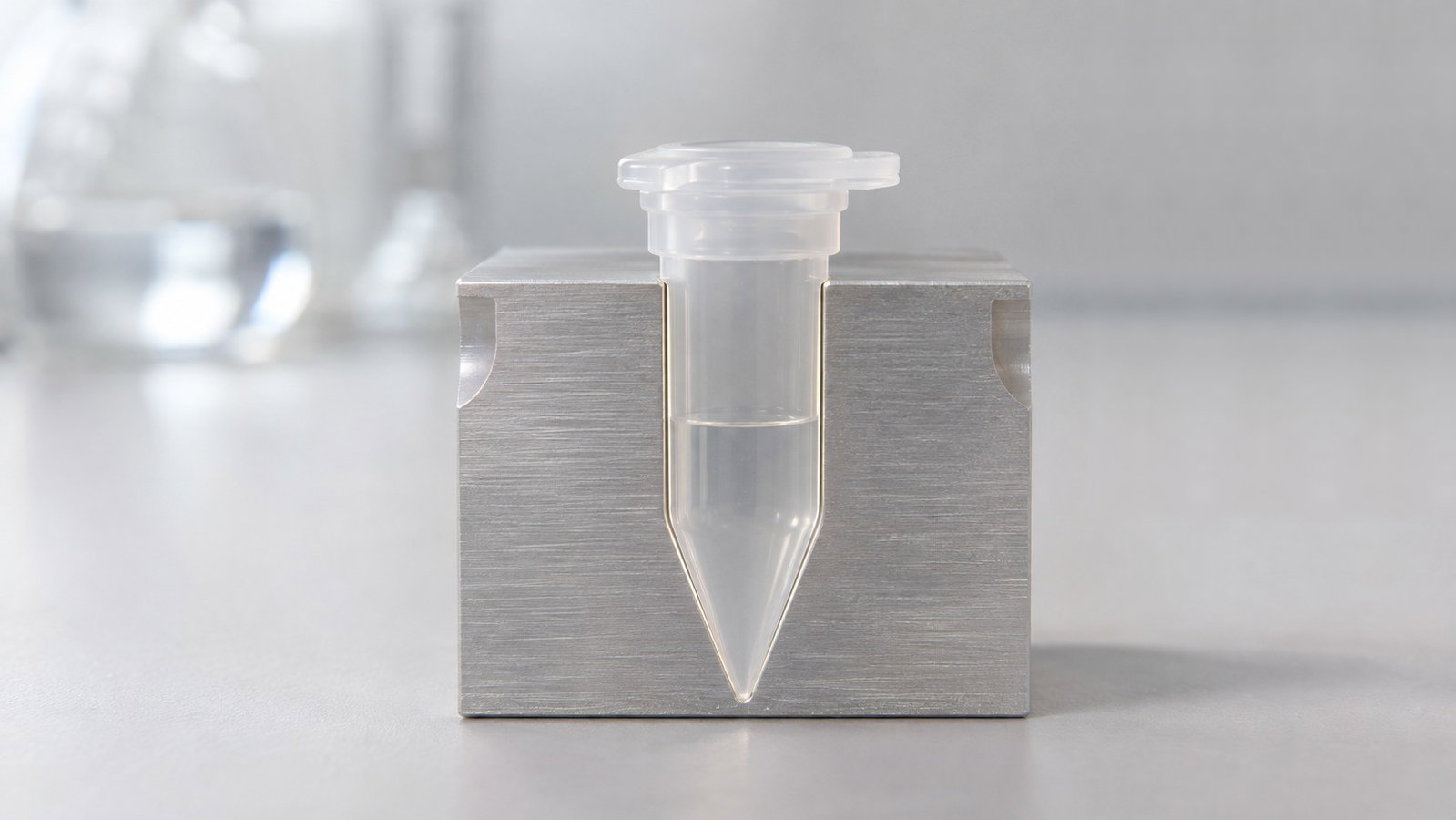
A heating block for tubes heats a sample through contact. The block may hold its set point, yet the liquid in a tube follows it through a chain of thermal resistances: the metal-to-plastic interface, any air gap, the plastic wall and the sample itself. This guide explains why tube fit matters, what poor fit looks like, how to read the diameter × depth tables of dry bath block modules, and how to choose and use blocks so samples track the block more closely. For the wider instrument family, see the guide to dry baths, thermo mixers and cooling blocks.
Quick answer:
- Why fit matters: heat crosses from block to tube where the two touch; air in the gap conducts heat poorly, so a gap slows the sample and can leave it short of the block temperature [1][5].
- What it does not change: an air gap does not alter the instrument's control accuracy. It changes how far and how fast the sample follows the block.
- What to check: compare the block's hole diameter, depth and shape with the tubes you actually use. Block tables can differ between instruments, even for the same nominal tube size.
- What helps: a hole that matches the tube, a sensible fill volume, a lid where the design provides one, enough equilibration time, and a liquid in the wells where both the instrument instructions and your protocol allow it [8].
1. Why Contact Matters
Heat moves by conduction through a chain. In a dry block, heat flows from the metal through the tube wall into the liquid, and the resistances of each step add in series. No two solid surfaces make perfect contact: heat crosses an interface through points of solid contact and through tiny gas-filled gaps, and gases conduct heat poorly [1]. Contact-resistance research treats these gaps, including gaps filled with oil or grease, as a separate term in the heat path [2]. The tube wall adds its own resistance, since polymers have low thermal conductivity [3].
Air gap thermal resistance. In a hole wider than the tube, part of the wall faces air instead of metal. A layer of thickness δ and conductivity k has a resistance of δ/k per unit area. At 300 K, air has a conductivity of about 0.026 W/m·K and water about 0.61 W/m·K [1].
| Hole wider than tube by | Radial gap if centred | Air layer: δ/k (m²·K/W) | Air layer: k/δ (W/m²·K) | Same gap filled with water: k/δ (W/m²·K) |
|---|---|---|---|---|
| 0.1 mm | 0.05 mm | 1.9 × 10⁻³ | 528 | 12,206 |
| 0.2 mm | 0.10 mm | 3.8 × 10⁻³ | 264 | 6,103 |
| 0.5 mm | 0.25 mm | 9.5 × 10⁻³ | 106 | 2,441 |
Calculated illustration, not a specification. The table assumes the conductivities above [1], a centred tube and a uniform layer; real tubes lean against one side and touch the metal along part of their surface, so the gap varies around the wall. On those assumptions, doubling the gap halves the layer's conductance. The water-gap values are hypothetical, not advice to put water in block wells. The 0.5 mm row matches a calibration limit: DKD-R 5-4 allows a bore at most 0.5 mm wider than the thermometer from −80 °C to 660 °C, unless an equivalent heat-transfer medium is used [4]. That is a thermometer-calibration rule, not a tube-fit specification for ALab dry baths.
Two effects on the sample. For a small, well-mixed sample, the temperature approaches its surroundings with a time constant τ = mc/(UA), where m is the sample mass, c its specific heat, U the overall heat-transfer coefficient and A the contact area [1]. A gap lowers U, so τ grows and the sample lags further behind the block. If the tube also loses heat to room air through its cap and upper wall, the sample settles between block and room temperature, and poorer contact enlarges that offset. Neither effect changes how accurately the instrument controls its block. For how this plays out against a water bath, see Dry Bath vs Water Bath: Uniformity, Contamination Risk and Heat-Up Time.
2. Symptoms of Poor Fit
- A tube that rocks noticeably or sits higher than the block surface. These are seating clues, not a measurement of thermal contact.
- In-tube readings that lag the well temperature. In a metrology study using 0.2 mL tubes in temperature-controlled wells, poor fit slowed equilibration; after 15 minutes, the in-tube reading was still 1.5 °C below the in-well reading. An optimal-fit comparison was within measurement uncertainty [5]. These are study results, not ALab dry-bath specifications.
- Run-to-run variation in timed steps. In a heat-resistance study, the time for tubes of media in heating block wells to reach 60 °C varied, with significant effects on the measurements [6]. Fit is one possible cause among several.
3. Reading a Block Table
Block tables usually give a capacity (positions × tube size) and a hole diameter × depth. Ask three questions:
- Diameter: does the hole match your tube's outer diameter where it should touch? Outer diameters vary between tube makers, so check the tube drawing, not the nominal volume.
- Depth vs fill height: the published depth is a hole dimension, not a validated immersion or sample-temperature specification. Compare it with the seated tube and liquid height; do not assume every listed block heats the same fill volume equally.
- Shape: one diameter cannot describe a tapered hole. Conical tubes touch a matching taper along a band, and a round-bottom tube sits differently from a cone-bottom one.
The shared table on the H100-Pro page shows why shape matters: the 8×5 mL round bottom block is listed at 13.6 × 42 mm and the 8×5 mL cone bottom block at 17 × 51.5 mm. Same nominal volume, different hole.
| Tube size | H100-Pro | HB105, HB150 | HB120-S, HB120-SC | Mini HCL100, Mini HC100, Mini H100 |
|---|---|---|---|---|
| 0.2 mL | strip or plate block (section 6) | 6.4 × 20 mm | 6.4 × 15 mm | 6.4 × 17 mm |
| 0.5 mL | 8.1 × 26 mm | 7.85 × 28.4 mm | 8.2 × 26.4 mm | 8 × 26 mm |
| 1.5 mL | 10.9 × 30.8 mm | 11 × 34.7 mm | 11 × 34.7 mm | 11.2 × 31 mm |
| 2 mL | 10.9 × 30.8 mm | 11 × 34.7 mm | 11 × 34.7 mm | 11 × 31 mm |
All values are diameter × depth. The H100-Pro page shares its block table with the HC110-Pro, HCM100-Pro and HM100-Pro pages; this is not evidence of block interchangeability between them. HB120-S and HB120-SC list the 0.2–2 mL blocks in Standard and Thin versions. Blocks for larger tubes are also listed; check their depths on your instrument's page.
For the shared block table, see the ALab™ H100-Pro Dry Bath to view the product or request a quote.
4. Same Tube, Different Block Listings
| Platform listing | 1.5 mL position | Diameter × depth |
|---|---|---|
| H100-Pro | 24×1.5 mL | 10.9 × 30.8 mm |
| HB105, HB150 | 20×1.5 mL | 11 × 34.7 mm |
| HB120-S, HB120-SC | 40×1.5 mL | 11 × 34.7 mm |
| Mini HCL100, Mini HC100, Mini H100 | 15×1.5 mL | 11.2 × 31 mm |
Four platform listings give three distinct stated hole dimensions for 1.5 mL positions. These are platform-specific block listings. They are not evidence of fit for the same physical tube, of equivalent thermal contact, or of block interchangeability. A tube may seat differently in each, depending on its outer diameter, taper and skirt. The practical takeaway: check the block table of your own instrument against the tubes you use.
For the two series listings above, see the ALab™ HB105-S1/S2 & HB150-S1/S2 Dry Bath Series and the ALab™ HB120-S/HB120-SC/HB60-S Dry Bath Series to view the products or request a quote.
5. Choosing and Swapping Blocks
When choosing a heating block for tubes, start from the tubes, not the block name. Compare the block's diameter, depth and shape with the tube, then check that the tube seats without forcing. Seating is a basic check, not proof of thermal contact or temperature performance. Block options and mounting depend on the instrument:
- The H100-Pro offers "magnetic heat block mounting that eliminates the need of any tools".
- The HCM100-Pro/HM100-Pro Thermo Mix page describes "quick interchange of blocks with magnet adhesion technology without any tools".
- The CT4-Pro Thermostatic Ice Box page describes "easy replacement of magnetic adsorption"; cold holding is covered in Cooling Blocks for 4 °C Sample Holding Without an Ice Bucket.
- The Mini dry bath page lists "Interchangeable blocks for a wide variety of test tube sizes".
- The HB60-S carries "a 5mL×30+10mL×8 dual purpose heating block". The block table on that series page applies to HB120-S/HB120-SC, not to HB60-S.
Confirm the block for your instrument when you request a quote.
For a mini dry bath with interchangeable blocks, see the ALab™ Mini HCL100/Mini HC100/Mini H100 Mini Dry Bath to view the product or request a quote.
6. Plates and Strips
Plates sit on a block differently from tubes: a flat plate base touches metal where its wells or skirt meet it. In one study with a specific 96-well plate, an aluminium dry block did not improve heating performance over the water-bath conditions tested [7]. ANSI/SLAS specifies a nominal 127.76 × 85.48 mm footprint for compliant microplates [9]; height, skirt and well shape can still vary.
Plate and strip blocks and their dimensions:
- H100-Pro shared table: "12×0.2mL PCR 8-tube strip or 0.2mL 96 PCR Microplate" (5.7 × 13.2 mm wells), "ELISA microplate" (127 × 85 mm) and "Deep well Plate" (127 × 85 × 42 mm).
- HB120-S and HB120-SC: "microplate" (127 × 85 mm, Standard and Thin) and the 0.2 mL strip or plate block (5.7 × 13.2 mm, Thin version).
These blocks hold strips and plates at one set temperature; that is not thermal cycling.
7. Good Practice
- Match tube and block. Use the tube type the block is meant for, and one tube brand for timed steps.
- Mind the fill. Keep the liquid within the hole depth, and remember that a larger volume takes longer to follow the block [1].
- Use a liquid only where permitted. One lab's online heat-shock protocol calls for water in its block wells to improve heat transfer [8]. This is not permission to put liquid into every dry bath; check both instrument instructions and protocol.
- Use the lid as designed. In the metrology study, opening the heated lid changed the in-tube versus in-well difference to −0.5 °C [5]; that result is not an ALab specification. The Mini HCL100 "has a hot lid to prevent water condensing on the tube cap".
- Pre-heat and equilibrate. Let the block reach set point before loading, then allow time for the sample. Where timing matters, check with a calibrated probe in a representative tube.
8. Frequently Asked Questions
Does an air gap make my dry bath less accurate?
It does not change the instrument's control accuracy, which describes the block. It changes the sample: a gap slows heat transfer, so the sample takes longer to follow the block and may settle short of it [1][5].
Can I use thermal paste in heating block wells?
Conductive pastes and greases can improve contact in engineering joints [1][2], but those references do not validate their use in laboratory block wells. Use a contact medium only where the instrument instructions and protocol allow it; one separate protocol uses water [8].
Will a 1.5 mL block from one instrument fit another?
Do not assume so. Block tables can differ between instruments, even for 1.5 mL positions, and a shared table is not evidence of interchangeability. Use the block listed for your own instrument.
How long should I wait after loading tubes?
It depends on tube type, fill volume and fit. Check with a probe in a representative tube rather than relying on the display [1][5].
Is a hole that is too tight a problem?
A tube that has to be forced may not seat fully or may be hard to remove. A tube should go in fully and sit level.
9. Keep Exploring the Temperature Control Hub
- Dry Baths, Thermo Mixers and Cooling Blocks: temperature control for tubes and plates.
- Dry Bath vs Water Bath: uniformity, contamination risk and heat-up time.
- 4 °C Cooling Blocks: sample holding without an ice bucket.