
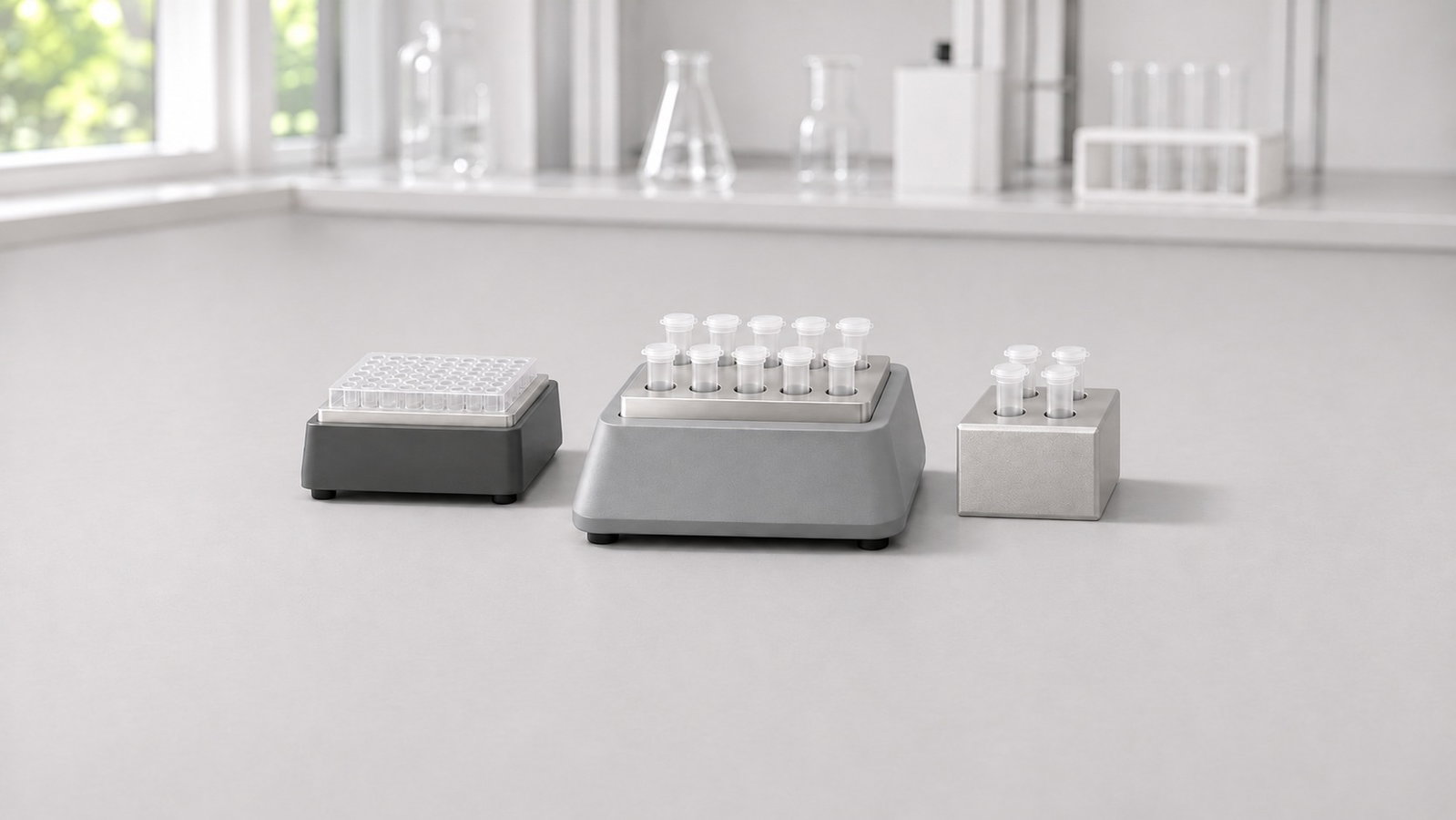
A dry bath incubator holds sample tubes in a temperature-controlled metal block instead of a tank of water. Such units are also called dry block heaters. They hold tubes and plates at a set temperature, but they are not cell-culture incubators: there is no CO₂ or humidity control. The physics is simple: dry baths heat tubes by conduction from a metal block; how closely the sample follows the block depends on tube–hole contact, how much of the tube sits above the block, and how long the sample is left to equilibrate [1]. This hub covers that physics, the dry bath versus water bath choice, block formats, mixing blocks, cooling below ambient and fixed 4 °C holding, how to read temperature specifications, and a selection table for everyday heating block lab work.
Quick answer:
- What it is: a dry block heater controls the temperature of a metal block; the sample in the tube follows it by conduction, with a lag.
- Dry bath or water bath: a block avoids standing water and suits well-fitting tubes; a bath contacts the submerged surfaces of irregular vessels and larger loads.
- Add mixing when a step needs heat and agitation together; add cooling when a step runs below room temperature.
- A cooling block with a fixed 4 °C set point holds samples cold on the bench; it is not colder than ice.
- Read specs with their test conditions: control accuracy, uniformity at a stated temperature, and the temperature range are three different numbers.
1. Heat Conduction and Time Constants
Why temperature control matters. Enzyme activity depends on temperature: it rises over a working range, then falls as the enzyme shifts toward an inactive form and finally denatures [2][3]. Incubation, denaturation and thawing steps are written around a temperature and a time, so the useful question is not just what the block reads, but what the sample reaches and when.
How heat gets into the tube. In a dry bath, a heated metal block surrounds the lower part of each tube. Heat flows from the block wall into the tube wall, through the plastic and into the liquid. Wherever the tube touches the metal, that path is short and conductive. Wherever there is an air gap, heat must cross a contact resistance, which slows the transfer [1]. The part of the tube above the block exchanges heat with room air, so a tall tube, a fill line above the block surface, an open lid or a cold cap pulls the sample away from the block temperature.
Time constants. A small, well-mixed sample warms roughly exponentially toward the block temperature. The time constant τ = mc/(UA) depends on the sample's mass m and heat capacity c, the contact area A and the overall heat-transfer coefficient U. A lumped system comes within about 95 % of a step change after three time constants [1].
| Overall coefficient U (W/m²·K) | Time constant τ | About 95 % of the step (3τ) |
|---|---|---|
| 100 | about 70 s | about 3.5 min |
| 250 | about 28 s | about 1.4 min |
| 500 | about 14 s | about 0.7 min |
Calculated illustration, not a specification. Assumes 1 mL of water (m = 1 g, c = 4.18 J/g·K) and 6 cm² of effective contact area; real tubes, fills and fits differ.
The pattern matters more than the numbers: poorer contact means a lower U and a longer wait. This is why protocols add a pre-incubation or equilibration time, and why a probe in a representative tube is the honest check.
Block warm-up is a different number. The block itself must also reach temperature before you load it. The ALab™ Mini HCL100/Mini HC100/Mini H100 Mini Dry Bath is one example: the instrument takes ≤20 min from 25 °C to 100 °C, with a maximum heating rate of 8 °C/min for the Mini HCL100 and Mini HC100 and 6.5 °C/min for the Mini H100. That is an instrument warm-up figure, not a measured time for a loaded tube. The Mini is a compact format, 110×162×140 mm, ≤1 kg and 60 W, running on 100–240 V or 12 V DC, with an option to power it from an automobile power adapter; it has an LCD display, 9 programs of 2 steps each, and temperature self-calibration. The Mini HCL100 adds a "hot lid to prevent water condensing on the tube cap", which addresses the part of the tube above the block. To compare the three Mini models in full, ALab™ Mini HCL100/Mini HC100/Mini H100 Mini Dry Bath: view the product or request a quote.
2. Dry Bath vs Water Bath
Contact. A water bath surrounds a vessel below the waterline, whatever its shape. A dry bath gives good contact where the tube matches the hole. How the vessel sits matters in both: in one study, the wells of a microplate floating on a water bath stayed 1.9–4.7 °C below the bath temperature, while a submerged plate tracked the bath closely [4]. In another, the time needed for tubes of media in heating block wells to reach 60 °C varied enough to change heat-resistance results, and the authors preferred the water bath for that test [5].
Contamination. Warm standing water can support bacterial growth. In its guidance for health-care facilities, the CDC lists water baths as a source of Pseudomonas, Burkholderia and Acinetobacter, and recommends adding a germicide to the water [6]. A dry bath removes the standing water, but wells, lids and tube exteriors still need cleaning.
Protocols. Many methods were written and timed around a water bath or ice. A common heat-shock transformation method moves cells from ice to 42 °C for 45 seconds and back to ice [7]; if you move such a step to a block, verify the tube temperature and timing first.
A practical split. Use a block for tubes that fit its holes and for routine incubation, thawing and denaturation; use a bath for flasks, bottles, odd shapes, large loads or methods validated in water. For heating round-bottom flasks, a different task, see Heating Round-Bottom Flasks: Heating Mantle vs Oil Bath vs Heating Block vs Hotplate. The full comparison is in Dry Bath vs Water Bath: Uniformity, Contamination Risk and Heat-Up Time.
A heat-only dry bath example. The ALab™ HB105-S1/S2 & HB150-S1/S2 Dry Bath Series covers room temp +5 °C to 105 °C (HB105) or 150 °C (HB150), with a uniformity of ±0.2 °C at 37 °C; control accuracy is listed in two segments, 25–90 °C: ±0.3 °C and 90–105 °C: ±0.6 °C for HB105, and 25–90 °C: ±0.3 °C and 90–150 °C: ±0.6 °C for HB150. The units are "equipped with a lid for heat preservation, and preventing pollution", list an "External temperature sensor PT1000", use an LED display, and measure 290×210×120 mm and 3.2 kg, at 100 W (S1) or 200 W (S2). Research uses include molecular biology, assay preparation, biochemistry and genetics. For the four models, ALab™ HB105-S1/S2 & HB150-S1/S2 Dry Bath Series: view the product or request a quote.
3. Blocks and Tube Formats
Fit is the hidden variable. Air conducts heat poorly: at 300 K its thermal conductivity is about 0.0264 W/m·K, against about 0.6103 W/m·K for water [1]. A thin air layer therefore resists heat flow roughly 23 times more than the same layer of water.
Calculated illustration, not a specification: 0.6103 ÷ 0.0264 ≈ 23 for equal layer thickness.
The German guideline for temperature block calibrators permits a bore diameter up to 0.5 mm larger than the thermometer diameter from −80 °C to 660 °C, or equivalent contact using a heat-transfer medium [8]. This calibrator rule is cited only as an analogy, not as a tube-fit requirement for ALab sample blocks. In a metrology study of 0.2 mL tubes, a poor tube-to-well fit left the in-tube temperature 1.5 °C lower after 15 minutes of stabilization [9]. A loose tube does not change the controller's accuracy; it changes how far and how fast the sample follows the block.
Same tube, different holes. Hole sizes differ between platforms. Four ALab product-page block tables list three distinct 1.5 mL hole dimensions (diameter×depth): 10.9×30.8 mm (H100-Pro, HC110-Pro, HCM100-Pro and HM100-Pro), 11×34.7 mm (HB105/HB150 and HB120-S/SC) and 11.2×31 mm (Mini). These are hole dimensions, not fit data; check your own tubes in the block you will use.
Plates. Microplate blocks follow the plate's footprint; ANSI/SLAS specifies a nominal 127.76×85.48 mm footprint for compliant microplates [10], while height, skirt and well shape still vary. Choose the block for the plate you actually run.
Interchangeable blocks. The ALab™ H100-Pro Dry Bath uses "magnetic heat block mounting that eliminates the need of any tools", and "each heating block has a lid to minimize the heat loss". It covers room temp +5 °C to 100 °C, with ±0.5 °C control accuracy and ±0.5 °C uniformity at 37 °C, programs with up to 6 sequential steps, a TFT display, an inbuilt temperature calibration function for users, 200 W, and 200×235×120 mm at 7.3 kg. Its block list includes blocks for 0.5 mL to 50 mL tubes, an ELISA microplate and a deep well plate. For the block list, ALab™ H100-Pro Dry Bath: view the product or request a quote. Fit and air gaps are covered in depth in Heating Block Modules and Tube Fit: How Air Gaps Affect Sample Temperature.
4. Thermo Mixing
Why mix while heating. In still liquid, heat transfers by conduction and dissolved substances by diffusion; fluid motion adds convective transport of both [1].
Not every shake mixes. In small wells, the liquid surface can stay flat with no liquid movement until a critical shaking intensity is exceeded, because surface tension holds the liquid in place [11]. In 96-well plates, convective mixing was mainly observed in the upper part of the well, and mixing times ranged from seconds to minutes [12]. Reviews of shaken systems summarize how orbit, frequency, vessel geometry and fill act together [13]. Speed alone does not define mixing; the block, the tube and the fill do too.
What a heating-and-mixing block adds. The ALab™ HCM100-Pro/HM100-Pro Thermo Mix pairs temperature control with orbital mixing up to 1500 rpm, block-dependent (600 rpm for 4×50 mL), on a 3 mm orbit; the speed range is 200–1500 rpm. The HCM100-Pro heats, cools and mixes, with a range of "Below room temp 15 to 100" °C; the HM100-Pro heats and mixes, with a range of "Room temp to 100" °C. Both list ±0.5 °C control accuracy at 20–45 °C and ±0.5 °C uniformity at 20–45 °C, a TFT display, 9 programs, a maximum heating speed of 5.5 °C/min, 150 °C overheating protection, 200 W, and 200×235×120 mm at 7.3 kg. Blocks are exchanged by "magnet adhesion technology without any tools". Applications include "Gene synthesis, gene purification, gene and protein denaturation, enzymatic reaction, bacterial growth". For the two models, ALab™ HCM100-Pro/HM100-Pro Thermo Mix: view the product or request a quote. For mixing in depth, see Thermo Mixers: Combining Temperature and Shaking for Incubation, Lysis and Denaturation.
5. Cooling Below Ambient and Fixed 4 °C Holding
Two different jobs. Some steps need a block below room temperature for a while, such as a reaction near ambient on a warm day. Others need samples held cold on the bench between steps. Cold storage matters because the shelf life of a protein depends on its storage conditions, including temperature [14].
Ice is still a good tool. An ice–water mixture sits near the ice point, essentially 0 °C, and holds steady while ice remains [15]. A 4 °C block is not colder or more stable than ice; it removes the topping up, draining and meltwater. Keep ice for steps that call for it, such as the heat-shock method above [7].
Heat-and-cool blocks. The ALab™ HC110-Pro Thermo Control heats and cools, with a range of "Below room temp 25 to 110" °C, ±0.5 °C control accuracy at 20–45 °C and ±0.5 °C uniformity at 20–45 °C, a TFT display, 9 programs, a maximum heating speed of 5.5 °C/min and 150 °C overheating protection; it does not mix. The Mini HCL100 and Mini HC100 also heat and cool, across (RT − 23 °C) to 100 °C, where RT is room temperature, with a maximum cooling rate of 3 °C/min, a rate rather than a time to any set point. These ranges are written relative to room temperature, so the lowest reachable block temperature depends on your room; none of these units is presented here as a 4 °C holding device. For the heat-and-cool unit, ALab™ HC110-Pro Thermo Control: view the product or request a quote.
A fixed 4 °C unit. Among the instruments discussed here, the CT4-Pro is the only one specified with a fixed 4 °C set point. The ALab™ CT4-Pro 4°C Thermostatic Ice Box lists a temperature control setting of 4 °C, ±0.5 °C control accuracy and ±0.5 °C uniformity at its 4 °C set point, an "LED Dual Colour (Red&Green)" status indicator, 80 W and 3.3 kg. Despite the "Ice Box" in its name, it is a powered unit, and its listed uses include "sample preservation". Its cooldown is described as "it takes only about 10 minutes to reduce the temperature from room temperature to 4°C"; that is the unit cooling down, not a sample placed in it, which still needs its own equilibration time. Modules offer "easy replacement of magnetic adsorption". For the fixed 4 °C unit, ALab™ CT4-Pro 4°C Thermostatic Ice Box: view the product or request a quote. Cold holding on the bench is covered in Cooling Blocks for 4 °C Sample Holding Without an Ice Bucket.
6. How to Read Temperature Specs: Control Accuracy, Uniformity at Its Stated Test Temperature, and Temperature Range vs Setting Range
Control accuracy is the stated temperature-control specification, not a measurement inside a tube. Uniformity describes variation across the block at a stated test temperature: 37 °C for the applicable dry-bath series, 20–45 °C for the HC110-Pro, HCM100-Pro and HM100-Pro, and the fixed 4 °C set point for the CT4-Pro. The HB series pages note that "this value is the uniformity at 37°C, not the control accuracy". A figure at 37 °C says nothing about uniformity at 100 °C, so compare figures under the same stated condition, not across conditions. Calibration practice treats block homogeneity and the effect of loading as separate checks [8].
Temperature range vs setting range. The temperature range is what the block can reach in a given room; a setting range is what the controller accepts, and on several pages it extends below the temperature range. Room temp +5 °C places the stated lower bound 5 °C above ambient. Read the temperature range row, not the setting range.
An example. The ALab™ HB120-S/HB120-SC/HB60-S Dry Bath Series shows both cases. HB120-S and HB120-SC cover room temp +5 °C to 120 °C, with ±0.5 °C control accuracy and ±0.5 °C uniformity at 37 °C, LED displays, 170 W and 175×290×85 mm at 3 kg; the HB120-SC has a "temperature calibration function inbuilt for users". HB60-S has preset temperatures of 25, 30, 37, 45 and 60 °C; its Temperature range is room temp +5 °C to 60 °C, so the lowest presets may not be reachable in a warm room. The HB60-S lists ±0.5 °C control accuracy, ±0.3 °C uniformity at 37 °C, 160 W, 2.5 kg and a "5mL×30+10mL×8 dual purpose heating block". For the three models, ALab™ HB120-S/HB120-SC/HB60-S Dry Bath Series: view the product or request a quote. For more on reading these numbers, see Dry Bath vs Water Bath: Uniformity, Contamination Risk and Heat-Up Time.
7. Selection Table
Capability ladder. Of the 15 ALab models on these seven pages, 9 heat only (H100-Pro, HB105-S1, HB105-S2, HB150-S1, HB150-S2, HB120-S, HB120-SC, HB60-S, Mini H100), 3 heat and cool (Mini HCL100, Mini HC100, HC110-Pro), 1 heats and mixes (HM100-Pro), 1 heats, cools and mixes (HCM100-Pro), and 1 provides fixed 4 °C cooling (CT4-Pro). Only HCM100-Pro and HM100-Pro mix, and only CT4-Pro is specified as a fixed 4 °C device. Start from the job: heat only, heat and cool, heat and mix, or hold at 4 °C. Then check the range, the block for your tubes, and the stated test conditions. "—" means no value is given or the function does not apply.
| Model | Functions | Temperature range | Control accuracy | Uniformity (test temperature) |
|---|---|---|---|---|
| H100-Pro | Heat | Room temp +5 °C to 100 °C | ±0.5 °C | ±0.5 °C at 37 °C |
| HB105-S1 | Heat | Room temp +5 °C to 105 °C | 25–90 °C: ±0.3 °C; 90–105 °C: ±0.6 °C | ±0.2 °C at 37 °C |
| HB105-S2 | Heat | Room temp +5 °C to 105 °C | 25–90 °C: ±0.3 °C; 90–105 °C: ±0.6 °C | ±0.2 °C at 37 °C |
| HB150-S1 | Heat | Room temp +5 °C to 150 °C | 25–90 °C: ±0.3 °C; 90–150 °C: ±0.6 °C | ±0.2 °C at 37 °C |
| HB150-S2 | Heat | Room temp +5 °C to 150 °C | 25–90 °C: ±0.3 °C; 90–150 °C: ±0.6 °C | ±0.2 °C at 37 °C |
| HB120-S | Heat | Room temp +5 °C to 120 °C | ±0.5 °C | ±0.5 °C at 37 °C |
| HB120-SC | Heat | Room temp +5 °C to 120 °C | ±0.5 °C | ±0.5 °C at 37 °C |
| HB60-S | Heat | Room temp +5 °C to 60 °C | ±0.5 °C | ±0.3 °C at 37 °C |
| Mini H100 | Heat | Room temperature +5 °C to 100 °C | ±0.5 °C | — |
| Mini HCL100 | Heat, cool | (RT − 23 °C) to 100 °C | ±0.5 °C | — |
| Mini HC100 | Heat, cool | (RT − 23 °C) to 100 °C | ±0.5 °C | — |
| HC110-Pro | Heat, cool | Below room temp 25 to 110 °C | ±0.5 °C at 20–45 °C | ±0.5 °C at 20–45 °C |
| HM100-Pro | Heat, mix | Room temp to 100 °C | ±0.5 °C at 20–45 °C | ±0.5 °C at 20–45 °C |
| HCM100-Pro | Heat, cool, mix | Below room temp 15 to 100 °C | ±0.5 °C at 20–45 °C | ±0.5 °C at 20–45 °C |
| CT4-Pro | Fixed 4 °C cooling | 4 °C (fixed setting) | ±0.5 °C | ±0.5 °C at its 4 °C set point |
| Model | Heat-up or heating rate | Cooling | Mixing | Display | Power | Size and weight |
|---|---|---|---|---|---|---|
| H100-Pro | — | — | — | TFT | 200 W | 200×235×120 mm, 7.3 kg |
| HB105-S1 | — | — | — | LED | 100 W | 290×210×120 mm, 3.2 kg |
| HB105-S2 | — | — | — | LED | 200 W | 290×210×120 mm, 3.2 kg |
| HB150-S1 | — | — | — | LED | 100 W | 290×210×120 mm, 3.2 kg |
| HB150-S2 | — | — | — | LED | 200 W | 290×210×120 mm, 3.2 kg |
| HB120-S | — | — | — | LED | 170 W | 175×290×85 mm, 3 kg |
| HB120-SC | — | — | — | LED | 170 W | 175×290×85 mm, 3 kg |
| HB60-S | — | — | — | LED | 160 W | 175×290×85 mm, 2.5 kg |
| Mini H100 | ≤20 min, 25 °C to 100 °C; up to 6.5 °C/min | — | — | LCD | 60 W | 110×162×140 mm, ≤1 kg |
| Mini HCL100 | ≤20 min, 25 °C to 100 °C; up to 8 °C/min | ≤25 min (20 °C to 0 °C); up to 3 °C/min | — | LCD | 60 W | 110×162×140 mm, ≤1 kg |
| Mini HC100 | ≤20 min, 25 °C to 100 °C; up to 8 °C/min | ≤25 min (20 °C to 0 °C); up to 3 °C/min | — | LCD | 60 W | 110×162×140 mm, ≤1 kg |
| HC110-Pro | Up to 5.5 °C/min | Cools below ambient | — | TFT | 200 W | 200×235×120 mm, 7.3 kg |
| HM100-Pro | Up to 5.5 °C/min | — | 200–1500 rpm; block-dependent (600 rpm for 4×50 mL); 3 mm orbit | TFT | 200 W | 200×235×120 mm, 7.3 kg |
| HCM100-Pro | Up to 5.5 °C/min | Cools below ambient | 200–1500 rpm; block-dependent (600 rpm for 4×50 mL); 3 mm orbit | TFT | 200 W | 200×235×120 mm, 7.3 kg |
| CT4-Pro | — | ≤10 min to 4 °C (unit), depending on the module | — | Status LED | 80 W | 3.3 kg |
Heat-up and cooling figures describe the instrument, not a loaded sample. Mini cooling times apply to the stated test condition; published heating rates are not controlled side-by-side comparisons.
8. Frequently Asked Questions
Is a dry bath incubator the same as a laboratory incubator?
No. A dry bath incubator controls the temperature of a metal block that holds tubes or plates. It does not control CO₂ or humidity, and it is meant for timed steps such as warming, incubating, denaturing or thawing.
Should I use a dry bath or a water bath?
Use a block for tubes that fit its holes and when you want to avoid standing water. Use a bath for odd shapes, flasks, large loads or methods validated in water, and keep the bath clean [4–6].
Why does my sample lag the displayed temperature?
The display shows the block, not the sample. Heat must cross the tube wall and any air gap, and the part of the tube above the block loses heat to the room. Allow equilibration time and check with a probe in a representative tube [1][9].
Do I need a model that cools?
Yes, if a step runs below room temperature or your lab is warm. A heat-only block with a range starting at room temp +5 °C cannot hold a sample at or below room temperature.
When does mixing help?
When a step needs heat and agitation at the same time, such as keeping a suspension or reaction mixed during incubation. Whether a tube or well actually mixes depends on the speed, orbit, block and fill [11–13].
Can a cooling block replace an ice bucket?
Not as a rule. Ice–water sits near the ice point, essentially 0 °C, while ice remains [15]; a 4 °C block holds a different temperature. Among the units here, the CT4-Pro is specified with a fixed 4 °C set point; the heat-and-cool models list ranges relative to room temperature, so check your room and your protocol first.
9. Keep Exploring the Temperature Control Hub
- Dry Bath vs Water Bath: uniformity, contamination risk and heat-up time.
- Heating Block Modules and Tube Fit: how air gaps affect sample temperature.
- Thermo Mixers: combining temperature and shaking for incubation, lysis and denaturation.
- 4 °C Cooling Blocks: sample holding without an ice bucket.