
A thermo mixer holds tubes or plates at a set temperature while an orbital drive shakes them, so a sample is heated and shaken in the same step. That matters whenever a reaction depends on both temperature and contact between its components, as in enzymatic digestion, protein work or bacterial growth. This guide explains what the instrument does, why mixing during incubation helps, why the usable speed depends on the block, how to plan a multi-step run, and when a heat-only dry bath is the simpler choice. For the wider instrument family, see the guide to Dry Baths, Thermo Mixers and Cooling Blocks: Temperature Control for Tubes and Plates.
Quick answer:
- What it is: a block heater, with or without cooling, mounted on an orbital shaker, for incubation with mixing in tubes and plates.
- Why mix: in a still tube, heat and dissolved molecules move slowly through the liquid; moving the liquid speeds up both [1][2].
- Speed is block-specific: maximum rpm can differ from block to block, and liquid in plates and wells can respond differently to the same orbit, so check the maximum for the block you will use, not the headline range.
- Know the limits: this guide does not present a thermo mixer as a physical cell-disruption device, and the published lysis and denaturation methods below come from the literature, not from instrument validation.
- Skip shaking when: the step is a simple heat hold, such as a denaturation step, and your protocol does not ask for mixing.
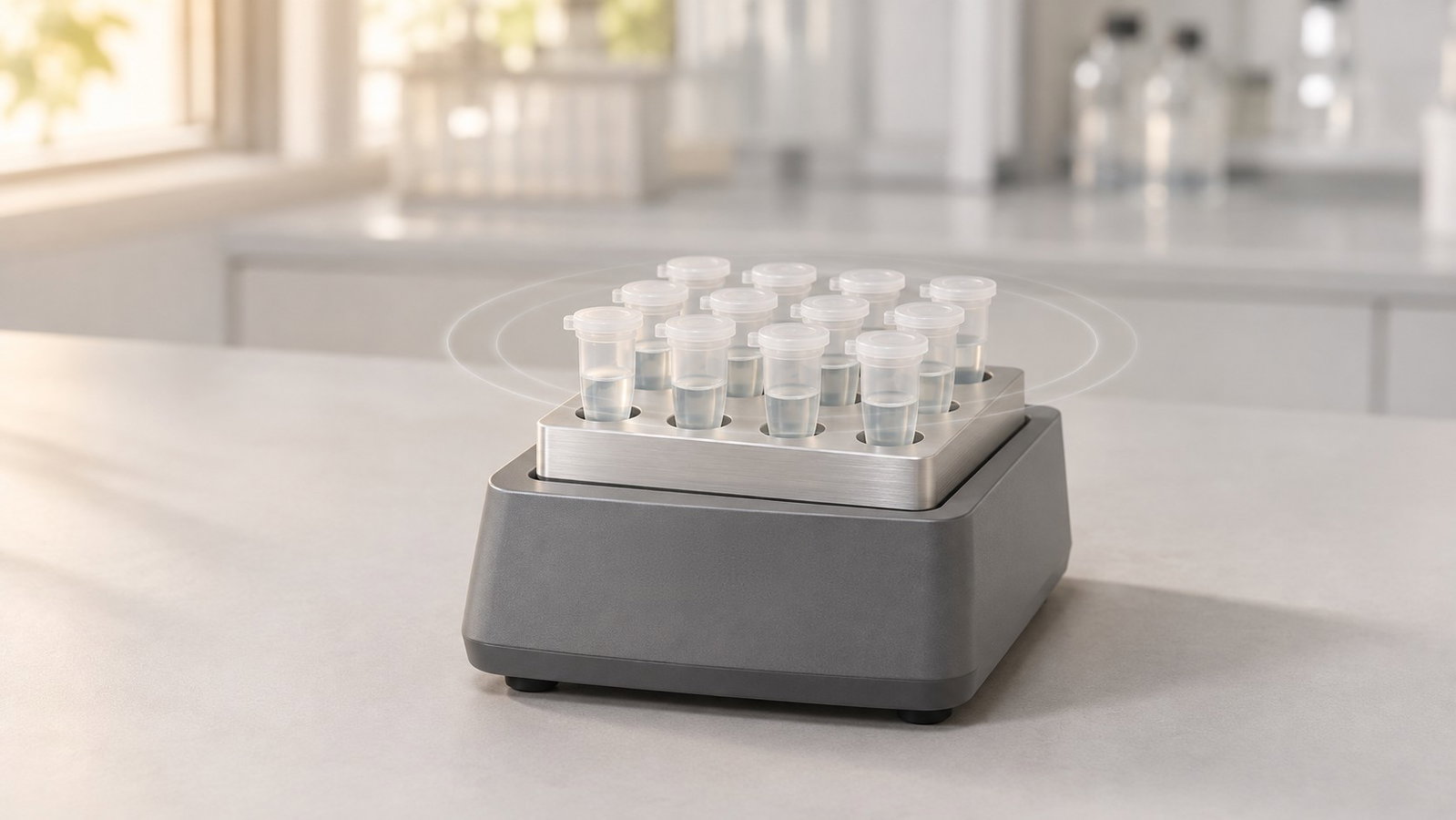
1. What a Thermo Mixer Does
Two functions in one footprint. A thermo mixer combines a temperature-controlled metal block, like a dry bath, with an orbital drive that moves the whole block in a small circle. Each tube or well follows the block's orbit, but circulation of the liquid inside depends on vessel geometry, fill volume and shaking conditions. Motion of the block alone does not establish effective mixing. Some users call this a heating shaker for tubes; the principle is the same whichever name is used.
Orbit and speed. Two numbers describe the motion. The orbit is the diameter of the circle the block traces, and the speed is how many circles it makes per minute (rpm). Together with tube size and fill volume, they decide how the liquid moves, and whether it moves at all [3][4].
An example instrument. The HCM100-Pro and HM100-Pro list a mixing speed of 200–1500 rpm and a mixing orbit of 3 mm; the HCM100-Pro is specified as "Heating, cooling & mixing" and the HM100-Pro as "Heating & mixing". To compare the two models in full, view the product or request a quote on the ALab™ HCM100-Pro/HM100-Pro Thermo Mix page.
What it is not. A thermo mixer is not a vortex mixer for quick resuspension at room temperature, which is covered in Vortex Mixers Explained: Orbit, Speed and Touch, Infrared and Continuous Modes. It provides temperature-controlled incubation with mixing; its listed block formats do not establish thermal-cycling capability.
2. Why Mix During Incubation
Heat moves faster in moving liquid. In a block, heat enters a tube through its wall. In still liquid, it then spreads inward by conduction and by weak buoyancy-driven flow, known as natural convection. When the liquid is moved, heat is also carried by the flow itself, which is forced convection [1]. A heat-transfer textbook gives convection coefficients that range over about six orders of magnitude between situations, depending on the fluid, the flow and the geometry [1]. The practical point is that moving the liquid helps the center of the sample follow the wall temperature, rather than lag behind it.
Dissolved molecules move slowly on their own. Diffusion in liquids is far slower than in gases; for dilute liquid solutions, the diffusion coefficient is on the order of 10⁻⁹ m²/s near room temperature [1]. A rough diffusion time is the distance squared divided by the diffusion coefficient.
Calculated illustration, not a specification: with D = 1 × 10⁻⁹ m²/s, diffusing 1 mm takes about 1000 s (about 17 min), and diffusing 5 mm takes about 25,000 s (about 6.9 h). This is an order-of-magnitude estimate for diffusion alone, not a measured mixing time for a 1.5 mL tube. Pipetting, density differences, natural convection and shaking can all change the actual mixing behavior.
Surfaces and particles are sensitive to this. When a reaction happens at a surface, such as a coated well or a suspended particle, transport of the target molecule to that surface can govern the rate as much as the chemistry itself [2]. Mixing thins the depleted layer next to the surface and brings fresh solution in.
Oxygen and suspensions. In culture vessels that permit gas exchange, shaking can increase gas–liquid oxygen transfer and help keep cells suspended. A tightly sealed tube cannot be assumed to receive a continuing external oxygen supply simply because it is shaken. Engineering studies of shaken cultures show that vessel design, fill volume and shaking conditions can change outcomes in both quantitative and qualitative ways [3][5].
Not every shake mixes. Shaking does not by itself mean good mixing:
- In 96-well plates, the liquid surface stayed flat and showed no liquid movement until a critical shaking intensity was exceeded, because surface tension holds small volumes in place [4].
- In 48-well plates, a 1 mm shaking diameter produced "out of phase" conditions, in which the liquid no longer follows the shaker; larger diameters of 2–50 mm at high frequencies gave much higher oxygen transfer [6].
- In square deep-well plates, the cited experiments reported out-of-phase flow and poor vertical mixing with a 2.5 cm shaking diameter, whereas a 5 cm shaking diameter produced turbulent flow under the study conditions [7].
- In 96-well plates, convective mixing was mainly seen in the upper part of the well, mixing times ranged from a few seconds to several minutes, and mixing by liquid dispensing was much more effective than shaking [8].
Reviews of shaken systems summarize the same picture: orbit, frequency, well geometry, fill volume and surface tension act together [5][9]. These studies used shakers and plates of their own, so they explain the physics rather than predict how any one instrument performs.
3. Rpm Depends on the Block
Why the block matters. Maximum speed can differ from block to block, as the example below shows, and liquid in plates and wells can respond differently to the same orbit, as the studies above show [4][7]. Check the maximum for the block you will use rather than the overall range.
Example: one block table. For the HCM100-Pro and HM100-Pro, the heating block table gives the following maximum speeds.
| Block (HCM100-Pro, HM100-Pro) | Maximum speed |
|---|---|
| 24×0.5 mL | 1500 rpm |
| 24×1.5 mL | 1500 rpm |
| 24×2 mL | 1500 rpm |
| 24×1.5 mL chromatography vial | 1500 rpm |
| 8×5 mL round bottom | 1500 rpm |
| 8×5 mL cone bottom | 1400 rpm |
| 8×15 mL | 800 rpm |
| 4×50 mL | 600 rpm |
| "12×0.2mL PCR 8-tube strip or 0.2mL 96 PCR Microplate" | 1500 rpm |
| ELISA microplate | 1500 rpm |
| Deep well plate | — |
"—" means no maximum speed is specified for the deep-well plate block. The overall mixing speed is specified as 200–1500 rpm, but the block maximum is 1400 rpm for the 8×5 mL cone-bottom block, 800 rpm for the 8×15 mL block and 600 rpm for the 4×50 mL block.
Choosing a speed. Use the speed specified by your validated protocol, provided it falls within the listed maximum for the installed block. If no validated setting is available, consult the instrument manual and establish conditions appropriate to the tube or plate format, fill volume and closure. A block's maximum rpm is a limit, not a recommended operating speed. Keep the selected conditions consistent across comparable runs.
4. Common Uses: Listed Applications and Literature Methods
Listed applications. The Thermo Mix names "Gene synthesis, gene purification, gene and protein denaturation, enzymatic reaction, bacterial growth" among its applications. The methods described below, including lysis, come from published literature and are not protocols validated by ALab.
Enzymatic reactions. Enzyme activity depends strongly on temperature. Work on the temperature dependence of enzymes describes activity rising with temperature up to a point, then falling as the enzyme shifts into an inactive form and finally denatures [10][11]. A stable hold at the temperature your protocol specifies therefore matters. Where effective liquid circulation occurs, incubation with mixing can help reduce concentration gradients between enzyme and substrate during long steps.
Bacterial growth. In culture vessels with suitable gas exchange, shaking conditions, fill volume and vessel design affect oxygen transfer and cell suspension [3][5]. These literature findings do not establish aeration or bacterial-growth performance in sealed tubes on the HCM100-Pro or HM100-Pro.
Protein denaturation. Protein samples for SDS gel electrophoresis are commonly heated in an SDS sample buffer of the kind described by Laemmli [12]. Heat is not harmless for every protein. A very hydrophobic membrane transporter aggregated strongly when boiled in the classical Laemmli buffer, and high temperature promoted the aggregation [13]. In a later western blotting study, heating samples at 95 °C for 5 min caused loss of resolution for one membrane transporter because of aggregates, while detection of another protein required heating [14]. The heat step is therefore protein-specific: follow the temperature and time in your protocol.
DNA denaturation. The temperature at which double-stranded DNA denatures depends on its base composition, which is the basis of a classic method for estimating that composition [15].
A note on mixing and denaturation. Denaturation is driven by temperature and buffer chemistry. None of the sources cited here tests shaking as a factor in denaturation, so treat mixing during a hot hold as optional rather than as part of the method.
Lysis (literature methods). Lysis is not among the named applications. Published protocols for bacterial genomic DNA typically lyse the cells and then incubate with a nonspecific protease [16]; one protocol uses sodium dodecyl sulfate and proteinase K to lyse the cells [17]. Heat itself is used in other methods, a classic example being the rapid boiling method for preparing bacterial plasmids [18]. In both cases, the temperature, time and any mixing come from the protocol, not from the instrument. Physical cell-disruption methods are outside this guide. The HCM100-Pro and HM100-Pro list a 3 mm mixing orbit and a 200–1500 rpm mixing-speed range, but those figures do not establish cell-disruption performance. Neither model is presented here as a physical cell-disruption device. Instruments built for that task are discussed in Microplate Shakers and Cell Disruptors: Mixing in Wells and Preparing Cell Lysates in 2 mL Tubes.
5. Multi-Step Program Timing Example
Why ramps matter. A run with several holds spends time moving between them. Ramp time is the temperature change divided by the ramp rate, and the sample lags the block during each ramp [1]. Planning a run means adding up holds and ramps, then allowing some time for the sample to settle at each new temperature.
The example. The hypothetical protocol below includes a warm enzymatic hold, a higher-temperature digestion hold, a short heat step for which no mixing is requested, and a cool-down to a warm resting temperature. The mixing instructions describe the hypothetical protocol, not a demonstrated feature of either instrument. All temperatures, times and mixing instructions are illustrative; follow your own protocol.
Calculated illustration, not a specification: assume a start at 25 °C, a heating ramp of 4 °C/min and an active cooling ramp of 2 °C/min. These ramp rates are calculation inputs, not ALab specifications or figures for any instrument.
| Step | Temperature change | Ramp time | Hold | Illustrative mixing instruction |
|---|---|---|---|---|
| 1 | 25 → 37 °C | 3.0 min | 30 min | On |
| 2 | 37 → 56 °C | 4.75 min | 60 min | On |
| 3 | 56 → 95 °C | 9.75 min | 10 min | Off |
| 4 | 95 → 40 °C | 27.5 min | — | Off |
| Total | — | 45.0 min | 100 min | — |
Reading the result. The illustrative holds total 100 min and the assumed ramps total 45.0 min, yielding 145 min of theoretical block-temperature scheduling; ramps account for about 31 % of that total. The 27.5 min cool-down from 95 to 40 °C, the longest ramp in this example, follows from the assumed 2 °C/min rate. Actual elapsed time may be longer because sample equilibration, handling and any transition delays are excluded. For the HM100-Pro, the maximum cooling speed row is "—"; the example does not describe an HM100-Pro active-cooling capability or predict HCM100-Pro performance.
Programs. The HCM100-Pro and HM100-Pro each list 9 programs. The specifications do not state whether a program can hold several steps, whether mixing can be switched between steps, or whether a sequence like this one can run unattended, so check the instrument manual before planning a multi-step run.
6. Tubes vs Plates
Tubes. Closed tubes are the natural format for a thermo mixer: the cap limits evaporation, and each tube sits in its own hole. The block table in Section 3 lists tube blocks from 24×0.5 mL to 4×50 mL.
Plates on a thermo mixer. For thermo shaker microplate work, the HCM100-Pro and HM100-Pro list a "12×0.2mL PCR 8-tube strip or 0.2mL 96 PCR Microplate" block, an ELISA microplate block and a deep-well plate block. The first two carry a maximum speed of 1500 rpm; no speed is given for the deep-well plate block. Standard microplates share a common footprint of 127.76 × 85.48 mm under ANSI SLAS 1-2004 [19], but well shape, well depth and fill differ between plate types, so confirm that a given plate fits the intended block.
Why plates behave differently. The studies in Section 2 show why: in small wells, surface tension can hold the liquid still until a critical shaking intensity is reached [4], and in deep wells the flow can fall out of phase [7]. Mixing in wells is therefore a separate question from mixing in tubes.
Dedicated microplate incubator shakers. Instruments built around plates are designed for plate formats from the start. The theory is the same: orbit, frequency, well geometry and fill set the outcome [5][9]. Plate-mixing mechanics, including well volume and shaking speed, are covered in Microplate Shakers and Cell Disruptors: Mixing in Wells and Preparing Cell Lysates in 2 mL Tubes.
7. When You Don't Need Shaking
Heat alone is often enough. Many steps are simple holds: pre-warming a reagent, a heat step at the end of a reaction, or a fixed incubation of a sample that is already mixed. In these cases a dry bath does the job with fewer variables. How dry baths compare with water baths on uniformity and heat-up time is covered in Dry Bath vs Water Bath: Uniformity, Contamination Risk and Heat-Up Time.
A heat-and-cool instrument without mixing. The HC110-Pro is specified with the functions "Heating & cooling" and a temperature range of "Below room temp 25 to 110". Its description ends with "it does not mix", and its mixing rows show "—". If your protocol has no mixing step, view the product or request a quote on the ALab™ HC110-Pro Thermo Control page.
Cold holding. Holding samples cold before or after a run is a different task. A dedicated device such as the CT4-Pro 4°C Thermostatic Ice Box, specified with the function "Cooling", is discussed in Cooling Blocks for 4 °C Sample Holding Without an Ice Bucket.
8. Heat-Only vs Heat and Cool
What the two models share and where they differ. The HCM100-Pro and HM100-Pro share the mixing specifications but differ in cooling:
| Parameter | HCM100-Pro | HM100-Pro |
|---|---|---|
| Functions | Heating, cooling & mixing | Heating & mixing |
| Temperature range (°C) | Below room temp 15 to 100 | Room temp to 100 |
| Maximum heating speed | 5.5 °C/min | 5.5 °C/min |
| Maximum cooling speed | 5 °C/min (100 °C to room temp); 0.5 °C/min (below room temp) | — |
| Mixing speed | 200–1500 rpm | 200–1500 rpm |
| Mixing orbit | 3 mm | 3 mm |
| Temperature control accuracy @ 20–45 °C | ±0.5 °C | ±0.5 °C |
| Temperature uniformity @ 20–45 °C | ±0.5 °C | ±0.5 °C |
| Programs | 9 | 9 |
| Display | TFT | TFT |
| Overheating protection | 150 °C | 150 °C |
How to read the temperature range rows. Both ranges are written relative to room temperature. The HM100-Pro range is "Room temp to 100", and its functions row names no cooling. The HCM100-Pro range is "Below room temp 15 to 100", and it is the model with a specified cooling speed. These ranges are relative to room temperature, so do not convert them into absolute lower limits.
About the accuracy figures. The ±0.5 °C accuracy and uniformity figures are specified at 20–45 °C. Treat them as describing that range, not a 95 °C heat step.
Which to choose. Choose a heat-only model when every step sits above room temperature and the sample can cool on the bench afterwards. Choose a heating and cooling model when a run needs active cool-down between steps, or a step below room temperature. In either case, compare every protocol temperature with the listed range before choosing.
9. Frequently Asked Questions
Is a thermo mixer the same as a heating shaker for tubes?
Both names describe a heated block on an orbital drive. A thermo mixer may also cool; check the functions row of the instrument you are considering.
What speed should I use?
Use the speed in your protocol, then check it against the maximum for the block. For the HCM100-Pro and HM100-Pro, block maximums run from 600 rpm for 4×50 mL tubes to 1500 rpm for small tubes and two of the three plate blocks, with no speed given for the deep-well plate block.
Can I run lysis on a thermo mixer?
Some published enzymatic or heat-based lysis methods include controlled-temperature incubation. A thermo mixer may provide an incubation step only when the protocol's temperature, tube format and mixing requirements are compatible with the instrument. The cited methods were not validated on ALab instruments. Follow your protocol for lysis chemistry, temperature, time and any required mixing; orbital shaking should not be treated as a physical cell-disruption method.
Does shaking help denaturation?
The sources in this guide do not show that it does. Denaturation depends on temperature and buffer, so mixing can stay off during a hot hold unless your protocol asks for it.
Can a thermo mixer replace a cooling block for cold holding?
This guide does not treat the HCM100-Pro or HM100-Pro as cold-holding devices; see the temperature range rows in Section 8. For holding samples cold, see the cooling block guide listed below.
How are blocks changed?
The HCM100-Pro and HM100-Pro offer "quick interchange of blocks with magnet adhesion technology without any tools". Check that a block is seated before starting a mixing run.
10. Keep Exploring the Temperature Control Hub
- Dry Baths, Thermo Mixers and Cooling Blocks: temperature control for tubes and plates.
- Dry Bath vs Water Bath: uniformity, contamination risk and heat-up time.
- 4 °C Cooling Blocks: sample holding without an ice bucket.
- Vortex Mixers Explained: orbit, speed and touch, infrared and continuous modes.
- Microplate Shakers and Cell Disruptors: mixing in wells and preparing cell lysates in 2 mL tubes.