
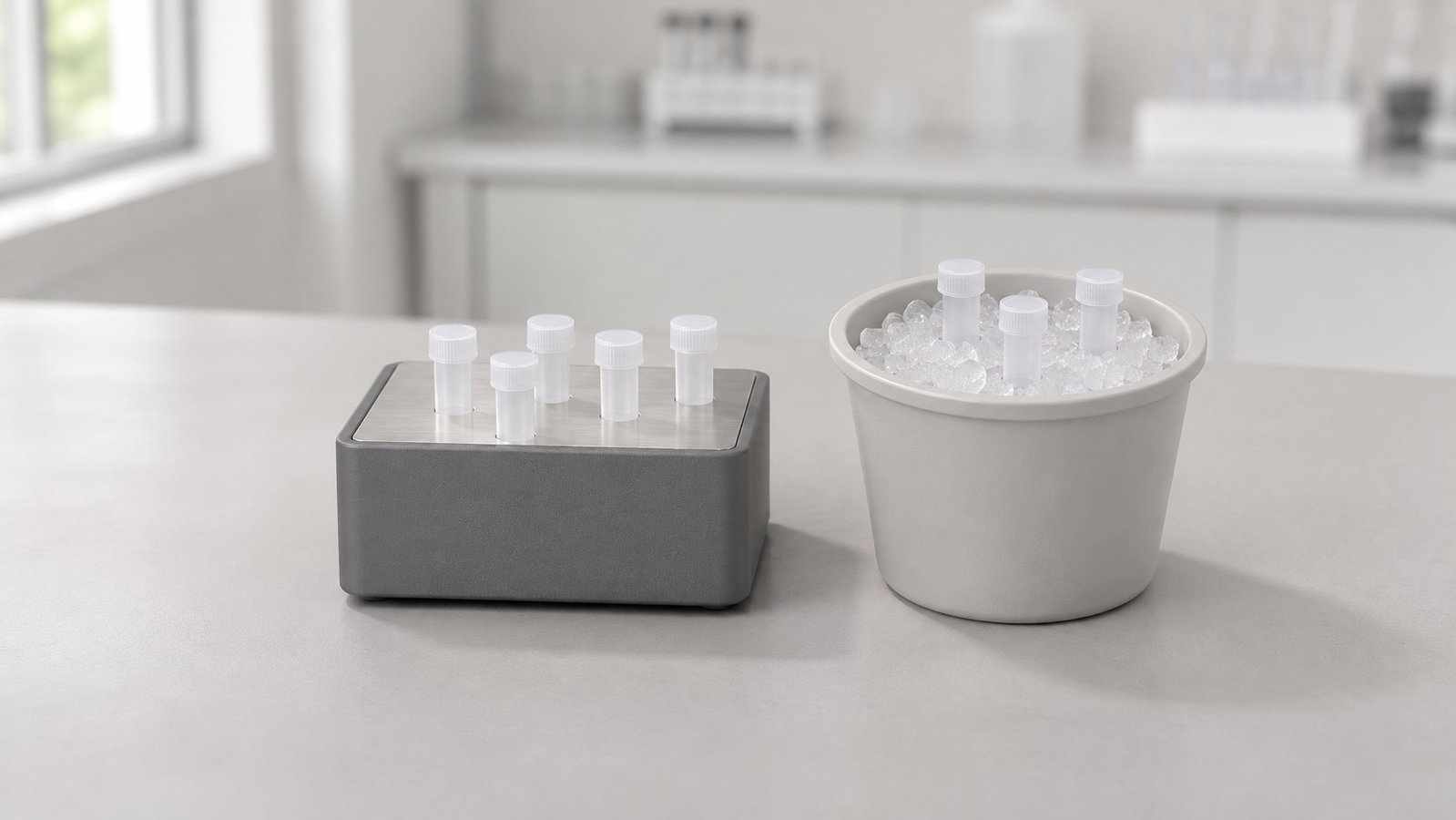
A 4 °C cooling block is a powered unit with a fixed cold control setting that can help keep samples cold on the bench without filling, topping up and draining an ice bucket. It is not colder than ice, and it does not replace every "on ice" step. This guide covers why cold holding matters, what ice buckets do well, what a fixed 4 °C specification tells you, how a fixed unit compares with adjustable heat-and-cool units and how to use a cooling block in practice. For the wider instrument family, see the guide to Dry Baths, Thermo Mixers and Cooling Blocks: Temperature Control for Tubes and Plates.
Quick answer:
- Why cold: many enzymes, proteins and other biological samples change more slowly at low temperature, but some are damaged by cold, so follow your protocol.
- Ice buckets: an ice–water mixture sits near 0 °C while ice remains, which makes it a dependable cold medium; melting, uneven contact and meltwater are the usual drawbacks.
- A 4 °C cooling block: a sample cooling block with a fixed set point controls the block's temperature, not the sample's; the sample still needs time to cool.
- Not a universal swap: keep ice wherever a protocol needs 0 °C or a fast quench, and confirm which tubes fit before you buy.
1. Why Hold Samples at 4 °C on the Bench
Slower reactions. Enzyme activity depends on temperature and varies between systems. Over many ordinary working ranges, lower temperatures reduce reaction rates, while some enzymes lose activity at higher temperatures through shifts toward inactive forms [1][2]. Cold holding may slow unwanted reactions while a sample awaits the next step.
Proteases and degradation. Cell lysis releases proteases that were kept apart from other proteins inside the cell, and protein work relies on limiting their effect until the protein of interest is separated from them [3]. Whether a protein keeps its activity during storage depends on both the protein itself and the storage conditions, including temperature [4].
Cold is not always better. Proteins can also unfold at low temperature, a general effect known as cold denaturation [5]. Use the temperature your protocol specifies, and treat 4 °C as one common choice rather than a rule.
2. Ice Buckets: What They Do Well and What Goes Wrong
What ice does well. An ice–water mixture near equilibrium remains near the ice point, essentially 0 °C; the ≤0.005 °C uncertainty reported for a carefully prepared calibration ice bath is not a specification for an ordinary bench bucket [6]. As long as ice remains, melting absorbs heat and the mixture stays near 0 °C. An ice bucket needs no power and suits odd-shaped vessels. That stability is real, and a 4 °C block should not be described as colder or more stable than ice.
What goes wrong in daily use.
- Melting and topping up. A calibration ice bath is kept at its fixed point by siphoning off water and adding fresh ice [6]. As ice melts, the slush thins, and once the ice is gone, the water can warm. Tubes may also tip or float.
- Uneven contact. Air conducts heat far less well than water, so tubes resting on top of cubes cool more slowly than tubes surrounded by slush [7]. How contact affects sample temperature is covered in Heating Block Modules and Tube Fit: How Air Gaps Affect Sample Temperature.
- Meltwater and cleanliness. A survey of 4,346 food-service ice samples found that most lacked the measured indicator bacteria, but ice used to cool drinks had poorer microbiological quality when meltwater was present in buckets [8]. A separate food-establishment study detected coliforms in 71 of 105 ice-chest samples [9]. Neither study measures contamination in research laboratories; keeping meltwater away from tube caps and labels remains a sensible handling precaution. Water handling in heated baths is compared in Dry Bath vs Water Bath: Uniformity, Contamination Risk and Heat-Up Time.
When ice is the right tool. Some protocols depend on ice itself. A common heat-shock transformation method incubates competent cells and DNA in ice, applies a short 42 °C heat shock and returns the tube to ice [10]. Where a step specifies ice, a quench or 0 °C, keep the ice bucket unless you have validated an alternative.
3. Fixed 4 °C Set-Point Control
What a fixed set point means. A fixed 4 °C control setting specifies the block's target temperature, not the temperature reached inside a loaded tube. Among the instruments discussed here, the CT4-Pro is the only one specified with a fixed 4 °C set point.
General principle, not a product specification. Some electrical cooling systems use thermoelectric devices that convert electrical power directly into cooling or heating [11]. This describes a general technology and does not identify the cooling mechanism of any ALab model in this article.
Example: the CT4-Pro. Despite the "Ice Box" in its name, the CT4-Pro is a powered thermostatic unit. It is rated at 80 W, alongside the specifications summarized below.
| Parameter | CT4-Pro |
|---|---|
| Functions | Cooling |
| Temperature control setting | 4 °C (fixed) |
| Temperature control accuracy | ±0.5 °C |
| Temperature uniformity | ±0.5 °C at its 4 °C set point |
| Unit cooldown to 4 °C | ≤10 min, depending on the module |
| Status indicator | LED Dual Colour (Red&Green) |
| Running state | Continuous |
| Noise level | ≤55 dB |
| Protection class | IP20 |
| Power | 80 W |
| Weight | 3.3 kg |
| Permissible ambient temperature and humidity | 5–40 °C, 80 % RH |
| Module list and tube formats | — |
Module models and supported tube formats are not specified. Module changeover is described as "easy replacement of magnetic adsorption", and applications include "sample preservation".
What the time figure means. The description says "it takes only about 10 minutes to reduce the temperature from room temperature to 4°C". That is the unit cooling down, and it depends on the module. It does not mean that every sample placed in it reaches 4 °C within 10 minutes.
What the specifications do not establish. The specifications do not give an ambient condition for the ±0.5 °C figures, and the 5–40 °C range is the permissible operating environment, not a promise that the block holds 4 °C across that range. Module compatibility, tube formats, in-tube temperature and sample equilibration time are not established, so confirm which tubes fit when you request a quote. To review the full specifications, view the product or request a quote on the ALab™ CT4-Pro 4°C Thermostatic Ice Box page.
Block temperature vs sample temperature. In a simple lumped-capacitance model with approximately constant surroundings, a sample approaches the surrounding temperature exponentially. The time constant depends on heat capacity and heat-transfer conditions; the model reaches about 95 % of its total temperature change after three time constants [7].
Calculated illustration, not a specification: assume a sample at 20 °C placed in surroundings held at 4 °C, with simple exponential cooling. After one time constant it is at about 9.9 °C, after three about 4.8 °C, and after five about 4.1 °C. The time constant itself depends on the tube, the fill volume and the contact, and is not given for any instrument here.
A possible ice bucket alternative. For holding enzymes, reagents or prepared samples at a steady cold temperature, a fixed 4 °C unit can be an ice bucket alternative for suitable workflows. It is not a universal replacement for steps that need ice.
4. Fixed 4 °C vs Adjustable Heat-and-Cool Units
Cooling below ambient is a different specification. Several heat-and-cool instruments can cool below room temperature, but their ranges are written relative to room temperature, so how cold they get depends on the room.
| Model | Functions | Temperature range or setting |
|---|---|---|
| CT4-Pro | Cooling | 4 °C (fixed setting) |
| HC110-Pro | Heating & cooling | Below room temp 25 to 110 |
| HCM100-Pro | Heating, cooling & mixing | Below room temp 15 to 100 |
| Mini HCL100 | Heating & cooling | (RT − 23 °C) to 100 °C |
| Mini HC100 | Heating & cooling | (RT − 23 °C) to 100 °C |
RT = room temperature. These ranges are relative to room temperature, so do not convert them into absolute lower limits.
Reading the contrast. The HC110-Pro, HCM100-Pro, Mini HCL100 and Mini HC100 all cool below ambient. None of them is presented here as a 4 °C holding device, and whether one reaches or holds 4 °C in your room is a question to confirm at quotation. The Mini HCL100 and Mini HC100 list a maximum cooling rate of 3 °C/min; that is a rate, not a time to reach 4 °C. The Mini H100 on the same page heats but does not cool, with a temperature range of room temperature +5 to 100 °C.
When an adjustable unit makes sense. If one instrument must heat a step and then cool below room temperature, an adjustable heat-and-cool unit fits better than a fixed 4 °C box. View the product or request a quote on the ALab™ HC110-Pro Thermo Control page, or for a compact heat-and-cool option, on the ALab™ Mini HCL100/Mini HC100/Mini H100 Mini Dry Bath page. If the step also needs shaking, see Thermo Mixers: Combining Temperature and Shaking for Incubation, Lysis and Denaturation.
5. Practical Tips for Cold Holding
- Pre-cool before loading. Switch the unit on and let the block reach its set point before samples go in; the time depends on the module.
- Warm samples add heat. Loading many room-temperature tubes at once can warm the block until it recovers; where your protocol allows, load in smaller batches.
- Check the fit. Confirm the module is compatible with your tubes and that each tube seats as intended; poor thermal contact can slow cooling.
- Watch for condensation. A cold surface in warm, humid air collects condensed water, much as droplets form on a glass of ice water [7]. Dry tube caps and labels before opening or reading them.
- Keep ice for ice steps. Where a protocol calls for ice or 0 °C, follow it.
6. Frequently Asked Questions
Is a 4 °C cooling block colder than an ice bucket?
No. An ice–water mixture sits near 0 °C while ice remains. A 4 °C unit uses a different, warmer set point; it is a way to keep samples cold without ice, not a colder alternative.
Can I replace every "on ice" step with a 4 °C block?
No. Steps that need ice, a fast quench or 0 °C, such as the ice incubations in heat-shock transformation, should stay on ice unless you have validated an alternative.
How long does a sample take to cool in a 4 °C block?
The CT4-Pro's specified ≤10 min cooldown to 4 °C, depending on the module, applies to the unit, not the sample. Sample cooling time is not specified and depends on the tube, fill volume and thermal contact.
Which tubes fit the CT4-Pro?
No module list or tube format is specified, so confirm module and tube fit when you request a quote.
Can a heat-and-cool dry bath hold 4 °C instead?
None of the heat-and-cool models discussed here specifies a 4 °C holding figure: they list temperature ranges relative to room temperature, so ask at quotation whether a model meets your target in your room.
7. Keep Exploring the Temperature Control Hub
- Dry Baths, Thermo Mixers and Cooling Blocks: temperature control for tubes and plates.
- Dry Bath vs Water Bath: uniformity, contamination risk and heat-up time.
- Heating Block Modules and Tube Fit: how air gaps affect sample temperature.
- Thermo Mixers: combining temperature and shaking for incubation, lysis and denaturation.