
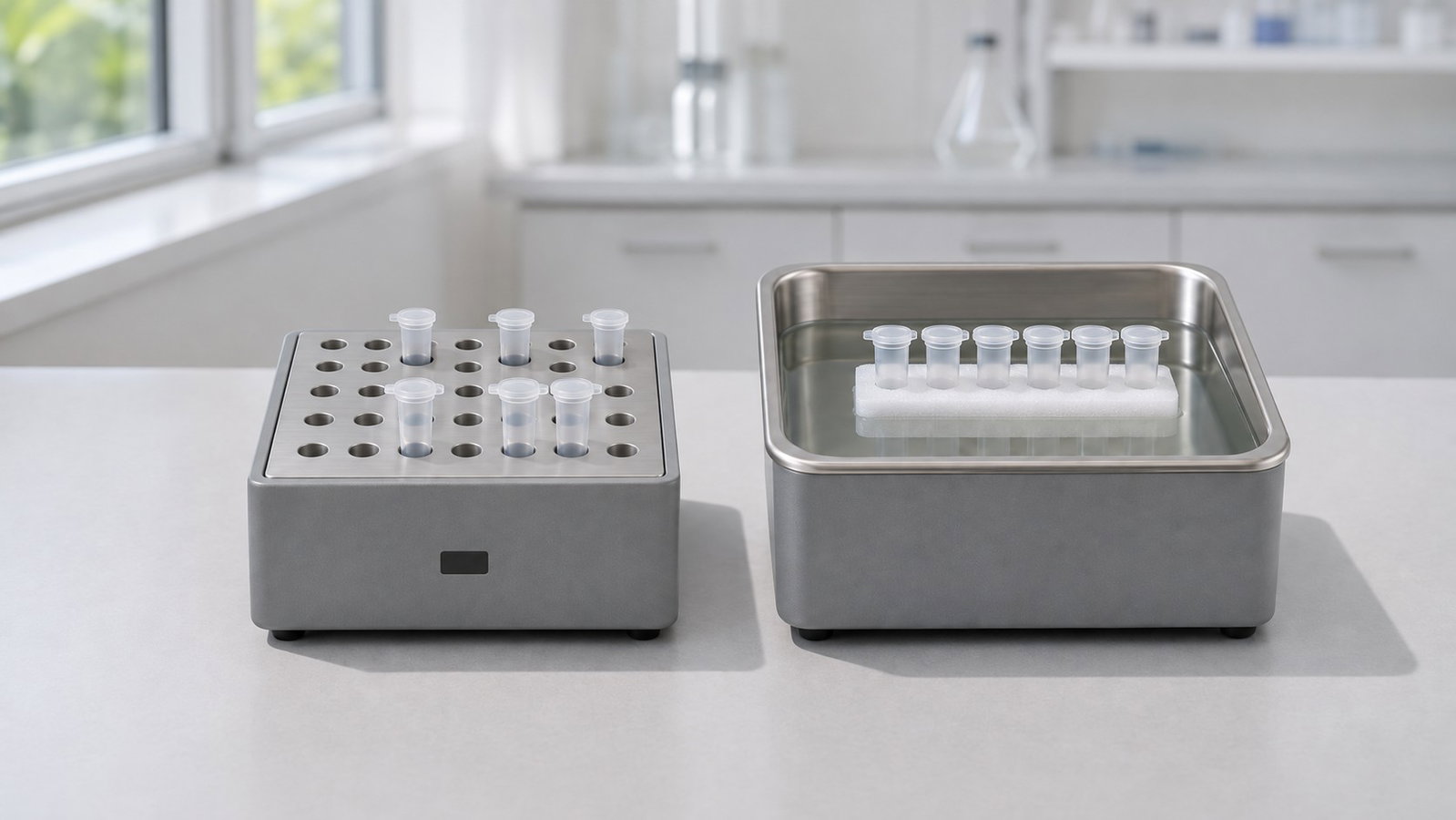
Dry bath vs water bath is really a choice between two ways of getting heat into a sample. A dry bath, also called a dry block heater, holds tubes in holes machined into a heated metal block, so heat arrives by conduction wherever the tube wall touches the metal. A water bath surrounds the vessel with warm liquid, so heat arrives by convection over the whole wetted surface. That one difference shapes the three things people compare most: how uniform the temperature is, what contamination risk comes with standing water, and how long heat-up takes. This guide covers each with theory, studies, protocols and ALab dry bath specifications, and shows where a water bath still fits better. For the wider instrument family, see the guide to dry baths, thermo mixers and cooling blocks.
Quick answer:
- Uniformity: a dry bath's uniformity figure describes the block at a stated test temperature, for example ±0.2 °C at 37 °C for the ALab HB105/HB150 series. It is neither the control accuracy nor the temperature inside your tube, which also depends on how well the tube fits the hole [1][2].
- Contamination risk: warm standing water can support bacterial growth, and water baths have repeatedly been traced as reservoirs of Pseudomonas and related bacteria [9–13]. A dry block removes the open water, but it still needs routine cleaning; neither device makes a sample sterile.
- Heat-up time: separate instrument warm-up (the block or bath reaching set point) from sample equilibration (the tube contents reaching it). Immersion gives full contact below the waterline on any vessel shape [1][3]; a block gives good contact where the tube matches the hole [1][2].
- Choosing: a water bath suits odd shapes, bottles and large volumes; a dry bath suits standard tubes when you want no water to fill, change or treat.
1. How Each One Heats a Tube
Water bath: convection over the wetted surface. In a water bath the liquid touches every part of the vessel below the waterline, whatever its shape. A textbook's illustrative natural-convection heat-transfer coefficients are about two orders of magnitude higher in water than in air [1]. Two practical limits follow. First, heat enters below the waterline, which is why one transformation protocol places the bottom half to two-thirds of the tube in the bath [7]. Second, a floating vessel sits partly out of the water: in one study, wells of a floating microplate stayed 1.9–4.7 °C below the bath temperature, while a submerged plate tracked the bath closely [3].
Dry bath: conduction through contact. In a block, heat flows from metal to tube wall through the places where they touch. No two solid surfaces make perfect contact; heat crosses the interface through points of solid contact and through tiny gas-filled gaps, and gases conduct heat poorly [1]. At 300 K, air has a thermal conductivity of about 0.026 W/m·K and water about 0.61 W/m·K [1].
| Layer 0.1 mm thick | Thermal conductivity (W/m·K, 300 K) | Resistance R = L/k (m²·K/W) |
|---|---|---|
| Air | 0.0264 | 3.8 × 10⁻³ |
| Water | 0.6103 | 1.6 × 10⁻⁴ |
Calculated illustration, not a specification. Using the textbook conductivities above [1], a 0.1 mm air layer resists heat flow about 23 times more than a 0.1 mm water layer. This illustrates why an air-filled gap can impede heat transfer between a block and a tube. It does not establish a universal difference in sample equilibration time between dry baths and water baths; vessel geometry, contact area and loading conditions also matter.
Metrologists treat this gap seriously. The German calibration guideline for temperature block calibrators requires the bore to be no more than 0.5 mm wider than the outer diameter of the thermometer being calibrated between −80 °C and 660 °C, or a heat-transfer medium that gives equal or better thermal contact [2]. How tube shape, hole size and air gaps affect what the sample sees is covered in depth in Heating Block Modules and Tube Fit: How Air Gaps Affect Sample Temperature.
2. Uniformity: What the Numbers Mean
Three different numbers often get mixed up in a dry block vs water bath comparison:
- Control accuracy: how closely the controlled temperature matches the set point under the manufacturer's stated test conditions; it is not automatically the accuracy of the temperature inside a sample tube.
- Uniformity: how much temperature varies between positions in the block (or bath) at a stated test temperature.
- Sample temperature: what the liquid inside your tube reaches, which also depends on contact, tube wall, volume and time (sections 1 and 4).
ALab dry bath specifications keep the first two apart: for the HB105/HB150 series, the ±0.2 °C figure is "the uniformity at 37°C, not the control accuracy". Heating block uniformity describes how evenly the metal is heated at its test temperature, not how evenly samples in different tubes are heated.
| Model | Uniformity at 37 °C | Control accuracy | Temperature range |
|---|---|---|---|
| HB105-S1, HB105-S2 | ±0.2 °C | 25–90 °C: ±0.3 °C; 90–105 °C: ±0.6 °C | room temp +5 °C to 105 °C |
| HB150-S1, HB150-S2 | ±0.2 °C | 25–90 °C: ±0.3 °C; 90–150 °C: ±0.6 °C | room temp +5 °C to 150 °C |
| HB120-S, HB120-SC | ±0.5 °C | ±0.5 °C | room temp +5 °C to 120 °C |
| HB60-S | ±0.3 °C | ±0.5 °C | room temp +5 °C to 60 °C |
| H100-Pro | ±0.5 °C | ±0.5 °C | room temp +5 °C to 100 °C |
| Mini HCL100, Mini HC100 | — | ±0.5 °C | (RT − 23 °C) to 100 °C |
| Mini H100 | — | ±0.5 °C | room temperature +5 °C to 100 °C |
How to read the table:
- Uniformity is given at 37 °C. Do not assume the same figure at 60 °C or 95 °C. The Mini page gives control accuracy but no uniformity figure, shown as "—".
- Temperature range is relative to the room. "Room temp +5 °C" means the block heats to at least 5 °C above ambient; the lower end moves with your lab temperature. HB60-S has preset temperatures of 25, 30, 37, 45 and 60 °C; its Temperature range is room temp +5 °C to 60 °C, so the lowest presets may not be reachable in a warm room.
- Compare like with like. A water bath's uniformity figure, where one is given, also depends on its own test conditions, such as circulation, water level, lid and load. Figures measured under different conditions are not directly comparable.
How block uniformity is characterized. For temperature block calibrators, the same calibration guideline describes a homogeneous measurement zone, usually at the bottom of the bore, and asks the calibration laboratory to determine axial homogeneity and the temperature differences between bores, plus the effect of loading where very small uncertainties are claimed [2]. These are method concepts, not a statement about any particular dry bath, but they show why a single uniformity number belongs to a defined test.
Load matters in both devices. In ATCC's serum heat-inactivation procedure, placing the bottle in a 56 °C water bath makes the bath temperature drop, and timing starts once the bath has returned to 56 °C [14]. A block likewise gives up heat to cold tubes until its controller recovers, which is why the calibration guideline treats loading as a separate effect [2].
What one comparison found. In a study of heat resistance in Escherichia coli, the time needed for tubes of media in heating block wells to reach 60 °C varied, which significantly affected the results; the authors concluded that the water bath method gave more reliable and consistent data for that test [4]. Check the tube type, fill volume and well fit before switching methods.
For research work such as molecular biology, assay preparation, biochemistry and genetics, where you want to thaw, boil, incubate and warm samples in a block with uniformity specified at ±0.2 °C at 37 °C, see the ALab™ HB105-S1/S2 & HB150-S1/S2 Dry Bath Series to view the product or request a quote. For the HB120-S, HB120-SC and HB60-S models in the table above, including the HB60-S presets, see the ALab™ HB120-S/HB120-SC/HB60-S Dry Bath Series.
3. Contamination Risk: Standing Water and Handling
Why water bath contamination happens. Warm water and a source of nutrients favour bacterial growth, and gram-negative bacteria such as Pseudomonas can grow in distilled water [9]. A classic study showed that Pseudomonas aeruginosa can grow relatively fast in distilled water from hospitals [10]. The CDC's environmental infection-control guideline lists water baths as a source of Pseudomonas, Burkholderia and Acinetobacter, and gives adding a germicide to the water as a control measure [9].
Several reports trace contamination to warm baths used to thaw or warm materials. One found 10⁵–10⁶ organisms/mL of P. aeruginosa in a 37 °C water bath and proposed a routine disinfection procedure expected to reduce contamination to below 20 organisms/mL [11]. Another used environmental sampling and DNA typing to identify a water bath as the likely reservoir of P. aeruginosa [12]. A third found mixed bacterial growth, mostly Pseudomonas species, on swabs from a water bath [13]. These reports come from hospital equipment, not research labs; they are cited here as evidence that bath water can carry high bacterial loads when it is not maintained.
How it reaches a sample. Potential exposure routes include bath water contacting caps or threads, droplets carried on the vessel exterior, and handling a wet tube near an open sample. The likelihood depends on the vessel seal and handling procedure [14][15]. ATCC's guidance for thawing frozen vials in a 37 °C water bath reflects this: keep the O-ring and cap out of the water to reduce the possibility of contamination [15], then remove the vial and decontaminate it by dipping in or spraying with 70 % ethanol [14].
Keeping a water bath clean. None of this makes water baths unusable. Change the water regularly, clean the tank, use an additive where the manufacturer allows it [9][11], keep caps above the waterline [15], and wipe vessels before opening them [14].
A dry block removes standing bath water, but still needs cleaning. Without an open water reservoir, there is no bath water to maintain; however, spills, condensate and residue can still collect in wells. Routine cleaning remains necessary. Dry-bath lids serve different purposes, and none of the functions described below establishes a sterilization or decontamination capability:
- The HB105/HB150 and HB120/HB60 dry baths are "equipped with a lid for heat preservation, and preventing pollution", a cover over the block.
- On the H100-Pro, "each heating block has a lid to minimize the heat loss".
- The Mini HCL100 "has a hot lid to prevent water condensing on the tube cap". This is a condensation-control feature, not a claim that the lid sterilizes the tube or prevents external contamination.
For a dry bath with a lid on each heating block and programs with up to 6 sequential steps, see the ALab™ H100-Pro Dry Bath to view the product or request a quote.
4. Heat-Up Time: Instrument Warm-Up vs Sample Equilibration
"Heat-up time" covers two different quantities:
- Instrument warm-up: the time for the block or the bath water to reach set point from a cold start.
- Sample equilibration: the time for the contents of a tube, once loaded, to approach the block or bath temperature.
Instrument warm-up depends on heater power and the thermal mass being heated. A water bath heats its whole water volume; a dry bath heats a metal block. Neither design is quicker in general, so compare stated figures for the specific instruments. The Mini dry baths are specified for instrument warm-up at ≤20 min from 25 °C to 100 °C, with a maximum heating rate of 8 °C/min for the Mini HCL100 and Mini HC100 and 6.5 °C/min for the Mini H100. These figures describe the block, not your sample. For the H100-Pro and HB models in the section 2 table, the current product pages do not state instrument warm-up times. When comparing these units, check instrument warm-up and sample equilibration separately under the intended loading conditions.
For a mini dry bath with a stated instrument warm-up and, on the Mini HCL100, a hot lid, see the ALab™ Mini HCL100/Mini HC100/Mini H100 Mini Dry Bath to view the product or request a quote.
Sample equilibration follows a heat-transfer rule of thumb: for a small, well-mixed sample, the temperature approaches the surroundings exponentially with a time constant τ = mc/(UA), where m is the sample mass, c its specific heat, U the overall heat-transfer coefficient and A the contact area; after three time constants the sample has completed about 95 % of the change [1]. Better contact (higher U) shortens τ, and a larger fill volume lengthens it.
| Assumed U (W/m²·K) | Time constant τ | Time to ~95 % (3τ) |
|---|---|---|
| 100 | 70 s | 209 s |
| 250 | 28 s | 84 s |
| 500 | 14 s | 42 s |
Calculated illustration, not a specification. Inputs: 1 mL of water (m = 1.0 × 10⁻³ kg, c = 4181 J/kg·K), an assumed heat-transfer area of 6 cm², and three assumed values of U. The U values are chosen to show scaling; they are not measurements of any instrument or bath. Halving the effective coefficient, for example through a poorer tube fit, doubles the time.
Measured results point the same way:
- In a water bath preheated to 55 °C, 200 µL of PBS in a floating thin-walled 0.5 mL tube reached within 1 °C of its observed maximum temperature in 44–52 s. A CellCarrier 96-well plate took approximately three times as long when submerged and 5.5 times as long when floating. Heating the tested plate on an aluminium dry block did not improve its heating performance compared with the tested water-bath methods [3].
- A review of thermal-therapy test platforms reports that conventional water baths and CO₂ incubators can need 80–2400 s to bring culture vessels to 42–50 °C, depending on the vessel [5].
- In heating block wells, the time for tubes of media to reach 60 °C varied enough to change heat-resistance results [4].
Short, timed steps are the sensitive case. Bacterial heat-shock protocols are a good example: one specifies 42 °C for 45 s [6], another 30–60 s in a 42 °C water bath, noting that the ideal time depends on the competent cells [7], and a third allows a heat block or a water bath for exactly 90 s, filling the block wells with water for efficient heat transfer [8]. These times are tuned to a vessel and a heat source. If you move a timed step from a bath to a block, or the reverse, re-check it with your own tubes.
5. Odd Shapes, Large Volumes and Bead Baths
Water conforms to the vessel; a block needs a matching hole. Bottles, flasks, bags and non-standard tubes are therefore natural water bath loads. ATCC's procedures use a water bath to thaw cryovials at 37 °C and to heat-inactivate serum at 56 °C, with enough water to immerse the bottle above the level of the serum [14]. Large or mixed loads favour a bath for the same reason.
Bead baths sit between the two: a tank of small dry beads replaces the water, so irregular vessels can be pushed into the medium without standing water. Beads touch the vessel at many small points with air between them, so contact is less complete than in water (the contact-resistance principle in section 1) [1]. The HB105/HB150 series offers a "Dual purpose block, bead bath/water bath"; if such a block is filled with water, the water bath cleaning habits in section 3 apply.
For heating round-bottom flasks, where mantles, oil baths and blocks are the usual options, see Heating Round-Bottom Flasks: Heating Mantle vs Oil Bath vs Heating Block vs Hotplate.
6. Dry Bath vs Water Bath at a Glance
| Factor | Dry bath (heated block) | Water bath |
|---|---|---|
| Heat path | Conduction through tube–hole contact | Convection from liquid over the wetted surface |
| Vessel shapes | Tubes and plates that match a block | Any vessel that can be immersed or floated |
| Contact quality | Depends on fit; air gaps add resistance | Full contact below the waterline |
| Uniformity figure | Block, at a stated test temperature | Bath, at its own stated test conditions |
| Standing water | None, unless a water-filled block is used | Yes; needs changing, cleaning and treatment |
| Contamination route | Spills and condensate in wells; handling | Water at caps and threads; drips; growth in the bath |
| Instrument warm-up | Heats a metal block | Heats the whole water volume |
| Sample equilibration | Depends on tube fit, contact area, fill volume and elapsed time | Depends on immersion, vessel geometry, fill volume and elapsed time; floating vessels may lag |
| Load recovery | Block temperature drops when cold tubes go in | Bath temperature drops when a cold load goes in |
7. When to Choose Each
Choose a dry bath when:
- your samples are in standard tubes or plates that match an available block;
- you want no water to fill, top up, change or treat, and no wet tubes to wipe;
- you can re-check timed steps with your own tubes, or fill wells with water where a protocol asks for it [8].
Choose a water bath when:
- vessels are bottles, flasks, bags or odd shapes, or loads are large;
- your protocol was developed and timed in a water bath, as the heat-shock and serum procedures cited here are [7][14];
- full immersion of plates or tubes matters for even heating [3][4].
Either way: where the method permits, use a suitable calibrated probe in a representative sample vessel with the intended fill volume. Allow the instrument to reach its operating temperature, avoid overloading, and check sample equilibration time rather than relying on the displayed set point alone.
8. Frequently Asked Questions
Is a dry bath more accurate than a water bath?
Not as a rule. Compare control accuracy and uniformity at their stated test temperatures, then consider contact: a well-fitting block and a well-maintained, stirred bath can both serve, while a loose tube or a floating plate lags either one [1][3].
Can I use a dry bath for a heat-shock step?
Some protocols explicitly allow either a heat block or a water bath, while others specify a water bath. Follow the method for your competent cells and equipment. If changing the heat source, verify the sample temperature and timing; fill block wells with water only when the protocol calls for it [6–8].
Does a dry bath remove contamination risk?
It removes standing water, the main growth medium in a bath, but wells, lids and tube exteriors still need cleaning, and handling remains a route for contamination [9][15].
Why does a thermometer in my tube read differently from the set point?
The displayed set point and the actual sample temperature are different quantities. Heat must pass through the tube wall and any imperfect contact with the heating block; sample volume and equilibration time also matter. A temperature-control accuracy specification does not establish the temperature inside every tube [1][2].
Does a dry-bath lid prevent contamination?
A lid may conserve heat, cover the block or limit condensation, depending on its design, but it does not establish sample sterility or a validated decontamination capability. Clean the equipment and handle samples according to your laboratory protocol.
9. Keep Exploring the Temperature Control Hub
- Dry Baths, Thermo Mixers and Cooling Blocks: temperature control for tubes and plates.
- Heating Block Modules and Tube Fit: how air gaps affect sample temperature.
- 4 °C Cooling Blocks: sample holding without an ice bucket.