
An optical dissolved oxygen sensor and an electrochemical one answer the same question, how much oxygen is in the water, in very different ways. Electrochemical sensors, polarographic and galvanic, measure a current produced as oxygen is reduced behind a membrane. Optical sensors, also called luminescent sensors, measure how oxygen dims the glow of a dye. The difference decides how each sensor behaves in still water, in sulfide-rich samples and during long deployments, and how much upkeep it needs. This guide explains both principles, how temperature, salinity and pressure turn an oxygen reading into mg/L, and when to choose each, with a summary of ALab dissolved oxygen meters at the end. For the wider picture, see the pH, conductivity and dissolved oxygen meter guide.
Quick answer:
- Electrochemical (polarographic or galvanic): oxygen diffuses through a membrane and is reduced at a cathode; the current is proportional to oxygen. The sensor consumes oxygen, so its reading depends on sample flow across the membrane, and it needs electrolyte and membrane upkeep [1][2][4].
- Optical (luminescent): oxygen quenches the luminescence of a dye; the sensor measures the change in intensity or lifetime. It consumes no oxygen, so it has no flow dependence, and it measures accurately in the presence of hydrogen sulfide [2][3][5].
- mg/L is calculated: both sensor types respond to oxygen partial pressure. Converting to mg/L needs temperature, salinity and barometric pressure [1][3][5].
- No universal winner: optical suits still water, sulfide-rich samples and long deployments; electrochemical sensors can respond faster and cost less [1][3].
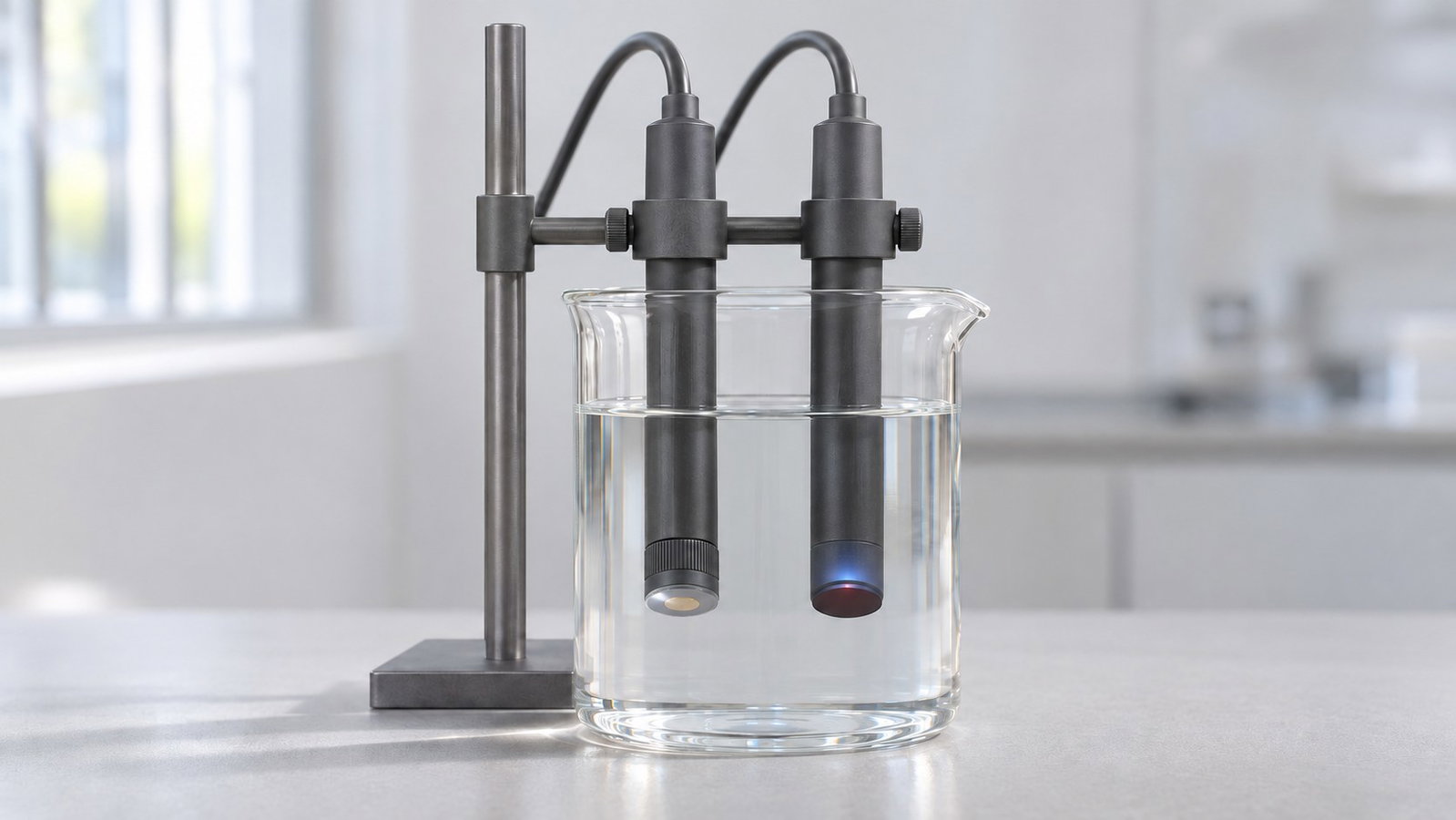
1. How Electrochemical DO Sensors Work
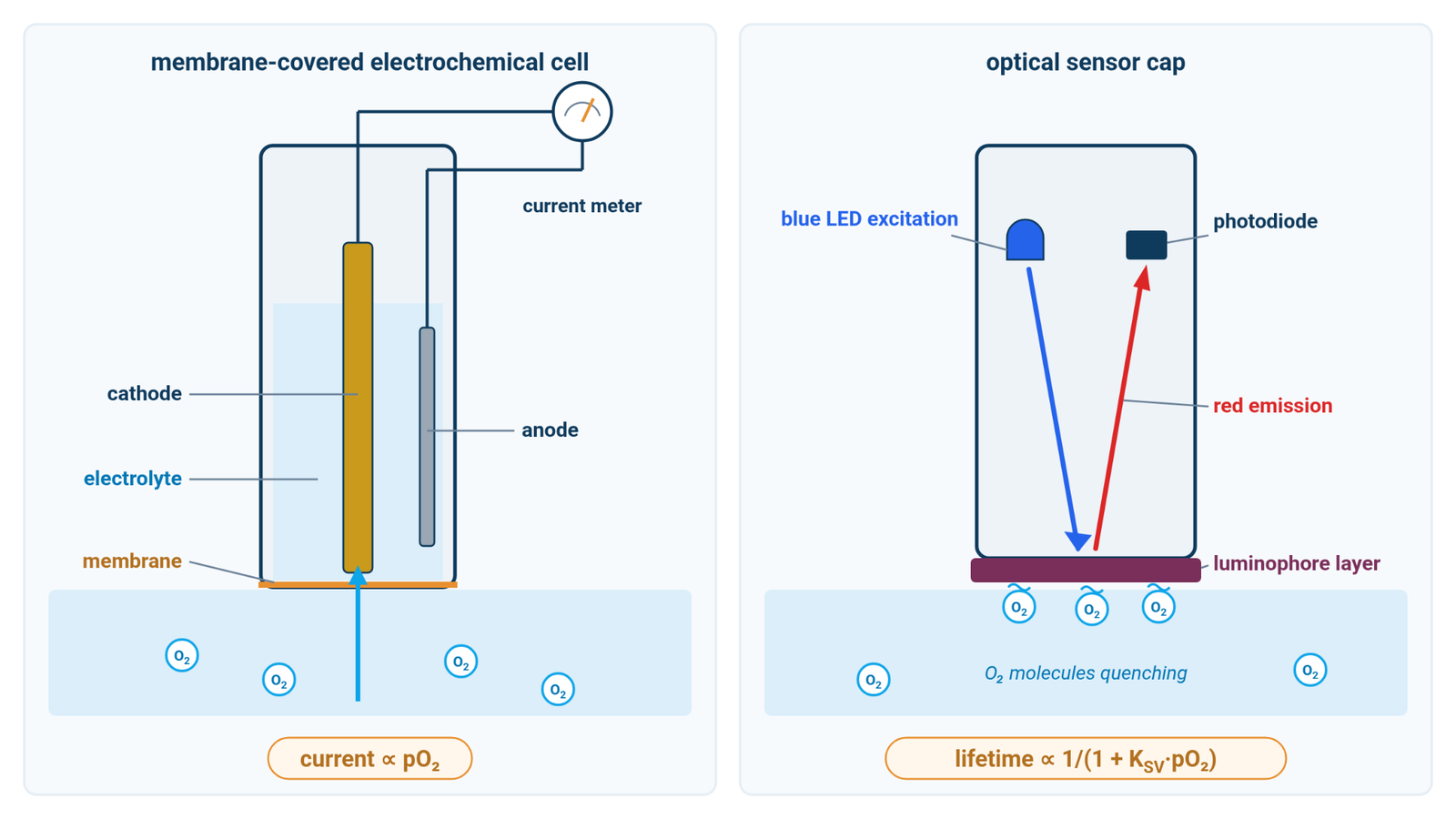
Electrochemical dissolved oxygen sensors descend from the membrane-covered electrode Leland Clark described in 1956 [6]. A cathode and an anode sit in an electrolyte, separated from the sample by a thin gas-permeable membrane. Oxygen diffuses through the membrane and is reduced at the cathode, and the resulting current is proportional to the oxygen partial pressure outside the membrane [1][4]. Two designs share this principle:
- Polarographic. An external voltage polarizes the electrodes [4]. In a common design with a gold cathode and a silver anode, a fixed polarizing voltage (0.8 V in one widely described sensor) drives the reduction O₂ + 2H₂O + 4e⁻ → 4OH⁻ at the cathode, while silver is oxidized to silver chloride at the anode in a chloride-containing electrolyte [1]. Because the electrodes must polarize after the sensor is switched on, polarographic sensors need a warm-up; the literature gives 5–15 minutes as a typical range [1].
- Galvanic. Dissimilar electrodes, for example a silver cathode with a zinc or lead anode, generate the polarizing voltage themselves, so the sensor is always polarized and needs no warm-up [1][4]. The trade-off is that the anode is consumed continuously, even when the sensor is not in use [1].
Both designs share three practical consequences:
- They consume oxygen. The cathode removes oxygen from the sample right at the membrane. In still water the layer next to the membrane can become depleted and the reading can drift low, so many conventional membrane electrodes require adequate sample movement. One field manual cites about 1 foot per second (about 0.3 m/s) for amperometric sensors; the actual requirement depends on the probe design [2].
- Chemical interferences. Gases that pass the membrane can interfere. Hydrogen sulfide is the best-known example; it can interfere with the reading and degrade the electrodes [2][4]. ISO 5814 also lists chlorine, amines, ammonia, bromine and iodine, and notes that solvents, oils, carbonates and biofilms can obstruct or deteriorate the membrane or corrode the electrodes [4].
- Consumables. The electrolyte and membrane must be replaced periodically, and the membrane must be free of wrinkles, bubbles and damage [1][2]. One manufacturer guide gives 2–8 weeks between membrane changes, depending on use [1].
2. How an Optical Dissolved Oxygen Sensor Works
A luminescent DO sensor replaces the electrodes with a sensing layer containing an oxygen-sensitive luminophore, often a metal–ligand complex immobilized in an oxygen-permeable polymer matrix [5][7]. An LED excites the luminophore, which emits light at a longer wavelength, often red in blue-excited designs. Optical DO sensing is also described as fluorescence-based sensing; luminescence is the broader term used here. Oxygen molecules that reach the dye take energy away from the excited state without light being emitted, a process called dynamic or collisional quenching. The more oxygen, the weaker and shorter-lived the luminescence [7][8]. Many designs add a second, reference light source to correct for drift in the optics [1][5].
For ideal dynamic quenching in a uniform sensing environment, the relationship is described by the Stern–Volmer equation [1][7][8]:
- I₀/I = τ₀/τ = 1 + K_SV · pO₂, where I and τ are the luminescence intensity and lifetime with oxygen present, I₀ and τ₀ are the values with no oxygen, and K_SV is the quenching constant of the sensing layer.
Real sensing layers can depart from the ideal Stern–Volmer relationship because luminophores experience different local environments; manufacturers correct for those departures in the sensor's calibration function, for example with a polynomial fit [1][7]. Sensors can measure either intensity or lifetime. Lifetime, often measured as the phase shift of pulsed or modulated light, does not depend on the intensity of the excitation or emitted light, which makes it a reliable basis for the measurement [2][5]. Quenching also depends on temperature, so the sensor's temperature must be measured and compensated alongside the oxygen signal [5].
The key difference from electrochemical sensors is that the measurement does not consume oxygen [2][3]. Optical sensors therefore have no flow dependence and can measure accurately in still water [2][3]. They also measure accurately in the presence of hydrogen sulfide, and they need no electrolyte and no polarization warm-up [1][2][3].
Optical sensors are not free of upkeep. The luminophore ages and the sensing cap or module is replaced periodically, commonly every one to two years depending on the manufacturer [2][3]. Some organic solvents can damage the sensing layer [3]. Optical sensors also have to be calibrated or calibration-checked, although they typically hold calibration for longer than electrochemical sensors [1][3].
3. Polarographic vs Optical DO: Side-by-Side
The table summarizes the general characteristics reported in methods literature and manufacturer guides. Individual sensors vary, so treat it as a guide to the principles rather than a ranking of products.
| Characteristic | Polarographic | Galvanic | Optical (luminescent) |
|---|---|---|---|
| Measuring principle | O₂ reduced at cathode; external polarizing voltage | O₂ reduced at cathode; self-polarizing electrodes | O₂ quenches dye luminescence |
| Consumes oxygen | Yes | Yes | No |
| Needs sample flow or stirring | Yes | Yes | No |
| Warm-up after switch-on | Yes, typically minutes | No | No polarization warm-up |
| Hydrogen sulfide | Interferes; can degrade electrodes | Interferes; can degrade electrodes | Measures accurately in its presence |
| Routine consumables | Electrolyte, membranes | Electrolyte, membranes; anode consumed | Sensing cap or module, replaced periodically |
| Calibration | Frequent, often daily for spot sampling | Frequent, often daily for spot sampling | Holds longer; still check regularly |
| Response | Can be fast with thin membranes | Can be fast with thin membranes | Varies by design; some are slower |
| Power and cost | Can be lower | Can be lower | Can be higher |
Sources: [1–5]. General sensor classes; not specifications for any ALab meter or probe.
Both principles are recognized measurement methods. ASTM D888 includes an electrochemical-probe method and a luminescence-based method, each for about 0.05–20 mg/L [11]. Standard Methods 4500-O includes a membrane-electrode method and an optical-probe method [12], and ISO publishes separate standards for the electrochemical probe (ISO 5814) and the optical sensor (ISO 17289) [4][5]. For most routine field operations without project-specific requirements to the contrary, the U.S. Geological Survey recommends optical sensors as the standard method. Its guidance highlights robustness, freedom from flow dependence and higher-quality data, especially at low oxygen concentrations, and it describes optical methods as reliable for groundwater below about 2 mg/L [3].
4. From Partial Pressure to mg/L: Dissolved Oxygen Solubility, Temperature, Salinity and Pressure
Neither sensor type measures mg/L directly. Both respond to the partial pressure of oxygen, which relates most directly to percent saturation [1][5]. The meter converts that to a concentration using the solubility of oxygen at the sample's temperature, salinity and barometric pressure [1][3][5]. At air saturation, dissolved oxygen solubility generally decreases as temperature or salinity increases and varies with the oxygen partial pressure, which depends on barometric pressure after accounting for water vapour. Standard equations for this, from Benson and Krause and from Garcia and Gordon, underlie the tables used in methods literature [3][9][10].
| Temperature | Freshwater, 100 % saturation | Seawater (salinity 35), 100 % saturation |
|---|---|---|
| 0 °C | 14.62 mg/L | 11.45 mg/L |
| 10 °C | 11.29 mg/L | 9.02 mg/L |
| 20 °C | 9.09 mg/L | 7.40 mg/L |
| 25 °C | 8.26 mg/L | 6.77 mg/L |
| 30 °C | 7.56 mg/L | 6.24 mg/L |
Calculated illustration, not a specification. Oxygen solubility at 101.325 kPa (760 mmHg). Freshwater values are from USGS Table 6.2-2 [3]; salinity-35 values were calculated using standard solubility equations [9][10].
Three consequences follow for anyone reading a DO meter:
- Temperature. Cold water holds far more oxygen than warm water at the same saturation: 100 % saturation is 14.62 mg/L at 0 °C but 7.56 mg/L at 30 °C. Temperature also changes how the sensor itself responds, so DO meters measure temperature and, in most current designs, compensate automatically [3][5].
- Pressure. Saturation concentration falls as barometric pressure falls, in proportion to the oxygen partial pressure after water vapour is accounted for. At 20 °C, 100 % saturation in freshwater is 9.09 mg/L at 760 mmHg but about 7.13 mg/L at 600 mmHg (about 80 kPa), as at a high-elevation site [3]. Calculated illustration, not a specification.
- Salinity. Dissolved salts lower oxygen solubility. Suppose a sensor reads 88 % saturation in a sample at 20 °C. Assuming freshwater gives 8.0 mg/L; if the sample is actually seawater with a salinity of 35, the correct concentration is about 6.5 mg/L, so leaving salinity at zero would overstate the result by roughly 23 %. Calculated illustration, not a specification.
Percent saturation can also exceed 100 %. Water can become supersaturated, for example where algae photosynthesize in sunlight, so a saturation range that extends well above 100 % is useful in natural waters [2][5].
5. Calibration and Upkeep for Both Sensor Types
Every DO sensor needs calibration, optical sensors included. Both types are commonly calibrated at saturation, in water-saturated air or air-saturated water, using temperature and barometric pressure to establish the expected saturation value [1][3][5]. Standard methods also describe checking the zero with an oxygen-free solution [4][5]. Follow the instrument manual and your laboratory method for the procedure and the frequency.
Upkeep differs more than calibration:
- Electrochemical. Replace the electrolyte and membrane when readings become slow, noisy or drift, and inspect the membrane for damage or bubbles [1][2]. Allow polarographic sensors to warm up before calibrating or measuring [1]. For spot sampling, one manufacturer guide recommends calibration every day the sensor is used [1].
- Optical. Keep the sensing cap clean, and replace it at the interval the manufacturer gives [2][3]. Optical sensors often hold calibration for months, but regular checks are still recommended, and a cap or module replacement calls for a fresh calibration check [1][3].
6. When to Choose Each
The right choice depends on the samples, the measurement routine and the budget, not on a single "better" technology.
An optical dissolved oxygen sensor is often the better fit when:
- Samples are still or slow-moving, such as small vessels or quiet water, where stirring is impractical. No oxygen is consumed, so no flow is needed [2][3].
- Hydrogen sulfide is present, as in some wastewater, sediment-adjacent water or anoxic samples [2][3].
- Oxygen is low, where USGS guidance reports higher-quality optical data and reliable optical measurements in groundwater below about 2 mg/L [3].
- The sensor is used intermittently or for long periods, and warm-up time, frequent membrane changes and electrolyte refills are a burden [1][2].
An electrochemical sensor remains a reasonable choice when:
- Response speed matters and a thin membrane can be used [1].
- Cost and power matter, and the selected electrochemical sensor meets the application's measurement, flow and maintenance requirements [1].
- Samples can be stirred or flow past the probe, and a routine of membrane and electrolyte maintenance is already in place [1][2].
- The method calls for it, since membrane-electrode methods remain part of the standard methods literature [4][11][12].
If you also measure pH or conductivity and are deciding between pocket, portable and benchtop meters, see our guide to choosing pH and conductivity meters: pocket tester, portable or benchtop.
7. Optical and Polarographic DO on ALab Meters
ALab dissolved oxygen meters use two of the sensor types described above: one portable optical meter, and portable and benchtop meters with a polarographic probe. Kit probes and accuracy:
| Series | Models | DO sensor | DO probe in kit | Membrane consumables in kit | DO accuracy | DO response time |
|---|---|---|---|---|---|---|
| Portable optical DO | DDOPRO10 | Optical (fluorescence) | ODO01-3M, 3 m cable | None (no membranes, no electrolyte) | ±0.20 mg/L | Shorter than 15 s |
| Portable (pH/Cond/DO) | DPCD10 | Polarographic | DO01-2M-H | DOS-01 membrane refill solution (30 mL); DOSC membrane caps (3 pcs) | ±0.30 mg/L | — |
| Portable | DDO10, DPD10, DCD10 | Polarographic | DO01-2M-H | DOS-01 membrane refill solution (30 mL); DOSC membrane caps (3 pcs) | ±0.30 mg/L | — |
| Touchscreen | DDO100T, DPD100T, DCD100T, DPCD100T | Polarographic | DO01-2M | DOS-01 membrane refill solution (30 mL); DOSC membrane caps (3 pcs) | ±0.30 mg/L | — |
| Classical | DDO100, DPD100, DCD100, DPCD100 | Polarographic | DO01-2M | DOS-01 membrane refill solution (30 mL); DOSC membrane caps (3 pcs) | ±0.30 mg/L | — |
For entries marked "—", contact us to discuss the parameter.
The DO accuracy specifications are ±0.20 mg/L for the DDOPRO10 and ±0.30 mg/L for the polarographic meters. The test conditions are not specified, so the figures are not a head-to-head comparison.
All of the meters above share the same dissolved oxygen measurement and compensation features:
| Feature | All ALab DO meters above |
|---|---|
| DO range | 0.00–20.00 mg/L |
| DO saturation | 0.0–200.0 % |
| Barometric pressure compensation | Automatic, 0–200.0 kPa |
| Temperature compensation | Automatic |
| Salinity compensation | Manual, 0–45 ppt |
How to read the tables:
- Salinity is entered manually. The meters compensate for salinity from the value you enter, up to 45 ppt. For brackish or seawater samples, enter the sample's salinity; using a zero-salinity setting for a saline sample would overstate mg/L, as illustrated in section 4.
- Pressure and temperature are compensated automatically, so percent saturation and mg/L follow the sample's conditions (section 4).
- Range is not accuracy. The 0.00–20.00 mg/L and 0.0–200.0 % figures are measuring ranges; accuracy is specified separately, and neither is the total uncertainty of a field measurement.
- DDOPRO10. The optical meter uses fluorescence sensor technology with no membranes, no electrolyte and no warm up. ACS Material specifies no minimum flow rate requirement and no sensitivity to hydrogen sulfide for this model, which is relevant to the still-water and sulfide-containing samples discussed in section 6.
- Polarographic kits. The DPCD10, Portable, Touchscreen and Classical DO kits include DOS-01 membrane refill solution and DOSC membrane caps for membrane and electrolyte maintenance. Follow the meter's manual for probe preparation and measurement practice.
- Kits and pricing. Probe and kit configurations are confirmed on the quotation. For pricing, request a quote or contact us.
For dissolved oxygen in still or sulfide-containing samples, or wherever no membranes, no electrolyte and no warm up are preferred, explore the ALab™ DDOPRO10 Portable Optical Dissolved Oxygen Meter. To measure dissolved oxygen alongside pH and conductivity with a polarographic probe, see the ALab™ DPCD10 Portable pH/Conductivity/Dissolved Oxygen Meter, the ALab™ Portable Meters or the ALab™ Benchtop Meters — Touchscreen Series.
8. Frequently Asked Questions
Is an optical dissolved oxygen sensor more accurate than a polarographic one?
Not inherently. Both are recognized methods, and accuracy depends on the specific sensor, its calibration and how it is used. Optical sensors avoid oxygen-consumption-related flow effects and conventional membrane-electrode interferences, and can improve data quality in low-flow or low-oxygen field conditions [2][3].
Do optical DO sensors need calibration?
Yes. They typically hold calibration longer than electrochemical sensors, but calibration should still be checked regularly and after the sensing cap is replaced [1][3].
Why does my polarographic DO reading drop when I stop stirring?
The sensor consumes oxygen at the membrane. Without flow, the water next to the membrane becomes depleted, and the reading falls. Keep the sample moving past the membrane [1][2].
Why do I need to enter salinity for a dissolved oxygen measurement?
Salt lowers how much oxygen water can hold at saturation. The sensor responds to oxygen partial pressure, so the meter needs the salinity to calculate mg/L correctly. In seawater, ignoring salinity can overstate mg/L by roughly 20–30 %, depending on temperature, as calculated from the solubility values in section 4 [3][9][10]. This is a calculated illustration, not a meter specification.
9. Keep Exploring the pH, Conductivity and DO Hub
- Choosing a pH or conductivity meter: pocket tester, portable or benchtop meter for the lab and the field.
- pH, conductivity and dissolved oxygen measurement: principles, calibration and choosing a meter.