
How to choose a pH meter comes down to three questions: where you measure, what you measure, and what you need to do with the numbers afterwards. A pocket tester, a portable meter and a benchtop meter can all read pH, and many also read conductivity, but they differ in power, protection, display, data handling and calibration options. This guide explains what each specification means, why range, resolution and accuracy are three different numbers, and how to read a comparison of meter families without treating form factor as an accuracy ranking. It ends with a side-by-side comparison of the ALab pH and conductivity meter families. For how pH, conductivity and dissolved oxygen measurements work in general, see the pH, conductivity and dissolved oxygen meter guide.
Quick answer:
- Pocket pH tester: a compact, battery-powered instrument for spot checks; compare the available probe, protection and data features by model.
- Portable meter: a handheld meter with a separate probe on a cable, a larger display and on-meter data logging, for field rounds and work away from the bench.
- Benchtop meter: designed for fixed-bench work, with a larger display; check each model for its probe-holder and data-export options.
- Multiparameter meter: one instrument for pH plus conductivity (and sometimes dissolved oxygen), useful when you measure several parameters on the same sample.
- Form factor is not accuracy: compare range, resolution and accuracy separately, choose the electrode for the sample, and remember that buffers and electrode condition limit the result [1][3].
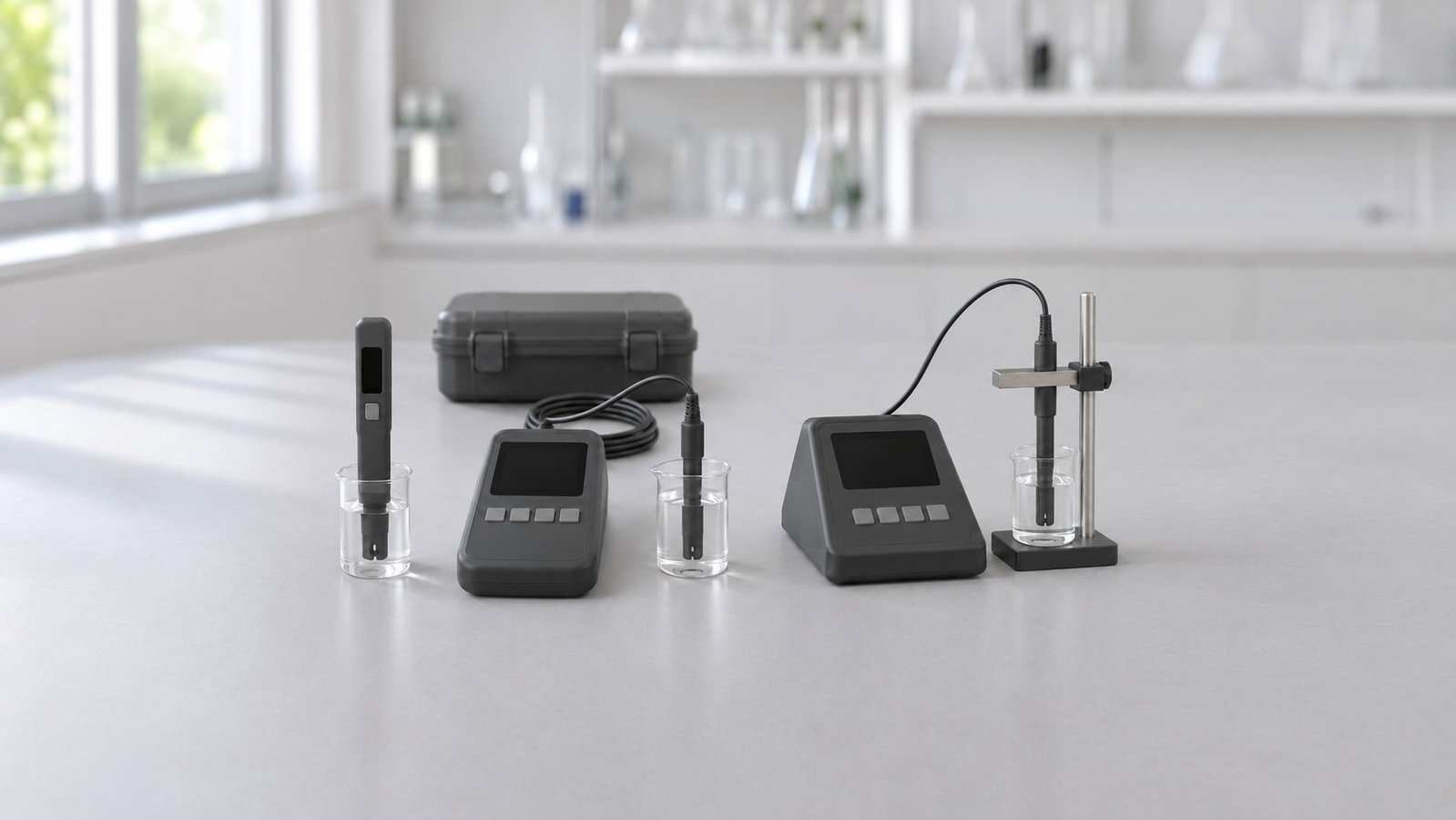
1. Pocket pH Tester, Portable or Benchtop: Start With Where You Measure
The setting narrows the choice faster than any specification. Each form factor solves a different practical problem.
- Pocket pH tester. The electrode sits in, or plugs directly into, a pen- or palm-sized body. There is no cable to manage and nothing to set up, so a pocket tester suits spot checks at many points in a day, in a greenhouse, a pilot plant or a teaching lab. Depending on the model, trade-offs can include a smaller display, fewer data features and a narrower meter range.
- Portable meter. A handheld meter connects to one or more probes by cable. The probe can reach into a tank, a sampling bottle or a stream while the meter stays in your hand. Models with onboard storage can retain readings for later review. Portable meters suit field rounds and work in several rooms or buildings.
- Benchtop meter. A mains-powered meter with a large display, often used with a probe holder, so the electrode can stay in position over a beaker while you prepare the next sample. Benchtop meters suit routine batches, where data export to a computer, flash drive or printer saves transcription.
The benchtop vs portable pH meter decision is rarely about which is "better". It is about whether readings are taken at the sample or the sample is brought to the meter. Field guidance makes the point: the USGS field manual requires pH meters used for its field work to be battery powered and to have automatic temperature compensation (ATC), an accuracy of ±0.1 pH or better and a resolution of 0.01 pH [4]. Those are portability and data-quality requirements for one agency's field program, not a ranking of meter types.
The probe matters as much as the meter body. Conductivity probes with epoxy, plastic or stainless-steel bodies and graphite electrodes are well suited to field use, whereas glass probes with platinum-iridium electrodes are more fragile and better suited to the laboratory [7]. The same logic applies to pH electrodes: the right electrode depends on the sample, and electrode guides cover junction types, reference electrolytes and membrane glass for particular samples [3].
2. Which Parameters: pH, ORP, Conductivity or a Multiparameter Meter
List the parameters you need before you compare meters, because they decide which models are relevant at all.
- pH needs a pH electrode and, for temperature compensation, a temperature sensor, either built into the electrode or separate [3].
- ORP (oxidation-reduction potential) is read in millivolts with an ORP electrode. Many pH meters have an mV or ORP mode, but the mode alone does not include the electrode, so check whether an ORP electrode is part of the kit.
- Conductivity needs a conductivity cell whose cell constant suits the expected range: the lower the sample conductivity, the smaller the cell constant should be [8]. TDS, salinity and resistivity are usually calculated from conductivity, so they come with the conductivity function rather than as separate sensors. ASTM D1125 Method A covers field and routine laboratory measurements on static samples with conductivity from 10 to 200 000 µS/cm [9]. Whatever the meter, check that the meter and probe cover the full range of conductivity you expect [7].
- Dissolved oxygen (DO) requires a dedicated probe. Choosing the DO sensor technology is covered in a separate guide.
A multiparameter meter combines two or three of these on one instrument. One meter provides a shared display and can simplify the measurement workflow; data-logging features vary by model. It does not merge the probes: each parameter still has its own electrode or cell, with its own calibration and care. Some multiparameter meters use a combined probe; others have a separate socket for each probe, which lets you replace one sensor without affecting the others. If you measure several parameters on the same samples, a multiparameter meter reduces handling; if you only ever measure pH, a single-parameter meter keeps the setup simple.
3. Range, Resolution and Accuracy Are Different Numbers
Three numbers appear on every pH meter specification, and they answer different questions.
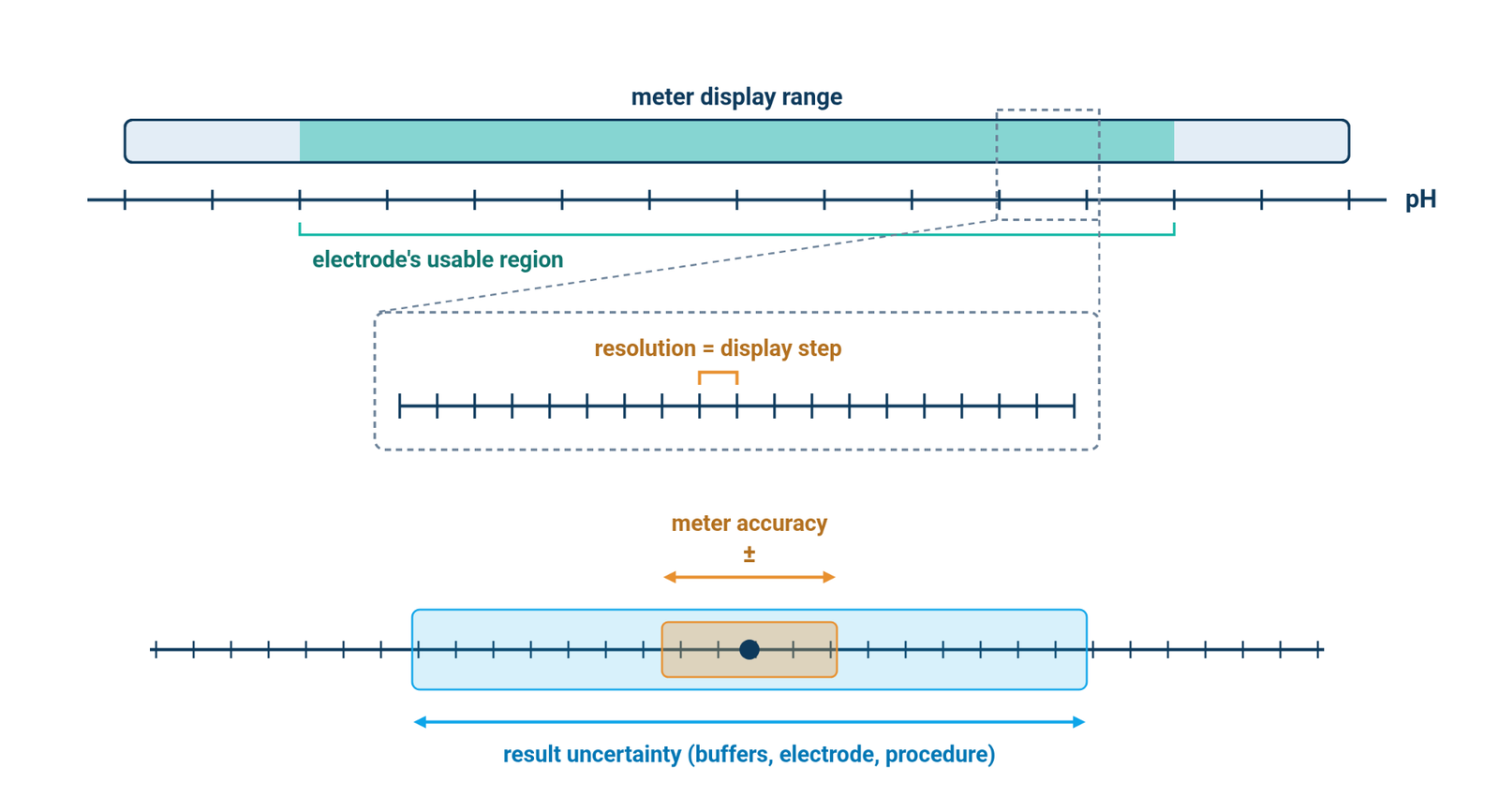
- Range is the span of values the meter can display. A meter range of −2.000 to 20.000 pH describes the electronics, not the chemistry. The usable range is set by the electrode: in strongly alkaline solutions with sodium or lithium ions, the glass membrane responds partly to those ions and reads too low (the alkaline or sodium error, which grows with pH above about 9 and with temperature), and in strongly acidic media the electrode reads too high (the acid error) [3]. A wide meter range does not mean the electrode reads accurately at the extremes.
- Resolution is the smallest step the display shows, such as 0.1, 0.01 or 0.001 pH. A finer resolution lets you watch a reading settle, but it does not make the result more accurate. The USGS field manual records field pH to 0.01 pH, if the meter provides that precision [4].
- Accuracy refers to the meter's performance, often expressed as ± pH units ±1 digit. It is not the full uncertainty of a sample result, which also depends on the buffers, electrode and procedure. IUPAC gives a target expanded uncertainty of 0.02–0.03 pH for two-point bracketing calibration when buffer uncertainty is 0.01 pH or better [1]. A meter-accuracy figure of ±0.002 pH does not guarantee a sample result accurate to ±0.002 pH.
Conductivity accuracy is often given as a percentage of full scale (% F.S). That percentage refers to the full scale of the range in use, not to the reading, so the absolute error depends on which range the meter is on. Calibrating with a standard close to the expected sample conductivity is the practical way to check performance where it matters [7][8].
4. Calibration Points and Temperature Compensation
A pH meter is only as good as its calibration. IUPAC notes that in most practical applications glass electrodes are calibrated with two buffers that bracket the sample, which sets both the offset and the slope; multipoint calibration with up to five buffers is used when minimum uncertainty is needed over a wide pH range [1]. ISO 10523 describes setting the zero point with the first buffer and the slope with the second [2], ASTM D1293 includes a method that uses two buffers to standardize the instrument [5], and EPA Method 9040C calls for at least two points that bracket the expected sample pH [6].
So, when you compare meters, ask how many calibration points you actually need. For a narrow, known sample range, two bracketing buffers are usually enough; additional points may be useful when the sample range is wide and the method supports them [1]. Slope, offset and how often to calibrate are covered in our guide to pH meter calibration: 2-, 3- and 5-point calibration, slope and offset.
Conductivity meters are calibrated differently. The cell constant, the ratio that converts measured conductance to conductivity, is determined by measuring a standard of known conductivity, usually at one point near the sample range [7][8].
Temperature compensation. ATC uses the measured temperature to correct the electrode's theoretical slope. It does not correct the sample's own change in pH with temperature [2][6], and it does not convert the pH to a value at 25 °C. Report the measurement temperature together with the pH [6]. ATC is still worth having on any meter used across varying sample temperatures, and the temperature sensor's own accuracy matters too.
5. Data, Power and Protection
Once the measurement specifications fit, practical features often decide the choice.
- Data. Decide whether readings are written by hand, stored on the meter, or exported. Stored readings support field logs; timed logging records a reading at a set interval without you pressing a key; export to a flash drive, a PC or a printer avoids transcription errors in the lab.
- Power. Replaceable batteries are simple to swap in the field, rechargeable batteries avoid buying cells, and mains power suits a meter that never leaves the bench.
- Protection. The IP code from IEC 60529 rates an enclosure in two digits [10]. The first digit covers solid objects and dust: 5 means dust-protected (some dust may enter, but not enough to interfere with operation), and 6 means dust-tight. The second digit covers water: 4 means protection against splashing water from any direction, and 7 means protection against the effects of temporary immersion under standardized conditions of pressure and time [10]. An IP code describes the enclosure's test result; it is not a statement about how long a meter can be used underwater, so follow the instrument manual.
6. ALab pH and Conductivity Meters Compared
The ALab pH and conductivity meters come in five families: pocket testers, portable meters, the DPCD10 portable 3-in-1 meter, and two benchtop series. The rows below follow form factor, from pocket to benchtop; the order is not a ranking, and no family is the default choice. The table includes models with pH, conductivity or both functions.
| Series | Models (pH and/or conductivity) | Display | Power | Protection | Data storage | Data export |
|---|---|---|---|---|---|---|
| ALab™ Pocket Testers | DPH1, DPH1+, DEC1, DEC1+, DPC1, DPC1+ | Multi-color backlight | 4×1.5 V AAA batteries | IP67 | — | Bluetooth APP on "+" models |
| ALab™ Portable Meters | DPH10, DPC10, DPD10, DPO10, DEC10, DCD10 | 3.5-inch TFT color | Rechargeable lithium battery, Type-C charging | IP57 | Up to 3000 groups | — |
| ALab™ DPCD10 Portable pH/Conductivity/Dissolved Oxygen Meter | DPCD10 | 3.5-inch TFT color | Rechargeable lithium battery, Type-C charging | IP57 | Up to 3000 groups | — |
| ALab™ Benchtop Meters — Classical Series | DPH100, DPC100, DPD100, DPCD100, DEC100, DCD100 | 7-inch, white backlight | DC12V | IP54 | 450 readings | Flash disk; optional wireless printer (not included) |
| ALab™ Benchtop Meters — Touchscreen Series | DPH100T, DPC100T, DPD100T, DPCD100T, DEC100T, DCD100T | 7-inch touch screen | DC12V | IP54 | 500 readings per parameter | Flash disk, PC; optional wireless printer (not included) |
For entries marked "—", contact us for details; a dash does not mean the feature is unavailable.
| Series | pH range (meter) | pH resolution | pH accuracy | pH calibration | ORP mode range | Conductivity accuracy | Conductivity calibration |
|---|---|---|---|---|---|---|---|
| −2.00 to 16.00 | 0.1 / 0.01 | ±0.01 pH ±1 digit | Up to 3-point automatic | −1000.0 to +1000.0 mV | ±1.0 % F.S ±1 digit | — | |
| Portable | −2.000 to 20.000 | 0.1 / 0.01 / 0.001 | ±0.002 pH ±1 digit | Up to 3-point automatic | −1999.9 to +1999.9 mV | ±0.5 % F.S ±1 digit | One point |
| DPCD10 | −2.000 to 20.000 | 0.1 / 0.01 / 0.001 | ±0.002 pH ±1 digit | Up to 3-point automatic | −1999.9 to +1999.9 mV | ±0.5 % F.S ±1 digit | One point; probe constant or standard solution |
| Classical | −2.00 to 20.00 | 0.1 / 0.01 | ±0.01 pH ±1 digit | Up to 3-point automatic | −1999.9 to +1999.9 mV | ±1.0 % F.S ±1 digit | One point |
| Touchscreen | −2.000 to 20.000 | 0.01 / 0.001 | ±0.002 pH ±1 digit | 1- to 5-point | −1999.9 to +1999.9 mV | ±0.5 % F.S ±1 digit | One point |
Specifications in each row apply only to models that offer the corresponding measurement mode; not every model in a series measures every parameter shown. A dash does not mean a feature is unavailable—contact us for model-specific details. F.S = full scale.
How to read the tables:
- Ranges are meter ranges. The pH figures describe what each meter can display; the electrode sets the usable range (section 3). Conductivity accuracy is a percentage of full scale on the range in use, not of the reading.
- The order is not an accuracy ranking. The Classical Series has a meter pH-accuracy figure of ±0.01 pH ±1 digit, compared with ±0.002 pH ±1 digit for the Portable Meters. A benchtop form factor does not by itself imply a smaller accuracy figure, and resolution remains a separate specification.
- Calibration points. The Pocket, Portable, DPCD10 and Classical meters support up to 3-point automatic calibration for pH. The Touchscreen Series supports 1- to 5-point calibration in pH mode, including 1- and 4-point choices; 4- and 5-point routines are available only on the Touchscreen Series. Conductivity calibration is one point on the Portable, DPCD10, Classical and Touchscreen meters.
- Temperature. Across all five families, pH-capable models offer automatic temperature compensation and have a temperature-measurement accuracy of ±0.2 °C. For the Pocket pH testers, the pH ATC range is 0–60 °C.
- ORP. The pH models read ORP in mV mode with an ORP electrode (not included). The exceptions are the DPO10, whose kit includes an ORP electrode, and the dedicated ORP models DORP1, DORP1+ and DORP10, which also include one.
- Pocket testers. These models use replaceable combined probes and color-coded backlighting for measurement, calibration and alarm modes. The conductivity-capable DEC1, DEC1+, DPC1 and DPC1+ have a 0–19.99 mS/cm range; the Bluetooth "+" models offer calibration reminders, sample IDs and timed logging through a mobile APP.
- Portable Meters. The portable meters combine a 3.5-inch TFT display with automatic timed data logging, parameter setting and a data hold function, in single- and multi-parameter models.
- DPCD10. The DPCD10 has separate BNC, 4-pin and 8-pin sockets for pH/ORP, conductivity/temperature and DO probes, respectively. It offers selectable timed logging and two conductivity-calibration methods: probe constant and standard solution.
- Classical Series. The classical benchtop meters pair a 7-inch display with automatic calibration, flash-disk export and an optional wireless printer, and a flexible probe holder is included with every model.
- Touchscreen Series. The touchscreen benchtop meters offer 1- to 5-point pH calibration, storage per parameter and export to flash disk or PC; the DPCD100T displays pH, conductivity and dissolved oxygen simultaneously.
For dissolved oxygen measurements, the ALab™ DDOPRO10 Portable Optical Dissolved Oxygen Meter is a separate, dedicated DO option; optical and polarographic DO sensors are compared in our guide to optical vs electrochemical dissolved oxygen sensors.
Kits and pricing. Probe and kit configurations are confirmed on the quotation. For pricing, request a quote or contact us.
7. A Checklist Before You Choose
In practice, how to choose a pH meter comes down to a short list of answers. Work through these questions, then compare the families that fit every answer:
- Where will readings be taken? At the sample (field, production floor, several rooms) or at a fixed bench?
- Which parameters? pH only, pH and ORP, conductivity, or pH plus conductivity and DO on the same samples?
- What sample range? Very acidic or strongly alkaline samples call for an electrode chosen for those conditions, whatever the meter range [3]. For conductivity, match the cell constant and the meter range to your samples [7][8].
- How many calibration points? Two bracketing buffers for routine work; more when samples span a wide pH range [1].
- What happens to the data? Handwritten, stored on the meter, logged at intervals, or exported to a PC, flash disk or printer?
- How much protection? Splashes on a bench, dust on a site, or occasional immersion in the field (section 5)?
- Which method or SOP applies? If your laboratory follows a written method, check its requirements for calibration, temperature reporting and record keeping before choosing [2][4][5].
8. Frequently Asked Questions
Is a benchtop pH meter more accurate than a portable one?
Not automatically. Accuracy is a specification of each meter, not of its form factor, and the uncertainty of a pH result depends mainly on the buffers, the electrode and the procedure [1]. Compare the accuracy specifications of the specific meters, and calibrate with buffers that bracket your samples.
Do I need 0.001 pH resolution?
Only if your method calls for it. Resolution is the display step, not the accuracy of the result. For example, the USGS field manual records field pH to 0.01 pH [4]. A finer display can help you see when a reading has settled.
Can a pocket pH tester measure conductivity?
Some can. Combined pH and conductivity testers exist, and the same compact format is available for conductivity alone. Check that the tester's conductivity range covers the samples you expect to measure [7].
What does IP67 mean on a meter?
Under IEC 60529, the 6 means dust-tight and the 7 means protection against the effects of temporary immersion in water under standardized test conditions [10]. It is an enclosure rating, not a guarantee for continuous use underwater.
When is a multiparameter meter worth it?
When you routinely measure two or more parameters, such as pH and conductivity, on the same samples. You use one instrument for several measurements, but logging features vary by model and each probe still needs its own calibration and care.
9. Keep Exploring the pH, Conductivity and DO Hub
- pH, conductivity and dissolved oxygen measurement: principles, calibration and choosing a meter.
- pH meter calibration: 2-, 3- and 5-point calibration, slope and offset.
- Optical vs electrochemical dissolved oxygen sensors: how they work and when to choose each.