
pH meter calibration turns the millivolt signal from a glass electrode into a pH value you can trust. Every electrode drifts: its zero point moves, and its response per pH unit, the slope, falls as it ages. A calibration measures both against buffers of known pH. This guide explains slope and offset, how 1-, 2-, 3- and 5-point calibrations differ, how to choose and handle pH calibration buffers, what published sources accept as slope and offset, and how often to calibrate a pH meter. For how pH, conductivity and dissolved oxygen meters work in general, see the pH, conductivity and dissolved oxygen meter guide.
Quick answer: A pH calibration establishes the relationship between electrode voltage (mV) and pH using known buffers; multi-point methods may use one fitted line or separate segments (section 3). The offset is the electrode's voltage in a pH 7 buffer (ideally 0 mV), and the slope is the change in voltage per pH unit, ideally 59.16 mV at 25 °C and usually reported as a percentage of that value [1][5][6]. A 1-point calibration corrects only the offset; a 2-point calibration with buffers that bracket the sample sets both offset and slope and is the most common routine procedure; 3 or more points cover a wider pH range, and up to five buffers can be fitted by regression [1]. Calibrate with fresh buffers at the sample temperature, and check the slope and offset against your method's or electrode manufacturer's limits. One manufacturer's guide recommends calibrating at least once a day and the USGS field manual daily; recalibrate whenever a check buffer reads outside your tolerance [5][6].
Scope note: The ALab meters discussed support up to 3-point automatic calibration, except the Touchscreen Series, which offers 1- to 5-point calibration for pH mode. The 2-, 3- and 5-point calibrations in the title are explained as general technique; they are not a statement that every ALab series offers all three (section 7).
1. What a pH Calibration Measures: Slope and Offset
A pH electrode does not read pH directly. A glass combination electrode produces a voltage that changes with the hydrogen-ion activity of the solution, and the meter converts that voltage to pH. The constant part of that voltage varies from electrode to electrode and from day to day, which is why an electrode is calibrated with a standard buffer before use [4]. In the ideal case the response follows the Nernst equation, E = E° − k·pH, where k = (RT/F)·ln 10 is the theoretical slope [1]. At 25 °C, k is 59.16 mV per pH unit [5][6]. The voltage therefore falls as pH rises: positive in acid buffers, near zero around pH 7, negative in alkaline ones.
Real electrodes depart from this ideal in two ways, and a calibration measures both:
- Offset and zero point. The offset is the voltage, in mV, that the electrode gives in a pH 7.00 buffer; ideally it is 0 mV [5][12]. The zero point expresses the same property in pH units: the pH at which the electrode gives 0 mV, close to pH 7 for most glass electrodes [5]. The USGS field manual calls this pH the isopotential point [6]; it is not the same as the isothermal intersection point, where calibration lines measured at different temperatures cross [5]. ISO 10523 asks that the meter allow adjustment of the "zero point of the pH electrode (or offset voltage)" as well as the slope [2].
- Slope. The change in voltage per pH unit. Glass electrodes often show a practical slope smaller than the theoretical value, a "sub-Nernstian" response; IUPAC notes that the practical slope may be up to 5 % lower than theoretical [1]. Meters usually report slope as a percentage of the theoretical value [6]. Coatings and electrode ageing produce an apparent decrease of the slope [2], so a falling slope is one of the first signs that an electrode needs cleaning or replacement [5].
The theoretical slope also changes with temperature; that is covered in our article on temperature compensation in pH and conductivity. Here, slope and offset are treated at the calibration temperature.
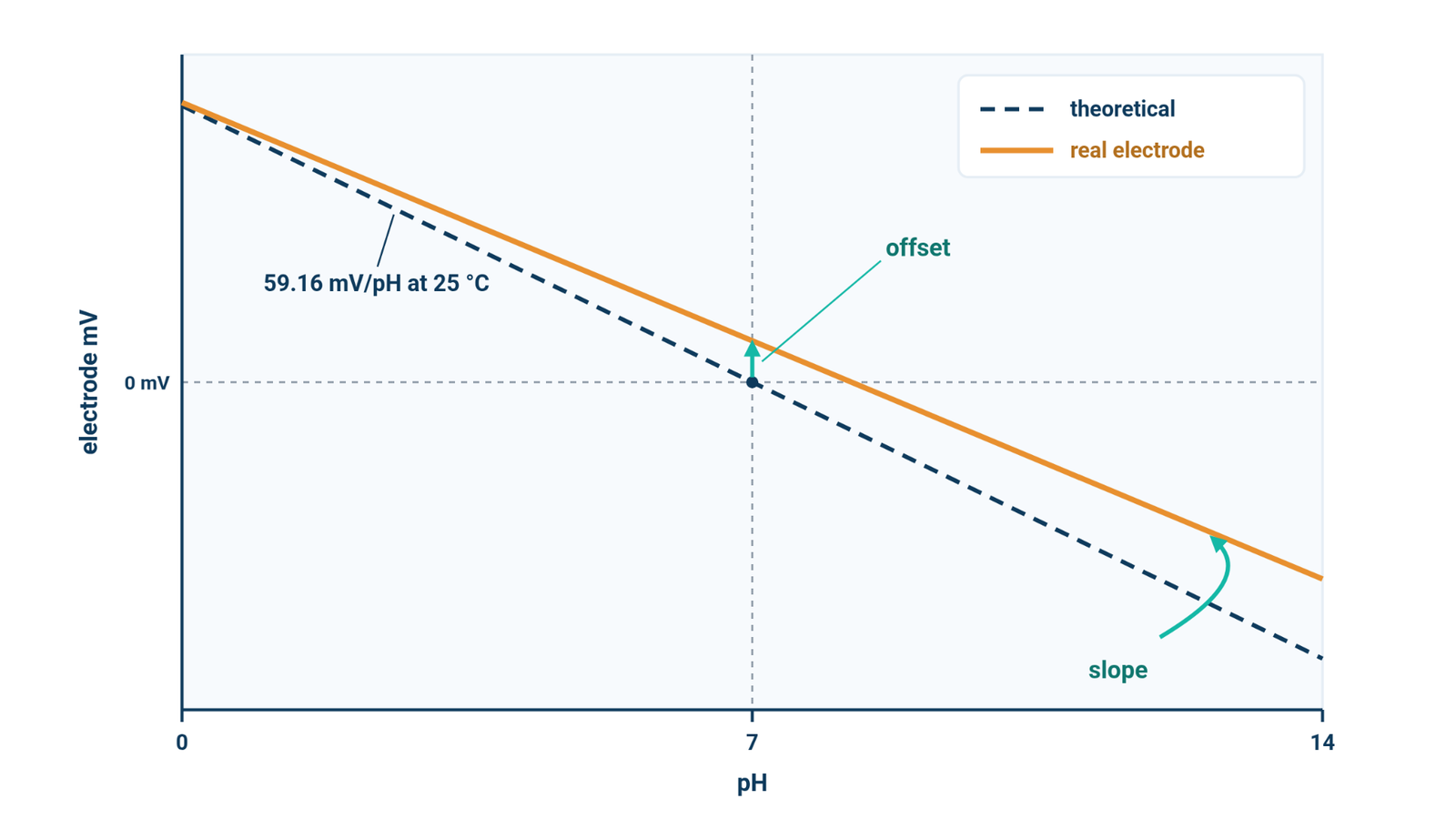
Calculated illustration, not a specification. Suppose an electrode reads +5.0 mV in a pH 7.00 buffer and +175.0 mV in a pH 4.00 buffer, both at 25 °C. The offset is +5.0 mV. The slope is (175.0 − 5.0) / (7.00 − 4.00) = 56.67 mV per pH unit, which is 56.67 / 59.16 = 95.8 % of the theoretical slope. A sample reading +90.0 mV then has pH = 7.00 − (90.0 − 5.0) / 56.67 = 5.50. These numbers are invented for the arithmetic; they are not values for any electrode or meter.
2. 1-, 2-, 3- and 5-Point Calibration Compared
IUPAC describes three procedures in common use: one-point, two-point (bracketing) and multipoint [1]. They differ in how many buffers you measure, and so in what the meter can correct.
1-point calibration. One buffer can correct only the offset. The slope has to be assumed, either the theoretical value or a value from an earlier calibration [1]. One manufacturer's manual describes exactly this behaviour: with a 1-point calibration only the offset is adjusted, and the previously stored slope or the theoretical slope (100 %) is used [11]. IUPAC calls this approach "not a reliable procedure" because slope and offset both change as the electrode ages, and estimates an expanded uncertainty of about 0.3 pH when the sample is 3 pH units from the buffer and the true slope is 5 % below theoretical [1].
In the illustration above, a 1-point calibration at pH 7.00 with the theoretical slope would put the +90.0 mV sample at 7.00 − 85.0 / 59.16 = 5.56 instead of 5.50, a 0.06 pH error from the slope assumption alone (calculated illustration, not a specification).
2-point calibration. IUPAC notes that in the majority of practical applications glass electrodes are calibrated with two standard buffers that bracket the unknown, giving both offset and slope [1]. ISO 10523 describes the usual sequence: the first buffer, usually pH 7, sets the zero point; the second sets the slope [2]. NBS/NIST guidance likewise calls for two bracketing standards [3], and EPA Method 9040C for at least two points that bracket the expected sample pH and are about three pH units or more apart [10].
3-point calibration. Adding a third buffer extends the calibrated range across both sides of pH 7. One pH guide recommends at least three points when measuring over a large pH range [5], and the USGS field manual notes that a three-point calibration with pH 4.01, 7.00 and 10.01 buffers allows measurement over a larger range [6].
Multipoint (up to 5-point) calibration. IUPAC describes multipoint calibration with up to five standard buffers, fitted by linear regression; more than five points do not yield any significant improvement [1]. It is recommended when minimum uncertainty and maximum consistency are needed over a wide pH range, but only where the electrode response is truly linear [1].
| Procedure | What it sets | Typical buffers | Target expanded uncertainty of sample pH (IUPAC, k = 2, 25 °C) | When to use |
|---|---|---|---|---|
| 1-point | Offset only; slope assumed | One buffer near the sample (often pH 7) | About 0.3 pH for ΔpH = 3 with an assumed slope [1] | Quick checks close to the buffer pH |
| 2-point (bracketing) | Offset and slope | Two buffers above and below the sample, e.g. pH 7 + pH 4 or pH 7 + pH 10 [6] | 0.02–0.03 pH [1] | Routine work in a known pH range |
| 3-point | Offset and slope across acid and alkaline sides | pH 4, 7 and 10 [6] | — (IUPAC gives no separate figure) | Samples spread across a wide range |
| Multipoint (up to 5) | Regression line (intercept and practical slope) | Up to five standard buffers [1] | 0.01–0.03 pH [1] | Wide range, minimum uncertainty, linear region only |
IUPAC's target uncertainties assume standard buffers with an uncertainty of 0.01 pH or better and depend heavily on the electrode and on technique [1]. They are targets for the whole measurement, not limits for any meter.
3. Multi-Point Calibration: Segments or One Fitted Line?
With three or more buffers, a meter can use the data in two different ways, and manufacturers differ:
- One fitted line. All points are fitted with one straight line by linear regression, giving a single slope and intercept. This is how IUPAC describes multipoint calibration [1]. The USGS field manual states that most manufacturers use a linear calibration curve for all calibrations, including multipoint ones [6].
- Segments. Each pair of adjacent buffers defines its own slope, so a 3-point calibration has an acid segment and an alkaline segment. One manufacturer's application guide explains that its meters calculate an offset for each calibration segment [12], and another manufacturer's operating manual lists both "Linear" and "Segmented" calibration types [11].
Neither approach is universally preferred. IUPAC notes that in non-linear regions of the response, the two-point method with buffers as close to the sample as possible has clear advantages [1], while the USGS field manual does not recommend meters that use point-to-point calibration or a non-linear function for its field work [6]. Check your meter's manual to see which method it uses; the ALab specifications do not specify the method for these meters.
| Buffer pair or fit (25 °C) | Readings used | Slope (mV/pH) | Slope (% of 59.16) |
|---|---|---|---|
| Acid segment, pH 4.00–7.00 | +175.0 mV, +5.0 mV | 56.67 | 95.8 % |
| Alkaline segment, pH 7.00–10.01 | +5.0 mV, −163.0 mV | 55.81 | 94.3 % |
| One fitted line, pH 4.00 / 7.00 / 10.01 | all three | 56.24 | 95.1 % |
Here the two segments differ by about 1.5 percentage points; a fitted line averages them, segments keep them apart. The +90.0 mV sample still reads about pH 5.50 either way (calculated illustration, not a specification).
4. Choosing and Handling pH Calibration Buffers
Bracket the sample. Choose buffers so that the sample pH lies between them [2][3][6]. ASTM D1293-18 describes Method A using at least two of seven standard reference buffer solutions and Method B using two buffers to standardize the instrument [7]. The 24th edition identifies Standard Methods 4500-H⁺ [8]. The US National Environmental Methods Index (NEMI) summary of 4500-H⁺ B describes an initial buffer to set the isopotential point, followed by a second buffer within 2 pH units of the sample pH at the sample temperature [9]. Only measure samples within the calibrated range [5].
Buffer values depend on temperature. The nominal values printed on common buffers (pH 4.00, 7.00 and 10.01) are normally specified at 25 °C, and a buffer's pH shifts as its temperature changes. The primary pH standards tabulated by IUPAC show how much. The values below are IUPAC typical values for primary standard buffers, not values for any commercial or kit buffer [1]:
| IUPAC primary standard (typical values) | 10 °C | 25 °C | 40 °C |
|---|---|---|---|
| 0.05 mol/kg potassium hydrogen phthalate | 3.997 | 4.005 | 4.027 |
| 0.025 + 0.025 mol/kg phosphate | 6.923 | 6.865 | 6.838 |
| 0.025 + 0.025 mol/kg sodium hydrogen carbonate + sodium carbonate | 10.179 | 10.012 | 9.889 |
The carbonate buffer moves by more than 0.1 pH between 10 °C and 25 °C; the phthalate buffer barely changes. For your own buffers, take the pH value at the actual temperature from the buffer's certificate or bottle table [2][6]; many meters can apply stored buffer tables [5], but check your meter's manual; the ALab specifications do not list buffer-temperature tables. Calibrate with buffers and samples at the same temperature where possible [2][3]; the USGS manual recommends buffers within 10 °C of the sample [6].
Temperature compensation does not fix everything. Automatic temperature compensation (ATC) accounts for the temperature dependence of the electrode's theoretical Nernst slope. It does not correct the sample's own temperature-dependent pH or convert that pH to a value at 25 °C. ISO 10523 notes that the temperature compensation in commercial pH meters is based on the Nernst equation and does not compensate for the temperature dependence of the sample's pH [2], and EPA Method 9040C separates the two effects, noting that the sample effect "cannot be controlled" and should be handled by reporting both pH and temperature [10]. Always report the temperature together with the pH [6][10]. More on this in our article on temperature compensation in pH and conductivity.
Handle buffers so they stay accurate.
- Atmospheric carbon dioxide affects buffers, especially alkaline ones; keep bottles closed and avoid frequent opening [2][3].
- Pour a fresh portion for each calibration; never calibrate directly in the stock bottle and never pour used buffer back [5].
- Mark the date of first opening, and do not use buffers past their expiry date [2][5][6]. One laboratory SOP treats purchased buffers as stable until the expiry date or within six months of opening, whichever is sooner [13].
- Rinse the electrode and temperature sensor before, between and after buffers [2]. Stir to equilibrate, then stop stirring and wait for a stable reading before accepting each point [2].
- Use certified buffers where possible [2]. pH buffers are traceable to primary standards measured by national metrology institutes [1][14][15].
5. Reading Slope and Offset: Acceptance Windows From the Literature
Most meters report the slope as a percentage after calibration [6], and many also report the offset in mV [11][12]. What is acceptable is set by your method, quality system or electrode manufacturer, not by one universal rule, and published ranges differ:
| Source (type) | Slope | Offset / zero point | Notes |
|---|---|---|---|
| ISO 10523:2008 §7.4, electrode requirement for that water-quality method (standard text) | Practical slope shall be at least 95 % of theoretical | Chain zero point should not deviate by more than ΔpH = 0.5 from nominal (manufacturer's declared value) | Method-specific electrode requirement; not a general acceptance window or an ALab specification [2] |
| USGS National Field Manual (agency field guidance) | 95–101 % | pH 7.00 buffer voltage within ±15 mV of the electrode's original value | Outside the range: clean, recondition or replace [6] |
| Laboratory SOP for Standard Methods 4500-H⁺ B (laboratory guidance) | 92–102 % | — | Calibrated daily [13] |
| USP <791> | 90–105 % (typical) | ±30 mV (about 0.5 pH at 25 °C) | Plus a verification buffer within ±0.05 pH [12] |
| One manufacturer's own specification (manufacturer guidance) | 92–102 % | ±59 mV | [12] |
| One manufacturer's meter manual (manufacturer guidance) | 95–105 % good; 90–94 % clean; 85–89 % faulty | Absolute offset: 0–20 mV good; 20–35 mV clean; ≥35 mV faulty | [11] |
| One manufacturer's pH guide (manufacturer guidance) | Below 85 % (50 mV per decade): recondition or replace | Beyond ±30 mV: recondition or replace | [5] |
They apply to the sources' own procedures, electrodes and quality systems, and none of them is a value for any ALab meter or electrode.
What a poor slope or offset usually means. For a low slope or a large offset, first check the electrode, the buffers and the calibration procedure before drawing a conclusion about the cause [5]. Reference junction blockage, loss of electrolyte, contamination of the glass bulb and the use of incorrect calibration buffers all contribute to low slopes [5]. Coatings and ageing have the same effect [2]. Before replacing an electrode, open fresh buffers, check their expiry dates, clean the electrode as its manual directs and repeat the calibration [5].
6. How Often to Calibrate a pH Meter
There is no single interval that suits every laboratory. pH electrodes must be calibrated at regular intervals [14], and how often depends on your method, how much you use the electrode and what samples it sees. Published guidance gives a practical baseline:
- At least once a day before measuring, in one manufacturer's guide [5].
- Daily in the USGS field manual and in one laboratory SOP [6][13].
- Again after cleaning, maintenance, regeneration or long-term storage of the electrode [5].
- Again whenever a check fails. The USGS manual recalibrates if a buffer check deviates by more than ±0.05 pH [6]. EPA Method 9040C repeats buffer adjustments until readings are within 0.05 pH units of the buffer value [10].
A practical way to decide whether today's calibration is still good is a check buffer: a third buffer between your two calibration buffers, read as if it were a sample. The USP <791> summary quoted above describes exactly this, with the verification buffer read within ±0.05 pH of its expected value at that temperature [12]. If a check fails, recalibrate; if the slope or offset is outside your limits after recalibration, clean or replace the electrode. Keep a log of slope, offset and dates: a steady decrease in slope can be an early warning of electrode ageing [5][6].
7. Calibration Functions on ALab Meters
The ACS Material ALab meters offer the calibration functions below. The Touchscreen Series offers "1 to 5-point calibration for pH mode", so 1-, 2-, 3-, 4- and 5-point choices all fall within its specified range. The Classical Series, Portable Meters, the DPCD10 and the Pocket Testers offer up to 3-point automatic calibration; 4- and 5-point calibration is not specified for them.
| Series | Models | pH calibration | pH accuracy | pH buffers in the kit | Other calibration features |
|---|---|---|---|---|---|
| Touchscreen | DPH100T, DPC100T, DPD100T, DPCD100T | 1- to 5-point calibration for pH mode | ±0.002 pH ±1 digit | pH 4.00 / 7.00 / 10.01, 50 mL each | Automatic calibration, automatic temperature compensation |
| Classical | DPH100, DPC100, DPD100, DPCD100 | Up to 3-point automatic | ±0.01 pH ±1 digit | pH 4.00 / 7.00 / 10.01, 50 mL each | Automatic calibration; ATC measurement; calibration indication; automatic reading stable indication |
| Portable | DPH10, DPC10, DPD10, DPO10 | Up to 3-point automatic | ±0.002 pH ±1 digit | pH 4.00 / 7.00 / 10.01, 50 mL each | — |
| DPCD10 | DPCD10 | Up to 3-point automatic | ±0.002 pH ±1 digit | pH 4.00 / 7.00 / 10.01, 50 mL each | — |
| DPH1, DPH1+, DPC1, DPC1+ | Up to 3-point automatic | ±0.01 pH ±1 digit | pH 4.00 / 7.00 / 10.01, 30 mL each (DPH1, DPH1+); pH 4.00 / 7.00, 30 mL each (DPC1, DPC1+) | "CH, USA and NIST buffers selectable"; green backlight in calibration mode; app calibration reminder on the Bluetooth (+) models; pH ATC 0–60 °C |
— = no further calibration feature is listed in this table for that series; it does not mean the feature is absent.
A few points to read alongside the table:
- Accuracy is not the uncertainty of your result. The figures are the meter's specified accuracy; the uncertainty of a measured pH also depends on the buffers, the electrode and the procedure (IUPAC's target for two-point bracketing is 0.02–0.03 pH [1]). Nor is the table a ranking by size: the Classical Series is specified at ±0.01 pH and the Portable Meters at ±0.002 pH.
- Not specified. The ALab specifications do not give slope or offset values, acceptance windows, a calibration interval, isopotential-point data, electrode diagnostics or GLP functions, buffer-temperature tables, a specific offset-only behaviour for 1-point calibration, or whether multi-point calibration uses a fitted line or separate segments. Buffer-standard selection is specified for the Pocket Testers only. Apply your method's criteria (section 5) and the meter's manual.
- Temperature. All five series specify a temperature accuracy of ±0.2 °C. The Pocket Testers specify a pH ATC range of 0–60 °C. The Touchscreen Series lists automatic temperature compensation; the Classical Series lists ATC measurement. No temperature ranges are given here for the other models.
- Kits. The buffer sets are shown in the table; the Pocket pH and pH/conductivity testers also include a 3 mol/L KCl soaking solution. The itemized bill of materials is confirmed on the quotation.
- Pricing. For pricing and configurations, request a quote or contact us.
If your method calls for 4- or 5-point pH calibration, the ALab series that offers it is the ALab™ Benchtop Meters — Touchscreen Series. If you are choosing between a pocket tester, a portable meter and a benchtop meter, see our guide to choosing a pH meter: pocket, portable or benchtop.
8. pH Meter Calibration Checklist
- Check the buffers: in date, not contaminated, a fresh portion poured for today [5][6].
- Pick buffers that bracket your samples: pH 7 plus pH 4 for acidic samples, pH 7 plus pH 10 for alkaline ones, or three buffers for a wide range [6].
- Equalise temperatures: buffers, sample and electrode at the same temperature, or as close as practical [2][6].
- Rinse the electrode and temperature sensor before each buffer [2].
- Start with pH 7 to set the offset, then the second (and third) buffer for the slope, unless your meter's manual specifies another order [2].
- Wait for a stable reading at each point; stir to equilibrate, then read without stirring [2].
- Review slope and offset against your method's or electrode manufacturer's limits (section 5).
- Verify with a check buffer between your calibration buffers [12].
- Record the date, slope, offset and temperature, and report every pH with its temperature [6][10].
9. Frequently Asked Questions
How often should I calibrate a pH meter?
One manufacturer's guide recommends at least once a day before measuring, and the USGS field manual calibrates daily [5][6]; recalibrate also after electrode cleaning, maintenance or storage [5]. Recalibrate whenever a check buffer reads outside your tolerance, for example more than ±0.05 pH in the USGS procedure [6].
Is a 1-point calibration enough?
Only close to the buffer pH. A single buffer corrects the offset but has to assume the slope. IUPAC calls this not a reliable procedure, because slope and offset both change as the electrode ages, and its uncertainty grows as the sample pH moves away from the buffer pH [1]. Use two buffers that bracket your samples for routine work.
What is a good pH electrode slope?
It depends on the source. ISO 10523:2008 §7.4 requires at least 95 % for electrodes used in that water-quality method; USGS field guidance specifies 95–101 %, while one manufacturer's summary of USP <791> reports a typical range of 90–105 % [2][6][12]. These are not universal limits or ALab specifications. Follow the criteria for your method and electrode.
What does the pH offset tell me?
How far the electrode's voltage in a pH 7 buffer is from its ideal (usually 0 mV) [5]. A high offset after calibration calls for checking the electrode, the buffers and the calibration procedure [5].
Do I need a 5-point calibration?
Only when you need minimum uncertainty across a wide pH range and the electrode response is linear over that range [1]. For a known, narrow sample range, two bracketing buffers are usually enough [1].
Does ATC mean buffer and sample temperature no longer matter?
No. ATC adjusts the theoretical (Nernst) slope used to convert mV to pH to the measured temperature; it does not correct the sample's own pH change with temperature, and buffer values also shift with temperature [1][2][10]. Calibrate at the sample temperature where possible and report pH with its temperature.
10. Keep Exploring the pH, Conductivity and DO Hub
- pH, conductivity and dissolved oxygen meter guide: how the three measurements work and how to choose a meter.
- Temperature compensation in pH and conductivity: ATC, the Nernst slope and reference temperature.
- Choosing a pH or conductivity meter: pocket tester, portable or benchtop meter for the lab and the field.