
pH meter temperature compensation and conductivity temperature compensation share a name, but they correct different things. In pH, automatic temperature compensation (ATC) adjusts the electrode's Nernst slope to the measured temperature; the sample's own pH change with temperature stays in the result. In conductivity, the meter converts the reading to a reference temperature, usually 25 °C, using a temperature coefficient. This guide explains both, with worked numbers, and summarises automatic temperature compensation on ALab meters. For the wider picture, see the pH, conductivity and dissolved oxygen meter guide.
Quick answer:
- pH: the theoretical slope of a pH electrode, (RT/F)·ln 10, is proportional to absolute temperature: 59.16 mV per pH unit at 25 °C, and by calculation 54.20 mV at 0 °C and 64.12 mV at 50 °C [1][3][4]. ATC measures the temperature and uses the matching slope to convert mV to pH. It does not correct the sample's real pH change with temperature or convert pH to 25 °C, so always report pH together with its measurement temperature [2][5].
- Conductivity: for many ionic solutions, conductivity rises by about 0.5–3 % per °C [6], and meters therefore report it at a reference temperature, usually 25 °C, using a temperature coefficient α. Linear α values of 0.019–0.020 per °C (1.9–2.0 %/°C) suit many natural waters; acids and salts differ, and pure water can have a larger coefficient [6][7].
1. Temperature Affects a pH Reading in Two Ways
EPA Method 9040C separates two temperature effects in pH measurement [5]:
- The electrode effect. The electrode's output per pH unit changes with temperature. This can be controlled with an instrument that has temperature compensation, or by calibrating the electrode and meter at the sample temperature [5].
- The sample effect. The sample's pH itself changes as its temperature changes, because dissociation equilibria shift [2]. This effect is sample-dependent and "cannot be controlled"; it is handled by reporting both pH and temperature [5].
ISO 10523 makes the same distinction: the temperature compensation in commercial pH meters is based on the Nernst equation and does not compensate for the temperature dependence of the sample's pH [2].
2. pH Meter Temperature Compensation: Nernst Slope and ATC
An ideal glass electrode follows E = E° − k·pH, with k = (RT/F)·ln 10 [1]. The slope contains the absolute temperature T: E = E° − 0.198·T·pH in mV, with T in kelvin [3]. This linear, predictable dependence is what pH temperature compensation addresses [3]. For the illustration below, the ideal electrode reads 0 mV at pH 7.00, and the sample's true pH is held fixed.
| Temperature | Theoretical slope (mV/pH) | Slope vs 25 °C | Reading of a true pH 4.00 sample if the 25 °C slope is used |
|---|---|---|---|
| 0 °C | 54.20 | 91.6 % | 4.25 |
| 10 °C | 56.18 | 95.0 % | 4.15 |
| 20 °C | 58.17 | 98.3 % | 4.05 |
| 25 °C | 59.16 | 100.0 % | 4.00 |
| 30 °C | 60.15 | 101.7 % | 3.95 |
| 40 °C | 62.14 | 105.0 % | 3.85 |
| 50 °C | 64.12 | 108.4 % | 3.75 |
Calculated illustration, not a specification. A pH 4.00 sample at 10 °C gives an ideal electrode 3 × 56.18 = 168.5 mV. A meter that assumes the 25 °C slope reads 7.00 − 168.5 / 59.16 = 4.15; with ATC, the meter uses 56.18 mV and reads 4.00. At pH 6.50 the uncompensated reading would be 6.53: the error grows with distance from pH 7 and from the calibration temperature.
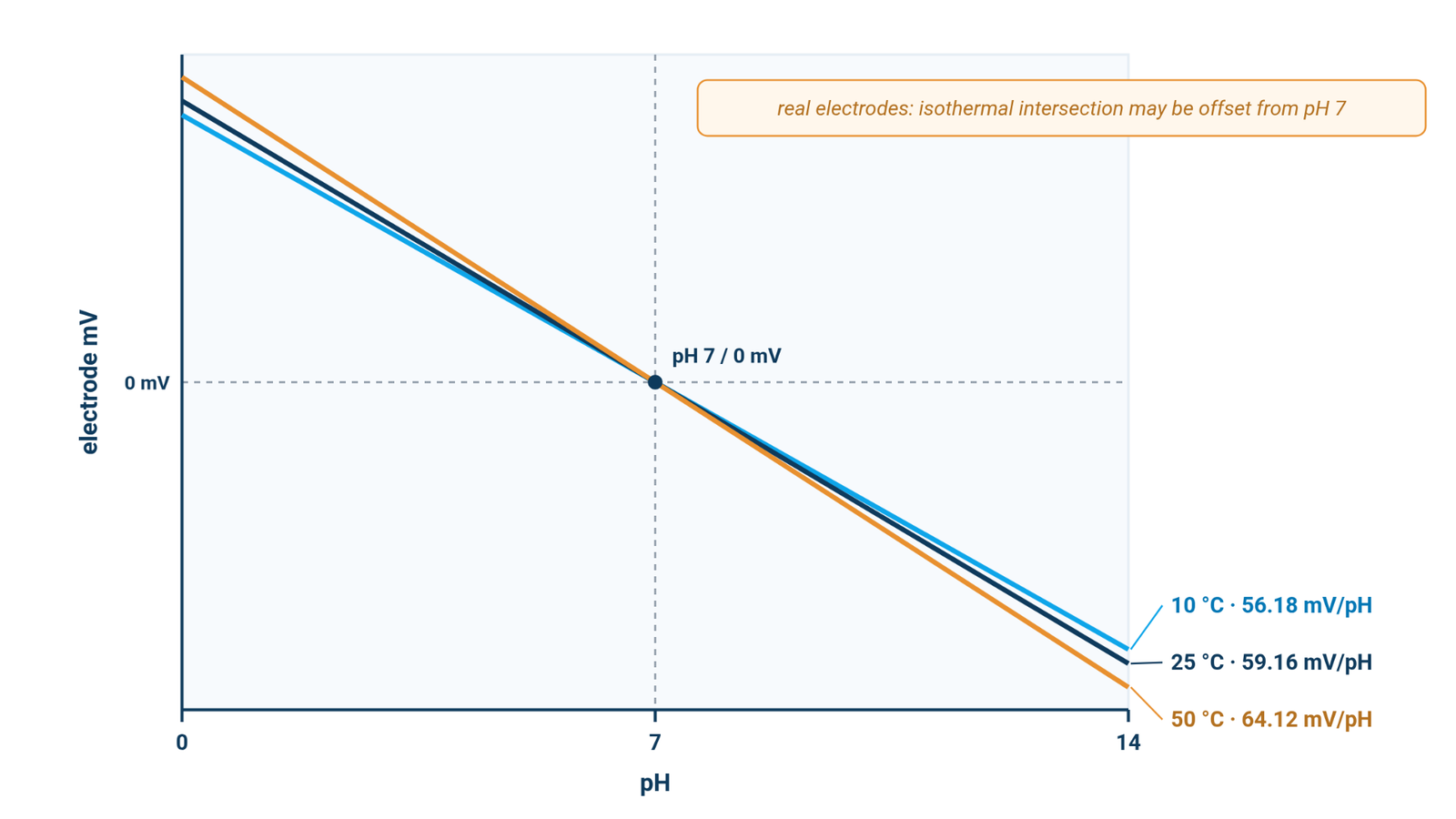
Why ATC is not perfect. For an ideal electrode, calibration lines at different temperatures cross at the zero point (pH 7.00, 0 mV). In real electrodes this isothermal intersection may sit elsewhere, and errors of the order of 0.1 pH can appear when calibration and sample temperatures differ [3]. The glass electrode potential is strongly temperature-dependent overall, so IUPAC advises calibrating and measuring under temperature-controlled conditions [1]. The most accurate pH is obtained when buffers and samples are at the same temperature [3]; the USGS field manual recommends buffers within ±10 °C of the sample [4].
What ATC leaves in the result. The sample's real pH change stays. In one manufacturer's examples, 0.001 mol/L NaOH has pH 11.17 at 20 °C and 10.83 at 30 °C, a phosphate buffer 7.43 and 7.40, while 0.001 mol/L HCl stays at 3.00 [3]. A calibration buffer's nominal pH applies at a specified temperature; use its certified value for the actual buffer temperature [2]. Our article on pH meter calibration, slope and offset covers buffer handling.
3. ATC, Manual Compensation and Where the Sensor Sits
An ATC pH meter uses a temperature sensor that may be separate from or integrated into the pH electrode, as described in ISO 10523 [2]. Either way, the sensor must sit in the same solution and reach its temperature; a separate sensor is immersed alongside the pH electrode [2]. Without a sensor, the meter is set to the measuring temperature by hand [2], often called manual temperature compensation (MTC), which is only as good as the temperature entered.
4. Conductivity: Reference Temperature and Temperature Coefficient
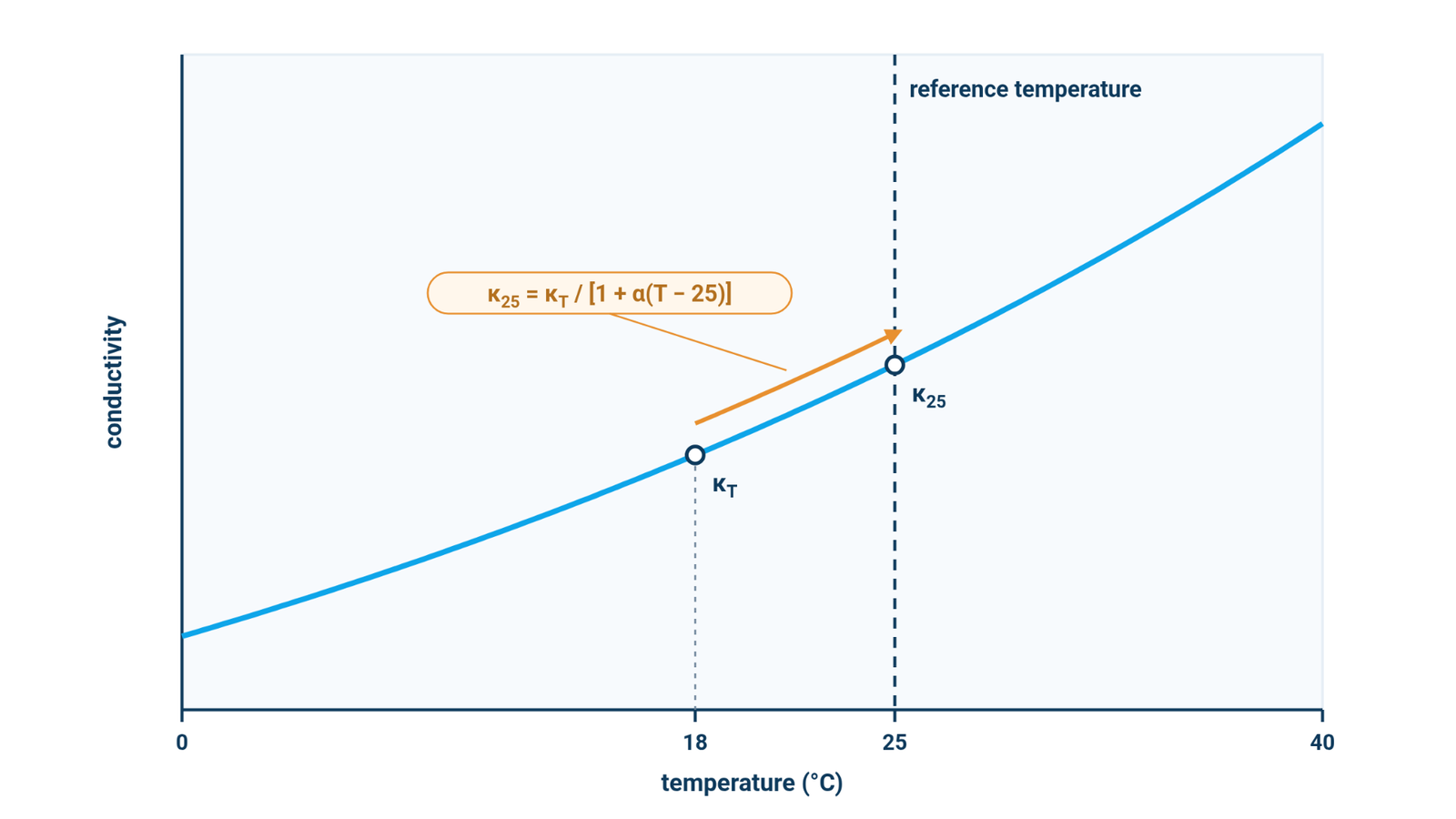
In conductivity measurement, temperature compensation converts the measured conductivity to an estimated value at a reference temperature; it does not change the sample. In many ionic solutions, conductivity rises by about 0.5–3 % per °C as temperature increases [6], although pure water can have a larger temperature coefficient [7]. One manufacturer's guide gives the classic example: 0.01 mol/L KCl has a conductivity of 1278 µS/cm at 20 °C and 1413 µS/cm at 25 °C [7]. Readings are therefore referred to a reference temperature, usually 25 °C, sometimes 20 °C [7]; the USGS and Standard Methods 2510 report conductivity at 25 °C [6][8].
The common linear correction is [6][7]:
κ25 = κT / [1 + α (T − 25 °C)]
where κT is the conductivity measured at temperature T and α is the temperature coefficient per °C.
Calculated illustration, not a specification. A natural-water sample reads 1230 µS/cm at 18.0 °C. With α = 0.0200 per °C, κ25 = 1230 / 0.860 = 1430 µS/cm; with α = 0.0191, 1420 µS/cm; with α = 0.0187, 1415 µS/cm. The choice of α alone moves the result by about 1 %.
There is no universal coefficient. α depends on the solution, its concentration and the temperature range:
| Solution or source | Temperature coefficient α (25 °C reference) |
|---|---|
| Acids, typical (manufacturer guide) | 1.0–1.6 %/°C [7] |
| Bases, typical (manufacturer guide) | 1.8–2.2 %/°C [7] |
| Salts, typical (manufacturer guide) | 2.2–3.0 %/°C [7] |
| Drinking water, typical (manufacturer guide) | 2.0 %/°C [7] |
| Pure water, typical (manufacturer guide) | 2.3–7.4 %/°C [7] |
| 0.01 mol/L KCl standard, cell-constant setting (Standard Methods 2510) | 0.0191 per °C [8] |
| Most natural waters, linear setting (USGS field manual) | 0.019–0.020 per °C [6] |
| Natural waters of very different compositions, 0–30 °C (Hayashi 2004) | 0.0175–0.0198 per °C, mean 0.0187 [10] |
Three practical consequences follow:
- Linear or non-linear. For natural waters, the non-linear correction associated with ISO 7888 is often recommended, while ultrapure water calls for a dedicated pure-water algorithm [6][7][11]. The USGS reports that standard compensation is typically accurate to ±5 % for waters at 5–35 °C and pH 4–11, but errors can reach 50 % in low-pH waters. For waters above pH 11, the USGS procedure recommends checking conductivity at ambient temperature and at 25 °C rather than relying on a temperature-compensation method [6].
- The coefficient belongs to its reference temperature. α values change when the reference temperature changes, so a coefficient determined for 25 °C should not be reused for 20 °C [7][10].
- Old shortcuts are approximate. EPA Method 120.1 (1982) corrects by 2 % of the reading per degree, based on KCl [9]. Standard Methods notes that the temperature coefficient of most waters is only approximately the same as that of KCl; the further you measure from 25 °C, the greater the uncertainty [8].
For cell constants, conductivity standards and TDS, see our article on conductivity, TDS and salinity: cell constants and how to choose one.
5. pH and Conductivity Compensation Side by Side
| pH | Conductivity | |
|---|---|---|
| What is corrected | The electrode's Nernst slope at the measured temperature [2][3] | The sample's conductivity, converted to a reference temperature [7] |
| Sample's own temperature effect | Not removed; report pH with its temperature [2][5] | Corrected, approximately, with α or a non-linear function [6][7] |
| Reported as | pH at the measurement temperature (e.g., pH 7.40 at 30 °C) | Conductivity at the reference temperature (e.g., µS/cm at 25 °C) |
| Main residual error | Isothermal intersection off pH 7; calibration vs sample temperature [3] | Wrong α for the sample; distance from 25 °C [6][8] |
6. Temperature Sensing on ALab Meters
For pH measurement, the Classical, Touchscreen and Portable ALab configurations below offer automatic temperature compensation:
| Series | Models | pH probe | ATC / temperature-probe details | Temperature accuracy |
|---|---|---|---|---|
| Classical | DPH100, DPC100, DPD100, DPCD100 | Plastic ATC pH probe 201T | ATC measurement | ±0.2 °C |
| Touchscreen | DPH100T, DPC100T, DPD100T, DPCD100T | Glass refillable combination pH probe 201G | Separate stainless-steel temperature probe TEMP-01; automatic temperature compensation for pH | ±0.2 °C |
| Portable | DPH10, DPC10, DPD10, DPO10 | Plastic ATC pH probe 201T-H | ATC pH probe; DPO10 kit also includes a stainless-steel temperature probe TEMP-02H | ±0.2 °C |
How to read the table:
- pH and conductivity configurations (Classical, Portable). DPC100 and DPCD100 (Classical) and DPC10 (Portable) include both the pH probe in the table above and a Plastic ATC Cond probe CON201T, K=1.0.
- Separate temperature probe (Touchscreen). As with any separate temperature sensor, keep the TEMP-01 probe in the same buffer or sample as the glass pH electrode and let both reach the solution temperature before reading (section 3).
- What pH ATC means. In the standard Nernst-slope model (section 2), temperature is used to interpret the electrode's mV response; this does not convert the sample's pH to 25 °C. Record the measurement temperature alongside pH [2][5].
- Check compensation settings. For conductivity, verify the reference temperature, temperature coefficient and correction mode in the instrument manual before use. For pH, check how the instrument handles temperature input and buffer values; do not assume that ATC corrects the sample's own pH change.
- Pocket Testers. The DPH1, DPC1, DPH1+ and DPC1+ configurations support pH ATC over 0–60 °C, with a temperature accuracy of ±0.2 °C.
- Kits and pricing. Probe configurations are confirmed on the quotation. For pricing, request a quote or contact us.
For benchtop work combining pH and conductivity measurements, explore the DPC100 and DPCD100 configurations in the ALab™ Benchtop Meters — Classical Series.
7. Temperature Compensation Checklist
- Keep the pH electrode and any separate temperature probe in the same solution, and wait for the temperature to stabilise. For conductivity, follow the instrument's cell and temperature-sensing instructions [2][6].
- Calibrate near the sample temperature. Bring buffers and samples to the same temperature where possible, within ±10 °C in the USGS procedure [3][4].
- Use buffer values for the actual temperature from the buffer's certificate [2].
- Report pH with its temperature. ATC does not convert pH to 25 °C [2][5].
- Report conductivity at a stated reference temperature, usually 25 °C, and record the compensation used [6][8].
- Choose α for the sample, or determine it from two readings at different temperatures; use non-linear or pure-water correction where appropriate, and measure close to 25 °C where you can [7][8].
8. Frequently Asked Questions
Does ATC convert a pH reading to 25 °C?
No. ATC uses the measured temperature to set the Nernst slope that converts the electrode's mV signal to pH. The displayed pH is the pH at the measurement temperature, so report it with that temperature [2][3][5].
With ATC, does temperature still matter for pH?
Yes. The sample's own pH changes with temperature, buffer values shift, and real electrodes add errors when calibration and sample temperatures differ [3][5].
What is the reference temperature in conductivity?
The temperature that compensated readings are converted to, usually 25 °C and sometimes 20 °C [6][7].
Is 2 %/°C the right conductivity temperature coefficient?
Only as an approximation. One manufacturer's guide gives roughly 1.0–1.6 %/°C for acids and 2.3–7.4 %/°C for pure water; observed natural-water coefficients span approximately 1.75–2.0 %/°C [6][7][10].
9. Keep Exploring the pH, Conductivity and DO Hub
- pH meter calibration: 2-, 3- and 5-point calibration, slope and offset.
- Conductivity, TDS and salinity: cell constants and how to choose one.
- pH, conductivity and dissolved oxygen measurement: principles, calibration and choosing a meter.