
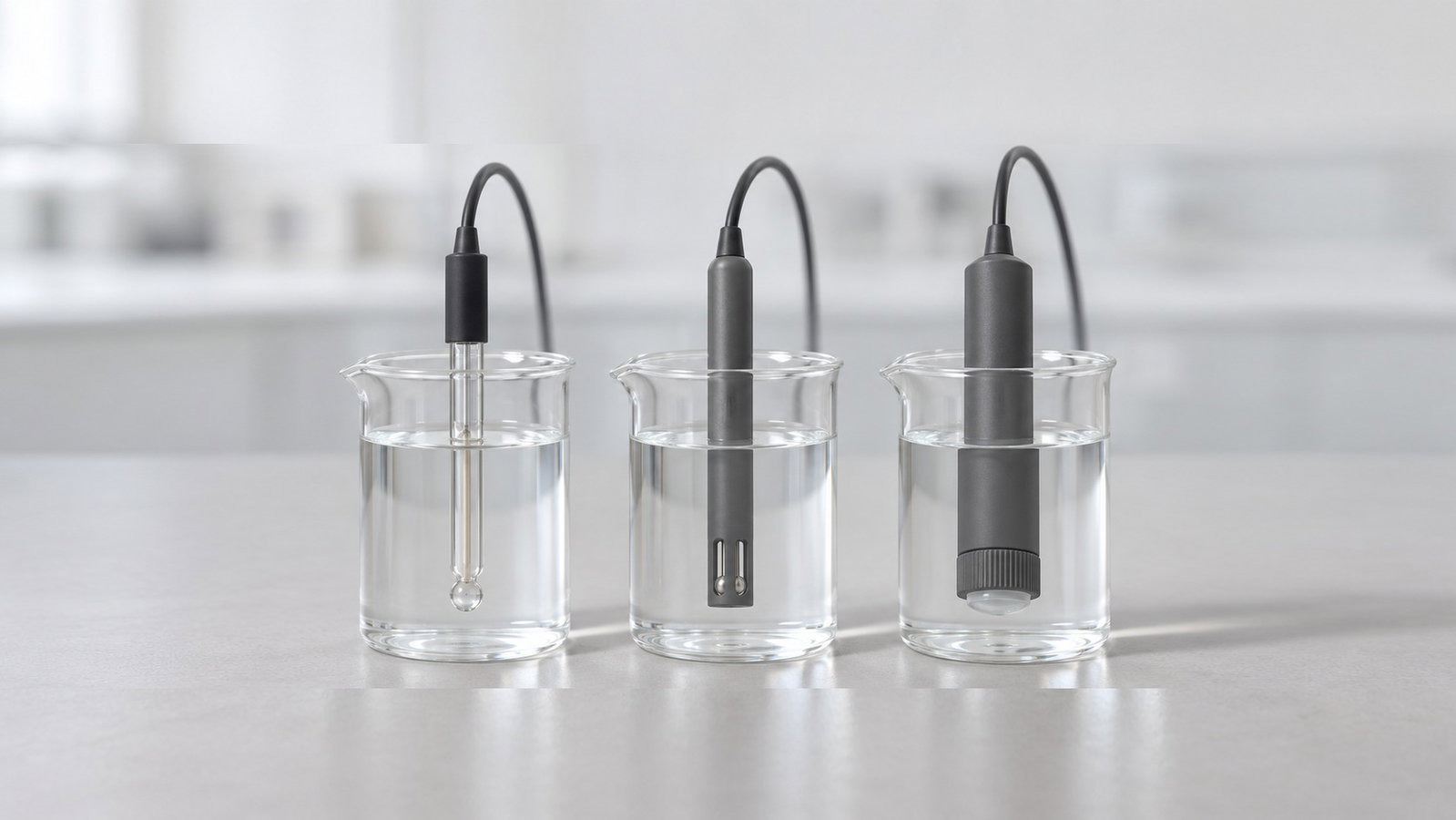
This pH, conductivity and dissolved oxygen meter guide explains the three most common water-quality measurements in one place: what each sensor actually responds to, how a meter turns that response into a number, how calibration and temperature affect the result, and how to choose a meter for the lab or the field. The three measurements rest on three different pieces of physics. A pH electrode produces a voltage that follows the Nernst equation, a conductivity cell measures how easily ions carry an electric current, and a dissolved oxygen (DO) sensor either reduces oxygen behind a membrane or watches oxygen dim the glow of a luminescent dye. Knowing which physics sits behind each reading makes it much easier to calibrate correctly, to spot a bad result and to compare instruments. The sections below give the essentials and point to the dedicated guides in this series for the detail.
Quick answer:
- pH meter: a glass electrode and a reference electrode produce a voltage that changes by about 59.16 mV per pH unit at 25 °C; calibration with buffers sets the electrode's offset and slope [1][2].
- Conductivity meter: the meter measures the conductance between two electrodes and multiplies it by the cell constant to give conductivity; TDS, salinity and resistivity are calculated from that conductivity [3][4].
- Dissolved oxygen meter: polarographic sensors measure the current from oxygen reduced at a cathode behind a membrane; optical sensors measure how oxygen quenches a luminescent dye. Both respond to oxygen partial pressure, and mg/L is calculated using temperature, salinity and pressure [5][6].
- Temperature matters for all three, but in a different way for each: it affects the pH electrode response, ionic conductivity and dissolved oxygen measurement. Measure and record temperature with the result [3][6][7][16].
- Choosing a meter: start with where you measure and which parameters you need; form factor (pocket, portable or benchtop) is not an accuracy ranking.
1. How Does a pH Meter Work?
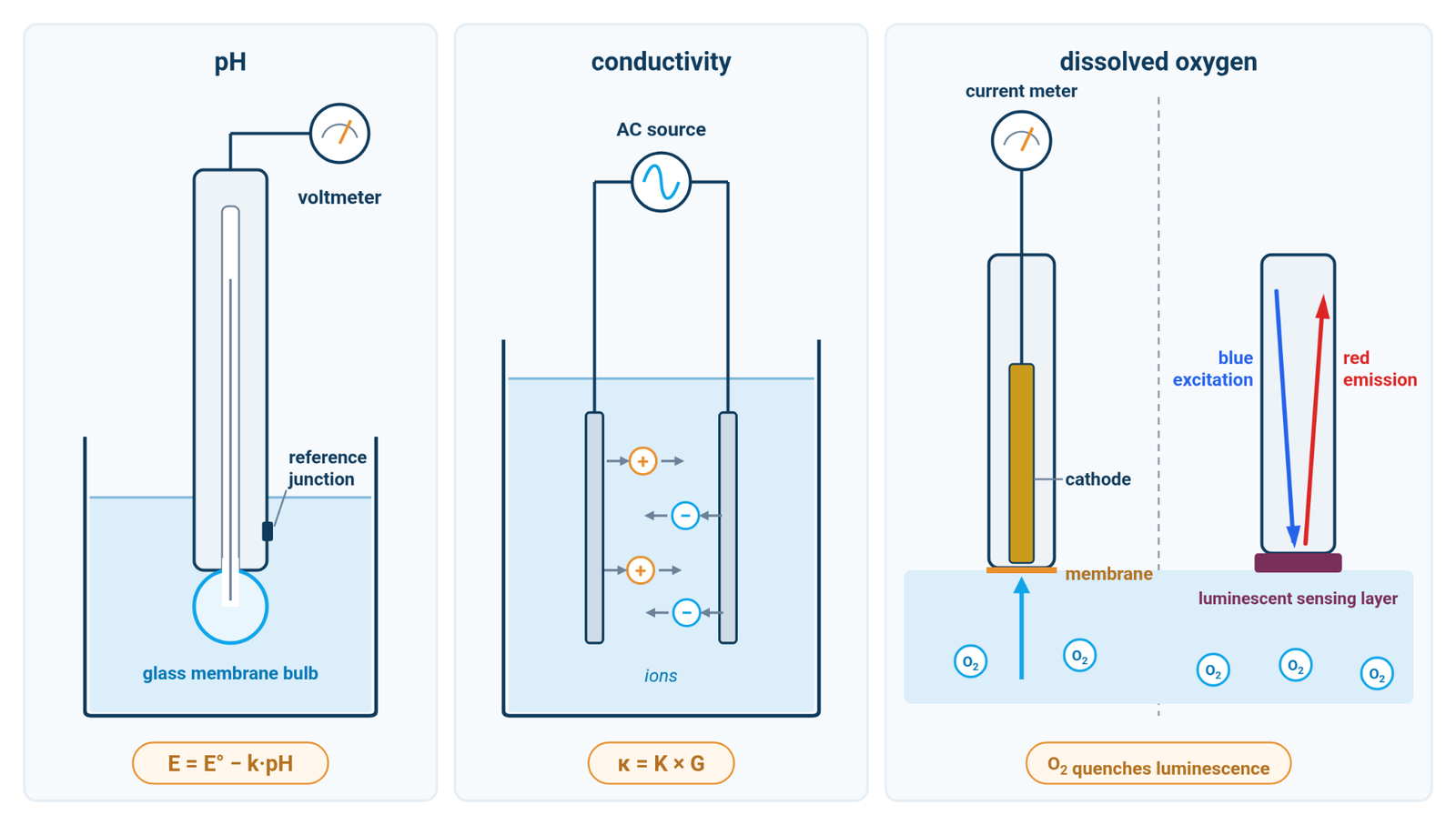
A pH meter is a very sensitive voltmeter connected to a pH electrode. The measuring element is a thin glass membrane whose outer surface responds to the activity of hydrogen ions in the sample. A reference electrode, in contact with the sample through a junction, supplies a stable potential to measure against. In a combination electrode, the pH electrode and the reference electrode are built into one body, and the U.S. Geological Survey uses combination electrodes in most of its field studies [8]. Because the glass membrane has a very high electrical resistance, the meter must draw almost no current; modern high-impedance meters are designed to do exactly that [9].
The voltage between the two electrodes follows the Nernst equation [1][2]:
- E = E° − k · pH, where k = (RT/F) · ln 10, R is the gas constant, T the absolute temperature and F the Faraday constant.
At 25 °C the theoretical slope k is 59.16 mV per pH unit [1][2]. A real electrode never matches the theory exactly. Its zero point (the offset) and its slope drift as the glass ages and the junction changes, which is why every pH measurement starts with calibration in buffers of known pH. ISO 10523 describes setting the zero point with the first buffer and the slope with the second [10]. How offset and slope are calculated, how many buffers to use and what the results say about electrode health are covered in our guide to pH meter calibration: 2-, 3- and 5-point calibration, slope and offset.
Because k contains the absolute temperature, the electrode slope changes with temperature. Automatic temperature compensation (ATC) handles that part of the problem; what ATC does and does not correct is explained in section 5 and, in detail, in our guide to temperature compensation in pH and conductivity: ATC, the Nernst slope and reference temperature.
Two practical limits are easy to forget. First, the usable pH range is set by the electrode, not by the display: in strongly alkaline solutions containing sodium or lithium ions the glass responds partly to those ions and reads too low, and in strongly acidic media the electrode reads too high [2]. A meter display range extending above pH 14 does not guarantee that a particular electrode can measure such samples accurately. Second, the electrode must suit the sample. The choice becomes particularly important for non-aqueous, low-conductivity, protein-rich and viscous samples, where general-purpose glass electrodes are subject to various sources of error [2].
Compact pocket testers combine the measuring instrument and probe in a small handheld format. The ALab™ Pocket Testers use 4×1.5 V AAA batteries and replaceable combined probes and have an IP67 rating; on the pH-capable models, the pH temperature-compensation range is 0–60 °C.
2. How a Conductivity Meter Works
Pure water conducts electricity poorly. Dissolved salts, acids and bases split into ions, and those ions carry current through the solution, so the electrical conductivity of a sample rises with the amount and type of dissolved ionic material [3][4]. A conductivity meter exploits this directly. It applies a voltage between two (or more) electrodes in a cell and measures the current, which gives the conductance G of the solution between the electrodes. The voltage is alternating rather than direct, because a direct current would cause electrolysis and polarization at the electrode surfaces and distort the reading [3].
Conductance depends on the geometry of the cell as well as on the sample. The cell constant K removes that dependence:
- κ = K × G, where κ is the conductivity (for example in µS/cm), G is the measured conductance and, for an ideal cell, K = L/A, the distance between the electrodes divided by their area [3].
Real cells are not ideal, so the nominal cell constant is only a starting point; the effective value is established using a standard of known conductivity [3][11]. Cell-constant selection affects the useful measuring range. How to match the cell constant, standard and sample is covered in our guide to conductivity, TDS and salinity: cell constants and how to choose one.
Conductivity rises strongly with temperature, so readings are normally compensated to a reference temperature before they are compared or reported [3][4]. The reference temperature and the temperature coefficient are explained in our guide to temperature compensation in pH and conductivity: ATC, the Nernst slope and reference temperature.
TDS, salinity and resistivity are derived values. A conductivity meter does not measure them separately:
- Resistivity is simply the reciprocal of conductivity and is used mainly for very pure water [3][11].
- Total dissolved solids (TDS) is, strictly, a gravimetric quantity: the residue left after a filtered sample is evaporated and dried [12]. A conductivity meter estimates TDS using a conversion factor that depends on the sample's dissolved composition [3][4]; the estimate is not a direct gravimetric measurement.
- Salinity calculated from conductivity assumes a known ionic composition, such as that of seawater, and conductivity responds only to ionic solutes [13]. In waters with an unusual composition, conductivity-based salinity is an approximation.
Portable meters provide a separate measuring instrument and probe for work away from a fixed bench. The ALab™ Portable Meters have a 3.5-inch TFT color display and IP57 protection; in conductivity mode, the DEC10, DPC10 and DCD10 models support probe constant calibration and conductivity standard solution calibration.
3. How a Dissolved Oxygen Meter Works: Polarographic and Optical
A dissolved oxygen meter has to detect a neutral gas, so it cannot rely on a simple electrode potential. Two sensor families are in wide use, and both respond to the partial pressure of oxygen in the sample rather than directly to its concentration [5][6].
Electrochemical (membrane) sensors. In a Clark-type polarographic sensor, oxygen diffuses through a gas-permeable membrane and is reduced at a cathode. The resulting current is proportional to oxygen partial pressure; because the sensor consumes oxygen, sample movement near the membrane affects the measurement [5][6][14]. Polarographic sensors use an applied polarizing voltage, while galvanic designs generate their own [5][14]. Both are established electrochemical principles; their operation and maintenance are covered in the DO sensor guide referenced below.
Optical (luminescent) sensors. An optical DO sensor excites an oxygen-sensitive dye and measures how oxygen quenches its luminescence, reducing the emitted intensity or lifetime [5][15]. Because this method does not consume oxygen, it avoids the oxygen-depletion flow dependence of membrane electrochemical sensors [6]. Optical sensing still requires calibration checks and periodic attention to the sensing cap; it is not maintenance-free [5][6]. Electrochemical and optical DO methods are addressed by separate ISO standards [14][16].
From partial pressure to mg/L. Because both sensor types respond to partial pressure, the meter calculates the concentration in mg/L from the solubility of oxygen at the sample's temperature, salinity and barometric pressure [5][16]. Solubility falls as temperature and salinity rise [17], so a temperature reading and a correct salinity setting are part of every DO measurement.
Which sensor fits still water, sulfide-rich samples, long deployments or a tight budget is the subject of our guide to optical vs electrochemical dissolved oxygen sensors: how they work and when to choose each.
The ALab™ DDOPRO10 Portable Optical Dissolved Oxygen Meter uses fluorescence sensor technology with no membrane, electrolyte or warm-up; the remaining ALab DO models use polarographic probes.
4. Multiparameter pH, Conductivity and DO Meters
Many samples need more than one measurement. A multiparameter pH, conductivity and DO meter brings two or more parameters onto one instrument, with a shared display and controls. The sensing principles remain distinct, even when several sensors are housed in a combined probe, as the table shows.
| Property | pH | Conductivity | Dissolved oxygen |
|---|---|---|---|
| Sensor | Glass and reference electrodes | Conductivity cell | Polarographic membrane or optical sensing layer |
| Responds to | Hydrogen-ion activity | Ions carrying current | Oxygen partial pressure |
| Key relation | E = E° − k·pH | κ = K × G | Reduction current or luminescence quenching |
| Calibration sets | Offset and slope | Cell constant | Saturation response; zero check as needed |
| Derived values | — | TDS, salinity, resistivity | Concentration in mg/L |
Table 1. The sensing principles behind three water-quality readings.
Practical points follow from that separation:
- Distinct sensors and calibrations. pH, conductivity and DO require separate sensing elements and parameter-specific calibration and maintenance, even when two or more sensors share one probe body. A multiparameter meter can combine the display and controls, but it does not make the underlying measurements interchangeable.
- Sockets. Some meters use a combined probe; others provide a separate socket for each probe, so one probe can be replaced without affecting the others.
- ORP. Oxidation-reduction potential is measured in millivolts using an ORP electrode. Many pH meters offer an ORP (mV) mode, which still requires an ORP electrode. In the ALab range, an ORP electrode is included only with the DORP1, DORP1+, DORP10 and DPO10 kits.
- Record temperature alongside the measurements. Temperature affects pH, conductivity and DO in different ways. Record it with the readings and apply the appropriate method-specific compensation (section 5).
Across the ALab range, pH is available on 17 models, conductivity on 16 and dissolved oxygen on 13, in single-parameter and combined versions. The ALab™ DPCD10 Portable pH/Conductivity/Dissolved Oxygen Meter is a portable instrument with separate BNC, 4-pin and 8-pin sockets for the pH/ORP, temperature/conductivity and polarographic DO probes, respectively.
5. Temperature: The Variable Behind All Three
Temperature affects every measurement in this guide, but in three different ways.
- pH. The electrode slope is proportional to absolute temperature (section 1). ATC uses the measured temperature to correct the electrode's slope. It does not correct the sample's own change in pH with temperature [7][10], and it does not convert the reading to a pH at another temperature. Report the measurement temperature together with the pH [7].
- Conductivity. Ion mobility rises with temperature, so the conductivity of the same sample changes as it warms or cools. Compensation to a reference temperature lets results taken at different temperatures be compared [3][4].
- Dissolved oxygen. Oxygen solubility falls as temperature rises [17], and the sensor response itself depends on temperature (oxygen diffusion through the membrane of an electrochemical sensor, luminescence quenching in an optical sensor), so the sensor temperature is measured and compensated alongside the oxygen signal [5][16]. Temperature is also one of the inputs when the meter converts partial pressure to mg/L [5].
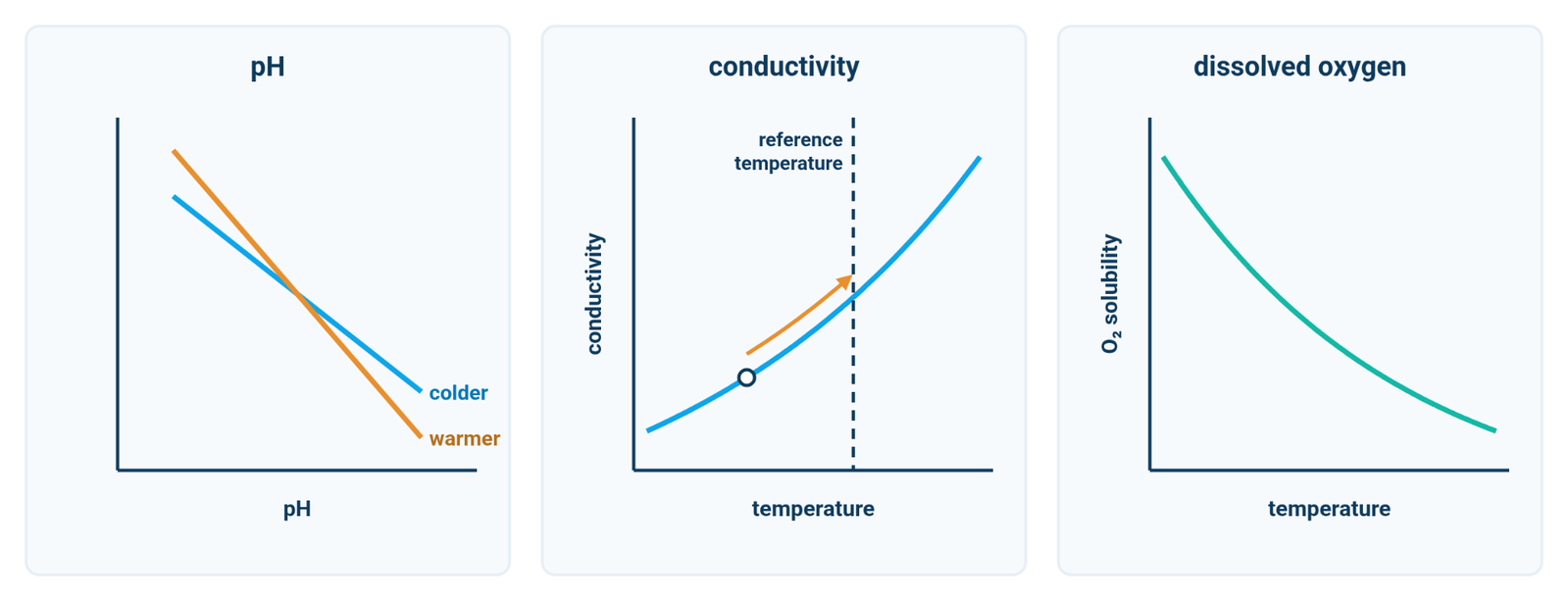
Two habits follow. First, let the temperature sensor and sample reach equilibrium before you read, because a lagging temperature reading feeds a wrong value into every compensation. Second, record the temperature with every result. The details for pH and conductivity, including the reference temperature and the temperature coefficient, are in our guide to temperature compensation in pH and conductivity: ATC, the Nernst slope and reference temperature.
Across the ALab Pocket, Portable and benchtop families, including DPCD10 and DDOPRO10, temperature-measurement accuracy is ±0.2 °C. The pH-capable models in these families offer automatic temperature compensation for pH. The ALab™ Benchtop Meters — Classical Series offer a 7-inch display, automatic calibration, automatic temperature compensation and a flexible probe holder included with every model.
6. Calibration and Quality Control
Every reading in this guide is only as good as the last calibration. The three measurements are calibrated in different ways, because each calibration fixes a different unknown.
- pH: bracket the samples with buffers. Two buffers around the expected sample pH establish the electrode's offset and slope, while additional buffers can support measurements over a wider pH interval [1]. Buffer quality and electrode condition matter as much as the meter's displayed digits. See our guide to pH meter calibration: 2-, 3- and 5-point calibration, slope and offset.
- Conductivity: one standard near the sample. The cell constant is determined with a conductivity standard, usually at one point close to the expected sample conductivity [3][11]. See our guide to conductivity, TDS and salinity: cell constants and how to choose one.
- Dissolved oxygen: check the saturation response. DO sensors are commonly calibrated against water-saturated air or air-saturated water, with barometric pressure accounted for; a zero-oxygen check may also be required by the method or sensor procedure [6]. See our guide to optical vs electrochemical dissolved oxygen sensors: how they work and when to choose each.
Good quality control is the same for all three. Use fresh standards within their expiry date, check the calibration before measuring samples, and keep a logbook of calibration and check results, so that electrode or sensor drift shows up before it spoils a data set [6][8].
Calibration capability varies by parameter and model. The pH-capable models in the ALab Pocket, Portable and Classical families, as well as DPCD10, support up to 3-point automatic pH calibration. The pH-capable models in the ALab™ Benchtop Meters — Touchscreen Series support 1- to 5-point calibration in pH mode, including 1- and 4-point choices; the series stores 500 readings per parameter and can export data to a flash disk or PC.
7. Choosing a Meter
Start with the parameters you need and where you will take readings. Pocket testers provide a compact format for spot checks; portable meters suit measurements in the field or between rooms; and benchtop meters provide a fixed-bench setup for routine sample batches. A multiparameter meter combines several measurements on one instrument, while a dedicated DO meter focuses on oxygen measurement. These are differences in form factor and parameter coverage, not an accuracy ranking: compare each meter's accuracy, resolution and measuring range separately, together with calibration, power, data handling and protection. Probe and kit configurations are confirmed on the quotation. For pricing, request a quote or contact us. For a model-by-model comparison by form factor, see this guide: Pocket tester, portable or benchtop meter? Choosing pH and conductivity meters for the lab and the field.
8. Frequently Asked Questions
How does a pH meter work?
A glass electrode and a reference electrode produce a voltage that depends on the hydrogen-ion activity of the sample. The meter measures that voltage with almost no current and converts it to pH using the offset and slope found during calibration; the theoretical slope is 59.16 mV per pH unit at 25 °C [1][9].
What is the difference between conductivity and TDS?
Conductivity is measured: it describes how well the ions in a sample carry current. TDS is a mass of dissolved solids, strictly determined by evaporation and weighing [12]. A conductivity meter estimates TDS from conductivity with a factor that depends on the sample composition [3].
What does a dissolved oxygen meter actually measure?
Both polarographic and optical DO sensors respond to oxygen partial pressure. The meter calculates the dissolved oxygen concentration in mg/L using the sample temperature, salinity and barometric pressure [5][6][16]. The sensing principles differ, but neither reading is independent of measurement conditions.
Why should temperature be recorded with pH, conductivity and DO readings?
Temperature affects the pH electrode's response and the sample's own pH, the mobility of ions carrying current, and the solubility of oxygen in water [3][7][17]. Compensation addresses some of these effects but not every change in the sample. Recording temperature makes the results easier to interpret and compare.
Does a multiparameter meter use one sensor for everything?
No. pH, conductivity and dissolved oxygen require distinct sensing elements, even if several elements share a probe body or one instrument handles their readings. The calibrations and maintenance needs remain parameter-specific.
9. Keep Exploring the pH, Conductivity and DO Hub
- pH meter calibration: 2-, 3- and 5-point calibration, slope and offset.
- Temperature compensation in pH and conductivity: ATC, the Nernst slope and reference temperature.
- Conductivity, TDS and salinity: cell constants and how to choose one.
- Optical vs electrochemical dissolved oxygen sensors: how they work and when to choose each.
- Choosing a pH or conductivity meter: pocket tester, portable or benchtop meter for the lab and the field.