
Condensing solvent vapor releases latent heat. A first-pass estimate combines liquid-equivalent evaporation rate with approximate solvent properties; final cooling-system sizing also depends on operating temperatures, heat transfer and additional loads. This guide shows how to estimate the condenser heat load, why coolant temperature matters as much as cooling capacity, how to read a chiller's rated capacity, and where the product data stop. Product statements are limited to ALab™ chiller and rotary evaporator product specifications.
Quick answer: Start with liquid-equivalent evaporation rate × density × latent heat, with units converted to watts. At 1.5 L/h, E3 estimates about 275 W for ethanol and 940 W for water, assuming complete condensation. Evaluate additional loads without double counting (Section 3), then confirm condenser performance and usable chiller capacity at the required setpoint, flow and ambient conditions. CCP5-Mini and DCP-5 are each specified at 700 W at 20 °C. This is a reference comparison, not proof of suitability; capacity at any other setpoint must be confirmed.
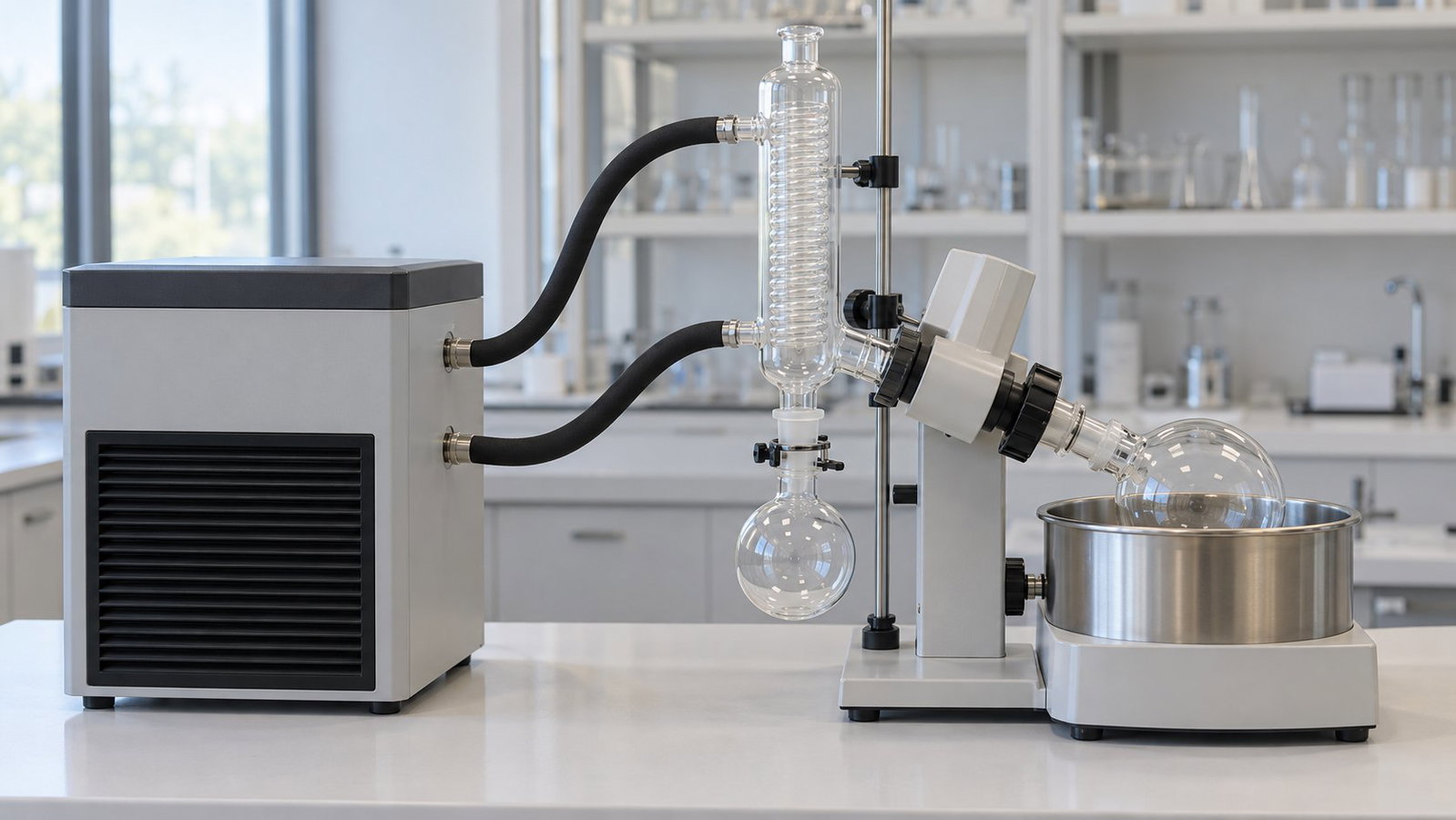
1. Why the Cooling Side Sets the Limit
Recovering vapor before it reaches the pump
Vapor releases latent heat when it condenses [1][2]. The primary condenser should recover most of it; inadequate heat removal can allow vapor to reach the downstream trap, pump and exhaust [3][4]. As the complete guide to rotary evaporation puts it, the cooling duty "is bigger than people expect."
Two separate questions
Sizing the cooling side means answering two questions: how much heat (the condenser load in watts, set by solvent and rate; Sections 2 and 3) and how cold (the coolant temperature at which the vapor condenses on the available area; Section 4). A chiller's rating answers the first question at one specified temperature only, which is the subject of Sections 5 and 6.
2. Estimating the Condenser Heat Load
The latent-heat estimate
For complete condensation, latent duty equals condensation mass rate times specific enthalpy of vaporization [1][2]. Here, rate is liquid-equivalent volume per hour, not vapor volume; density must correspond to that liquid-volume basis:
Qlatent (W) = rate (L/h) × density (kg/L) × ΔHvap (kJ/kg) × 1000 / 3600
This is the model of the condenser heat-load estimator embedded on the DCP-5 and CCP5-Mini product pages (E3). The table below applies the same formula and the same property values as that tool.
Latent heat load for common solvents
| Pure solvent | Latent load per 1 L/h | Latent load at 1.5 L/h | Share of 700 W reference at 1.5 L/h | Rate at which latent load alone reaches 700 W |
|---|---|---|---|---|
| Water | ~627 W | ~940 W | ~134 % | ~1.1 L/h |
| Methanol | ~242 W | ~363 W | ~52 % | ~2.9 L/h |
| Ethanol | ~183 W | ~275 W | ~39 % | ~3.8 L/h |
| Acetonitrile | ~158 W | ~237 W | ~34 % | ~4.4 L/h |
| 2-Propanol | ~145 W | ~217 W | ~31 % | ~4.8 L/h |
| Dichloromethane | ~122 W | ~183 W | ~26 % | ~5.8 L/h |
| Acetone | ~109 W | ~164 W | ~23 % | ~6.4 L/h |
| THF | ~102 W | ~153 W | ~22 % | ~6.9 L/h |
| Ethyl acetate | ~91 W | ~136 W | ~19 % | ~7.7 L/h |
| Toluene | ~87 W | ~130 W | ~19 % | ~8.1 L/h |
| n-Hexane | ~61 W | ~92 W | ~13 % | ~11.4 L/h |
How to read this table. These rounded, latent-only estimates reproduce E3's fixed approximate inputs, described by the tool as reference data rather than manufacturer data. E3 uses normal-boiling-point latent heats; density and latent heat vary with temperature [7][17]. Thermophysical compilations describe these properties [5][6], but those citations do not establish the source of each E3 input. The model assumes complete condensation and excludes sensible heat, line gains, cooldown and separate bath/equipment heat paths (Section 3). It is not a guaranteed lower bound on measured duty. The final two columns compare only with 700 W at 20 °C. Equality rates above the 5 L/h slider limit are algebraic results of the same equation, not tool readouts or achievable-throughput ratings.
Two readings that matter
First, the spread is large. Per liter, water carries several times the latent heat of common organic solvents, so a cooling setup that kept up with one solvent can fall behind when the solvent changes. Second, per kilogram and per liter rank solvents differently: dichloromethane has less latent heat per kilogram than acetone (about 330 versus 501 kJ/kg) but a higher density, so per liter it sits above acetone. Rates are observed in liters per hour, so the per-liter column is the practical one.
A worked example
Ethanol at 1.5 L/h, the E3 default, gives a latent load of about 275 W, or 39 % of the 700 W reference; the latent load alone would reach 700 W at about 3.8 L/h. The same rate of water gives about 940 W, above the reference before any margin. These figures match the readouts of the interactive tool on this page and the worked numbers given for the DCP-5: roughly 275 W for ethanol but close to 1 kW for water.
3. What the Latent-Heat Estimate Leaves Out
E3 estimates only latent duty. A system heat balance may also need [1][2][7]:
- Vapor desuperheating, if vapor enters above its condensation temperature.
- Condensate subcooling, if liquid is cooled further after condensation.
- Circuit heat gains, including net heat entering cooled hoses and equipment, and pump heat not already accounted for in a net cooling rating.
- Cooldown duty, when initially cooling the fluid and hardware; this is distinct from steady operation.
Bath input is not modeled separately: the energy producing the assumed vapor rate is already represented in the latent term. Do not add the bath heater's power rating again. Likewise, the returning coolant carries transferred heat; its temperature rise is not an extra load to add to that same heat. Quantify additional heat paths once and choose an application-specific reserve for load variation and uncertainty, rather than a universal margin percentage.
Rate is an input, not an output
The rate depends on bath temperature, vacuum, rotation, flask size and fill level. A specified evaporation capacity is a maximum under a stated condition (for example, max. 1.56 L/h with water for the RE100-Pro), not the rate of every run. Use a justified peak liquid-equivalent rate for the intended solvent and method. A specified maximum applies only to its stated test material and conditions.
4. Coolant Temperature and the ΔT Rule
What the condenser needs
For a steady condenser, Q = U × A × ΔTmean, where U is the overall heat-transfer coefficient and A is the area [1][2]. The appropriate mean temperature difference uses coolant inlet and outlet conditions, not just the chiller setpoint. With U and A unchanged, halving that mean difference halves the calculated duty.
The 20/40/60 arrangement discussed in solvent boiling points under vacuum uses coolant, target boiling and bath temperatures separated by 20 °C. It is an illustrative rule of thumb, not a requirement derived from U × A × ΔT or a guarantee of adequate condensation. Select temperatures for the process and verify capacity and flow at the chosen conditions.
Area and temperature trade against each other
With other conditions comparable, more area or a larger mean temperature difference can increase condenser heat transfer; neither establishes the chiller's available capacity. The condenser surfaces are specified as follows:
| Model | Condenser |
|---|---|
| RE100-S | 1200 cm² vertical (1700 cm² available for selection) |
| RE100-Pro | 1700 cm² vertical |
| RE200-Pro | Two-section vertical triple-coil, 1.2 m² |
| RE-E series main condensers | 0.28 m² (5 L), 0.49 m² (10 L), 1.29 m² (20 L), 1.75 m² (50 L) |
Source: ACS Material product specifications (October 2026).
\nA heat-transfer coefficient and a condensing capacity in watts are not specified for these glass condensers, so area cannot be converted into a wattage here. Area alone does not rank performance: geometry, overall heat-transfer coefficient, vapor conditions and coolant flow also matter [1].
Match coolant to the actual condensing conditions
A solvent's condensing temperature depends on pressure and vapor composition; it is not fixed near room temperature by the solvent name. Low condensing temperatures may require colder coolant to provide a useful driving difference. Solvent boiling points under vacuum discusses pressure-temperature relationships. Confirm available cooling capacity at the chosen setpoint rather than applying the 20 °C rating.
Air in the condenser
Non-condensable gas from leaks or degassing collects at the condensing surface and slows condensation, because vapor must diffuse through it to reach the cold wall [8][9]. A leaky system can look like an undersized chiller. Check joints and seals before concluding that more cooling is needed.
5. Reading a Chiller's Cooling Capacity
Chiller specifications
The two ALab™ recirculating chillers listed for rotary evaporator condensers have these specifications:
| Parameter | CCP5-Mini | DCP-5 |
|---|---|---|
| Temperature range | −20 °C to room temperature (upper limit follows the ambient temperature) | −20 to 40 °C |
| Cooling capacity | 700 W at 20 °C | 700 W at 20 °C |
| Temperature figure | ±0.3 °C stability | ±0.3 °C control accuracy |
| Tank | 4.5 L | 4.5 L |
| Maximum flow | 22 L/min | 22 L/min |
| Pump pressure | 0.3 bar (suction 0.2 bar) | 0.3 bar maximum |
| Connection | For 8 mm inner-diameter silicone insulation tube | 8 mm internal diameter of external pipe mouth |
Source: ACS Material product specifications (October 2026).
The 20 °C reference and its limit
Both chillers are rated at 700 W at a 20 °C coolant temperature; capacity at lower setpoints is not specified. For the DCP-5, ACS Material notes that capacity must be confirmed against the intended vapor load, coolant temperature and operating margin. In vapor-compression refrigeration in general, the capacity a unit delivers depends on its operating temperatures [10][11], which is why a rating is always tied to a stated condition. This article does not estimate the capacity of either chiller at any temperature other than 20 °C. Every numerical comparison uses that reference only. Confirm capacity at any other setpoint, warmer or colder, before final selection; at 20 °C, also confirm applicable fluid, flow and ambient conditions.
The illustrative 20/40/60 arrangement uses the specified 20 °C coolant reference, but not every test condition is specified, including ambient temperature. A colder setpoint changes the condenser temperature difference; it does not establish available cooling capacity or operating margin.
Flow, pressure and coolant
For both chillers, maximum flow and pump pressure are separate limits, not a simultaneous operating point, and no pump curve is specified. Delivered flow depends on hoses, condenser resistance and coolant viscosity [12]. Below 0 °C water freezes, so a heat-transfer fluid suited to the setpoint is required; approved fluids and concentrations are not specified, so refer to the operating manual. For the DCP-5, ACS Material advises keeping hose runs short and insulated for low-temperature work.
6. Matching a Chiller to the Evaporator
A sizing sequence
- Identify the solvent or mixture, thermal conditions and justified peak liquid-equivalent evaporation rate.
- For a pure solvent, estimate latent duty using the documented E3 inputs.
- Evaluate additional loads and an application-specific reserve without double counting bath energy or returning-coolant heat (Section 3).
- Choose trial coolant conditions from the required condensation temperature, condenser design and process constraints; Δ20 is an illustration, not a requirement.
- Confirm usable cooling capacity and delivered flow under those conditions. Use 700 W only as the specified 20 °C reference, not a capacity at another setpoint or an unconditional suitability verdict.
Benchtop evaporators: RE100-Pro and RE100-S
The RE100-Pro and RE100-S both have a specified maximum evaporation capacity of 1.56 L/h with water and take flasks of 50–3000 mL. ACS Material positions the CCP5-Mini for cooling rotary evaporators of the 3 L class; this positioning reflects typical duties at that scale, not a hard limit derived from the 700 W figure.
| Case (latent load only, E3) | Latent load | Relative to the 700 W reference at 20 °C |
|---|---|---|
| Ethyl acetate at 1.5 L/h | ~136 W | Below (about 19 %) |
| Ethanol at 1.5 L/h | ~275 W | Below (about 39 %) |
| Methanol at 1.5 L/h | ~363 W | Below (about 52 %) |
| Water at the specified 1.56 L/h test rate | ~978 W | Above (about 140 %), before any margin |
The three listed organic-solvent examples are numerically below the 700 W reference at 20 °C; this does not establish sufficient margin or suitability. The water estimate at 1.56 L/h is about 978 W, above that reference. Neither comparison predicts performance at another coolant temperature. Final selection requires the complete heat budget, condenser performance, delivered flow and capacity at the actual operating conditions. For aqueous work, reassess the required rate and cooling provision rather than treating flask size as a chiller-sizing rule.
Where the condenser rather than the chiller is the limit, the RE100-S offers an optional 1700 cm² condenser for applications that benefit from additional condensing surface or greater vapor-load capacity, and a secondary condenser component is optional on both benchtop models.
Pilot scale: RE200-Pro and the RE-E series
The RE200-Pro is specified at max. 4.5 L/h (75% alcohol); the RE-E series is specified at 2, 3.8, 5 and 11 L/h for 75 % alcohol across its 5, 10, 20 and 50 L models. A 75 % alcohol stream is a mixture, which E3 does not model, so no load is given for those rates. Those mixture ratings do not establish a pure-solvent load or a cooling requirement without composition, vapor rate and thermal conditions. For the 20 L RE200-Pro, cooling is sized against the process at quotation, and the recirculating chiller is a system item ordered separately and matched to the process.
7. Self-Cooling Condensers: The RE100-CV
The RE100-CV takes a different route. Refrigerant is introduced directly into its metal condenser, so no separate chiller is needed. Its specifications:
- Condenser temperature range: RT to −40 °C
- Condenser temperature control accuracy: ±3 °C
- Cooling power: 725 W
- Flasks up to 3000 mL; heating RT to 180 °C
The condition at which the 725 W figure applies is not specified, so it should not be set against the circulators' 700 W at a 20 °C coolant temperature, or against a latent load at a given setpoint, as if measured on the same basis. The same two questions apply (how much heat, how cold); confirm both for a given solvent and rate from the manufacturer's documentation.
8. Chiller, Tap Water or Dry Ice?
| Option | Coolant temperature | Points to weigh |
|---|---|---|
| Tap water | Set by the supply; varies by site and season | No setpoint control; continuous water consumption; check temperature, flow and required duty |
| Recirculating chiller | Set by the user within the specified range | Controlled setpoint and closed loop; confirm capacity at the operating conditions (Section 5) |
| Dry-ice condenser or trap | Approximately −78 °C for a suitable bath near atmospheric pressure; not a guaranteed condenser temperature | Colder than the two listed chillers' minimum setpoints; replenishment, CO₂, cold-contact and bath-fluid hazards require controls |
Dry-ice baths can provide temperatures below the listed −20 °C setpoint limits, but actual trap or condenser temperature depends on heat load, contact and replenishment [13][14]. Follow an approved procedure for bath-fluid selection, ventilation and cold-contact protection; flammable bath liquids add ignition hazards. Never seal the dry-ice coolant container [3][15][16][18]. A suitably selected and maintained cold trap may reduce vapor reaching the pump, but it does not guarantee capture or replace exhaust controls [3][4].
9. Frequently Asked Questions
What size chiller do I need for a rotary evaporator? Estimate latent duty from a justified liquid-equivalent rate, evaluate additional loads without double counting, and allow an application-specific reserve. Confirm both condenser heat transfer and usable chiller capacity at the required coolant temperature, flow and ambient conditions.
Is 700 W enough for a rotary evaporator? Not from wattage alone. At 1.5 L/h, E3 estimates about 275 W for ethanol and 940 W for water. These are latent-only comparisons with 700 W at 20 °C, not complete sizing results. Confirm additional loads, condenser performance and capacity at the actual conditions; capacity at other setpoints is not specified.
What coolant temperature should I set for a rotovap condenser? The Δ20 arrangement is a starting illustration, not a universal setting. Choose coolant conditions for the actual condensing temperature, duty and condenser design, then confirm chiller capacity and flow. Solvent boiling points under vacuum explains pressure-temperature estimates.
Why does solvent reach my pump even though the chiller is running? Possible causes include excessive vapor load, unsuitable coolant temperature, low coolant flow, restrictions or noncondensable gas. Check temperatures, circulation, leaks and trapping before changing the method. Lowering the setpoint does not establish adequate available cooling capacity.
Dry ice condenser or chiller? Choose for the required temperature and heat duty. Dry-ice baths need replenishment and controls for CO₂, cold contact and any flammable bath fluid; never seal the coolant container. Chiller suitability requires capacity and flow confirmation at the selected temperature.
10. Keep Exploring Rotary Evaporation
- Rotary Evaporation: The Complete Guide: principles, setup, vacuum, condensing and solvent recovery, with the condenser heat-load estimator
- Solvent Boiling Points Under Vacuum: the Δ20 °C rule and the interactive boiling-point explorer
- How a Rotary Evaporator Works: Five Steps
- Why the Flask Rotates: Films, Area and Bumping
See the CCP5-Mini and DCP-5 chillers, or browse all ALab™ rotary evaporators and accessories