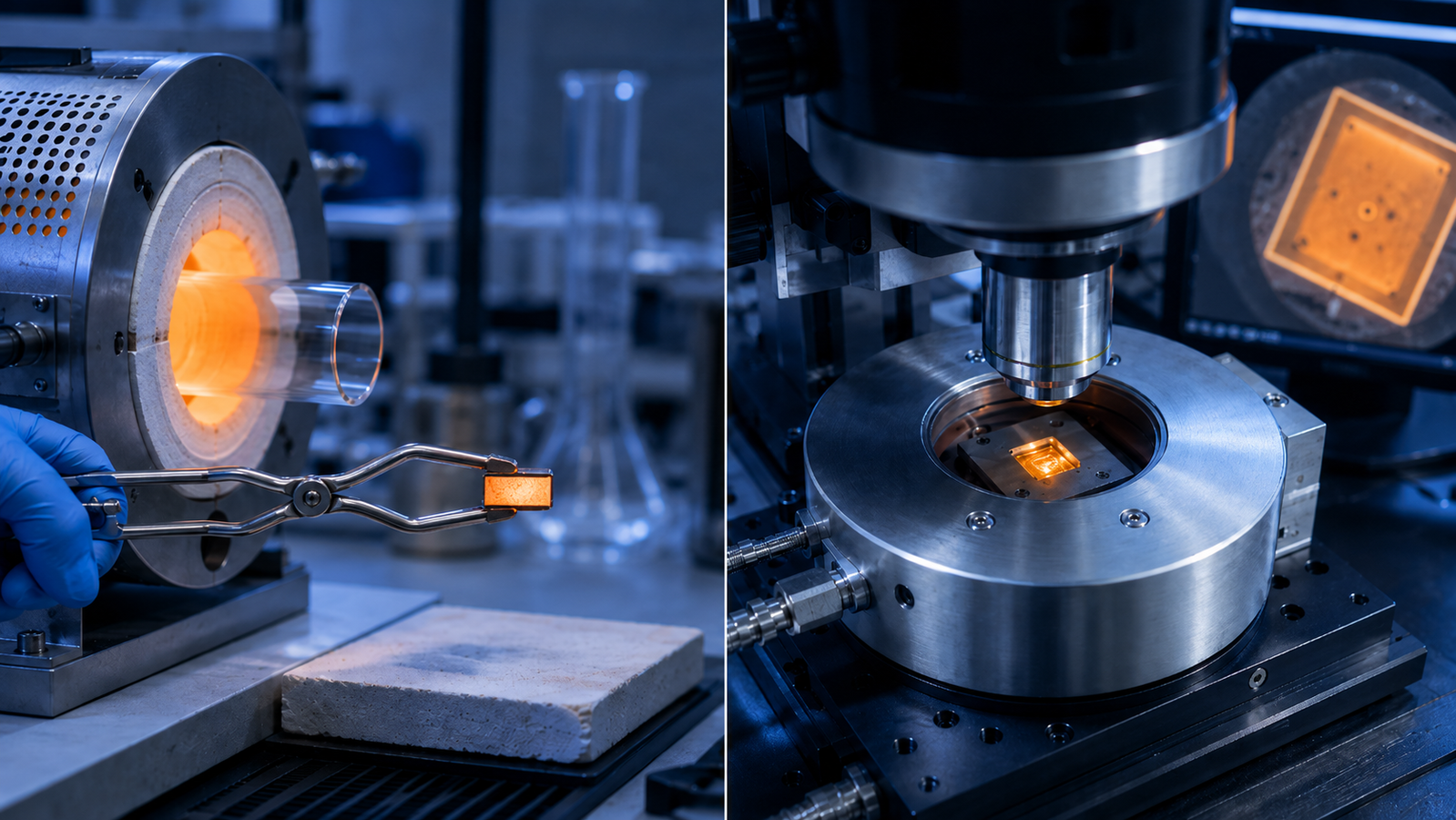
Two laboratories study the same phase transformation. One heats the sample in a furnace down the hall, quenches it, carries it to the microscope, and photographs what arrived. The other mounts the sample on a temperature-controlled stage under the same microscope and films the transformation happening. Both produce valuable data — ex-situ often at higher resolution — but only continuous in-situ observation preserves the full event trajectory. This article is the methodological case for the second laboratory: what ex-situ measurement systematically loses, when it remains exactly the right tool, what the in-situ approach costs in exchange, and how to decide — per experiment, not by ideology — which side of the divide your question lives on.
1. What Ex-Situ Measurement Systematically Loses
The transfer step is not neutral. Between treatment and measurement, three clocks run against you. The relaxation clock: metastable states — the scientifically interesting ones — decay toward stability during cooling and transport, so the instrument meets the survivor. The reaction clock: the walk through air is an uncontrolled exposure — oxidation, hydration, carbonation — that rewrites surfaces before they are seen. The sampling clock: a process is a trajectory, and ex-situ work samples it at one point per specimen; reconstructing kinetics that way costs a specimen per data point and still interpolates blindly between them. The field’s founding demonstrations were exactly about beating these clocks — recording diffraction from a battery electrode during cycling rather than after autopsy1 — and the modern era’s showcase results are states that ex-situ work could never have met at all: catalyst particles caught oscillating in shape under working gas, a dynamic that vanishes the instant the environment does2.
2. Four Classes of Casualties
Transients — intermediates that exist only mid-process: transition states of solid-state reactions, short-lived intermediate phases, moving interfaces. By definition they are gone when the process ends. Metastables — states that survive minutes to hours but relax on the bench: quenched-in high-temperature phases, supersaturated solutions, strained configurations. Pharmaceutical science is the cautionary tale here — polymorphs, hydrates and amorphous forms interconvert on handling, which is why the discipline leaned early and hard on thermal microscopy and in-situ thermal analysis34. Working states — configurations that exist only while the system operates: a catalyst’s surface under reaction conditions differs from its resting surface, which is the founding observation of the operando tradition in catalysis5. Sharp events — transitions so abrupt that point-sampling misses the moment entirely: the vanadium dioxide metal–insulator switch completes within a couple of degrees, trivially captured by a continuous in-situ ramp and easily straddled by discrete ex-situ points6.
3. Interactive: The Quench & Drift Lab
The simulator below puts Section 1’s relaxation clock on a slider. A sample carries a hot-state signal; you choose how long the ex-situ journey takes — quench and transfer, or a coffee break, or overnight — and watch the measured value drift from the truth the in-situ observer recorded at time zero.
The lesson is quantitative, not moralistic: for slow-relaxing systems the drift is negligible and ex-situ work is perfectly sound; for fast-relaxing ones the first minutes destroy the signal. The decisive ratio is transfer time over relaxation time — and when that timescale is unknown and transient states matter, an in-situ reconnaissance run is usually the safest starting point. The model is a schematic single-exponential decay with teaching constants, not data for any real material.
4. Case Files: Three Times the Transfer Lied
Method arguments are best made with case files, and the literature offers three in which the before/after picture and the live picture flatly disagreed. Case one: the catalyst that changed for the camera. The founding observation of operando methodology is that catalysts characterized at rest are, structurally and chemically, different materials from themselves at work: oxidation states shift under reaction feed, particles restructure, surfaces populate with intermediates — and the resting-state portrait can mislead about the active site entirely, which is exactly why the field moved to combined structure-plus-activity measurement under working conditions5 and eventually formalized the operando program by name7. Case two: the drug that would not hold still. Pharmaceutical polymorphs convert during grinding, drying, storage and — crucially — during the innocent-looking journey from oven to instrument; the discipline’s classic reviews are, at heart, catalogues of transfer artifacts, and the hot-stage tradition arose specifically to watch conversions rather than infer them34.
Case three: the electrode measured mid-breath. A cycling battery electrode inhales and exhales ions, its lattice parameters tracking state of charge continuously; the 1978 demonstration that diffraction could follow this live1 exists precisely because the alternative — disassemble, wash, dry, measure — interrogates an electrode that has already relaxed, reacted with the atmosphere, or both. A modern coda belongs to all three cases: even in-situ measurement must audit its own probe, since electron beams and intense illumination can alter sensitive samples during observation — the beam-effect literature is the standing reminder that “watching” is never perfectly free8. The cases converge on one moral: when the state of interest is a working or metastable state, the transfer is not a logistics step — it is an uncontrolled experiment performed on your sample without your consent.
5. In Defense of Ex-Situ
The comparison is not a demolition. Ex-situ measurement keeps four permanent advantages. Resolution: with the sample stable and the environment gone, every instrument runs at its best — ultra-high-resolution imaging, long acquisitions, surface science in pristine vacuum. Freedom: no window, no chamber, no compromise geometry between the probe and the sample. Throughput: treating batches offline and measuring queues of stable specimens scales in ways a one-sample stage cannot. Validity where states are robust: for genuinely stable products — a fired ceramic, an aged alloy at room temperature — the transfer changes nothing, and ex-situ characterization is simply correct. The mature laboratory runs both: in-situ to find when and how things happen, ex-situ to characterize what was made at full instrumental power.
6. What “Real Time” Really Requires
“Watch it happen” carries a quiet quantitative requirement: the instrument must sample faster than the process changes. Every probe has a cadence — the time to acquire one meaningful frame, spectrum or pattern — and every process has a clock; in-situ observation is only as real-time as the ratio between them. A crystallization front advancing over minutes is comfortably filmed by almost anything; a millisecond ignition event is invisible to a probe that needs seconds per point, no matter how faithfully the environment was controlled. The methodological literature treats this cadence-matching as a first-class design variable, and the historical arc of in-situ technique is substantially the story of driving acquisition times down — exemplified by rapid-acquisition total-scattering methods that collapsed structural measurement from hours toward seconds precisely so that transformation kinetics could be watched rather than bracketed9.
Three practical corollaries follow. First, match the probe to the clock, not the prestige: a humble optical camera at video rate often out-observes a slow high-resolution technique for fast events — and the correlative strategy (fast probe finds the moment, slow probe certifies the change) gets both. Second, slow the process where science permits: reducing ramp rate stretches events across more acquisition frames, trading experiment time for temporal resolution — the interrupted-ramp discipline of this hub’s stability chapter, viewed from the sampling side. Third, report the cadence with the result: a transformation “observed at 250 °C” means something different at one pattern per second versus one per ten minutes, and mature in-situ reporting states acquisition timing alongside environment as part of the measurement’s identity10. Real time, in short, is not a switch the stage provides — it is a budget the experiment must balance.
7. What In-Situ Costs
Honesty about the other column. Windows and geometry: the environment must be transparent to the probe, and every window is a compromise the instrument pays for. The sensor–sample gap: the controller reports its sensor, not the specimen — lag, gradients and self-heating live in that gap, and the discipline of closing it (traceable calibration11, soak, specimen-adjacent sensing) is this hub’s recurring homework. Perturbation: the probe itself can heat or alter the sample it watches. Representativeness: a measurable cell or chamber is never exactly the production environment — the gap the methodological literature spends real effort minimizing and, importantly, quantifying10. None of these costs is fatal; all of them are the reason the rest of this hub exists.
8. The Ladder: Ex-Situ → In-Situ → Operando
The distinction is really a ladder of realism. Ex-situ: measure the stable product. In-situ: measure inside the controlled environment, during the process. Operando: the sample is a working system — a cycling battery, a converting catalyst — and its functional performance is recorded on the same clock as the structural probe, so structure and function become one dataset5. Each rung buys causal proximity and pays in experimental complexity. This hub’s advanced chapters live on the upper rungs — the operando and correlative article maps them — but every climb starts with the same first step: putting the environment on the instrument. A middle rung deserves naming, too: quasi-in-situ workflows — cryogenic transfer, interrupted cycling, rapid quench-and-return — preserve part of a transient state and bridge continuous observation with high-resolution endpoint analysis.
| Aspect | In-situ | Quasi-in-situ | Ex-situ |
|---|---|---|---|
| What it captures | The full trajectory, live | Selected frozen waypoints | Stable endpoints |
| Signature strength | Kinetics, transients, working states | Partial transient preservation | Maximum resolution & technique freedom |
| Main cost | Windows, geometry, probe budget | Transfer hardware & protocol rigor | Relaxation, exposure, sparse sampling |
| Best first use | Unknown kinetics, sharp events | Beam-sensitive or vacuum-bound probes | Robust products, deep endpoint analysis |
9. Designing the Hybrid Workflow
The mature answer to “in-situ or ex-situ?” is usually “both, in the right order,” and the hybrid workflow has a repeatable shape. Step one — survey in place: run the process on the stage under continuous observation to locate the events: at what temperature does the transformation begin, how fast does it run, is there hysteresis, are there intermediates? This is reconnaissance, and it is cheap — one specimen, one programmed run. Step two — interrogate the map ex-situ: with the event temperatures known, prepare a small series of specimens quenched from strategically chosen points — just before onset, mid-transformation, just after completion — and take them to full-power instruments: the highest-resolution imaging, the longest acquisitions, the surface-science techniques that need pristine vacuum. The in-situ run tells you where to look; the ex-situ series lets you look as hard as your best instrument allows.
Step three — close the loop: return to the stage to test what the high-resolution snapshots suggested — a suspected intermediate is confirmed by catching it live, a proposed mechanism is checked by varying rate or atmosphere and watching the response. Catalysis research runs exactly this loop as standard practice, alternating between in-situ diffraction campaigns that map phase behaviour under feed and offline microscopy on recovered material12; device work runs its own version, pairing live self-heating measurements with post-mortem analysis of degraded units13. The hybrid’s quiet advantage is economic as much as scientific: stage time is spent only on what must be watched, instrument time only on what must be resolved, and neither method is asked to do the other’s job badly.
10. A Decision Framework
Four questions, in order. Is the state of interest stable on the transfer timescale? If genuinely yes, ex-situ is efficient and sound. If no or unknown — in-situ. Is the question about a process (when, how fast, through what intermediates) rather than a product? Processes are trajectories; continuous in-situ observation samples them most densely. Does the phenomenon exist only under stimulus? Working states and field-dependent phases may relax, transform or disappear when the stimulus is removed, making them difficult or impossible to preserve ex situ. Do you need the instrument’s absolute maximum? Then run the hybrid: in-situ to locate the event, ex-situ at full power on quenched specimens bracketing it — the combination that lets each method do what it does best. When the answers point stage-ward, the selection guide and the stage selector turn the decision into hardware; the InSitu Pro™ family covers the optical, spectroscopic, diffraction, electrical and SEM routes.
11. FAQ: In-Situ vs Ex-Situ
12. Keep Exploring the InSitu Pro™ Knowledge Hub
This article is the methodological foundation of the InSitu Pro™ knowledge hub. To keep going:
- What is an in-situ stage? A beginner’s guide — the hardware this argument runs on.
- In-situ heating, cooling & electrical stages: a theory guide — the pillar article on temperature control.
- Operando & correlative microscopy — the upper rungs of the ladder.
- In-situ oxidation studies by optical microscopy — a reaction the transfer step would rewrite.
- In-situ XRD: watching crystal structure evolve — trajectories, pattern by pattern.
- How to choose an in-situ stage — when the answer is “watch it happen.”
References
This article discusses in-situ and ex-situ methodology in general terms. Relaxation behaviours, transfer effects and representativeness are system-specific; experimental decisions should be validated against the published literature, your own observations and the applicable instrument and product datasheets. The interactive simulator is a schematic teaching tool built on a stated single-exponential model, not measured data for any real material. Contact ACS Material to discuss in-situ configurations for your instruments and applications.