
DMF, DMSO and NMP are useful polar solvents but can be difficult to remove from reaction mixtures. Water also presents evaporation and condensation challenges. This guide compares sourced pure-solvent saturation-pressure estimates within stated coefficient intervals, then considers mixtures, condensation, thermal hazards and alternative workups. The tables are property estimates, not validated operating settings or evidence that a particular pump will remove a solvent.
Quick answer: To remove DMF on a rotary evaporator, first assess the sample and establish an acceptable temperature window. The NIST-listed Gopal & Rizvi fit estimates pure-DMF saturation pressures of about 13 mbar at 40 °C and 23 mbar at 50 °C (29.85–89.85 °C interval) [2][3]. These are not bath settings or guaranteed flask pressures. Evaluate condensation, gas load and mixture behavior before choosing trial conditions. Consider a different, validated workup when the sample or equipment constraints make rotary evaporation unsuitable.
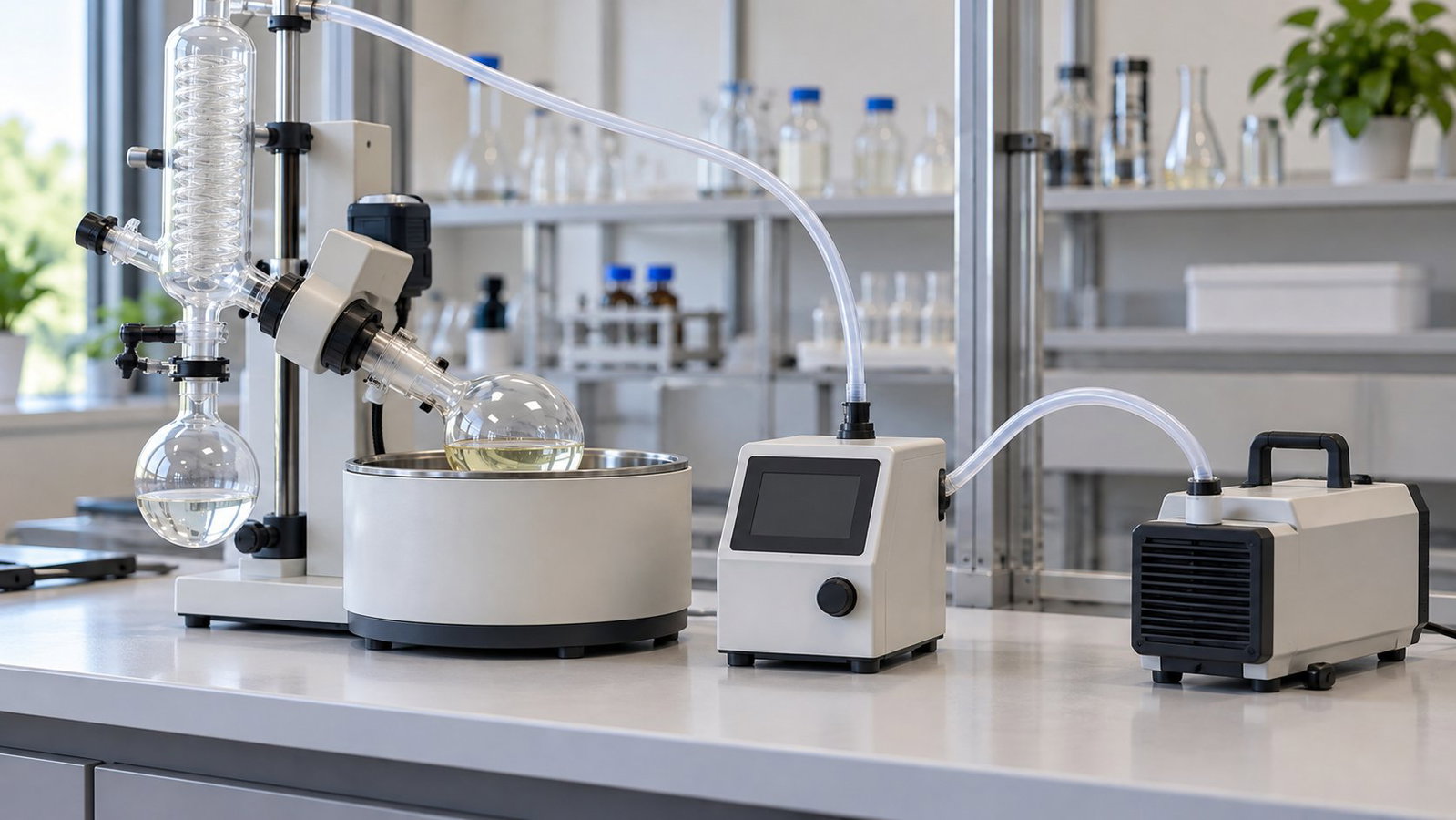
1. Why High-Boiling Solvents Are a Pressure Problem
Boiling points that sit far above the bath
At atmospheric pressure water boils at 100 °C, DMF at about 153 °C, DMSO at about 190 °C and NMP at about 202 °C [2][10]. A rotary evaporator brings the boiling point down to a temperature the sample tolerates by lowering the pressure. As the complete guide to rotary evaporation notes, "Deeper vacuum may be required for high-boiling solvents such as DMF or DMSO when the target is a moderate bath temperature."
The tables use a pure-liquid equilibrium temperature, not a bath setting or an assured vapor-sensor reading. Bath-to-liquid heat transfer and vapor-to-condenser heat transfer require suitable temperature differences. The companion article on solvent boiling points under vacuum discusses Δ20 °C as an illustration, not a universal requirement or proof of sufficient cooling.
Why low pressure changes vapor handling
For the same mass and temperature, an ideal gas occupies more volume as pressure falls [9][18]. The vapor path must accommodate that volume; the pump handles vapor escaping condensation plus leaks and outgassing. Achievable pressure and removal rate also depend on effective pumping speed, heat transfer and restrictions. A lower target alone predicts neither throughput nor process suitability.
2. How the Estimates Were Made
The Antoine equation and its range
Pure-liquid saturation pressure is commonly represented by log10P = A − B/(T + C), using the units specified for each coefficient set [1][9]. Use a fit only within its source-listed temperature interval; this does not establish process accuracy or thermal safety. Out-of-range cells below remain blank of numbers.
The water row reuses the unchanged coefficients of the E1 boiling-point explorer (see the vacuum-control article), matched to DDB water record 174 [22]. This article uses that record's 1–100 °C interval, not E1's wider 1–102 °C display interval. The explorer in solvent boiling points under vacuum remains a teaching tool: mixtures and solutes affect equilibrium, while superheating affects boiling onset. DMF, DMSO and NMP use separate static records below; no coefficients are added to E1.
Coefficient sets used
| Solvent | Coefficient record | Equation units | Source-listed interval |
|---|---|---|---|
| Water | E1 coefficients matched to DDB water record 174 [22] | P in mmHg, T in °C | 1–100 °C |
| DMF | NIST Chemistry WebBook, from Gopal & Rizvi (1968) [2][3] | P in bar, T in K | 303–363 K (29.85–89.85 °C) |
| DMSO (low range) | NIST Chemistry WebBook, from Douglas (1948) [2][4] | P in bar, T in K | 293–323 K (19.85–49.85 °C) |
| DMSO (high range) | NIST Chemistry WebBook, from Jakli & Van Hook (1972) [2][5] | P in bar, T in K | 325.49–442.09 K (52.34–168.94 °C) |
| NMP | DDB Antoine record 284 [6]; primary reference not given | P in mmHg, T in °C | 6–206 °C |
The E1 water outputs differ from the NIST-listed Stull fit by less than 2 % at 30–80 °C [2][7]. The supplied NMP coefficients give about 79.6 °C at 13 mbar, versus the NIST-listed 81.55 °C datum [2][6]. This is a limited consistency check, not validation over the full interval. NIST lists other NMP measurements [8] but no Antoine set; the DDB record's underlying primary reference is not stated.
3. Estimated Saturation Pressure at a Given Temperature
The table
Values are estimated pure-solvent saturation pressures in mbar absolute. Temperatures are calculation inputs, not operating recommendations or measured vapor temperatures. The solvent boiling points article discusses the pressure-temperature relationship; sample limits and actual heat transfer require separate assessment.
| Solvent (source; coefficient interval) | At 30 °C | At 40 °C | At 50 °C | At 60 °C | At 70 °C | At 80 °C |
|---|---|---|---|---|---|---|
| Water (E1/DDB 174 [22]; 1–100 °C) | ~42 | ~74 | ~123 | ~199 | ~311 | ~473 |
| DMF (NIST/Gopal & Rizvi [2][3]; 29.85–89.85 °C) | ~7.3 | ~13 | ~23 | ~39 | ~62 | ~97 |
| DMSO (NIST/Douglas [2][4]; 19.85–49.85 °C) | ~1.1 | ~2.2 | outside range | outside range | outside range | outside range |
| DMSO (NIST/Jakli & Van Hook [2][5]; 52.34–168.94 °C) | outside range | outside range | outside range | ~7.1 | ~12 | ~20 |
| NMP (DDB 284 [6]; 6–206 °C) | ~0.7 | ~1.3 | ~2.5 | ~4.5 | ~7.9 | ~13 |
How to read it
The DMF fit gives progressively higher saturation pressures at higher calculation temperatures. This does not justify increasing the bath temperature: the liquid temperature, sample stability and heat-transfer conditions need separate evaluation. Compare solvents at the same calculation temperature, not by equating their bath settings.
The empty DMSO cells at 50 °C are deliberate. Neither published DMSO set covers that temperature: the low-range set ends at 49.85 °C and the high-range set starts at 52.34 °C. The sets give about 4.1 and 4.6 mbar at their respective ends, but a value between them would be an interpolation neither source states. For the same reason DMF has no value at 90 °C (its range ends at 89.85 °C).
For an ideal solution containing a nonvolatile solute, dilution lowers the solvent's partial pressure at a fixed temperature [9]. Real-mixture behavior depends on composition and nonideality. The tables do not predict a solution's total pressure or justify progressively deeper vacuum as it concentrates.
4. Reading the Table the Other Way: Equilibrium Temperature at a Given Pressure
The table
Inverting the same fits estimates a pure-liquid equilibrium boiling temperature at a specified absolute pressure. A controller setting or sensor reading does not establish that temperature at the flask.
| Solvent (source; coefficient interval) | At 5 mbar absolute | At 10 mbar absolute | At 20 mbar absolute | At 50 mbar absolute |
|---|---|---|---|---|
| Water (E1/DDB 174 [22]; 1–100 °C) | outside range | ~7 °C | ~18 °C | ~33 °C |
| DMF (NIST/Gopal & Rizvi [2][3]; 29.85–89.85 °C) | outside range | ~35 °C | ~47 °C | ~65 °C |
| DMSO (NIST/Jakli & Van Hook [2][5]; 52.34–168.94 °C) | ~54 °C | ~66 °C | ~80 °C | ~100 °C |
| NMP (DDB 284 [6]; 6–206 °C) | ~62 °C | ~74 °C | ~88 °C | ~109 °C |
At 5 mbar the water and DMF temperatures fall below the lower limits of their sets (1 °C and 29.85 °C), so no value is shown. For 5–50 mbar, only the high-range DMSO set applies, since the matching equilibrium temperatures are above 49.85 °C.
What this means for the condenser
Blindly subtracting 20 °C from a calculated boiling temperature does not establish a suitable coolant setting. For water, a subzero coolant setpoint does not prove that the condensing surface or liquid film is below its freezing temperature. Ice may form if local conditions permit, restricting drainage or flow. Evaluate surface conditions, coolant flow, heat load and condensate composition rather than inferring freezing from the setpoint alone [18][19].
Pure DMSO melts near 18.5 °C [2]. Condensate may solidify on sufficiently cold surfaces, but composition and local heat transfer affect the outcome. Assess condensation, drainage and blockage risk; neither Δ20 nor keeping the coolant above the pure-solvent melting point is a complete sizing rule.
For reference, the CCP5-Mini and DCP-5 are specified with a −20 °C lower setpoint and 700 W at 20 °C. The RE100-CV lists a condenser range down to −40 °C. These limits do not establish condensation performance or capacity at another temperature; confirm the required operating conditions.
5. Vacuum Hardware: Reading the Ratings
Ultimate vacuum is a rating, not a working pressure
A pump datasheet quotes an ultimate vacuum: the lowest pressure it reaches on a blanked, dry, leak-tight inlet. The complete guide puts it this way: "That number is a capability limit, not a promise about your process." During evaporation the pump handles a continuous vapor load, and the pressure that establishes itself depends on how fast the flask makes vapor, how much the condenser removes, the conductance of the tubing and how tight the system is [18][19]. The same applies to the C410: its 13 mbar figure is an ultimate-vacuum rating, not a pressure it will hold during evaporation.
This article therefore draws no conclusion about whether a particular pump or model will remove a particular solvent. That depends on the whole system and the run conditions, and it should be confirmed for the actual setup. The specified ratings are:
| Product | Vacuum specification | Other specifications |
|---|---|---|
| C410 diaphragm pump | 13 mbar ultimate vacuum | Oil-free; 25 L/min free air |
| C960T diaphragm pump | Rated ultimate vacuum <2 mbar abs. | Triple stage; 3.6 m³/h (60 l/min) at atmospheric pressure; all wetted parts made of chemical-resistant materials |
| C2000T diaphragm pump | Rated ultimate vacuum <2 mbar abs. | Triple stage; 10.8 m³/h (180 l/min) at atmospheric pressure; chemical-resistant wetted parts |
| VC100 vacuum controller | 1–1000 mbar setting and measuring range | Single-point and programmed control, up to 5 programs of 5 steps; built-in vent valve for inert gas |
| RE100-CV rotary evaporator | 1–1000 mbar vacuum setting | Built-in vacuum pump controller; 5 programs of 5 steps |
Source: ACS Material product specifications (October 2026).
\nPump ultimate-vacuum ratings are blank-off capabilities; controller figures are setting ranges, not guaranteed flask pressures. The NMP estimate at 30 °C (Table 2) is below the controllers' specified 1 mbar minimum setting. This is a range check, not a pump-solvent verdict. Listing these products together does not establish electrical, chemical or system compatibility.
Practical points around the pump
A suitably selected trap may reduce vapor reaching the pump but does not guarantee capture or replace exhaust controls [18][24]. Confirm wetted-material compatibility; a generic chemical-resistance claim is insufficient. The C960T and C2000T support manual or controller-based vacuum regulation. Actual step behavior and system compatibility need confirmation; components need not evaporate sequentially. See why the flask rotates for bumping and foaming mechanisms.
6. Mixtures, Water Content and Azeotropes
The pressure changes as the composition changes
A reaction mixture in DMF is rarely pure DMF. Several components may evaporate together, with vapor and liquid compositions determined by phase equilibrium [9]. Relative volatility and nonideality can change during concentration, so pure-solvent rows do not prescribe a pressure program. Do not assume that water leaves first or that the required pressure always decreases.
Azeotropes and co-evaporation
At an azeotropic condition, the equilibrium vapor and overall liquid compositions are equal; the condition is pressure-dependent [11][23]. Evaporation can continue without enrichment at that composition. Intentional azeotropic removal requires documented phase behavior and an appropriate method, not a pure-solvent pressure chart.
Co-evaporation does not by itself demonstrate an azeotrope. This article does not establish toluene or heptane as a DMF-removal method. Any chase solvent needs evidence for the actual mixture and operating pressure, plus compatibility, product-recovery and residual-solvent checks [11].
7. Temperature, Thermal Stability and Safety
The bath limit is a sample decision
Table 2 describes pure-solvent equilibrium, not a safe heating window. The RE100-Pro and RE100-S have room-temperature-to-180 °C bath ranges, with oil operation toward the upper end on the RE100-Pro. This is an equipment specification, not permission to heat a solvent, mixture or residue to that temperature. Establish sample and process limits separately.
Solvent stability and hazards
DMSO and its mixtures have documented autocatalytic decomposition and explosion hazards, with some additives worsening them [12]. DMF also has documented incompatibility hazards involving acids, bases, halogenated reagents, oxidants and reductants [13]. No NMP thermal-stability limit is established here. Review current SDS information and the complete mixture, including changing residue composition, before heating or concentration. Do not treat a boiling point, coefficient interval or routine bath setting as a safe limit. Uncertain or reactive mixtures require qualified process-safety assessment; no numerical safe temperature is supplied.
Solvent selection guides flag DMF and NMP for reproductive toxicity and recommend substitution where a process allows it [14][15]. All four solvents should be handled under the institution's chemical hygiene plan, with the pump exhaust vented appropriately [18][21].
8. When to Use a Different Method
A rotary evaporator concentrates; it is not the only way to separate a product from a high-boiling solvent. As the complete guide puts it, "a rotary evaporator is a concentration device, not a drying device". The main alternatives:
| Approach | How it removes the solvent | Main caveat |
|---|---|---|
| Aqueous wash or extraction | Partition water-miscible solvent into an aqueous phase when a compatible two-phase workup has been established [19][20] | Confirm water compatibility, phase separation, partitioning and product recovery; no wash count or removal efficiency is assumed |
| Precipitation or crystallization | A product-specific antisolvent method may isolate a solid from solvent-rich mother liquor | Requires an established method and product-recovery assessment; retained solvent may need further removal |
| Freeze-drying (lyophilization) | For aqueous samples, water is removed by sublimation at low temperature [16] | Designed around aqueous systems; whether a given organic residue suits it needs to be checked |
| Co-evaporation with a chase solvent | A documented solvent-exchange or azeotropic method may assist removal (Section 6) [11] | Verify the actual mixture, operating pressure, compatibility and endpoint; no DMF chase method is established here |
| Vacuum oven | Final drying of a solid at controlled temperature and pressure [19] | Slow for bulk solvent; suited to a solid that is already mostly free of solvent |
| Membrane separation | Organic solvent nanofiltration has been investigated for solvent recycling, including high-boiling green solvents [17] | Process-specific development; this citation is not evidence of NMP recovery or a general DMF/NMP workup |
When the required conditions conflict with sample stability or equipment capability, assess an alternative workup. Do not assume that a rotary evaporator must perform the final removal stage, when residues may be most concentrated.
9. A Practical Sequence
A planning pattern, not a validated procedure:
- Identify the full composition and hazards, including residual reagents, water and cosolvents; obtain process-specific review where needed.
- Establish acceptable sample conditions. Tables 2 and 3 describe pure-solvent equilibrium, not bath settings or a mixture program.
- Assess condensation and drainage, using actual surface conditions, coolant flow and capacity; include possible ice or solid deposits.
- Evaluate alternative workups for compatibility, phase behavior, product recovery and residual solvent before selecting one.
- Confirm the complete equipment configuration and a reviewed operating method; observe condensation, drainage and pressure behavior.
- Treat unexpected behavior as a reason to stop safely and reassess. Follow the approved shutdown procedure; do not respond automatically with more heat or deeper vacuum.
10. Frequently Asked Questions
How do you remove DMF with a rotary evaporator? Assess sample stability and condensation before choosing trial conditions. The NIST-listed DMF fit gives about 13 mbar at 40 °C and 23 mbar at 50 °C (coefficient interval 29.85–89.85 °C) [2][3]. These are pure-solvent equilibrium estimates, not bath settings or a validated workup.
What pressure do I need to evaporate DMSO on a rotovap? The NIST-listed Jakli & Van Hook fit estimates about 7 mbar at 60 °C and 20 mbar at 80 °C (coefficient interval 52.34–168.94 °C) [2][5]. These are property estimates, not recommended temperatures. Assess mixture stability and possible solidification of condensate before use.
Why is NMP removal so slow? The supplied DDB fit estimates about 2.5 mbar at 50 °C (listed interval 6–206 °C) [6]. This low pure-solvent pressure is only one factor: actual removal also depends on composition, heat transfer, condensation and gas removal. Consider an alternative workup only after assessing phase behavior, compatibility and product recovery.
How do you evaporate water on a rotovap efficiently? The E1 water coefficients matched to DDB record 174 give about 74 mbar at 40 °C (coefficient interval 1–100 °C) [22]. This is not an efficiency guarantee. Choose trial conditions from sample limits and cooling capability, and assess freezing from local surface and condensate conditions, not coolant setpoint alone.
Is removing water or DMF with toluene azeotropic? Toluene-water azeotropic behavior and a DMF co-evaporation procedure are different questions. Check phase-equilibrium data at the intended pressure and an appropriate documented workup [11]. Repeated co-evaporation alone does not prove azeotrope formation or establish complete DMF removal.
11. Keep Exploring Rotary Evaporation
- Rotary Evaporation: The Complete Guide: principles, setup, vacuum, condensing and solvent recovery
- Solvent Boiling Points Under Vacuum: the Δ20 °C illustration, common-solvent tables and the interactive boiling-point explorer
- How a Rotary Evaporator Works: Five Steps
- Why the Flask Rotates: Films, Area and Bumping
See the VC100 vacuum controller, the C960T and C2000T pumps, or browse all ALab™ rotary evaporators and accessories