
A vacuum pump on its own does one thing: it pulls toward its ultimate vacuum. Rotary evaporation needs something different, a pressure chosen for the solvent, reached at a controlled pace and held while the run proceeds. That is the job of the vacuum controller. This guide explains how to choose a setpoint for a pure solvent from Antoine-based estimates, what single-point control and its switching band do, how a multi-step gradient program is structured, and what control can and cannot do about bumping. Product statements are limited to ALab™ VC100 and RE100-CV product specifications.
Quick answer: A vacuum controller regulates pressure measured at its sensor using the configured pump or valve; flask pressure can differ. For a pure solvent, an Antoine estimate within its stated range at the chosen boiling temperature can inform a trial setpoint, not a validated operating setting. Gradual pressure reduction may reduce one trigger of bumping but cannot eliminate the risk. Program transitions and timing must be checked for the instrument. Mixtures require a composition-specific assessment, not a recipe copied from pure-solvent values.
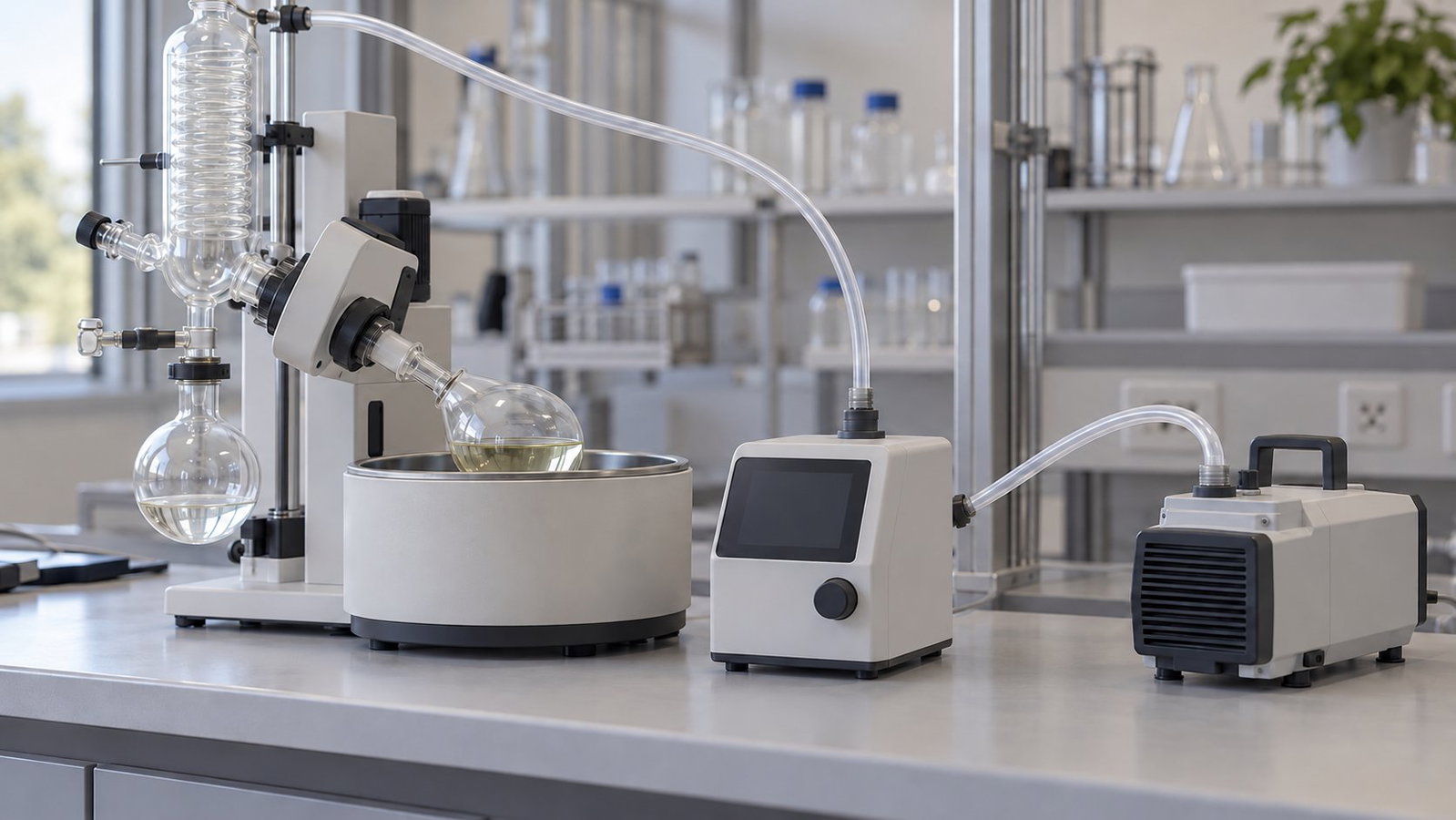
1. What a Vacuum Controller Adds to a Rotary Evaporator
Reaching a pressure versus holding one
An uncontrolled diaphragm pump pulls the system down until the gas it removes balances the vapor, leaks and outgassing coming in [1][2]. That balance depends on gas load, including solvent vapor, and on the effective pumping speed, condenser performance and system tightness. As the complete guide to rotary evaporation puts it, an uncontrolled pump "pulls to its limit. That is rarely what you want."
A controller closes the loop. A pressure sensor reads the system, and the controller acts on the pump or on a valve to keep the reading at a setpoint. Control permits a chosen pressure target and, where supported, programmed changes. It does not ensure that the sensor reading equals flask pressure or that the solvent remains at the intended temperature.
Two ways to add control in the ALab™ range
The VC100 vacuum controller is a standalone unit that displays, adjusts and controls the degree of vacuum in vacuum systems; together with a vacuum pump, it generally forms the vacuum control system of a rotary evaporator. Its specifications:
| VC100 function | Specification |
|---|---|
| Vacuum setting range | 1–1000 mbar |
| Vacuum measurement range | 1–1000 mbar |
| Control modes | Single-point control, programmed control |
| Program memory | Up to 5 programs, each with 5 steps in which the degree of vacuum and time can be set |
| Display and setting | 5" TFT touch screen |
| Sensor overload pressure | 1,500 mbar |
| Materials in contact with vapor | PTFE, PP, silicone and ceramics |
| Vent valve | Built-in; can feed inert gas into system equipment |
| Pump operation | Pump power control (temporary shutdown after a stable vacuum is reached) or pump normally open |
| Pump compatibility | 50 Hz pump power ≤400 W; 60 Hz pump power ≤500 W |
| Connector | 8 mm |
Source: ACS Material product specifications (October 2026).
The RE100-CV controlled rotary evaporator integrates the function. It has a built-in vacuum pump controller, a vacuum setting range of 1–1000 mbar, single-point and programmed control modes and storage for up to 5 programs of 5 steps each, alongside a 20–280 rpm drive, heating from RT to 180 °C and a self-cooling condenser rated RT to −40 °C.
For the benchtop RE100-Pro and RE100-S, ACS Material names the C410 diaphragm pump (13 mbar ultimate vacuum, 25 L/min) as the matched vacuum source; a programmable vacuum controller can be added for controlled pressure ramps that help reduce bumping. For the C410, the controller sits between pump and condenser.
2. Choosing the Setpoint for a Pure Solvent
Start from the vapor temperature
A liquid boils when its vapor pressure equals the pressure above it, so the setpoint follows from the temperature at which you want the solvent to boil [3][4]. An illustrative Δ20 °C arrangement uses a 60 °C bath, a 40 °C target boiling temperature and 20 °C coolant. These are selected temperature differences, not universal requirements or a guarantee of adequate cooling. Further discussion and solvent charts are in solvent boiling points under vacuum.
Antoine-based starting values
The vapor pressure comes from the Antoine equation, log₁₀(P/mmHg) = A − B / (T/°C + C), whose constants are specific to each substance and valid only over the temperature interval they were fitted to [3][6]. The table below was computed with the formula and coefficient set used by the boiling-point explorer embedded in that article (E1), converted to mbar. It covers pure solvents only, and each coefficient set is identified against a cited data record.
Estimated saturation pressures, mbar absolute; not validated controller settings:
| Pure solvent | E1 display interval† | At 30 °C | At 40 °C | At 50 °C | Coefficient record |
|---|---|---|---|---|---|
| Ethanol | −57 to 81 °C | ~104 mbar | ~178 mbar | ~294 mbar | A, B, C as listed in DDB Antoine record no. 11 (fitted −57 to 80 °C) [18] |
| Ethyl acetate | 10 to 79 °C | ~160 mbar | ~251 mbar | ~380 mbar | A and B match DDB no. 21; E1 uses C = 217.88, while DDB displays C = 217.9 (listed fitted interval: 16 to 76 °C) [19] |
| THF | 0 to 68 °C | ~268 mbar | ~402 mbar | ~586 mbar | A, B and C (C rounded) as listed in DDB Antoine record no. 159 (fitted 23 to 100 °C) [20] |
| Water | 1 to 102 °C | ~42 mbar | ~74 mbar | ~123 mbar | A, B, C as listed in DDB Antoine record no. 174 (fitted 1 to 100 °C) [21] |
† Interval used by the E1 explorer for display. It differs from the fitted interval of the cited record, given in the last column; every calculation temperature shown lies inside both intervals. Dichloromethane, acetone, methanol and toluene are not included in this table.
How to read this table. These are rounded pure-solvent equilibrium vapor-pressure estimates from E1, expressed as absolute pressure. Each coefficient set is identified in the last column; use it only within the fitted interval of that record. Mixtures and solutes alter phase equilibrium; superheating affects boiling onset. Leaks, noncondensable gases and sensor location affect operating pressure or its measurement, not the pure solvent's saturation-pressure curve. Treat the values as starting estimates, not validated settings or guarantees of achievable pressure.
The table shows why one habitual vacuum setting cannot serve every solvent. Pressure sensitivity must be assessed near the working point; the same millibar variation does not correspond to the same boiling-temperature change for different solvents.
Setting and checking
Check the estimate against the controller's range before selecting a trial setpoint. Approach a suitable target gradually while observing boiling and condensation. Check cooling, gas load and pressure measurement before increasing heat.
3. Single-Point Control and the Switching Band
How on-off control holds a pressure
In a basic on-off model, evacuation turns on at an upper pressure threshold and off at a lower threshold; between them, the previous actuator state is retained. Their separation is the hysteresis band [8][9]. This is a generic control explanation, not a documented VC100 or RE100-CV algorithm. Such cycling can produce the sawtooth-like trace discussed in the complete guide.
What the band width does
| Band | Effect on the run | Effect on hardware |
|---|---|---|
| Narrow | Smaller pressure excursion, other conditions equal | May require more frequent switching |
| Wide | Larger pressure excursion; boiling may vary more | May reduce switching frequency |
The boiling-temperature change associated with a pressure band depends on the local vapor-pressure slope. A larger dP/dT means a smaller temperature change for the same pressure change. Neither a narrow band nor a sawtooth trace guarantees steady boiling or adequate condensation. A hysteresis value for the VC100, and whether it is adjustable, are not specified; check the operating manual of the unit you use.
Pump power control or normally open pump
The VC100 offers two pump operating options: pump power control, which temporarily shuts down the pump power supply once a stable vacuum is reached, or operation with the pump normally open. The first option is presented as energy saving. These descriptions do not establish either mode's detailed switching logic; confirm it in the operating instructions.
4. Gradient Programs: Steps Toward the Setpoint
Why approach the setpoint in steps
A rapid pressure reduction can lower the equilibrium boiling temperature below the actual liquid temperature. If vapor formation is delayed, superheating can contribute to sudden boiling [10][11]. The physics is explained in why the flask rotates; a stepwise pressure approach may help limit this mismatch, depending on step size, timing and sample conditions. As how a rotary evaporator works in five steps notes, ramping the pressure down "whether by a programmable controller or by hand on a bleed valve" can "reduce the degree of localized superheating during pull-down."
How a program is structured
On the VC100, a program is a sequence of up to five steps, and each step can set the degree of vacuum and time. The RE100-CV has the same 5 programs × 5 steps structure. How the controller moves between two step pressures is not specified, for example whether it steps or ramps linearly, so the patterns below are described as a sequence of held setpoints.
An illustrative sequence begins above the intended working pressure, uses additional approach steps if needed, then holds the working target while the run is observed. Any lower-pressure finishing step needs process-specific justification. Unused slots are not mandatory steps; end-program behavior and venting must follow the operating instructions.
An illustrative two-step pattern for pure ethanol
| Step | Pressure | Basis | Time |
|---|---|---|---|
| 1. Approach | ~294 mbar | E1 estimate for ethanol at a 50 °C calculation temperature; coefficients as in DDB Antoine record no. 11 (fitted −57 to 80 °C) [18] | Duration to establish during method development |
| 2. Working | ~178 mbar | E1 estimate for ethanol at a 40 °C calculation temperature; coefficients as in DDB Antoine record no. 11 (fitted −57 to 80 °C) [18] | Duration to establish during method development |
This is a teaching pattern, not a validated method or executable program. The illustrative bath stays at 60 °C; 50 and 40 °C are calculation temperatures, not guaranteed measured vapor temperatures. No automatic detection of steady boiling or endpoint is documented. Establish durations and transition behavior for the instrument and sample before programming. Do not transfer this pattern to mixtures.
Pure solvents do not need a step-down for composition
For an unchanged pure liquid at fixed temperature, saturation pressure is independent of the quantity remaining. That does not establish that one setpoint remains appropriate throughout sample concentration: dissolved solutes, changing heat transfer and endpoint constraints require reassessment. Mixtures behave differently (Section 6).
5. Bumping and Foaming: What Control Can and Cannot Do
What a controller changes
Bumping is a nucleation problem: a superheated liquid releasing its vapor suddenly [10][11]. Rapid pressure drops are one common trigger; others are a bath much hotter than the boiling point, an over-filled flask and a stationary or slowly turning flask [5][7]. An appropriately configured controller may help limit rapid pressure changes. It does not prevent the others, and it does not guarantee that a superheated liquid will nucleate gently. Bumping can still occur under a controlled program.
A start-up order that limits the risk
- Fill the flask to no more than about half its volume.
- Start rotation before pulling vacuum, so a thin film is present when boiling begins.
- Let the bath settle at a modest differential, rather than overheating to speed things up.
- Start the program with an approach step above the working setpoint.
- Fit a bump trap for bump-prone, valuable or limited-volume samples [5][7].
Foaming is a different problem
Foaming involves gas bubbles stabilized by surfactants, proteins or fine solids [12]; foam can also expand abruptly under reduced pressure. Pressure approach, rotation speed, fill level and bath temperature must suit the sample; no single adjustment guarantees control. The diagnostic difference between the two is set out in why the flask rotates.
6. Solvent Mixtures: Why Programs Stay Qualitative
A mixture's boiling behavior depends on composition and phase equilibrium. For an ideal liquid solution with an ideal vapor, each component contributes its mole fraction times its pure-component saturation pressure to the bubble pressure [13][14]. Real mixtures may deviate strongly. At an azeotrope, vapor and liquid compositions are equal: evaporation can continue, but ordinary distillation does not enrich one component at that composition and pressure [14][15].
No numerical mixture program is given here. Review composition, phase behavior, sample stability and cooling capacity before developing a supervised method. Components need not leave one at a time, pressure need not decrease monotonically, and the last fraction is not necessarily water-rich. Slowing evaporation alone does not justify deeper vacuum; check heat transfer, condensation, leaks and restrictions. Reuse a stored program only after confirming comparable starting composition, batch conditions and endpoint criteria.
7. Setting Up the Control Loop
Where the controller sits
For the C410, the controller sits between pump and condenser. In this position the sensor reads the pressure on the vacuum line; a long or narrow hose between the sensor and the flask, or a restriction at a trap, means the flask pressure can differ from the reading [1][2]. Keep connections short, vacuum-rated and tight. The VC100 has an 8 mm connector.
Leaks and the reading
A leak adds gas load and may cause frequent cycling or prevent a target pressure from being reached; these signs are not specific to leaks. If a run cannot reach a setpoint that it reached before, check joints and seals before changing the program [1][7].
Venting
Follow the instrument's shutdown sequence: lift the flask clear of the bath before releasing vacuum, stop rotation, and vent slowly before detaching the supported flask. The VC100 has a built-in vent valve that can feed inert gas into system equipment, and one-click decompression for installation and dismantling. Venting with inert gas rather than air can matter for air-sensitive residues.
Matching pump and controller
The VC100 lists pump-power limits of 400 W at 50 Hz and 500 W at 60 Hz. The specified C410 95 W and C960T 370 W figures are below the 50 Hz limit, but wattage alone does not establish compatibility. The C2000T's 750 W exceeds both limits; do not assume compatibility with pump-power control. Confirm the mains supply, switching requirements and approved control configuration before ordering.
Exhaust and safety
Uncaptured vapor may reach the pump and exhaust. Select trapping for the actual vapor and operating temperature; a generic moisture trap does not establish solvent capture. Route exhaust according to the laboratory's procedures [7][16][17].
8. Frequently Asked Questions
Do I need a vacuum controller for a rotary evaporator? Without active control, pressure reflects the balance between gas load and removal. A controller regulates a chosen target at its sensor; supported programs may help manage pressure changes, but do not eliminate bumping risk.
What setpoint should I use? For a pure solvent, use a vapor-pressure estimate within its stated range at the chosen boiling temperature, then check the instrument's range and process constraints. Section 2 and solvent boiling points under vacuum provide starting estimates, not validated operating settings.
Does a gradient program stop bumping on a rotovap? No. It may reduce one common trigger: a rapid pressure drop. Fill level, bath temperature and rotation still matter, and a bump trap is recommended for valuable samples.
What is vacuum hysteresis? In an on-off model, hysteresis is the separation between switching thresholds; the actuator retains its state between them. The band need not be centered on the displayed setpoint. For the VC100, its width and adjustability are not specified.
Can I use a pure-solvent setpoint for a mixture? Not as a validated mixture setpoint. Composition and phase equilibrium matter; develop a supervised, mixture-specific method rather than copying pure-solvent values or automatically stepping pressure down.
9. Keep Exploring Rotary Evaporation
- Rotary Evaporation: The Complete Guide: principles, setup, vacuum, condensing and solvent recovery.
- How a Rotary Evaporator Works: Five Steps
- Solvent Boiling Points Under Vacuum, with the interactive boiling-point explorer
- Why the Flask Rotates: Films, Area and Bumping
- Rotary Evaporation vs Simple Distillation
See the VC100 vacuum controller and the RE100-CV, or browse all ALab™ rotary evaporators and vacuum equipment