
A method developed in a 1 L flask does not become a 20 L method merely by choosing a larger flask. Scaling an industrial rotary evaporator involves heat transfer, condensation, vapor handling and safe manipulation of larger inventories. This guide compares ALab™ product specifications and idealized calculations. Its time examples divide an assumed liquid-equivalent volume to be evaporated by the listed evaporation capacity; they are not manufacturer batch-time measurements.
Quick answer: Flask size is not throughput or an approved charge volume. For similar ideal spheres, area per nominal liter decreases as volume increases, but actual film and heat transfer require assessment. Dividing an assumed 50 L to be evaporated by the RE5000-E's specified 11 L/h maximum for 75% alcohol gives about 4.5 hours of constant-rate arithmetic. The rate is specified; the time is calculated here. It excludes heat-up, changing composition, endpoint and handling, and is neither a guaranteed lower bound nor a prediction for another process.
1. What "Industrial Rotary Evaporator" Means in This Article
From benchtop to pilot scale
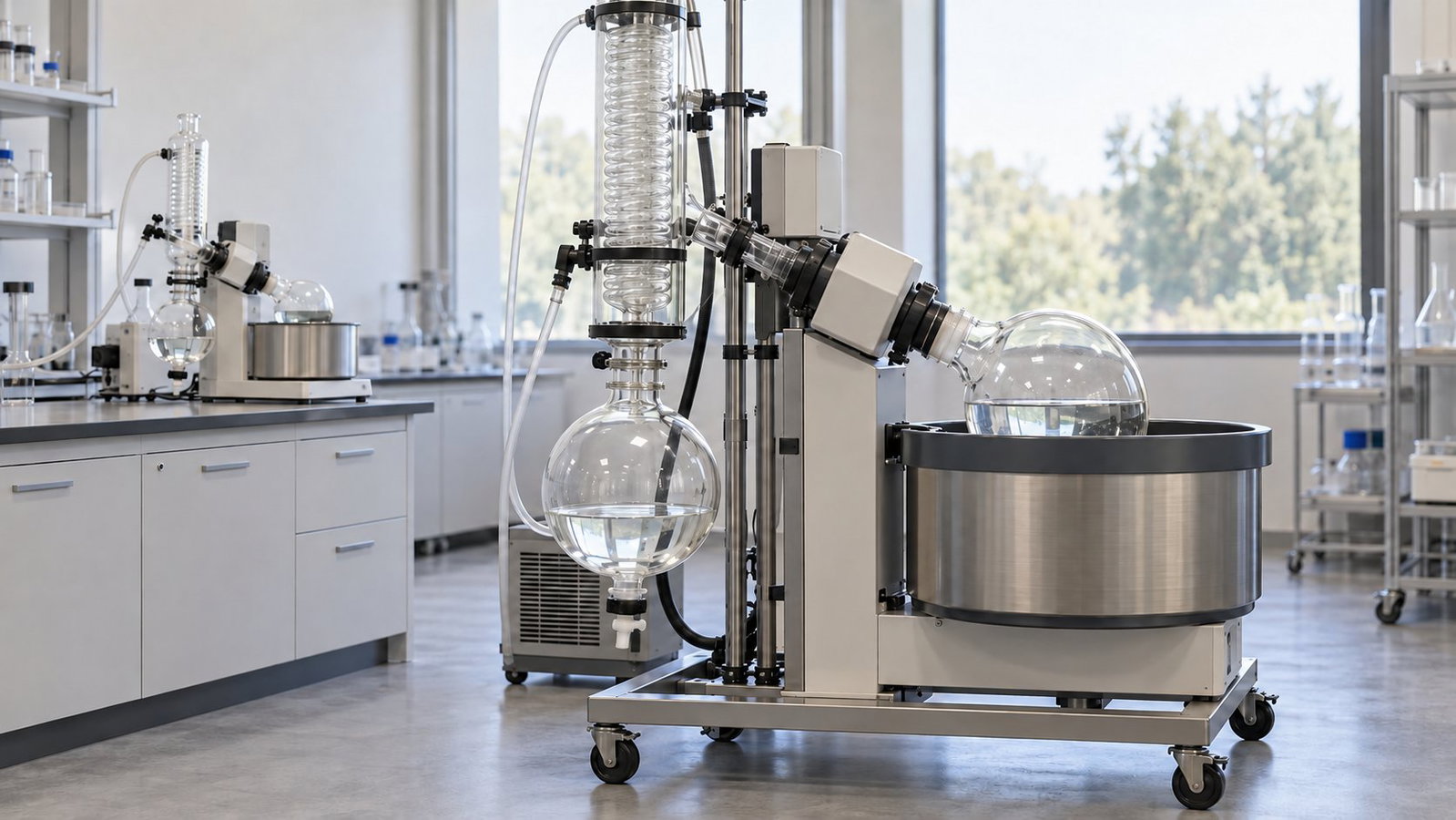
Here, "industrial rotary evaporator" is a search term for comparing bench and pilot equipment, not a certification or promised output. The scope includes benchtop flasks and the listed 20L rotary evaporator and 50L rotary evaporator options; nominal volume alone does not define an industry category. The RE100-Pro and RE100-S take 50–3000 mL flasks, and the RE100-CV takes flasks up to 3000 mL. The RE200-Pro is a 20 L pilot-scale rotary evaporation system for large-volume distillation, separation, sample concentration and solvent recovery, and the RE-E series is described as pilot scale, with 5, 10, 20 and 50 L evaporating flasks. This article keeps to ACS Material's term, pilot scale, and makes no statement about the output any process will reach.
Why scale-up is not a straight line
For geometrically similar shapes, volume scales with the cube of length and surface area with its square [1]. Thus total area per nominal volume decreases; actual heated, wetted and evaporating areas also depend on operating conditions. As the complete guide to rotary evaporation puts it: "Moving from a 1 L bench flask to a 20 L pilot flask is not a linear extension of the same experiment."
2. The Specifications Side by Side
Evaporator specifications
| Model | Evaporating flask | Max. evaporation capacity (test liquid) | Condenser cooling surface | Ultimate vacuum | Speed range |
|---|---|---|---|---|---|
| RE100-S | 50–3000 mL | 1.56 L/h (H2O) | 1200 cm² (1700 cm² option) | — | 20–200 rpm |
| RE100-Pro | 50–3000 mL | 1.56 L/h (H2O) | 1700 cm² | — | 20–280 rpm |
| RE500-E | 5 L | 2 L/h (75% alcohol) | 0.28 m² (main condenser) | 9 mbar | 20–180 rpm |
| RE1000-E | 10 L | 3.8 L/h (75% alcohol) | 0.49 m² (main condenser) | 9 mbar | 20–130 rpm |
| RE200-Pro | 20 L | 4.5 L/h (75% alcohol) | 1.2 m² (two-section triple-coil) | Less than 2.6 mbar | 10–150 rpm |
| RE2000-E | 20 L | 5 L/h (75% alcohol) | 1.29 m² (main condenser) | 9 mbar | 20–130 rpm |
| RE5000-E | 50 L | 11 L/h (75% alcohol) | 1.75 m² (main condenser) | 9 mbar | 20–130 rpm |
Source: ACS Material product specifications (October 2026). A dash means the specification is not listed. RE-E accessory listings show equal-area main and secondary condensers for 10, 20 and 50 L, but only a main condenser for 5 L. Only the listed main area is reported here; supplied quantities and total configured area require confirmation. RE100-CV evaporation capacity: not specified.
Cautions before comparing models
The benchtop rates refer to water; the pilot rates are given for 75% alcohol. The alcohol, percentage basis, complete composition, bath temperature, working pressure and coolant conditions are not specified, so do not assume a defined ethanol-water test. These maxima do not rank all models on a common feed. ACS Material advises that process parameters be re-optimized for the larger RE200-Pro system.
3. What Changes When the Flask Gets Bigger
Total area per nominal liter falls
Treat each nominal volume as a sphere, using V = 4πr³/3 and A = 4πr² [1][2]. The table gives total spherical surface per nominal liter, not product dimensions, actual heated area or film area. Fill, tilt, immersion, wetting and geometry must be assessed separately:
| Nominal flask volume | Ideal-sphere diameter | Total sphere area | Total area per nominal liter | Relative area/volume vs 1 L |
|---|---|---|---|---|
| 1 L | ~12 cm | ~480 cm² | ~480 cm²/L | 1.00 |
| 3 L | ~18 cm | ~1000 cm² | ~335 cm²/L | 0.69 |
| 5 L | ~21 cm | ~1400 cm² | ~283 cm²/L | 0.58 |
| 10 L | ~27 cm | ~2250 cm² | ~224 cm²/L | 0.46 |
| 20 L | ~34 cm | ~3560 cm² | ~178 cm²/L | 0.37 |
| 50 L | ~46 cm | ~6560 cm² | ~131 cm²/L | 0.27 |
From 1 L to 50 L the ideal volume rises 50-fold and total area about 13.6-fold. This calculation does not determine film area per charge, film thickness or evaporation rate. Thin-film behavior must be assessed for the actual geometry, liquid and operation [5]. The article on why the flask rotates makes the same point: "At pilot scale the surface-to-volume ratio falls and film behavior has to be re-optimized rather than transferred from the bench."
Specified speed ranges are not a scale-up rule
The listed ranges are 20–280 rpm for RE100-Pro, 10–150 rpm for RE200-Pro and 20–130 rpm for the 10–50 L RE-E units. These are available ranges, not recommended operating speeds. At equal rpm a larger radius has greater wall speed, since v = 2πrn with n in revolutions per second [1][4]. This kinematic fact does not establish why a manufacturer chose a range. Confirm suitable speed, film behavior and loading for the specific instrument and process.
Heat in and heat out
Condensing vapor releases latent heat; sensible cooling and other heat paths require separate accounting [2][3]. Thermophysical properties depend on their reference conditions [8][9]. For illustration, use the cluster's rounded teaching inputs of 660 kJ/L for pure ethanol and 2257 kJ/L for pure water, not temperature-corrected process properties. Then Q (W) = rate (L/h) × assumed latent energy (kJ/L) / 3.6. The example rates below coincide with listed rates, but do not assert that each model achieves them with either pure liquid.
| Assumed liquid-equivalent rate | Pure-ethanol arithmetic | Pure-water arithmetic |
|---|---|---|
| 1.56 L/h | ~290 W | ~980 W |
| 4.5 L/h | ~830 W | ~2.8 kW |
| 5 L/h | ~920 W | ~3.1 kW |
| 11 L/h | ~2.0 kW | ~6.9 kW |
These are two separate pure-solvent calculations, not verified bounds for 75% alcohol. Mixture duty requires composition, reference states and actual vapor conditions. Sensible cooling and circuit heat gains are excluded; do not add the bath heater's power to latent energy already represented by vapor generation. The DCP-5 recirculating chiller is rated at 700 W at 20 °C, and RE200-Pro cooling is sized for the process at quotation. This neither approves that pairing for every duty nor establishes capacity at another setpoint. Condenser area alone also cannot establish duty: overall heat-transfer coefficient, effective area, coolant flow, vapor conditions and the appropriate mean temperature difference all matter [2][3].
Vapor volume and the vacuum system
Using 0.789 kg/L and 46.07 g/mol as approximate ethanol inputs, 1 L contains about 17.1 mol. The ideal-gas equation gives about 4.5 m³ at 100 mbar absolute and 40 °C [8][9]. This illustrates vapor-path volume, not pump-inlet flow or pump capacity. The condenser should capture most vapor; the pump handles residual vapor, leaks and outgassing [4][12].
The specified vacuum figures are system ratings, not operating pressures: 9 mbar for RE-E and below 2.6 mbar for RE200-Pro. Confirm the test and installed configurations. ACS Material identifies the C410 diaphragm pump, rated to 13 mbar ultimate vacuum, as specified for RE100-Pro/RE100-S rather than the RE200-Pro pilot system. The RE-E series lists the C2000T diaphragm pump (10.8 m³/h at atmospheric pressure; rated ultimate vacuum <2 mbar abs.) and VC100 vacuum controller (1–1000 mbar) as related products. Such listings do not establish an approved electrical or process-compatible combination. Confirm the complete configuration; no pump-down, pump-sizing or solvent-suitability verdict is made here.
4. Time Arithmetic from Specified Capacity
The formula and its limits
Constant-rate arithmetic time (h) = assumed liquid-equivalent volume to be evaporated (L) ÷ listed maximum evaporation capacity (L/h)
The denominator is the manufacturer’s specified rate for its test liquid, not a verified rate for your process. The numerator is the amount assumed to leave as vapor on a liquid-volume basis, not automatically the feed volume or nominal flask size. These quotients exclude heat-up, rate variation, endpoint and handling. They are not universal lower bounds: that interpretation would require showing the actual rate never exceeds the chosen reference. The water and 75% alcohol rates are not a common-feed performance ranking.
| Model / reference rate / test liquid; columns show assumed volume to evaporate | 3 L | 10 L | 25 L | 50 L | 100 L |
|---|---|---|---|---|---|
| RE100-Pro / RE100-S (1.56 L/h, H2O) | ~1.9 h | ~6.4 h | ~16 h | ~32 h | ~64 h |
| RE500-E (2 L/h, 75% alcohol) | ~1.5 h | ~5.0 h | ~12.5 h | ~25 h | ~50 h |
| RE1000-E (3.8 L/h, 75% alcohol) | ~0.8 h | ~2.6 h | ~6.6 h | ~13 h | ~26 h |
| RE200-Pro (4.5 L/h, 75% alcohol) | ~0.7 h | ~2.2 h | ~5.6 h | ~11 h | ~22 h |
| RE2000-E (5 L/h, 75% alcohol) | ~0.6 h | ~2.0 h | ~5.0 h | ~10 h | ~20 h |
| RE5000-E (11 L/h, 75% alcohol) | ~0.3 h | ~0.9 h | ~2.3 h | ~4.5 h | ~9.1 h |
Volumes in this table are calculation totals, not approved single charges. Large totals may require separate batches or a documented feeding arrangement; the table includes neither recharging nor receiver-handling time. The RE-E series offers continuous feeding and collection. The RE200-Pro offers continuous distillate removal, which does not establish continuous feed. No feed capability is inferred for other models, and nominal flask capacity is not a permitted working fill.
Illustrative half-volume arithmetic
University of York teaching-lab guidance uses less-than-half-full flasks [17]; it does not approve working charges for these pilot models. For arithmetic only, assume the volume to evaporate equals half the nominal flask volume. Dividing by the listed reference rates gives about 75, 79, 120, 133 and 136 minutes for RE500-E, RE1000-E, RE2000-E, RE200-Pro and RE5000-E, respectively. These are not filling instructions, drying endpoints or elapsed batch times. The 5-to-50 L flask-size ratio is 10, while the corresponding listed rate ratio is 5.5; different equipment and unspecified test conditions prevent attributing that difference to geometry alone.
What the quotient leaves out
- Heat-up: a large bath and charge take time to reach temperature.
- The concentration tail: composition, viscosity, phase behavior and endpoint can change the removal rate; constant-rate arithmetic does not model them [3][4].
- Changing composition: composition may evolve; the test-liquid label alone does not define the trajectory (Section 5).
- Foaming: propensity depends on composition, fill and operating conditions; a larger inventory can increase the consequences of carryover [11].
- Handling: emptying receivers, changing flasks and cleaning glass add time between batches [6].
5. Why a Specified Test Liquid Is Not Your Process
An illustrative ethanol–water example
An ethanol-water mixture is an illustrative example, not a confirmed identification of ACS Material's 75% alcohol test liquid. Vapor enrichment depends on composition and pressure; a liquid below the relevant azeotropic composition may become more water-rich, but that path and its rate are not universal [4][10]. At about 1 atm, ethanol-water has an azeotrope near 95.6% ethanol by mass and 78.2 °C [10][20]. These are atmospheric reference values, not vacuum-process settings or a basis for interpreting the specified test. Use composition-specific data and measurements rather than assuming a fixed decline in rate.
Fixed illustrative energy inputs
The fixed illustrative inputs in Section 3 give a water-to-ethanol ratio of 2257/660, about 3.4. This is not a measured mixture-duty ratio or a conversion between the manufacturers' water and 75% alcohol rates. Density, vaporization enthalpy and composition depend on the conditions [8][9]. The guide to how a rotary evaporator works provides the workflow context; neither a benchtop water rate nor these pure-component inputs establish a pilot mixture rate.
The solvent boiling points article provides range-limited pure-solvent estimates and a Δ20 °C illustration, not validated bath or coolant settings. Establish safe sample limits, actual pressure and cooling conditions, then record removal rates and endpoints in a reviewed bench method. Mixtures require composition-specific assessment.
6. Transferring Bench Conditions to a 20 L or 50 L Flask
What carries over and what does not
For a pure solvent in equilibrium, saturation temperature at a specified absolute pressure does not depend on nominal flask size. This does not make a bench bath setting, controller reading or operating method transferable unchanged. Actual flask pressure, heat-transfer coefficients, film behavior, fill and condenser performance can differ. For the RE200-Pro, ACS Material calls for confirmation against the process and condenser capacity. Reassess operating conditions within established sample and equipment limits rather than assuming a larger bath setting is needed [1][5][6][7].
A sensible order of work
- Document the bench method: composition, endpoint, measured rate and pressures/temperatures, including measurement locations.
- Confirm the pilot configuration: safe working charge, vacuum performance under load, coolant conditions, delivered flow and usable cooling capacity.
- Review the larger inventory before operation: handling, containment, ignition control, thermal hazards and shutdown response; a smaller initial charge is not a substitute for review.
- Execute an approved trial and record it: use measured process rates and full cycle times, not specified maxima, for scheduling. Any stepwise increase requires review against the method and equipment limits.
Step-by-step operation is covered in the article on how a rotary evaporator works.
7. Handling, Services and Safety at Pilot Volume
Mass, glass and space
Using an illustrative ethanol density of 0.789 kg/L, liquid-only masses for 20 and 50 L are about 16 and 39 kg [9]. These are not approved fills or manual lifting limits. A motorized bath or flask lift does not establish that an operator can safely detach, carry or change a loaded flask. Confirm appropriate support and handling procedures for the configured glassware. The RE200-Pro has a 180 mm motorized lift and a 10 L receiving flask with drain valve, and motorized bath lifting (130–253 mm strokes) plus an automatic switching valve are specified for the RE-E series. Large glass under vacuum carries an implosion risk, so shielding and glassware inspection belong in the hazard review [12][15]. The RE200-Pro measures 1160 × 600 × 1860 mm and needs clearance above the condenser column for glassware handling; both pilot systems use a 220 V supply, and the electrical connection is part of RE200-Pro system selection.
Flammable solvent at volume
Have the responsible safety and facilities personnel confirm applicable quantity limits, ventilation, spill containment, exhaust and electrical requirements for the site [12][13][14]. Review the larger inventory, thermal behavior and handling before scale-up; heat removal and risk cannot be inferred from nominal volume alone [15][16]. The listed over-current, earth-leakage, boil-dry, overheat and lifting protections do not establish explosion protection, suitability for a hazardous location or process safety.
8. Bench, 20 L or 50 L: Questions to Answer First
Match the process to the specifications
| Question | What to check | Where the data come from |
|---|---|---|
| How much solvent per day or week? | Volume to remove ÷ specified reference rate as arithmetic only; plan elapsed time from process data | Section 4; product specifications |
| How far is your liquid from the test liquid? | Latent heat and composition vs. 75% alcohol or water | Section 5 [8][9] |
| What pressure does the process need? | Required flask pressure under load, confirmed system configuration and specified ratings; a rating is not a working-pressure guarantee | Product specifications; boiling-point tables |
| How much cooling? | Complete duty, actual coolant conditions and documented capacity; avoid double counting heat paths | Section 3; chiller specifications |
| Continuous feed or collection? | Feeding: RE-E; collection: RE-E and RE200-Pro | Product specifications |
| Space, power, handling? | Footprint, height, 220 V, lift, receiver size | Product specifications; facilities |
| Hazard review done? | Flammable quantities, glass under vacuum, exhaust | Refs [12]–[16] |
When the bench is still the right answer
For a small workload or a changing method, repeated benchtop runs may be preferable to a larger system. Water content alone does not determine that choice. ACS Material distinguishes bench method development from pilot-scale work requiring re-optimized parameters. Compare measured cycle time, handling, cooling and pilot-scale solvent recovery needs. Solvents contribute substantially to material use in pharmaceutical process chemistry [18], and thermal separations are energy-intensive [19]; these considerations motivate assessment, not a predicted recovery benefit.
9. Frequently Asked Questions
What is an industrial rotary evaporator?
The term has no size-based definition established by this article. Here it refers to comparison with the listed pilot-scale equipment, not a certification or throughput claim. ACS Material describes its 20 L and 5–50 L ALab™ units as pilot scale. Evaluate the specified configuration and process rather than relying on the label.
How long does it take to evaporate 20 L or 50 L?
For assumed removal totals, 20 L ÷ 4.5 L/h (RE200-Pro) is about 4.4 hours and 50 L ÷ 11 L/h (RE5000-E) about 4.5 hours. The rates are specified maxima for 75% alcohol; these times are author-calculated constant-rate examples, not measured batch times or guaranteed bounds. Neither total is an approved single charge. Actual elapsed time requires process-specific rates and handling allowances.
Does a 50 L rotary evaporator evaporate 50 L per hour?
No. 50 L is the evaporating flask size. The RE5000-E's specified evaporation rate is a maximum of 11 L/h for 75% alcohol, and real rates depend on liquid, bath temperature, pressure and condenser.
Can I use my benchtop settings on a 20 L unit?
Only a pure-solvent equilibrium relationship at the same actual absolute pressure is independent of flask size. Bath settings, controller readings, speed and rate are not automatically transferable. Establish a reviewed pilot configuration and method, then use measured rates and full cycle times for planning.
What pump and chiller does a pilot rotary evaporator need?
For the RE200-Pro, pump, chiller and vacuum control are separately selected system items, confirmed for the intended process at quotation. Specify composition, required flask pressure under load, vapor duty and cooling conditions. A related-products list or ultimate-vacuum figure alone does not establish compatibility or suitability.
10. Keep Exploring Rotary Evaporation
- Rotary Evaporation: The Complete Guide: principles, setup, condensing and scale-up to pilot volumes
- How a Rotary Evaporator Works: Five Steps
- Why the Flask Rotates: Films, Area and Bumping
- Solvent Boiling Points Under Vacuum: the Δ20 °C illustration and pure-solvent pressure–temperature tables
See the RE200-Pro 20 L rotary evaporator, the RE-E series (5–50 L), or browse all ALab™ rotary evaporators and accessories