
Balancing a centrifuge requires both matching the loaded assemblies and using the permitted placement pattern. This guide explains mass, radius and speed effects, gives idealized calculations and ring examples, and distinguishes them from equipment-specific loading instructions. It also summarizes the balance guidance and imbalance warnings or alarms listed for nine ALab™ centrifuges. The mathematical examples are not operating approval for any rotor.
Quick answer: Use the approved rotor, tubes, closures, adapters and loading pattern. Compare the complete assemblies specified by the instructions, using a suitable balance and the applicable mass-matching criterion. An odd sample count does not automatically require a blank; use only a permitted arrangement. For buckets or cups, confirm which components must remain installed and how loaded assemblies are matched. A listed alarm or warning does not supply a tolerance, prove automatic stopping, or replace these checks.
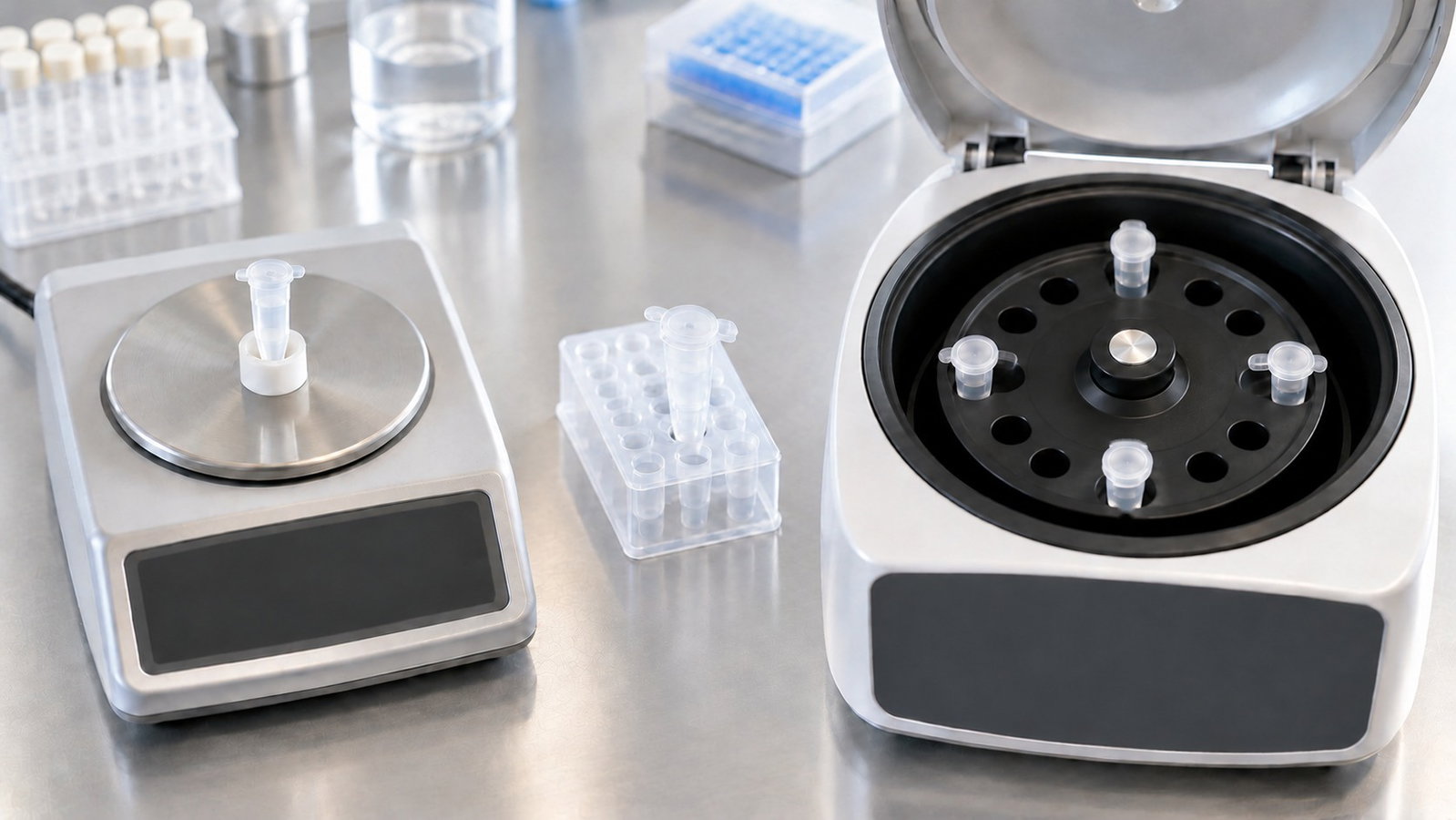
1. Why Balance Matters: Mass, Radius and Speed Squared
For point masses rotating at angular speed ω, the radial force resultant is ω² times the vector sum of the mass–radius products. The directions matter. Zero resultant does not eliminate internal rotor stress or, for loads in different axial planes, an unbalanced couple [1][2][7].
For two opposite point loads at the same radius and in the same plane, differing only by mass Δm:
Unbalanced force magnitude F = |Δm| × RCF × g_n
Use Δm in kilograms, dimensionless RCF and g_n = 9.80665 m/s² to obtain F in newtons [5]. This simplified excitation-force estimate is not a bearing-load or vibration prediction. RCF = 1.118 × 10⁻⁵ × r × N², with r in cm and N in rpm. At unchanged mass distribution, doubling speed quadruples this force.
The following calculations use the rated RCF figures and hypothetical point-mass mismatches at those reference locations. The listed radii are not identified as centers of mass of complete tubes or assemblies. These are illustrations, not measured instrument loads or permissible imbalances.
| Configuration | Rated RCF at specified radius | Mass difference | Calculated unbalanced force |
|---|---|---|---|
| DM0412, A12-10P rotor, 11 cm | 2,490 ×g | 1 g | ≈ 24 N (≈ 2.5 kg-force) |
| DG1616 / DG1616R, AS30-2 rotor, 10 cm | 28,620 ×g | 0.1 g | ≈ 28 N (≈ 2.9 kg-force) |
| DG1616 / DG1616R, AS30-2 rotor, 10 cm | 28,620 ×g | 1 g | ≈ 281 N (≈ 29 kg-force) |
In these examples, 0.1 g at 28,620 ×g gives a larger calculated force than 1 g at 2,490 ×g. This demonstrates the RCF dependence; it does not establish a permissible mismatch for either instrument. Kilogram-force is a force unit, not an added mass.
Imbalance can cause vibration, damage or breakage, but there is no guaranteed progression of warning signs [1][2][6]. Follow the safe-stop procedure for abnormal operation rather than waiting for visible movement. The D1008 Palm Micro Centrifuge guidance is to load the rotor symmetrically and place the unit on a level, stable surface.
2. Balance by Mass, Not by Volume
Mass matching includes the sample and its required container assembly. Volume markings alone cannot establish the match.
Liquids differ in density. As an illustrative calculation, 10 mL at 1.00 g/mL has a mass of 10 g, while 10 mL at 1.10 g/mL has a mass of 11 g. The 1 g difference excludes the containers. Equal fill markings are not a mass measurement.
Tubes, caps and adapters add mass. Use the approved component types and compare the complete loaded assemblies specified by the instructions, including closures, adapters and plugs where required. Equal total mass does not by itself establish equal mass distribution.
Blanks. Use a blank only where the approved pattern requires or permits it. Match the specified assembly, mass and fill distribution using a compatible balancing medium. WHO's 2004 manual lists distilled water or 70% propanol and cautions against saline or hypochlorite for counterbalancing [4, p. 72]; this is not blanket approval of either fluid for every instrument. Do not exceed permitted fill to match a denser sample.
Fill level. Leave the headspace the tube and rotor maker specify. An overfilled tube can leak at speed, and a leak redistributes mass mid-run, which can turn a balanced load into an unbalanced one [4].
How to weigh. Use a balance with documented measurement performance and suitable readability for the applicable criterion; display steps alone do not establish accuracy. Compare the required complete assemblies consistently, accounting for measurement uncertainty. Adjust only an approved blank or a sample preparation that the method permits, then recheck the closed assemblies. Matching displayed numbers is not proof of compliance.
3. Mass Tolerance: Why There Is No Universal Number
"How close is close enough?" must be answered for the actual instrument, rotor, assembly and operating conditions. The simple force calculation explains why speed and mass distribution matter; it does not derive an allowable mismatch. An imbalance-detection threshold is a separate design parameter, not a loading tolerance.
No permissible mass difference is specified for the nine ALab™ centrifuges. Obtain the applicable loading and balancing instructions from the operating manual or from us. If they are unclear, resolve that before running; matching as closely as the available balance allows is not a substitute.
Record the approved criterion, configuration, weighing method and loading pattern in the laboratory procedure. Closer matching can reduce the modeled imbalance, but cannot compensate for an unapproved pattern, incompatible component, damage or uncertain measurement.
4. Tube Placement: Opposite Pairs, Triangles and Odd Numbers
For identical point loads at one radius in one plane, zero vector sum places their combined center of mass on the axis. This is the ideal static-balance model used below, not a complete dynamic-balance or loading specification [3][7].
- Opposite pairs: equal masses 180° apart cancel in this model.
- Evenly spaced groups: three equal masses at 120°, four at 90°, and other regular groups cancel when those positions exist.
- Disjoint combinations: combining balanced groups preserves zero resultant; for example, an opposite pair plus a triangle can occupy five distinct positions in an ideal 12-position ring.
An actual rotor may require a more restrictive loading pattern. Use its instructions, not the mathematical existence of a pattern, to authorize a run.
Which counts can balance in an ideal ring?
For an ideal ring of n equally spaced positions, Sivek's theorem states that some arrangement of k identical point loads has zero resultant exactly when both k and n − k are sums of the prime divisors of n with nonnegative integer coefficients [3, Theorem 2]. Repetition of a prime divisor is allowed. This is an existence result, not a claim that every placement of that count balances.
The resulting ideal-ring counts are below. The 4-, 6-, 8- and 12-position cases were also confirmed by exhaustive enumeration; the remaining entries follow the same theorem.
| Positions in one ideal ring | Prime divisors | Counts with no zero-resultant arrangement of identical point loads |
|---|---|---|
| 4 | 2 | 1, 3 |
| 6 | 2, 3 | 1, 5 |
| 8 | 2 | 1, 3, 5, 7 |
| 12 | 2, 3 | 1, 11 |
| 18, 24, 36 | 2, 3 | 1 and n − 1 only |
| 30, 60 | 2, 3, 5 | 1 and n − 1 only |
The empty and fully occupied ideal rings have zero resultant. These are mathematical cases, not operating recommendations. ACS Material specifies capacities, not the single-ring coordinates assumed here. Do not infer a ring from a tube count or apply a blanket "ring-by-ring" rule to multi-ring, strip, plate or adapter configurations. Obtain the approved configuration-specific loading diagram.
Worked ideal-ring placements
Number equally spaced positions 0 to n − 1 clockwise; all listed loads are identical point masses at one radius and in one plane.
- 12 positions, 3 loads: 0, 4, 8.
- 12 positions, 5 loads: pair 0, 6 plus triangle 1, 5, 9.
- 12 positions, 7 loads: the complement, 2, 3, 4, 7, 8, 10, 11.
- 6 positions, 3 loads: 0, 2, 4.
- 8 positions: three or five identical loads cannot give zero resultant; four or six can form opposite pairs.
A single off-axis point load cannot balance by itself in this model. A real one-sample run needs an approved counterbalancing arrangement, not a universal instruction to put another tube opposite. None of these examples establishes an allowed ALab loading pattern.
PCR strips and partly filled strips
Use the approved strip-loading diagram, including orientation and partial-well occupancy; equal strip mass or equal numbers of filled wells alone do not establish matching distributions. D1008 A4-PCR8P and the D1524/D1524R/D3024 AS4-PCR8 list four 8-tube strips or 32 individual 0.2 mL tubes; DG1616 / DG1616R AS12-PCR8 lists 12 strips. Those capacities do not describe a single ring of equal-radius tube positions.
Where placement still goes wrong
A visual check can reveal a misplaced tube, incompatible assembly or missing component, but it cannot establish mass equality, hidden condition or an approved loading pattern. Combine inspection with the required weighing and configuration checks.
5. Adapters, Buckets and Cups
Adapters move tubes, and moving a tube changes the balance
Adapters contribute mass and can change its distribution. For two opposite point loads in one plane, cancellation requires equal mass–radius products; real assemblies also require the prescribed component matching and loading pattern. The DM0412 has specified RCF-reference radii of 11 cm for directly seated A12-10P configurations and 9.8 cm with the A10P15 adapter and plug. It does not establish the centers of mass of complete loaded assemblies.
As a hypothetical calculation only, two opposite 10 g point masses at 11 and 9.8 cm give 110 and 98 g·cm: a difference of 12 g·cm, equivalent to 12/11 ≈ 1.09 g at 11 cm. Using these specified distances does not make them measured assembly center-of-mass radii. The result is not an ALab imbalance measurement, tolerance or instruction to compensate for mixed adapters by changing mass.
The DM0506 specifications caution that an adapter's radius and RCF are not separately specified and the rotor maximum should not be assumed to carry over. That caution supplies neither a balance tolerance nor a loading diagram. Confirm the complete adapter configuration.
Rotors with buckets or cups
Some rotors carry the tubes in removable buckets or cups. The DG1616 / DG1616R has two rotors with hanging cups, lids and handles, and a four-bucket rotor whose bucket sets take different tube configurations. For rotors of this kind:
- Install the required components. Follow the rotor instructions for which cups, buckets and lids must remain fitted, including unloaded positions; do not omit hardware merely because no sample occupies it.
- Match the specified loaded assemblies. WHO's 2004 manual calls for pairing buckets and trunnions by weight and balancing them with tubes installed [4, p. 72]. For the actual rotor, confirm weight classes, assembly masses, maximum loads and internal load distribution.
- Packaging is not balance certification. That adapters are supplied two per set describes quantity. It does not establish a weight-matched pair, pairing tolerance or approved opposite positions.
- Use the approved partial-load diagram. Do not derive bucket loading from a generic mirror pattern or the SE4-100 RCF-reference radii. The listed 14–16.5 cm values do not specify loaded-bucket centers of mass.
For plates, confirm the permitted plate, carrier, stacking and partial-well arrangement as well as mass matching. The DG1616 / DG1616R has a listed microplate/deep-well plate rotor; that capacity listing does not establish every permitted loading pattern.
6. Imbalance Detection: What ACS Material Specifies
Here, imbalance detection means only an alarm or warning explicitly listed in a product's specifications. The words do not establish sensing mechanism, sensitivity, automatic stopping, braking or response time. Obtain the applicable operating instructions; do not infer those functions from a feature name.
Of the nine ALab™ centrifuges, two explicitly list imbalance detection:
- DG1616 / DG1616R High-Speed Centrifuges: automatic rotor imbalance warning.
- D1524R High-Speed Refrigerated Micro Centrifuge: rotor imbalance detection alarm, listed among its features and safety functions.
Detection threshold and post-signal response are not specified for either. Do not infer automatic stopping or use absence of a signal as proof of acceptable loading. Obtain the configuration-specific instructions and required action on a warning or alarm.
Source: ACS Material product specifications (October 2026). It is not a comparison of verified detection performance or a complete review of the operating manual.
| Model | Balance guidance and imbalance detection |
|---|---|
| D1008 | Load the rotor symmetrically; place the unit on a level, stable surface. |
| DM0412 | Load rotors symmetrically; never exceed a rotor's rated speed. |
| DM0506 | Load rotors symmetrically; never exceed a rotor's rated speed. |
| Q0408E | Load the rotor symmetrically; never exceed its rated speed. Imbalance alarm or warning: not specified. |
| D1524R | Rotor imbalance detection alarm |
| DG1616 / DG1616R | Built-in dynamic balance detection with automatic rotor imbalance warning |
| D1524 / D1524C, D3024, DM1424 / DM1224 | Symmetrical-loading guidance and imbalance alarm or warning: not specified. This is not proof that a feature is absent. |
Two cautions follow. First, keep related models distinct: the D1524R's alarm is listed for the D1524R only and should not be read across to the D1524 or D3024, even though the three share a rotor set. Second, other listed safety features, such as door interlocks and overspeed detection, protect against different faults; they are not imbalance detection.
Do not use detection to test whether an unverified load is acceptable. Weigh and load according to the approved instructions even when an alarm or warning is listed. No specific mistake-detection performance is established here.
7. A Balancing Routine for Every Run
- Check the equipment. Confirm approved components, correct installation, condition, stable placement and required clearance under the operating instructions.
- Match assemblies. Confirm tubes, closures, adapters and plugs, including permissible fill and maximum assembly load.
- Weigh as specified. Compare the required complete assemblies against the approved criterion using a suitable balance; use blanks only in a permitted arrangement.
- Check closures. Secure the specified caps or seals correctly. Closure alone does not guarantee freedom from leakage, evaporation or failure.
- Use the approved pattern. Follow the configuration's loading diagram and required bucket/cup installation, not the ideal-ring table.
- Inspect before closing. Check positions, seating and components; visual inspection supplements rather than replaces weighing.
- Check run limits. Apply the permitted instrument, rotor, tube and adapter limits for the actual method and load.
- Monitor as instructed. Observe startup from a safe position and respond to abnormalities under the shutdown procedure. Problems can also develop later; a quiet start does not validate the load [6].
8. Abnormal Running: Symptoms and What to Do
Signs to investigate. Unusual noise, knocking, shaking, movement or an alarm may indicate a problem, but do not uniquely diagnose sample imbalance. Do not continue running to identify the cause.
What to do.
- Stop the run using the instrument's stop control if it is still running. Do not try to steady the instrument by hand and do not lean on the lid.
- Wait for the rotor to stop completely. Never try to open the lid or slow the rotor yourself.
- Suspected breakage: keep the lid closed and follow the incident plan. WHO's 2004 example of a 30-minute closed wait concerns potentially infectious tube breakage in centrifuges without sealable buckets [4, pp. 79–80]. It is not universal safe-opening clearance. Notify the responsible safety personnel; containment, access, cleanup and restart depend on the material, equipment and approved procedure.
- Assess before restarting. After safe access is authorized, check loading, mass, component compatibility and condition under the instructions. Suspected breakage, leakage, rotor damage or an unresolved fault requires the applicable incident or service assessment, not simply rebalancing and restarting.
- Report repeated vibration or alarms. Remove the equipment from use until the required assessment is complete. A loading problem, installation error, damage or drive fault cannot be distinguished by the symptom alone.
9. Frequently Asked Questions
How do you balance a centrifuge with an odd number of tubes?
Check the rotor's approved loading pattern. In the ideal single-ring model, three equal loads at 120° can balance, so an odd count does not always need a blank. A catalog capacity divisible by three does not establish that geometry or authorize the pattern. Use only a documented arrangement and any required counterbalance.
Should I balance tubes by volume or by weight?
By mass, using the complete assemblies required by the instructions. Equal volume does not establish equal mass or distribution. Use the approved balancing criterion and pattern; change sample preparation only as the method permits.
How much weight difference is acceptable in a centrifuge?
Use the criterion applicable to the instrument, rotor, loaded assemblies and run conditions. No permissible mass difference is specified for any of the nine. If the instructions are unclear, obtain clarification before running. Neither the force example nor an alarm threshold supplies that criterion.
Do I need to fill every bucket in a bucket rotor?
Install every bucket, cup and lid required by the rotor instructions, including empty components where specified. Do not equate "no sample" with permission to omit hardware. Confirm the required assembly matching and partial-load pattern before use.
Does imbalance detection mean I don't need to balance?
No. DG1616 / DG1616R lists an automatic rotor imbalance warning; D1524R lists a rotor imbalance detection alarm. Neither specifies the threshold or post-signal response. A signal is not a substitute for approved loading, and no signal is not proof of balance or safety.
10. Keep Exploring Centrifugation
- Laboratory Centrifugation: RCF, Rotors, Sedimentation and How to Choose a Centrifuge: the centrifugation hub covering RCF, rotors, sedimentation, temperature, safety and the full series of guides.
Imbalance detection listed: DG1616 / DG1616R High-Speed Centrifuges (warning) and D1524R High-Speed Refrigerated Micro Centrifuge (alarm).
Low-speed centrifuges: DM0412, DM0506 and Q0408E. Microtube spin-downs: D1008.
Browse all ALab™ centrifuges.