
Choosing a centrifuge means checking a configuration: rotor, tubes and adapters, capacity, RCF and temperature requirements. Headline maxima may describe different configurations. This guide uses those four checks to compare nine ALab™ centrifuges, separating listed specifications from missing information and our selection advice.
Quick answer: Decide in this order. (1) Tube format: list every tube, strip, plate or bottle you will spin. (2) Capacity: how many of each per run, and which rotor holds them. (3) RCF: the force your method needs, in ×g, checked against the rated maximum of that rotor, tube and adapter combination, not the instrument headline. (4) Temperature: define the required sample conditions; compare specified cooling settings and confirm performance with the intended rotor, speed and load. Then compare control features (setting in ×g, acceleration and braking, programs, imbalance detection) exactly as ACS Material describes them. Where a figure is not specified, ask us before you order.
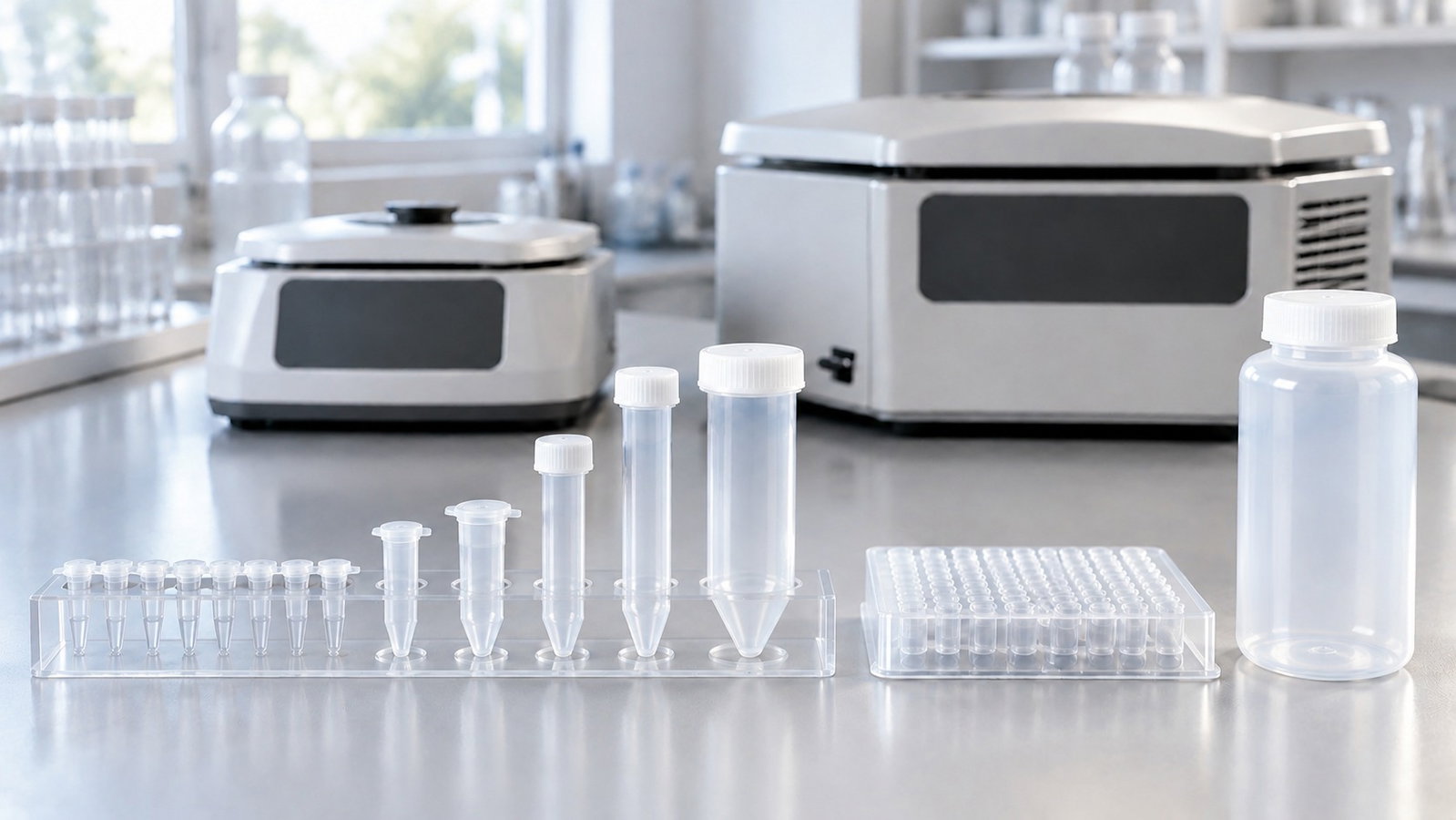
1. Start With the Tube: Format and Volume Decide First
Start from the method's required tubes, strips, plates or bottles. Record dimensions, bottom shape and nominal volume, not volume alone. A format change requires method review; physical fit alone does not establish an approved configuration.
Which models take which formats
The table maps common formats to the ALab™ models that take them. It is a lookup, not a ranking: a format may be listed only with one rotor or adapter (Section 6 names them).
| Tube format | Models |
|---|---|
| 0.2 mL tubes and PCR 8-tube strips | D1008; D1524, D1524R, D3024; DG1616 / DG1616R |
| Microplates (96- and 384-well, deep-well) | DG1616 / DG1616R only |
| 0.5–2 mL microtubes | D1008; D1524, D1524R, D3024; DG1616 / DG1616R; DM0506 (1.5/2 mL via adapter) |
| 5 mL tubes | D1524, D1524R, D3024 (cone- and round-bottom tube formats); DG1616 / DG1616R (cone-bottom tube format); DM0412 and DM0506 (1.5–5 mL ranges) |
| 13 × 75 mm to 16 × 107 mm tubes | DM0412; DM0506 (13 × 75 mm via adapter); DG1616 / DG1616R (13 × 75 and 13 × 100 mm bucket sets) |
| 15 mL tubes; shape and dimensions require configuration checks | DM0412, DM0506, Q0408E, DG1616 / DG1616R |
| 50 mL tubes; shape and dimensions require configuration checks | DM0412 (A6-50P configuration only), DM0506, DG1616 / DG1616R |
| Larger-volume tube/bottle sets | DG1616 / DG1616R; confirm dimensions for each listed set |
| Capillary tubes (24 places) | D1524C, DM1424, DM1224 |
Adapters change more than fit
An adapter or depth plug can change tube position and RCF; the effect is configuration-specific. DM0412 is specified at 11 cm / 2,490 ×g at 4,500 rpm for directly seated A12-10P configurations, versus 9.8 cm / 2,218 ×g with A10P15 and a plug. The radius reference-point definition is not specified. No separate adapter radius or RCF is specified for the DM0506. Confirm the exact tube/adapter/plug mapping rather than transferring a rotor maximum.
2. Capacity: Places per Run and What Each Rotor Holds
Capacity is the listed number and nominal size of tubes for a configuration, not an approved sample fill. Plan the batch using the rotor manual's permitted loading patterns and balance requirements [3]. Odd sample counts do not create a universal one-extra-position rule; include any required balance assemblies in the configuration plan.
One instrument, many capacities
DG1616 / DG1616R illustrates configuration-dependent capacity: AS30-2 lists 30 × 2 mL, AS60-2 lists 60 × 2 mL, and SR4-400 lists 4 × 400 mL. Its adapter options require their own fit and rating checks; these capacities do not share one maximum RCF.
Configurations chosen at quotation
The three low-speed models handle capacity differently, and the difference affects ordering:
- DM0412 is offered in two non-interchangeable configurations. The A12-10P (the standard configuration quoted) holds 12 tubes in the 1.5–5, 4–7 or 8.5–10 mL ranges, or 8 × 15 mL. The DM0412(A6-50P) holds 6 × 50 mL or 6 × 15 mL. The configuration is selected at quotation, so a lab that needs both 10 mL tubes and 50 mL tubes should resolve that before ordering.
- DM0506 lists two rotors with the same rating: A6-15P (6 × 1.5–5 / 7 / 10 / 15 mL) and A4-50P (4 × 20 mL or 4 × 50 mL). ACS Material frames the choice as a question of tube format rather than g-force.
- Q0408E lists one 8 × 15 mL rotor and no alternative rotor or adapter. Confirm the exact tube dimensions and compatibility; the listing is not approval of an arbitrary 15 mL workflow.
Read the rotor table, not the summary line
The D1524 capacity figures differ within its specifications: the summary omits 0.2 mL formats that appear in the AS24-2 and AS36-05 rotor listings. This article follows the rotor table, with listed adapters; if you need 0.2 mL tubes, confirm the rotor and adapter for your configuration with ACS Material before ordering. D1524R and D3024 list the same five AS rotors. D1524C remains separate: AC24P, 24 capillary tubes.
3. RCF: Match the Protocol at Your Configuration's Radius
RCF is centrifugal acceleration at a specified radius divided by standard gravity, expressed in ×g; rpm describes rotational speed [1][2]. RCF = 1.118 × 10⁻⁵ × r × N², with r in cm and N in rpm. Conversion needs an applicable radius or rating pair; it does not establish separation performance.
Rule 1: Specify the force in ×g
For an rpm-only method, establish the original rotor, tube/adapter and radius convention, or an applicable speed–RCF reference pair. Check that the intended configuration can provide the required RCF within its permitted settings and limits. Neither a generic margin nor an assumed adapter correction validates the choice.
Rule 2: Check headline ratings by configuration
Headline maxima can refer to different configurations. DG1616 / DG1616R has a headline of 28,621 ×g, while the AS30-2 rotor is rated to 28,620 ×g for 30 × 2 mL at 16,000 rpm. SR4-400 provides the 4 × 400 mL listing at 5,000 rpm / 4,639 ×g. DM0412 similarly separates A12-10P's 2,490 ×g from A6-50P's 50 mL configuration at 4,000 rpm / 1,800 ×g.
Rule 3: Compare ratings format by format
The specified maxima of the nine models fall into broad bands, but the useful comparison is always for one format. Two examples, using only the specified ratings:
- 50 mL listings. DM0412(A6-50P) and DM0506 A4-50P are specified at 1,800 and 2,600 ×g, respectively, but these entries do not establish conical-tube compatibility. DG1616 / DG1616R pairs conical formats with A8-50 at 3,968 ×g and AS6-50V at 17,468 ×g. Among these explicitly paired ratings, only AS6-50V exceeds an illustrative 10,000 ×g target; this is a specification screen, not method approval. SR4-400 lists a 50 mL adapter, but its 4,639 ×g rotor rating is not a separately specified adapter rating.
- Microtube listings. D1008 is rated to 2,680 ×g at 7,000 rpm, with no selectable range specified. D1524, D1524R and D3024 list 1.5/2 mL formats on AS24-2 at 21,380 ×g. DG1616 / DG1616R lists 2 mL tubes on AS60-2 at 21,912 ×g and AS30-2 at 28,620 ×g; those listings do not independently confirm every 1.5 mL tube.
Capillary rotors sit in their own band: 13,680 ×g at 12,000 rpm on the D1524C, DM1424 and DM1224.
Setting the force
Table 2 distinguishes RCF selection, conversion or readout, and setting increments. An increment is not speed accuracy; an RCF display does not establish its tube/adapter radius basis. Confirm both. Matching RCF at one reference point does not validate a transferred method: sample, medium, fill, time, temperature and acceleration/braking also matter [1][2].
4. Temperature Control: Refrigerated, Air-Cooled or Not Specified
Rotor operation and drive losses can warm samples [1][2]. Define the method's required sample temperature and allowable variation before comparing cooling features; a general sample category does not establish its temperature requirement.
Refrigerated models with a specified temperature setting
Two of the nine models are refrigerated:
- D1524R: temperature setting −20 °C to 40 °C; pre-cooling from room temperature to 4 °C in 7 minutes; cooling starts when the setting is below ambient, and an external condensation tank is listed.
- DG1616R: temperature setting −10 °C to 40 °C; cools from room temperature to 4 °C in as little as 7 minutes.
The specifications permit a rotor-list comparison, but refrigeration is not the only difference:
- DG1616 vs DG1616R share a rotor table. The DG1616 has no temperature setting; refrigeration is the DG1616R's distinguishing feature.
- D1524R vs D1524 and D3024 list the same five AS-series rotors with the same 15,000 rpm and 21,380 ×g ratings and the same tube capacities. Of the three, only the D1524R has a specified temperature setting.
The setting ranges and precooling times are ACS Material specifications, not measured sample temperatures under your load. Confirm the applicable test conditions and performance at your rotor, speed, load and run duration; use the approved method to assess temperature-sensitive work.
Air cooling is not refrigeration
ACS Material describes a double cooling air design on the D3024 that forces air above and below the rotor to remove heat. That is a ventilation feature, and no temperature setting is specified. Treat it as a non-refrigerated model with forced-air cooling, not as a substitute for a refrigerated one when a method specifies a run temperature.
Not specified means not specified
The other models (DM0412, DM0506, Q0408E, D1008, D1524, D1524C, DM1424 and DM1224) have no refrigeration specified. That does not mean the chamber is held at room temperature; it means no temperature control is specified. Where a permissible ambient range is specified (5–40 °C for the Q0408E and DG1616 / DG1616R), that range describes the operating environment, not sample temperature. Over-temperature detection is not temperature control; an alarm or shutdown response must be documented rather than inferred from the word detection.
5. Control and Safety Features
Once format, capacity, force and temperature have narrowed the list, control features separate the remaining options. Table 2 in Section 6 lists them model by model; compare them in ACS Material's own terms, because the wording carries different meanings.
- Acceleration and braking. Fragile pellets and loose interfaces can be disturbed by hard braking. ACS Material specifies this in different kinds of figure: times (for example 25 s up and 25 s down on the D1524, D1524C, D1524R and D3024), levels (nine up and nine down on the DG1616 / DG1616R, without times), settings (one acceleration and two deceleration settings on the DM0506, without times), or nothing at all (Q0408E). The DM0412 is specified with different braking for its two rotors and tells users to follow the operating manual.
- Imbalance detection. Only two models list it, in different words: the D1524R has a rotor imbalance detection alarm, and the DG1616 / DG1616R has built-in dynamic balance detection with an automatic rotor imbalance warning. Neither states what the instrument does next, so treat detection as a safeguard, not a substitute for following the approved loading and balancing instructions. No imbalance alarm or warning is specified for the others.
- Programs and run modes. Stored programs help when several users share one instrument: up to 100 on the DG1616 / DG1616R, 99 program memories with segmented programs on the Q0408E, up to 9 on the D1524, D1524C and D1524R, and two preloaded programs on the DM0506. The D1008 has no timer; closing the lid starts a spin-down and opening it stops the rotor.
- Size and weight. Specified weights run from 0.5 kg (D1008) to 30 kg (D1524R), 70 kg (DG1616) and 90 kg (DG1616R). Check bench space and handling before you short-list.
6. Static Comparison: Nine ALab™ Centrifuges
Source: ACS Material product specifications (October 2026). These matrices cover all nine linked products. Groups are editorial, not exclusive equipment classes or rankings. Table 2 covers the same products linked in Table 1; paired models are listed together only where indicated. A dash means the specification is not listed; it does not mean the feature is absent. Ratings and capacities are specified figures, not calculated values or approvals of an assembled configuration.
Table 1. Formats, capacity and ratings
| Model | Group | Rotors and largest listed loads (rotor table) | Max rpm / max RCF (configuration) | Radius specified? |
|---|---|---|---|---|
| D1008 | Palm spin-down | A8-2P: 8 × 0.2/0.5/1.5/2 mL (0.2/0.5 mL with listed adapters); A4-PCR8P: 32 × 0.2 mL or 4 PCR strips | 7,000 / 2,680 (single operating point, both rotors) | — |
| DM0412 (A12-10P) | Low-speed tubes | 12 × 1.5–5 / 4–7 / 8.5–10 mL or 8 × 15 mL; tubes 13 × 75 to 16 × 107 mm | 4,500 / 2,490 | Yes: 11 cm; 9.8 cm with A10P15 adapter and plug (2,218 ×g) |
| DM0412(A6-50P) | Low-speed 15/50 mL | 6 × 50 mL or 6 × 15 mL (non-interchangeable configuration) | 4,000 / 1,800 | — |
| DM0506 | Low-speed 15/50 mL | A6-15P: 6 × 1.5–5 / 7 / 10 / 15 mL; A4-50P: 4 × 20/50 mL | 5,000 / 2,600 (both rotors; adapter-specific ratings not specified) | — |
| Q0408E | Low-speed 15 mL | Single rotor 8 × 15 mL; no alternatives listed | 4,000 / 1,860 | — |
| D1524 | High-speed micro | AS24-2: 24 × 0.2/0.5/1.5/2 mL; AS36-05: 36 × 0.2/0.5 mL (smaller formats use listed adapters); AS4-PCR8: 32 × 0.2 mL or 4 strips; AS12-5V: 12 × 5 mL cone; AS18-5: 18 × 5 mL round | 15,000 / 21,380 (each rotor) | — |
| D1524R | High-speed micro, refrigerated | Same five rotors and capacities as D1524 | 15,000 / 21,380 (each rotor) | — |
| D3024 | High-speed micro | Same five rotors and capacities as D1524 | 15,000 / 21,380 (each rotor) | — |
| DG1616 / DG1616R | High-speed, large capacity | 11 rotors: from AS30-2 (30 × 2 mL) and AS60-2 (60 × 2 mL) to SR4-400 (4 × 400 mL); microplates (S2-MP) | 16,000 / 28,620 (AS30-2 rotor; headline 28,621); SR4-400 5,000 / 4,639 | Yes: listed rotors and SE4-100 bucket sets (10–16.6 cm); definition not specified |
| D1524C | Hematocrit | AC24P: 24 capillary tubes | 12,000 / 13,680 | — |
| DM1424 / DM1224 | Hematocrit | AC24: 24 capillary tubes | 12,000 / 13,680 (both) | — |
Table 2. Temperature, control and safety features
| Model | Temperature | Speed / RCF controls | Acceleration / braking | Imbalance detection | Programs |
|---|---|---|---|---|---|
| D1008 | — | Single specified operating point; no timer | Accelerates and brakes in seconds | — | — |
| DM0412 | — | Speed and RCF selectable and displayed; 100 rpm steps | A12-10P 20 s / 13 s; A6-50P 20 s / 20 or 90 s | — | — (pulse key; 30 s–99 min or continuous) |
| DM0506 | — | Set and displayed in rpm (10 rpm) or RCF (10 ×g) | 1 acceleration / 2 deceleration settings | — | 2 preloaded |
| Q0408E | No control specified (ambient 5–40 °C) | Speed and RCF toggle for readout; 10 rpm steps | — | No alarm or warning specified | 99, segmented |
| D1524 | — | Speed/RCF switchover; 100 rpm, 10 ×g | 25 s / 25 s; 9 levels | — | Up to 9 |
| D1524R | −20 °C to 40 °C; RT → 4 °C in 7 min | Speed/RCF switchover; 100 rpm, 10 ×g | 25 s / 25 s; 9 levels | Rotor imbalance detection alarm | Up to 9 |
| D3024 | Setting not specified; double cooling air design | Speed/RCF switch; 10 rpm, 10 ×g | 25 s / 25 s | — | — |
| DG1616 | Setting not specified | Increments: 1 rpm, 1 ×g | 9 / 9 levels, soft braking | Automatic rotor imbalance warning | 100 |
| DG1616R | −10 °C to 40 °C; RT → 4 °C in as little as 7 min | Increments: 1 rpm, 1 ×g | 9 / 9 levels, soft braking | Automatic rotor imbalance warning | 100 |
| D1524C | — | Speed/RCF switchover; 100 rpm, 10 ×g | 25 s / 25 s; 9 levels | — | Up to 9 |
| DM1424 | — | Speed/RCF switch; 10 rpm | 30 s / 30 s | — | — |
| DM1224 | — | Speed/RCF switch; 100 rpm | 40 s / 40 s | — | — |
Reading the tables fairly
- Each line is a configuration, not a ranking. A higher maximum is not better if your tubes do not fit the rotor that carries it.
- Paired listings hold distinct models. D1524 and D1524C differ in speed, rotor and purpose; DM1424 and DM1224 differ in speed range, increments, speed accuracy (±20 rpm vs ±100 rpm) and run times; DG1616 and DG1616R differ in refrigeration, power and weight.
- A dash is a question to ask us, not an assumed no. Most models have no specified rotor radius; the DG1616 / DG1616R and the DM0412 A12-10P are the exceptions.
- Hematocrit models are built around 24-place capillary rotors. What a hematocrit reading means and where its limits lie is a separate topic from choosing a general-purpose centrifuge.
7. A Selection Sequence in Six Steps
- List formats and batch size. Record tube dimensions, bottom shape, nominal volume and samples per run. Account for the permitted loading pattern and any required balance assemblies [3].
- Find the rotors that hold them. Use each model's rotor table, not the summary capacity figure. Where one instrument needs two non-interchangeable configurations (as with the DM0412), decide which before ordering.
- Check RCF per configuration. Establish the method's radius convention or applicable reference pair, then confirm the required RCF is achievable within the complete assembly's permitted settings and limits. Do not combine unrelated headline maxima.
- Check temperature performance. D1524R and DG1616R have refrigerated settings; confirm required sample conditions under the intended load. Forced-air cooling and over-temperature detection do not establish temperature control.
- Compare control and safety wording. Setting in ×g versus readout only; acceleration and braking times, levels or settings; imbalance alarm or warning; program storage; run-time limits.
- Check the bench. Footprint, weight and power from the specifications, plus the space you need around the instrument.
Before you request a quotation
Request confirmation of tube/adapter compatibility and ratings, the radius definition, included versus optional components, permitted loading and sample-temperature performance under the intended conditions. Keep unresolved fields explicit rather than treating a quotation or a matching headline as method validation.
8. Frequently Asked Questions
How do I choose a centrifuge?
Start with your tube formats and batch size, find the rotors that hold them, confirm that the complete rotor/tube/adapter configuration can provide the method's RCF within its permitted settings and limits, and decide whether you need refrigeration. Then compare control features such as setting in ×g, braking options, programs and imbalance detection.
Is a higher maximum RCF always better?
No. A maximum may apply to one or several listed configurations. Check the rating and compatibility of the exact rotor, tube and adapter; a larger headline does not establish suitability.
Do I need a refrigerated centrifuge?
For a method requiring controlled cooling, D1524R and DG1616R are the two models with specified refrigerated settings. Confirm performance at the intended rotor, speed, load and duration. D3024's forced-air design does not establish a controlled sample temperature.
Can one centrifuge handle both microtubes and 50 mL tubes?
The DG1616 / DG1616R offers microtube and 50 mL rotor options with different ratings. Confirm each complete configuration. On DM0412, 15 mL formats appear in both configurations; 50 mL requires A6-50P. A12-10P and A6-50P are not user-interchangeable.
Why do capacity figures sometimes differ within one product's specifications?
Summary lines compress several rotors into one sentence and can drift from the rotor table. Use the rotor table, which names the rotor for each capacity, and ask us to confirm any mismatch.
9. Keep Exploring Centrifugation
- Laboratory Centrifugation: RCF, Rotors, Sedimentation and How to Choose a Centrifuge: the centrifugation hub covering RCF, rotors, sedimentation, temperature, safety and the full series of guides.
- DG1616 / DG1616R High-Speed Centrifuges: specified rotor ratings and radii, with separate SE4-100 bucket-set data.
- D1524R High-Speed Refrigerated Micro Centrifuge: the refrigerated counterpart to the D1524 and D3024 rotor set.
Low-speed models (formats differ by configuration): DM0412, DM0506 and Q0408E.
Microtube spin-downs: D1008 Palm Micro Centrifuge. Capillary rotors: D1524C and DM1424 / DM1224.
Browse all ALab™ centrifuges.