
The Landau-Levich equation is the standard way to estimate how thick a liquid film will be when a plate is pulled out of a bath. It links the wet film thickness to the liquid’s viscosity, surface tension and density and to the withdrawal speed. This article states the Landau-Levich equation in its standard form and shows where it comes from. It then walks through a calculation with every unit spelled out, lists the unit traps that shift the result by factors from about 3 to more than 1,000, and explains when the equation holds and when it does not.
In one paragraph: the wet film thickness rises with viscosity and speed to the power 2/3, falls weakly with surface tension (power −1/6) and falls with density (power −1/2). Use SI units throughout: Pa·s, m/s, N/m and kg/m3 give metres. Check the capillary number before trusting the result; the equation assumes Ca well below 1, no significant evaporation during deposition and no surfactant effects. Multiply by the volume fraction of non-volatile material for a first estimate of dry thickness, then replace the estimate with a fitted curve from your own measurements.
1. The equation and its symbols
Landau and Levich published the result in 1942 [1], and Derjaguin derived it independently in 1943 [2], so it is sometimes called the Landau-Levich-Derjaguin (LLD) law. In the form used for dip coating [3]:
| Symbol | Quantity | SI unit | Common lab unit |
|---|---|---|---|
| h | Entrained wet film thickness, per face | m | µm or nm |
| η | Dynamic viscosity | Pa·s | mPa·s (= cP) |
| U | Withdrawal speed | m/s | mm/min |
| γ | Liquid–vapour surface tension | N/m | mN/m (= dyn/cm) |
| ρ | Liquid density | kg/m3 | g/cm3 |
| g | Gravitational acceleration | m/s2 | 9.81 m/s2 (value) |
The prefactor is quoted as 0.94 or 0.946 depending on rounding. The thickness is that of the liquid film on each face of the plate in the steady region, above the start-up zone and away from the side edges. For the wider picture of the dip coating process, including the regime at very low speeds where this equation does not apply, see the dip coating pillar article, Dip Coating Explained: Withdrawal Speed, Coating Regimes and Film Thickness.
2. Where the equation comes from
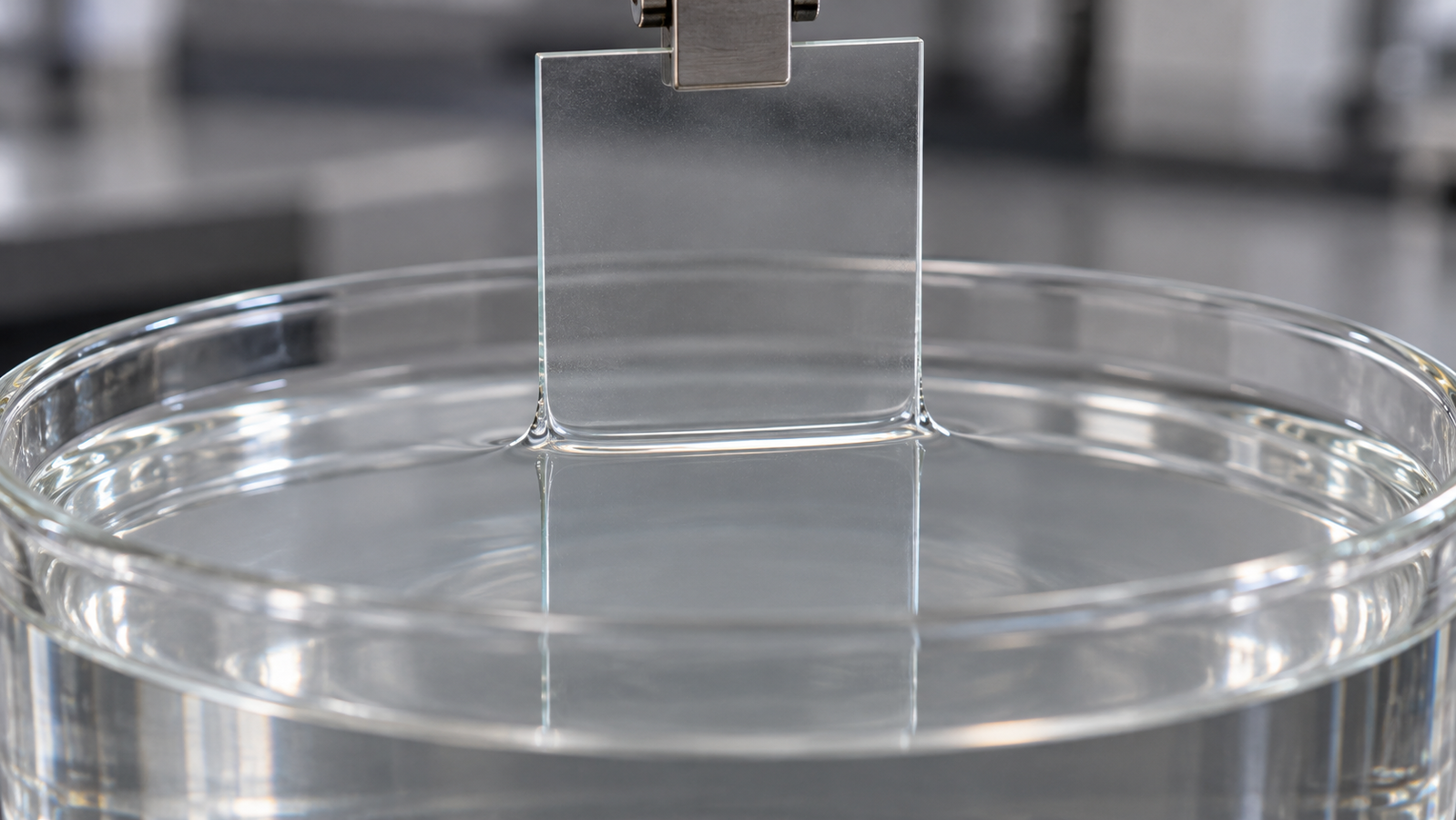
As the plate rises, it drags liquid upward by viscosity. Above the bath, the free surface forms a static meniscus whose shape is set by surface tension and gravity. Between the static meniscus and the flat entrained film is a short dynamic meniscus, where the surface curvature changes from the meniscus value to almost zero. That curvature change creates a capillary pressure gradient that pushes liquid back toward the bath, against the viscous drag of the plate [4].
A scaling argument captures the result. Call the length of the dynamic meniscus λ:
Curvature matches the static meniscus: h/λ2 ~ 1/lc ⇒ λ ~ (h·lc)1/2
Combining: h ~ lc · (ηU/γ)2/3 = lc · Ca2/3
The numerical prefactor comes from solving the full thin-film equation in the dynamic meniscus and matching its curvature to the static meniscus. For a fully wetting vertical plate, the standard treatment gives about 1.34·Ca2/3 divided by the meniscus curvature √2/lc, which is 0.946·lc·Ca2/3 [1][4]. Two consequences are worth remembering. The dynamic meniscus is short, of order (h·lc)1/2, so the film thickness is decided in a small region just above the bath. And the result depends on the meniscus being the gravity-shaped static meniscus of a wide plate, which is why fibres, narrow strips and edges behave differently [5].
3. Capillary number and capillary length
Writing the equation as h = 0.94·lc·Ca2/3 separates two questions.
The capillary number, Ca = ηU/γ, compares viscous forces with surface tension. It is dimensionless, so it is the quickest check that your units are consistent: if Ca comes out above 1 for a thin, runny liquid at a few millimetres per minute, a unit has gone wrong. It also decides whether the equation applies at all (Section 7).
The capillary length, lc = (γ/ρg)1/2, is the length over which surface tension can hold liquid up against gravity. For most solvents and aqueous solutions it lies between about 1.5 and 3 mm. It changes little from one liquid to another because it depends on the square root of a ratio of two properties that vary only moderately.
| Illustrative liquid (assumed values) | η (mPa·s) | γ (mN/m) | ρ (kg/m3) | lc (mm) |
|---|---|---|---|---|
| A: ethanol-like | 1.2 | 22 | 790 | 1.68 |
| B: water-like | 1.0 | 72 | 1,000 | 2.71 |
| C: more viscous aqueous liquid | 50 | 65 | 1,150 | 2.40 |
Approximate room-temperature properties assumed for illustration. Measure or look up the properties of your own liquid at its working temperature and composition.
4. How each variable moves the thickness
Because the equation is a product of powers, the effect of changing one variable by a factor is the factor raised to its exponent:
| Variable | Exponent | Effect of doubling | Effect of a tenfold increase |
|---|---|---|---|
| Withdrawal speed U | +2/3 | ×1.59 | ×4.64 |
| Viscosity η | +2/3 | ×1.59 | ×4.64 |
| Surface tension γ | −1/6 | ×0.89 | ×0.68 |
| Density ρ | −1/2 | ×0.71 | ×0.32 |
Three practical points follow:
- Speed and viscosity are interchangeable in this regime because they appear only as the product ηU. A liquid twice as viscous, withdrawn at half the speed, gives the same wet thickness.
- Surface tension is a weak lever on thickness, but a strong one on wetting. Adding a surfactant to improve wetting barely changes the predicted thickness, but surfactants can thicken real films beyond the prediction [5].
- Viscosity is the hidden variable. It often changes with temperature, solid content and the age of a sol, so a recipe that drifts over days may reflect a viscosity change rather than a speed change.
5. Worked example, step by step
Illustrative example. Liquid A (ethanol-like: η = 1.2 mPa·s, γ = 22 mN/m, ρ = 790 kg/m3), withdrawn at 100 mm/min. All values are assumed for the calculation.
- Convert to SI. η = 1.2 × 10⁻³ Pa·s; γ = 0.022 N/m; U = 100/60,000 = 1.667 × 10⁻³ m/s.
- Numerator. ηU = 1.2 × 10−3 × 1.667 × 10−3 = 2.0 × 10⁻⁶ N/m. Then (ηU)2/3 = 1.587 × 10⁻⁴, and 0.94 × 1.587 × 10−4 = 1.492 × 10⁻⁴.
- Denominator. γ1/6 = 0.0221/6 = 0.529. ρg = 790 × 9.81 = 7,750 N/m3, and (ρg)1/2 = 88.0. The product is 0.529 × 88.0 = 46.6.
- Divide. h = 1.492 × 10⁻⁴ / 46.6 = 3.2 × 10⁻⁶ m = 3.2 µm of wet film per face.
- Check with the dimensionless form. Ca = 2.0 × 10⁻⁶ / 0.022 = 9.1 × 10⁻⁵; Ca2/3 = 2.02 × 10⁻³; lc = 1.68 mm. So h = 0.94 × 1.68 mm × 2.02 × 10−3 = 3.2 µm. The two forms agree.
- Check validity. Ca ≈ 10−4 is well below 1, so the low-capillary-number assumption holds. Whether evaporation is negligible depends on the solvent and atmosphere; for a volatile solvent at much lower speeds it may not be.
Illustrative calculation with assumed liquid properties. It is not a measurement or a result from any coating liquid, dip coater or Levon™ instrument.
6. Unit traps
Most wrong Landau-Levich results come from mixing laboratory units with SI. Because of the fractional exponents, each mistake produces a characteristic error factor:
| Mistake | Correct conversion | Error in input | Error in h |
|---|---|---|---|
| Speed entered in mm/min as if m/s | 1 mm/min = 1.667 × 10⁻⁵ m/s | ×60,000 | ×1,530 (too thick) |
| Viscosity entered in mPa·s (cP) as if Pa·s | 1 mPa·s = 10−3 Pa·s | ×1,000 | ×100 (too thick) |
| Surface tension in mN/m (dyn/cm) as if N/m | 1 mN/m = 10−3 N/m | ×1,000 | ×0.32 (too thin) |
| Density in g/cm3 as if kg/m3 | 1 g/cm3 = 1,000 kg/m3 | ×0.001 | ×31.6 (too thick) |
Two habits prevent these errors. First, convert every input to SI before calculating, and keep the result in metres until the end. Second, compute Ca separately: it is dimensionless, so a value far from what you expect points straight to a unit mistake. For thin solvents at ordinary dip coating speeds, Ca is usually small, roughly 10−7 to 10−3.
7. When the equation holds, and when it does not
The Landau-Levich result rests on several assumptions [4][5]. Check each one before relying on a prediction:
- Low capillary number. The derivation is an expansion for Ca « 1. Wilson computed higher-order corrections that become significant as Ca grows [6]. At higher Ca, viscous drag is balanced mainly by gravity and the thickness follows h = c1·(ηU/ρg)1/2, with c1 ≈ 0.8 for Newtonian liquids [3].
- Newtonian liquid. Shear-thinning, viscoelastic or yield-stress liquids, including many concentrated suspensions and polymer solutions, deviate from the 2/3 exponent.
- No surfactant or surface-elasticity effects. Surface-active species can make the interface less mobile and thicken the film compared with the prediction [5].
- Negligible evaporation during deposition. At very low speeds with volatile solvents, evaporation at the meniscus deposits material directly, and the thickness increases as speed decreases. This is the capillary regime, described by Faustini and co-workers and by Grosso [7][8].
- Steady withdrawal of a wide, smooth, fully wetted plate. The start-up zone, the side edges, rough or porous surfaces and poorly wetted substrates all depart from the ideal.
- No drainage after deposition. If the film stays liquid for a long time, it continues to thin under gravity above the meniscus [9], so the measured thickness may be lower than h, especially near the top.
Written in the same dimensionless terms, the viscous-gravity form is h = 0.8·lc·Ca1/2, because ηU/ρg = Ca·lc2. Taken at face value, the two expressions give the same thickness when 0.94·Ca2/3 = 0.8·Ca1/2, that is at Ca = (0.8/0.94)6 ≈ 0.38. This is an arithmetic crossing of two limiting laws, not a sharp physical boundary; the real transition is gradual and begins well below that value. As a working practice, treat Landau-Levich predictions with increasing caution once Ca rises above roughly 10−2, and rely on measured data there.
8. From wet thickness to dry thickness
The equation predicts the wet liquid layer. For a solution that dries to a dense film without lateral shrinkage, the first estimate of the dry thickness is:
φ = volume fraction of non-volatile material, counted as the dense dried solid
Solid content is usually known as a mass fraction w, so convert it with the densities of the solid (ρs) and the solvent (ρl):
Illustrative example. With w = 0.10, ρs = 2.2 g/cm3 and ρl = 0.79 g/cm3 (assumed values), φ = 0.0455 / (0.0455 + 1.139) ≈ 0.038. If a sol with this φ had the viscosity, surface tension and density of liquid A, withdrawal at 600 mm/min would give about 10.6 µm of wet film and hdry ≈ 0.038 × 10.6 µm ≈ 0.41 µm. A real 10 wt% sol is usually more viscous than its solvent, so measure its properties before using the equation.
Remember that φ also changes the viscosity, so raising the solid content raises the dry thickness through both terms. Porosity makes real films thicker than the dense estimate, and densification during heat treatment makes them thinner; for sol-gel films, gel structure and shrinkage dominate the final value [10]. The sol-gel case is covered in Sol-Gel Dip Coating: From Sol to Dense Oxide Film (SiO2, TiO2).
9. Thickness across a dip coater’s speed range
The Levon™ DP100-BE, DP100-BE-H and DP150-DR pages each state a withdrawal speed of 0.1–600 mm/min, which is 1.667 × 10⁻⁶ to 0.01 m/s. That is a factor of 6,000 in speed. If one regime applied over the whole span, the Landau-Levich law would predict a factor of 6,0002/3 ≈ 330 in wet thickness. In practice, the lowest speeds may fall in the capillary regime for volatile solvents, so the draining law should be applied only where measurements confirm it.
The table applies the equation to the three illustrative liquids:
| Speed (mm/min) | A: ethanol-like h (µm) / Ca | B: water-like h (µm) / Ca | C: viscous aqueous h (µm) / Ca |
|---|---|---|---|
| 1 | 0.15 / 9.1 × 10⁻⁷ | 0.10 / 2.3 × 10⁻⁷ | 1.2 / 1.3 × 10⁻⁵ |
| 10 | 0.69 / 9.1 × 10⁻⁶ | 0.45 / 2.3 × 10⁻⁶ | 5.7 / 1.3 × 10⁻⁴ |
| 100 | 3.2 / 9.1 × 10⁻⁵ | 2.1 / 2.3 × 10⁻⁵ | 27 / 1.3 × 10⁻³ |
| 600 | 10.6 / 5.5 × 10⁻⁴ | 6.8 / 1.4 × 10⁻⁴ | 88 / 7.7 × 10⁻³ |
Wet film thickness per face from h = 0.94·(ηU)2/3/(γ1/6(ρg)1/2) with the assumed properties in Section 3. Illustrative only: the low-speed values for volatile liquids may not apply because of evaporation, and these are not results from any Levon™ instrument.
Two patterns stand out. For thin solvents, Ca stays far below 1 across the whole range, so the low-Ca assumption is safe and the real questions are evaporation and drainage. For the viscous liquid at the highest speed, Ca approaches 10−2 and the wet film is tens of micrometres thick, so the correction toward the viscous-gravity form and slow drying both deserve attention. For multi-bath sequences on a turntable, see Layer-by-Layer and Multi-Solution Dip Coating with a Carousel Dip Coater. When the bath or substrate is heated, viscosity and evaporation both change, as described in Heated Dip Coating: How Temperature Shifts Evaporation and the Capillary Regime. The DP100-BE-H page states a heated base (RT to 120 °C, temperature controllable); it does not state the bath or substrate temperature reached.
10. Fitting the equation to your own data
Uncertainty in liquid properties and drying can limit the accuracy of a thickness prediction. The more reliable approach is to use the equation’s form and fit its constant, and if necessary its exponent, to measurements.
- Coat at several speeds spread on a logarithmic scale, with all other conditions fixed.
- Measure the dry thickness in the central region of each film. A dedicated article, How to Measure Thin Film Thickness: Profilometry, Ellipsometry and Interference (coming soon), will cover these methods.
- Fit ln h = ln K + n·ln U. A slope near 2/3 is consistent with Landau-Levich scaling; fix n = 2/3 only if the data and validity checks support it. A slope near 1/2 or below zero can suggest other regimes, but dry-film slopes alone do not establish the mechanism. If the thickness passes through a minimum, fit each side separately and stay on one side when setting speeds; a single straight line across the minimum has no meaning.
- Use the fit to set speeds within the measured range. If a series covers both regimes, Faustini and co-workers fitted thickness over the whole speed range as the sum of a capillary term proportional to 1/U and a draining term proportional to U2/3 [7].
with n = 2/3: h2 = h1·(U2/U1)2/3 and U2 = U1·(h2/h1)3/2
Illustrative example. Suppose a dry film measures 120 nm at 30 mm/min (an assumed value) and the speed series supports n = 2/3. At 60 mm/min the fitted form predicts 120 × 22/3 ≈ 190 nm. To reach 150 nm, the speed would be 30 × (150/120)3/2 ≈ 42 mm/min. The prediction holds only if the solution, temperature and drying stay the same and the speeds remain in the draining regime.
The fitted K absorbs the prefactor, the liquid properties, the solid content and the drying shrinkage, so it is specific to one solution and one set of conditions. Refit when the solution batch, its age or the room conditions change significantly. For background on the stages of the process and the full speed range, see the review by Brinker [11] and the analysis of dip coating physics by Scriven [12]. For how dip coating compares with other methods, see the pillar guide to solution-processed thin films; for the equivalent thickness laws in spin coating, see Spin Coating Explained: Stages, Physics and Film Thickness.
11. Keep exploring the dip coating knowledge hub
Start here
- Solution-Processed Thin Films: Choosing Spin, Dip, Slot-Die or Blade Coating — when dip coating is the right method, with the interactive coating method selector.
- Spin Coating Explained: Stages, Physics and Film Thickness — thickness models for the main alternative to dip coating.
Dip coating process guides
- Dip Coating Explained: Withdrawal Speed, Coating Regimes and Film Thickness — the stages, regimes and speed series of dip coating.
- Sol-Gel Dip Coating: From Sol to Dense Oxide Film (SiO2, TiO2) — from sol to dried and fired oxide films.
- Heated Dip Coating: How Temperature Shifts Evaporation and the Capillary Regime — temperature, viscosity and evaporation.
- Layer-by-Layer and Multi-Solution Dip Coating with a Carousel Dip Coater — sequential baths, rinses and oxide stacks.
- How to Measure Thin Film Thickness: Profilometry, Ellipsometry and Interference (coming soon) — measuring the dried films used in a fit.
Levon™ dip coaters
- DP100-BE Dip Coater — 0.1–600 mm/min, ±0.01 mm displacement accuracy, 0–100 mm stroke, designed for placement in a glovebox.
- DP100-BE-H Heated Dip Coater — the same motion range with a heated base, RT to 120 °C.
- DP150-DR Carousel Dip Coater — six-position turntable, 240 mm maximum stroke, substrates to 150 × 150 mm.
- All Levon™ dip coaters — the dip coater category page.
Questions about a specific solution, substrate or configuration can be sent through the contact form.
12. FAQ
What does the Landau-Levich equation predict?
It predicts the wet film thickness entrained on each face of a plate withdrawn vertically from a Newtonian liquid at a slow, steady speed: h = 0.94·(ηU)2/3/(γ1/6(ρg)1/2). The dry film thickness then depends on the solid content and drying.
What units should I use in the Landau-Levich equation?
Use SI units throughout: viscosity in Pa·s, speed in m/s, surface tension in N/m, density in kg/m3 and g = 9.81 m/s2. The result is in metres. Convert mm/min, mPa·s, mN/m and g/cm3 before calculating, and check that the capillary number is plausible.
When is the Landau-Levich equation not valid?
It loses accuracy as the capillary number grows toward and beyond about 10−2, for non-Newtonian liquids, with surfactants, at very low speeds where evaporation dominates, and near the start-up zone and edges of the substrate. In those cases, measured speed–thickness data are the better guide.
Why does thickness depend so weakly on surface tension?
Surface tension appears twice: it resists entrainment through the capillary number, but it also sets the size of the meniscus through the capillary length. The two effects partly cancel, leaving an overall exponent of −1/6, so doubling the surface tension reduces the wet thickness by only about 11%.
Is the Landau-Levich law the same as the Landau-Levich-Derjaguin law?
Yes. Landau and Levich published the result in 1942 and Derjaguin derived it independently in 1943, so the names LL and LLD refer to the same thickness law for a plate withdrawn from a wetting liquid.