
Rotor motion and drive losses generate heat, while the sample temperature depends on heat transfer, starting conditions and the cooling system. Refrigeration can remove heat below ambient conditions; ventilation uses the incoming air as a heat sink. Neither a cooling feature nor a temperature setting alone establishes what a loaded sample experiences. This guide separates those quantities and compares five ALab™ models from their specifications, without treating their ratings as a validated thermal comparison.
Quick answer: Define the sample-temperature requirement and allowable variation, then evaluate the complete rotor, tube, load and run conditions. D1524R and DG1616R have refrigerated settings; D3024 has forced-air cooling, while D1524 and DG1616 state no refrigerated setting. Ventilation alone does not actively cool a load below the incoming air temperature, but a prechilled load can remain colder temporarily. Neither that transient nor a refrigerated setpoint proves compliance. Check the approved method and configuration-specific temperature performance.
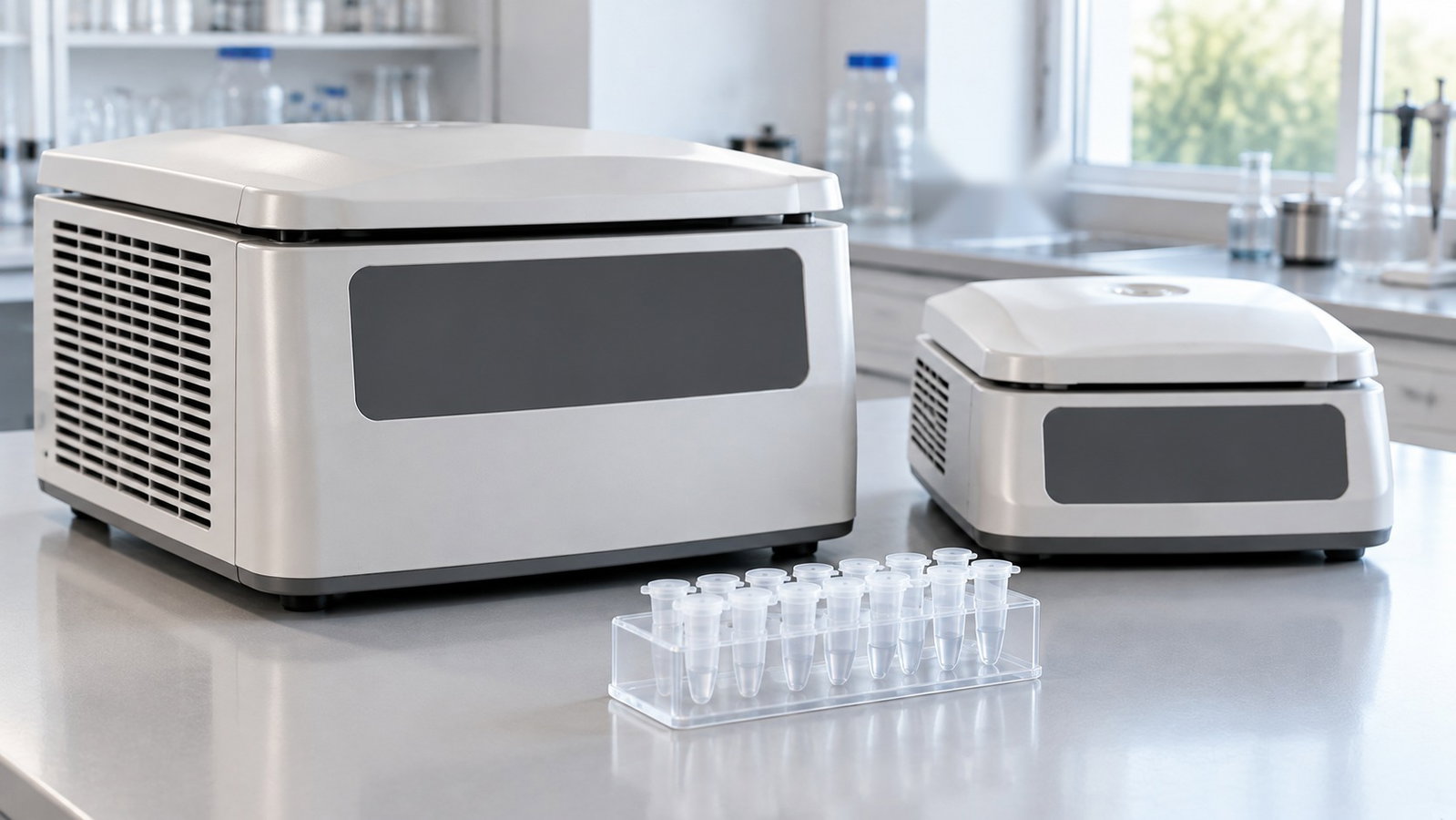
1. Where the Heat Comes From: Windage, the Drive and a Closed Chamber
Windage: friction between the rotor and the air
A rotor rotating in gas drives flow and dissipates mechanical energy through aerodynamic drag, called windage. The windage power is the resisting torque multiplied by angular speed: P = Mω. Daily and Nece studied smooth disks in cylindrical enclosures and identified different flow regimes governed by Reynolds number and clearance [1]. Their results support a dependence on speed, size and enclosure geometry, not a universal speed or radius exponent for every centrifuge rotor. No heat output or temperature rise for an ALab model is calculated here.
Increasing speed can increase windage substantially, but thermal significance also depends on configuration, run duration, starting temperatures and heat removal. Neither a brief spin nor a low speed establishes negligible sample warming. Longer or repeated runs warrant checking heat accumulation; they do not supply a model-independent temperature-rise estimate.
The drive, and a closed chamber
The models have brushless DC motors, but the specifications do not partition losses between windage, motor and electronics or quantify how much reaches the sample. As a general energy-balance statement, temperature evolves with net heat input, heat removal and thermal storage. A steady state, if reached, balances heat input and removal; its temperature and the time to reach it are configuration-dependent. No sample-temperature-versus-time curve is specified for the intended run.
2. Sample Temperature Is Not the Setpoint
A display reading of 4 °C does not identify the temperature at every sample location. Separate the following quantities:
- The setpoint: the number you enter. It is the target the controller works toward, nothing more.
- The indicated or sensed temperature: the display may show a target, a sensor reading or an estimate. Chamber air, bowl and rotor temperatures can differ. The sensing location and display convention are not specified.
- The sample temperature: what the liquid in your tube actually reaches during the run. This is the only one your chemistry responds to, and it is not specified for any centrifuge in this comparison.
Heat can pass between sample, tube, adapter, rotor, gas and chamber surfaces through more than one path [2][3]. Its direction depends on their temperature differences. A warm rotor can warm a cold sample, while a colder rotor can absorb heat. Thermal mass and heat-transfer resistance create lag; the specifications do not establish how long a particular sample takes to approach its surroundings.
Three practical consequences follow:
- Starting conditions matter. Record sample, rotor and ambient conditions. No universal duration separates a starting-temperature-dominated run from a steady-state run.
- Operating conditions matter. Temperature can change during acceleration, steady-speed running, braking and the wait before unloading. A longer run does not by itself establish equilibrium or compliance with the setpoint.
- Verify against a defined requirement. Use an approved temperature-check method with representative, correctly balanced test assemblies and suitable calibrated measurement equipment. Account for uncertainty, position, response time and delay before reading [4]. A post-run measurement describes that endpoint; one reading does not prove the maximum/minimum during the run, every tube’s temperature or repeatability. Never improvise a probe installation in rotating equipment.
Read the cooling figures below as product specifications, not as a measured temperature history for the intended sample.
3. What Refrigeration Adds: the D1524R and DG1616R
Two of the nine ALab™ centrifuges are refrigerated models. Both have a specified temperature setting and pre-cooling time.
D1524R High-Speed Refrigerated Micro Centrifuge
The D1524R lists 15,000 rpm and 21,380 ×g, with five AS-series rotors covering 0.2, 0.5, 1.5, 2 and 5 mL tube formats and PCR strips, with listed adapters where applicable. ACS Material specifies:
- Temperature setting: −20 °C to 40 °C.
- Pre-cooling: 7 minutes from room temperature to 4 °C.
- Compressor behaviour: the compressor starts cooling automatically whenever the set temperature is below ambient.
- Condensation: an external condensation tank keeps water from accumulating in the centrifuge chamber.
- Rotor temperature: less than 8 °C after one hour for D1524R rotors. This is ACS Material’s rotor figure, not an independently verified measurement or a sample-temperature specification.
- Safety: over-temperature detection is listed alongside over-speed detection, a dual door lock and a rotor imbalance detection alarm.
DG1616R High-Speed Refrigerated Centrifuge
The DG1616R is the refrigerated model of the DG1616/DG1616R pair. Its headline maxima are 16,000 rpm and 28,621 ×g. The listed rotor options include 2 mL tubes, microplates and a separate 4 × 400 mL configuration; the largest capacity is not available at the headline RCF. ACS Material specifies:
- Temperature setting: −10 °C to 40 °C.
- Cooling: from room temperature to 4 °C in as little as 7 minutes.
- Scope: the temperature setting (−10 °C to 40 °C) and rapid cooling apply to the DG1616R only.
- Allowed ambient: 5–40 °C, 80 % RH (both DG1616 and DG1616R).
How to read these cooling figures
The figures are useful, but each one answers a narrower question than it may seem to:
- Seven-minute cooling statements are conditional specifications. Neither specification identifies the rotor, load, initial room temperature, motion during cooling or sensing point. Note that the DG1616R figure is a best case (as little as 7 minutes). Neither figure establishes when the complete assembly or sample is ready; obtain the applicable conditions and readiness criteria rather than adding an arbitrary wait.
- The below-8 °C statement concerns the rotor. D1524R’s specifications do not give the setpoint, speed, particular rotor, load, sensor location or measurement method. Treat it as ACS Material’s figure, with conditions not specified, not a sample guarantee or a comparative performance result.
- The setting range is a controller range. It is the span you can enter. It does not guarantee that every setpoint is held at every speed with every rotor; no temperature-versus-speed table is specified for either.
- Setpoints above room temperature. Both ranges run up to 40 °C. The D1524R compressor is described as starting when the setpoint is below ambient; neither specification states how a setpoint above ambient is reached or held, for example whether a heater is fitted. If you need to run warm, ask us.
- Sub-zero settings require a method-specific assessment. Intended applications and post-run cooling behavior are not specified. Freezing depends on the actual solution temperature, composition and exposure, not on crossing 0 °C on the display alone. Confirm method suitability, container limits and an approved verification procedure; do not use an improvised freezing trial to qualify a setting.
4. Non-Refrigerated Designs: Air-Cooled and No Refrigeration Specified
D3024: forced-air cooling
The D3024 High-Speed Micro Centrifuge has the same 15,000 rpm and 21,380 ×g rating and the same five AS-series rotors as the D1524R. ACS Material describes a double cooling air design that forces air over both the upper and lower side of the rotor, for fast rotor cooling and low energy consumption. Temperature setting: not specified.
As a general heat-transfer limit, convection to incoming room air removes heat from a warmer surface but does not actively cool that surface below the incoming-air temperature. This does not prohibit a prechilled rotor or sample from remaining colder temporarily; air would then warm it. No quantitative D3024 temperature benefit over an unventilated design is established here. Its ventilation claim does not demonstrate a controlled sample temperature, including 4 °C, under the intended conditions.
D1524: no cooling specified
The D1524 High-Speed Micro Centrifuge is listed together with D1524C but is a distinct model. D1524 lists 15,000 rpm, 21,380 ×g and the same AS-series rotor family as D1524R. Over-temperature detection is listed, but its threshold and response are not established here; it is not temperature control. No refrigerated setting or cooling performance is specified for the D1524. Common rotor ratings do not make D1524 and D1524R otherwise identical.
DG1616: no temperature setting
DG1616 and DG1616R share rotor tables. The DG1616 has no temperature setting, and ACS Material says so explicitly. Those shared specifications support a configuration comparison, not a controlled experiment isolating refrigeration. Their documented size, power and weight also differ.
What no specified refrigeration means
The remaining ALab™ centrifuges (the DM0412, DM0506, Q0408E, D1008, D1524C, DM1424 and DM1224) have no refrigeration specified. That wording is deliberate. It does not mean the chamber is held at room temperature, because that is not specified, and it does not mean the instrument stays cool. It means no temperature control is specified. Where an allowed ambient range is specified, such as 5–40 °C for the Q0408E and DG1616 / DG1616R, that describes the room the instrument may operate in, not the temperature of the sample.
5. Specification Comparisons: Cooling, Power and Size
The models below share some rotor ratings, but they are not matched test specimens differing only in refrigeration. Source: ACS Material product specifications (October 2026). Listed electrical watts are not measured run energy, cooling capacity or a component-level heat budget. Dimension labels are shown as ACS Material gives them; models may use different axis conventions, so compare them with care. A dash means the specification is not listed; in the pre-cooling column it does not mean zero cooling time.
| Model | Temperature setting | Cooling | Pre-cooling | Power | Weight | Dimensions |
|---|---|---|---|---|---|---|
| D1524 | — | No cooling specified; over-temperature detection (safety) | — | 210 W (200–240 V) / 200 W (100–120 V) | 8.8 kg | 280 × 400 × 240 mm [W × D × H] |
| D3024 | — | Double cooling air design (forced air above and below rotor) | — | 200 W | 12 kg | 280 × 364 × 266 mm [W × D × H] |
| D1524R | −20 °C to 40 °C | Compressor; external condensation tank | RT → 4 °C in 7 min | 500 W | 30 kg | 332 × 553 × 283 mm [W × D × H] |
| DG1616 | None (no temperature setting) | No refrigeration specified | — | 650 W | 70 kg | 440 × 640 × 375 mm [L × W × H] |
| DG1616R | −10 °C to 40 °C | Refrigerated | RT → 4 °C in as little as 7 minutes | 1050 W | 90 kg | 623 × 640 × 375 mm [L × W × H] |
The three microcentrifuges list headline maxima of 15,000 rpm / 21,380 ×g; the DG pair lists 16,000 rpm / 28,621 ×g. The DG rotor table separately prints 28,620 ×g for AS30-2 and 4,639 ×g at 5,000 rpm for SR4-400. Match each tube and capacity to its rotor; do not combine headline RCF with the largest capacity.
Reading the pairs
- D1524 vs D1524R. They share the listed AS-series rotor family and maxima. D1524R adds documented refrigerated settings and pre-cooling; its listed weight and dimensions are larger. This does not establish that refrigeration alone accounts for the differences or that other operating features are equivalent.
- DG1616 vs DG1616R. Their specifications list 70 versus 90 kg and 650 versus 1050 W; the listed L dimension is 440 versus 623 mm. Power by component is not specified. These are installation-related specifications, not measured energy or thermal-efficiency results.
- D3024 vs D1524R. The former has forced-air cooling and the latter refrigerated settings. Select against required sample conditions and obtain applicable performance evidence. This article makes no quantitative rotor-temperature comparison between them.
6. When You Need Cooling, and When You Don't
Define the method’s required sample-temperature range, allowable excursions and relevant time interval. Then assess whether the proposed equipment and preparation can meet that requirement. A sample label, run duration or setting alone is not sufficient.
Cases requiring evaluation of controlled cooling
- Specified cold conditions. When a method requires sample conditions below the laboratory ambient temperature, evaluate refrigerated configurations and their documented operating capability. A setting of 4 °C is not proof that the sample stays there.
- Temperature-sensitive materials or steps. Use the method’s stability and processing requirements, not an assumption that colder is always better. The same applies to a cold precipitation or pelleting step.
- Long or repeated runs. Check the temperature history over the intended sequence, including time between runs. Heat generation, removal and storage all matter; time alone does not determine warming.
- Reproducibility. A documented temperature-control setup can help manage one source of variation, but the same setpoint does not ensure the same sample conditions across loads, instruments or rooms.
Cases where a non-refrigerated setup may suffice
- Brief spin-downs or pulses. Evaluate the starting temperatures, rotor history and permitted variation rather than assuming there is no meaningful warming.
- Room-temperature protocols. Follow the specified range. Active heat removal may still be needed to offset run-generated heat; do not equate room-temperature processing with absence of cooling.
- Lower-speed work. Windage may be lower under otherwise comparable conditions, but that does not establish sample-temperature compliance.
Cases where cold is the wrong choice
Cold handling must be compatible with the actual sample, reagent formulation and method. Follow the specified preparation and processing conditions; do not inherit another user’s 4 °C setting. For methods above ambient temperature, confirm how the instrument reaches and controls that condition rather than inferring a heater from the setting range.
Borderline cases: verify the temperature requirement
A prechilled sample may remain below ambient during part of a non-refrigerated run. Whether that is sufficient must be established for the actual method with representative starting conditions, loads and repeated runs. An acceptable endpoint alone cannot exclude earlier excursions or position-dependent temperatures. Use an approved verification plan with defined acceptance criteria; do not turn one dummy-tube reading into an equipment-suitability verdict.
| Situation | Selection implication | What must be confirmed |
|---|---|---|
| Method requires sub-ambient sample conditions | Evaluate refrigerated configurations | Required range and variation under the intended load and run |
| Temperature-sensitive sample | Follow the method’s thermal requirement | Sample/formulation stability and actual temperature history |
| Repeated or long runs | Evaluate accumulated heat and recovery | Full sequence, starting conditions and time between runs |
| Brief spin-down or pulse | No automatic exemption from temperature checks | Rotor/sample starting conditions and allowed excursion |
| Room-temperature protocol | Meet the specified range; cooling may still be needed | Heat removal during the run, not merely room temperature |
| Prechilled sample in a non-refrigerated run | Method-specific verification | Transient behavior, positional variation and repeatability |
7. Running Cold Well: Pre-Cooling, Condensation and Setup
The following are planning checks, not a universal pre-cooling, measurement or maintenance procedure. Apply the instrument and rotor instructions together with the approved sample method.
- Prepare the intended assembly. Use the documented conditioning procedure for the rotor, adapters, tubes and sample. A display reaching its target or an arbitrary extension of the seven-minute claim does not establish equilibration.
- Use the method’s starting conditions. Keep samples cold only when required and compatible. Avoid unapproved handling changes or relying on rapid loading as thermal validation.
- Keep the required separation conditions. Do not reduce speed solely to reduce heating without method approval. D1524R lists speed/RCF switchover and the DG1616 / DG1616R a 1 ×g increment; neither statement independently establishes every RCF-input mode or adapter-radius basis.
- Manage condensation under the instructions. Condensation depends on surface temperature and humidity; freezing additionally depends on local conditions. D1524R lists a condensation tank, but that does not establish ice prevention, drying instructions or post-run cooling behavior. Follow the specified shutdown, cleaning and storage procedure.
- Assess sub-zero settings before use. Confirm solution properties, container limits, intended operation and the approved verification method. Do not infer a safe freezing threshold from the display.
- Apply all configuration limits. Use approved loading patterns and the permitted instrument, rotor, tube and adapter limits, including temperature-related limits where specified.
- Document temperature verification. Record representative loads, initial and ambient conditions, rotor, speed, duration, measurement location, timing and uncertainty [4]. Assess repeatability and recheck after relevant changes. An endpoint reading is not a continuous record; use only approved measurement arrangements.
A short checklist before buying
- What sample-temperature range and allowable variation does each method require, and during which stages?
- Which documented rotor, tube and adapter configuration meets the format and separation requirements?
- Is temperature performance documented for that configuration, speed, load and duration? D1524R lists −20 °C to 40 °C settings; DG1616R lists −10 °C to 40 °C.
- Are the listed dimensions, required clearances, weight and electrical supply compatible with the installation?
- Which sensing, precooling, above-ambient or post-run details remain unspecified, and how will they be resolved before method qualification?
8. Frequently Asked Questions
What is a refrigerated centrifuge?
A refrigerated centrifuge uses a refrigeration system and temperature controls to remove heat. Its usable performance depends on the configuration and conditions. The non-refrigerated contrasts have no specified refrigerated setting; ventilation alone does not actively cool below incoming-air temperature. Neither description establishes the sample temperature during a particular run.
Why does a centrifuge heat up?
Windage dissipates energy as the rotor moves through gas, and drive/electronic losses can also contribute. The share reaching the sample depends on the thermal design and run conditions. Those contributions and any sample-temperature rise are not quantified in the specifications.
If I set 4 °C, is my sample at 4 °C?
Not necessarily. The setpoint is a control target whose sensing basis is not specified. Sample temperature also depends on starting conditions, configuration and run history. Use the applicable conditioning instructions and an approved temperature-verification method; a single endpoint reading does not establish the entire run.
Is an air-cooled centrifuge good enough for 4 °C work?
D3024’s forced-air claim does not establish that it maintains a sample at 4 °C. Incoming room air cannot actively cool a warmer rotor below its own temperature. A refrigerated setting is a candidate capability, not proof either: confirm the complete configuration against the method’s temperature requirement.
Which ALab™ centrifuges are refrigerated?
D1524R lists −20 °C to 40 °C settings and seven-minute pre-cooling to 4 °C; DG1616R lists −10 °C to 40 °C and cooling to 4 °C in as little as 7 minutes. The cooling-test conditions are not specified, and these are not sample-temperature guarantees. D1524 and DG1616 provide the corresponding non-refrigerated rotor-family comparisons, not otherwise identical thermal test pairs.
9. Keep Exploring Centrifugation
- Laboratory Centrifugation: RCF, Rotors, Sedimentation and How to Choose a Centrifuge: the centrifugation hub covering RCF, rotors, sedimentation, temperature, safety and the full series of guides.
- D1524R High-Speed Refrigerated Micro Centrifuge: −20 °C to 40 °C setting; five AS-series rotors for 0.2, 0.5, 1.5, 2 and 5 mL formats and PCR strips, using listed adapters where required.
- DG1616 / DG1616R High-Speed Centrifuges: the same rotor table with and without refrigeration, from 2 mL tubes to 4 × 400 mL.
- D3024 High-Speed Micro Centrifuge: forced-air double cooling design, no temperature setting.
- D1524 High-Speed Micro Centrifuge: the non-refrigerated counterpart to the D1524R.
Browse all ALab™ centrifuges.