
Choosing a vacuum pump for a rotary evaporator comes down to three specifications that answer three different questions. Ultimate vacuum tells you how low the pressure can go at all. Pumping speed tells you how quickly the system gets to its working pressure and how much gas the pump can remove while holding it there. Chemical resistance tells you whether the pump will tolerate the solvent vapor that reaches it. This guide explains each number and compares three ALab™ diaphragm pumps using only their product specifications.
Quick answer: A vacuum pump for a rotary evaporator is usually the wrong choice for one of two reasons. Either its ultimate vacuum is too close to the working pressure your methods need, or its pumping speed is too low for your system volume and gas load. Find the working pressure first, pick a pump whose ultimate vacuum sits well below it, check the pumping speed at that pressure rather than the free-air figure, then confirm wetted materials, trap and exhaust. For the benchtop RE100-S and RE100-Pro, ACS Material names the oil-free C410 diaphragm pump (13 mbar ultimate vacuum, 25 L/min free air) as the matched vacuum source. Larger systems are matched to the process. Ultimate vacuum alone does not tell you whether a particular solvent will evaporate.
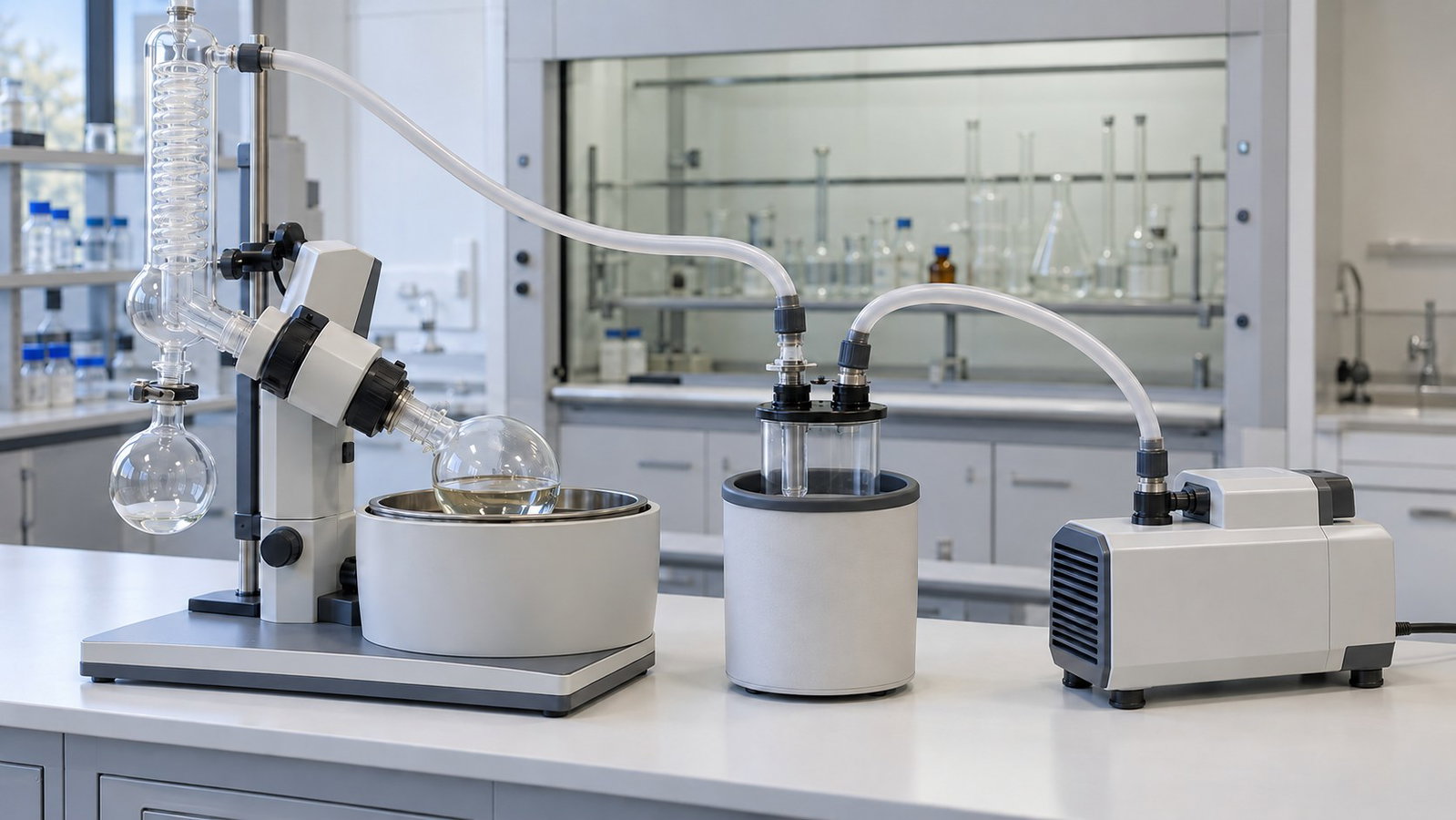
1. Three Specifications, Three Different Questions
Three datasheet numbers decide whether a pump suits rotary evaporation, and they are easy to confuse.
| Specification | Question it answers | What it does not tell you |
|---|---|---|
| Ultimate vacuum (base pressure) | How low can the pressure go in a dry, leak-tight, blanked-off test? | The pressure a run will sit at, or how fast it gets there |
| Pumping speed (volume flow rate) | What gas volume per minute the pump removes at a given inlet pressure | Speed at other pressures; a free-air figure applies at atmospheric inlet only |
| Chemical resistance (wetted materials) | Will the parts the vapor touches tolerate your solvents? | Whether the process is safe overall; traps, exhaust and ventilation matter too |
ISO 21360-1 defines base pressure as the pressure "obtained in the test dome after conditioning the vacuum pump and the test dome." It also notes that "the term 'pumping speed' and symbol 'S' are often used instead of 'volume flow rate'" [1]. ISO 21360-2 applies these methods to positive displacement pumps, the family that includes diaphragm pumps [2][5]. An ultimate-vacuum figure is a capability measured under ideal conditions; pumping speed is a curve, not a single number.
2. Ultimate Vacuum: The Floor, Not the Operating Point
What the number means
Ultimate vacuum is the floor of the pump. During evaporation the flask pressure is set by a balance: vapor leaves the liquid, most of it condenses, and the pump removes the rest together with air leaking in through joints and seals [3][4]. As the complete guide to rotary evaporation puts it, ultimate vacuum is a capability, not an operating pressure.
How to use it in selection
Start from the working pressure, not from the pump. It is set by the solvent's vapor pressure at the vapor temperature you choose, which is solvent-specific and covered, with a calculator, in solvent boiling points under vacuum. Then choose a pump whose ultimate vacuum sits clearly below the lowest working pressure your methods need. Hoses, traps, small leaks and the vapor load all keep a real system above the blanked-off rating [3], so a rating close to the required pressure leaves little room for a worn seal or a long hose.
A low ultimate vacuum is necessary but not sufficient. It does not prove that a pump "can evaporate" a given solvent, because the result also depends on pumping speed, condenser capacity, bath temperature and system tightness.
Stages, units and "abs."
ISO 3529-2 classes the diaphragm pump as a dry positive displacement pump "in which the gas is compressed and expelled due to the movement of a reciprocating or oscillating action of a diaphragm by using suitable valves" [5]. Stages "can be combined as multi-stages" [5]; connecting diaphragm stages in series lowers the attainable ultimate pressure, because each stage compresses the gas only part of the way to atmosphere [6].
One millibar equals 100 Pa (1 hPa); 1 Torr is 133.322 Pa, so 1 mbar is about 0.75 Torr [7]. "Abs." means absolute pressure, measured from zero rather than relative to the atmosphere.
3. Pumping Speed: Why One Number Is Not Enough
Speed falls as pressure falls
Pumping speed is a volume flow rate. The amount of gas the pump actually removes, the throughput, is the product of speed and pressure: Q = S × p [3][8]. In diaphragm pumps, residual-gas re-expansion and valve behavior can reduce volumetric efficiency as inlet pressure falls; use the specified speed curve. At the ultimate pressure the pumping speed reaches zero [6]. The free-air figure is the speed at atmospheric inlet pressure, the most favorable point on the curve.
The C410 Chemistry-Design Diaphragm Vacuum Pump has a specified pumping speed at six pressures:
| Inlet pressure (mbar) | 1000 | 880 | 750 | 600 | 480 | 280 |
|---|---|---|---|---|---|---|
| C410 pumping speed (L/min) | 25 | 22 | 20 | 12 | 7.5 | 5 |
At 280 mbar the C410 delivers 5 L/min, one-fifth of its 25 L/min free-air figure. Speed below 280 mbar: not specified. The 13 mbar figure is the pump's ultimate-vacuum rating, not a point on the speed curve.
What speed decides: time to pressure
For an ideal closed vessel of volume V pumped at constant speed S, pump-down time from p₀ to p is t = (V/S) · ln(p₀/p) [3][9]. For variable speed, integrate t = V ∫ dp / [S(p) · p] from the target pressure to the starting pressure. With V in liters and S in L/min, t is in minutes. This is the calculation behind the C410 pump-speed estimator (E2) on the C410 product page and in the complete guide, which interpolates linearly between the six specified C410 points.
Worked estimate: idealized C410 pump-down times
The table lists estimator results for three illustrative system volumes (everything under vacuum: flasks, condenser, hoses and trap), next to the time you would get by assuming the 25 L/min free-air figure held all the way down.
| System volume | Target pressure | Idealized time, interpolated C410 data | Time if 25 L/min held constant |
|---|---|---|---|
| 2 L | 600 mbar | about 3 s | about 2.5 s |
| 2 L | 300 mbar | about 15 s | about 6 s |
| 5 L | 600 mbar | about 8 s | about 6 s |
| 5 L | 300 mbar | about 38 s | about 14 s |
| 10 L | 480 mbar | about 31 s | about 18 s |
| 10 L | 300 mbar | about 76 s | about 29 s |
These are idealized estimates, not measured times or guaranteed bounds. They use linear interpolation of six specified C410 pressure–flow points over 280–1000 mbar, starting at 1000 mbar; E2 accepts targets of 280–950 mbar. The model assumes a fixed-volume, leak-tight, isothermal vessel without solvent vapor load or connecting-line restrictions. Hose restrictions, leaks and vapor loads generally lengthen evacuation. No estimate is made below 280 mbar.
Two lessons carry over to any pump. Sizing from the free-air figure alone is optimistic, more so at lower target pressures; at 300 mbar the curve-based estimate is about two and a half times the constant-speed one. And a pump-down estimate needs a pressure–flow curve: from an atmospheric flow figure alone, the time to a working pressure cannot be calculated.
What speed decides: holding pressure under load
Once the system is down, the pump keeps removing gas: air leaking through joints and the rotary seal, dissolved gas, and vapor that passes the condenser [4][10]. At steady state, Q = p × Seff(p), using pressure and effective pumping speed at the same location [3]. Q is pressure-volume throughput, not L/min; use Seff at the flask, not the free-air rating.
The vapor itself is a large volume. As an ideal-gas estimate, 1 mL of liquid ethanol (0.789 g/mL, 46.07 g/mol [11]) contains about 0.0171 mol. At 100 mbar and 313 K (40 °C) that becomes about 4.5 L of vapor (V = nRT/p [12]). This illustrates why the condenser must remove most vapor. Evaluate the residual load against pumping speed at the same inlet conditions, not an atmospheric free-air rating. This calculation predicts neither evaporation rate nor pump suitability.
Hoses and traps reduce the speed you get
For passive connecting components at a specified operating point, 1/Seff = 1/S + 1/C [3][9]; conductance C depends on gas, pressure and geometry. At rotary-evaporation pressures, flow in tubing is mostly viscous, and conductance rises steeply with internal diameter and falls with length [3][9]. Short, wide, vacuum-rated hoses keep more of the rated speed available.
4. Chemical Resistance: What the Vapor Does to the Pump
Why the pump has to tolerate solvent
In rotary evaporation the pump handles solvent vapor as well as air. In an oil-sealed rotary-vane pump, vapor can dissolve or condense in the oil, which degrades it and raises the attainable pressure [6][13]. Dry diaphragm pumps have no oil in the gas path, which is why they are the usual choice for routine rotary evaporation [13][17]. ISO 3529-2 also describes gas ballast, admitting "a controlled quantity of a suitable non-condensable gas during the compression part of the cycle so as to reduce or avoid the extent of condensation within the vacuum pump" [5]. Condensation and chemical attack can impair pump performance. Select a trap for the actual vapor and operating temperature; do not assume a generic moisture trap captures every solvent vapor [10][13].
Wetted materials
"Chemical resistant" refers to every part the gas touches: diaphragms, valves, pump head and connectors. Fully fluorinated polymers such as PTFE are widely used for these parts because they resist most laboratory solvents, acids and bases [14], but no material resists everything.
The C960T and C2000T have all wetted parts made of chemical-resistant materials; the materials themselves are not specified. The C410 is an oil-free chemistry-design pump whose suitability depends on vapor compatibility, system configuration and the use of appropriate traps; its wetted materials are not specified. For corrosive vapors, ask for the wetted-material list of the specific model before you order.
The exhaust is part of the system
Whatever passes the condenser and trap leaves at the exhaust; solvent vapors must be trapped, recovered or routed to suitable ventilation. In the United States the OSHA Laboratory Standard requires a written Chemical Hygiene Plan where hazardous chemicals are used [15]; Prudent Practices in the Laboratory covers vacuum equipment and traps [10], and ANSI/ASSP Z9.5 covers laboratory ventilation [16]. Route pump exhaust according to your institution's procedures.
5. Comparing the C410, C960T and C2000T on Their Specifications
This is a specification comparison only.
| Specification | C410 | C960T | C2000T |
|---|---|---|---|
| Ultimate vacuum | 13 mbar | <2 mbar abs. | <2 mbar abs. |
| Flow at atmospheric inlet pressure | 25 L/min (free air) | 3.6 m³/h (60 L/min) | 10.8 m³/h (180 L/min) |
| Pressure–flow data specified | Yes: six points, 1000–280 mbar | No: atmospheric only | No: atmospheric only |
| Pump configuration | Two-head chemistry design | Triple stage | Triple stage |
| Wetted-part materials | Not specified; oil-free design | Not specified; chemical-resistant materials | Not specified; chemical-resistant materials |
| Power | 95 W | 370 W max. | 750 W max. |
| Noise | 50 dB | 50 dB | 60 dB |
| Connections | 8 mm hose nozzles | 10 mm hose connections | Inlet KF25, outlet G1/2 |
| Power supply | 110 V / 60 Hz (US) or 220 V / 50 Hz (EU, UK) | 220 V / 50 Hz | 220–240 V / 50 Hz |
Source: ACS Material product specifications (October 2026).
What the table supports
- Floor. The C960T and C2000T are specified with a lower ultimate vacuum (<2 mbar abs.) than the C410 (13 mbar). Where a method needs working pressures near or below about 13 mbar, the C410's rating leaves no margin, and a pump with a lower floor belongs on the shortlist.
- Flow at atmosphere. At atmospheric inlet pressure, the C960T moves 60 L/min and the C2000T 180 L/min, against 25 L/min for the C410.
- Practicalities. Power, noise, connections and supply differ widely; the C960T and C2000T are specified for 50 Hz supplies at 220 V and 220–240 V. Check your mains supply before planning around a model.
What the table does not support
- Pump-down time comparisons. For the C960T and C2000T, flow is specified only at atmospheric pressure, with no pressure–flow curve. Speed at atmosphere does not scale predictably to a working pressure, so this article does not estimate or compare their pump-down times. The idealized estimate above applies to the C410 alone.
- Solvent verdicts. A lower ultimate vacuum does not by itself mean a pump will evaporate a particular solvent at a particular rate.
6. Matching the Pump to the Rotary Evaporator
What is specified for each evaporator
| Rotary evaporator | Scale | Vacuum source |
|---|---|---|
| RE100-S | 50–3000 mL flasks; max. 1.56 L/h (H₂O) | C410 named as the matched vacuum source; confirm suitability for the intended process |
| RE100-Pro | 50–3000 mL flasks; max. 1.56 L/h (H₂O); 1700 cm² condenser | Same C410 pairing; confirm process suitability |
| RE200-Pro | 20 L flask; max. 4.5 L/h (75% alcohol); 1.2 m² condenser | Ultimate vacuum below 2.6 mbar; C410 not specified for this system; pump selected against solvents, batch size and target pressure |
| RE-E series | 5–50 L flasks; 2–11 L/h (75% alcohol) | Ultimate vacuum 9 mbar; vacuum controller optional; pump: not specified |
Source: ACS Material product specifications (October 2026).
\nThe C960T and C2000T list the RE-E series, the RE100-CV and the VC100 vacuum controller as related products; that is not a specified pairing or a rating for a combined system.
A selection sequence
- Set the working pressure. Use solvent boiling points under vacuum to find the lowest pressure your methods need; how a rotary evaporator works in five steps shows where that setpoint enters a run.
- Check the floor. Keep the pump's ultimate vacuum clearly below that pressure. For RE200-Pro and RE-E, confirm the test configuration and operating limits behind the specified system ratings.
- Check the speed where you work. Estimate the system volume and look for the speed at the working pressure. If only an atmospheric figure is specified, ask for the pressure–flow curve before relying on it for a high-load process.
- Check the chemistry. Confirm wetted materials, select an appropriate vapor trap, and plan the exhaust.
- Check the practicalities. Mains supply, connections, noise and bench space.
- Decide on control. The VC100 lists 1–1000 mbar, up to five five-step programs, and compatible pump-power limits of 400 W at 50 Hz or 500 W at 60 Hz. The C2000T's 750 W exceeds these limits; do not assume compatibility. Confirm the control configuration before ordering. For bumping mechanisms, see why the flask rotates.
Recognizing the two failure modes
Insufficient ultimate vacuum. If verified blank-off pressure exceeds the target, greater speed alone cannot reach it; first exclude faults and unsuitable test conditions.
Insufficient effective pumping speed. Slow evacuation or rising pressure under load can also reflect leaks, restrictions or inadequate condensation. Check these causes before replacing the pump.
A blank-off reading at the pump inlet, compared with the reading at the evaporator, can help distinguish pump limitations from system problems [3][13].
7. Frequently Asked Questions
Which vacuum pump suits a rotary evaporator? For routine removal of common solvents on a rotovap, an oil-free chemistry-design diaphragm pump is the usual choice, because solvent vapor passes through the pump. The right model has an ultimate vacuum clearly below your working pressure and enough speed at that pressure for your system volume and gas load. For the RE100-S and RE100-Pro, ACS Material names the C410 as the matched pump.
Is a 13 mbar ultimate vacuum enough? It depends on the working pressure your methods need. Find that pressure with solvent boiling points under vacuum, then check that 13 mbar leaves a clear margin below it.
What is the difference between ultimate vacuum and pumping speed? Ultimate vacuum is the lowest pressure reached against a dry, blanked-off inlet. Pumping speed is the gas volume removed per minute at a given inlet pressure; it falls as pressure falls, so the free-air figure overstates speed at a working pressure.
Can I compare the pump-down times of the C410, C960T and C2000T? Not from their specifications. Only the C410 has a specified pressure–flow curve (1000–280 mbar); for the C960T and C2000T, flow is given at atmospheric pressure only.
Why does my pump reach its rating when empty but not during a run? During a run, uncondensed vapor, leaking air and gas released from the liquid add to the gas load. At steady state, flask pressure reflects that load and the effective pumping speed at the flask, including hose and trap restrictions—not the pump's free-air rating.
8. Keep Exploring Rotary Evaporation
- Rotary Evaporation: The Complete Guide: principles, setup, vacuum, condensing and solvent recovery.
- How a Rotary Evaporator Works: Five Steps
- Solvent Boiling Points Under Vacuum
- Why the Flask Rotates: Films, Area and Bumping
- Rotary Evaporation vs Simple Distillation
Try the interactive pump-speed estimator on the C410 product page, or browse all ALab™ rotary evaporators and vacuum equipment