
RPM describes rotational speed; relative centrifugal force (RCF, ×g) expresses centrifugal acceleration at a specified radius relative to standard gravity. This guide derives the conversion, labels radius evidence and provides static calculations from ALab™ rotor specifications. Matching a calculated RCF does not, by itself, validate a separation method.
Quick answer: RCF = 1.118 × 10⁻⁵ × r × N², with radius r in centimeters and speed N in rpm; N = √(RCF / (1.118 × 10⁻⁵ × r)). The DM0412 has a specified radius of 11 cm for directly seated A12-10P configurations and 9.8 cm with the A10P15 adapter and plug. Identify the rotor, tube/adapter and radius definition. An applicable specified speed–RCF pair can also be scaled at unchanged radius. At fixed radius, +10% speed gives +21% RCF; −10% gives −19%.
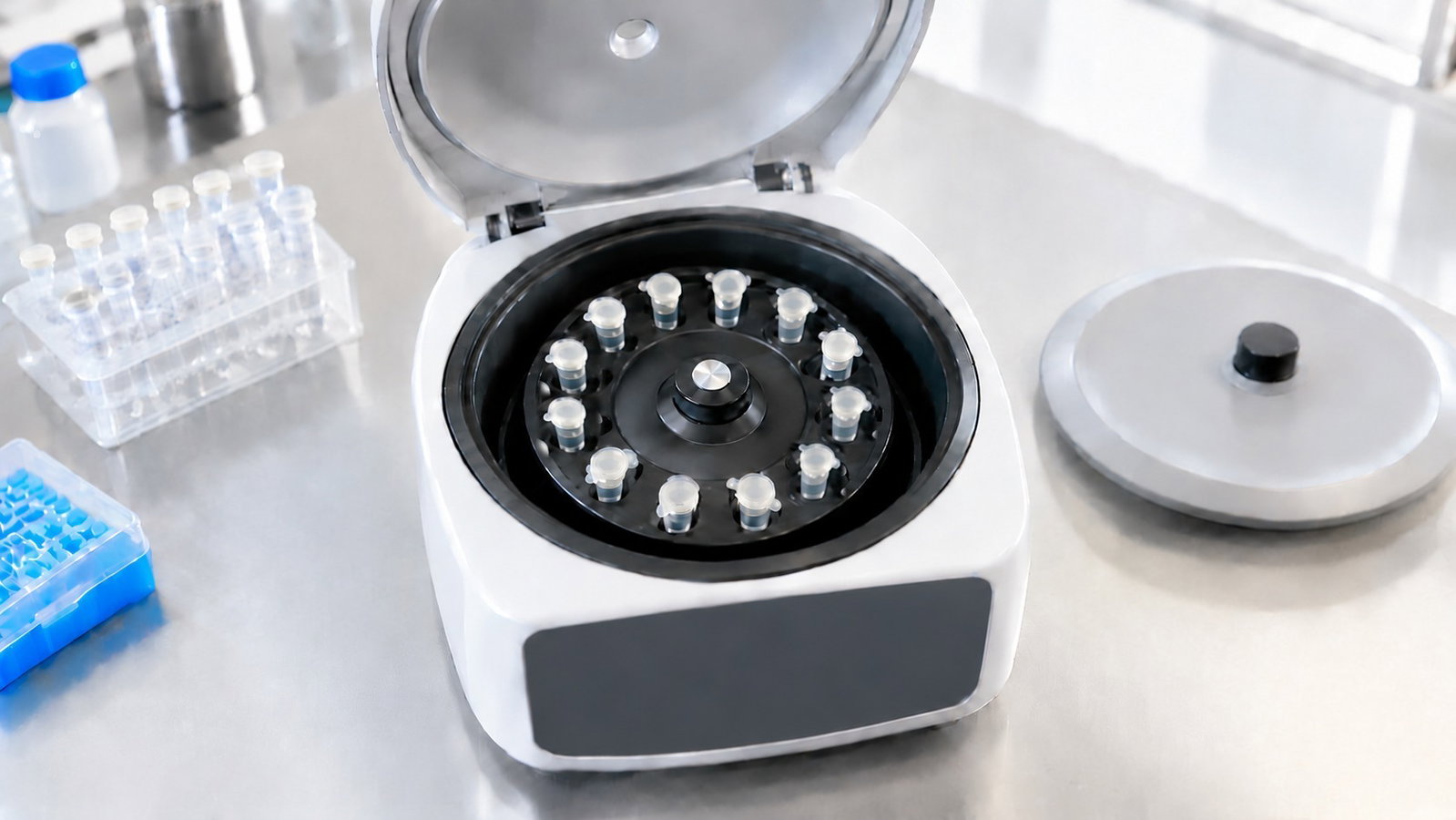
1. RPM and RCF: Two Ways to Describe the Same Spin
RPM counts revolutions per minute. RCF is the ratio of centrifugal acceleration magnitude at a specified radius to standard gravity: 2,000 ×g means 2,000 times g_n, not a force in newtons [1][2][3].
The same rpm gives different RCF at different radii. Record RCF and its radius basis, rotor, tube/adapter, fill, time and temperature. These details support comparison; they do not establish equivalent separation across configurations [2][3].
2. The Formula: From Centripetal Acceleration to 1.118 × 10⁻⁵ · r · N²
Derivation
A particle moving in a circle of radius r at angular velocity ω has a centripetal acceleration of ω²r. Dividing by standard gravity, gₙ = 9.80665 m/s² [1], gives the acceleration as a multiple of g [2][3]:
RCF = ω² r ÷ gₙ, with ω = 2πN ÷ 60
Substituting ω and expressing r in centimeters gives:
RCF = (2π ÷ 60)² ÷ 9.80665 ÷ 100 × r × N² = 1.11824 × 10⁻⁵ × r(cm) × N²
The constant is usually rounded to 1.118 × 10⁻⁵, changing calculated RCF by about 0.022%. This is coefficient rounding, not an uncertainty bound for radius or instrument performance. The unit variants are:
| Radius unit | RCF formula | RPM formula (inverse) |
|---|---|---|
| centimeters | RCF = 1.118 × 10⁻⁵ × r × N² | N = √(RCF ÷ (1.118 × 10⁻⁵ × r)) ≈ 299.1 × √(RCF ÷ r) |
| millimeters | RCF = 1.118 × 10⁻⁶ × r × N² | N ≈ 945.8 × √(RCF ÷ r) |
| meters | RCF = 1.118 × 10⁻³ × r × N² | N ≈ 29.91 × √(RCF ÷ r) |
Does the formula match the specifications?
For the 17 configurations in Tables A/B, calculated and rated maximum RCF differ by at most 0.173%: the 14 cm, 4,000 rpm row gives 2,504.32 ×g versus the rated 2,500 ×g. This is an arithmetic check, not radius validation. The DG1616 / DG1616R AS30-2 rotor is rated to 28,620 ×g; the formula rounds to 28,621 ×g, matching the headline. The DM0412 11 cm calculation rounds to its rated 2,490 ×g. The rated maximum remains the limit.
Speed is squared, radius is not
Two consequences follow from the form of the equation:
- RCF scales with the square of speed. Doubling the speed quadruples the force; halving it cuts the force to a quarter. The D1008 FAQ makes the same point: speed is squared, radius is not.
- RCF scales linearly with radius. A tube seated 10 % closer to the axis sees 10 % less force at the same speed.
The square law also gives a useful shortcut. If you know one valid speed–force pair for a configuration, you can scale it without knowing the radius: RCF₂ = RCF₁ × (N₂ ÷ N₁)². This is only valid if both runs use the same rotor, tube and adapter, so that the radius really is unchanged.
3. Rotor Radius: Which r, and Where It Comes From
One tube, several radii
Radius is the perpendicular distance from the rotation axis to the point of interest in its operating position. For an illustrative sample column, call its inner and outer radial positions r_min and r_max; here r_av = (r_min + r_max)/2 is only a schematic midpoint, not a universal method-conversion radius. For a hypothetical 6–11 cm column, inner RCF is 6/11, about 55%, of outer RCF. Fill and configuration affect these positions [2][3].
Maximum RCF commonly refers to a maximum radius [2][3]. ALab™ specifications do not say whether the specified radius is r_min, r_av or r_max. This article calls it the specified radius and uses it for the arithmetic here; confirm its definition and configuration before transferring a method.
Adapters and tube length move the sample
An adapter or depth plug can change tube position; the effect depends on the configuration. DM0412 is specified at 11 cm / 2,490 ×g for directly seated tubes and 9.8 cm / 2,218 ×g for shorter tubes in A10P15 with a plug. These are the specified configurations, not a radius assignment to every tube accepted by A10P15. Confirm the exact tube/plug combination.
The DG1616 / DG1616R shows the same effect with its SE4-100 rotor (four buckets, standard accessory, rated to 4,000 rpm). At that speed the specified bucket-set radii run from 14 cm (13 × 75 mm tubes with a plug, 2,500 ×g) to 16.5 cm (13 × 100 mm tubes, 2,950 ×g).
The DM0506 takes the cautious line for its A5P17 and A2P17 adapters. ACS Material lists the tube dimensions they accept but no separate radius or maximum RCF for those configurations, and notes that the rotor maximum should not be assumed to carry over.
Specified, not specified, and inferred
For the conversion you need a radius whose source you know. This article uses three labels:
| Label | Meaning | Used for |
|---|---|---|
| Specified radius | Specified for a given rotor or tube/adapter combination; radius definition not specified | DM0412 A12-10P (11 cm; 9.8 cm with A10P15 and plug); listed DG1616 / DG1616R rotors and SE4-100 bucket sets |
| Not specified | No radius is specified | All other ALab™ centrifuge configurations |
| Inferred effective radius | Back-calculated from a specified maximum speed and maximum RCF: r = RCF ÷ (1.118 × 10⁻⁵ × N²) | Orientation only (Section 6); not a measured dimension |
An inferred effective radius reproduces the specified maximum by construction. It does not tell you where in the tube the force is quoted, how an adapter changes the geometry, or whether different rotors that share a rating also share a radius.
4. Static RPM-to-RCF Table for Specified Radii
Tables A/B use the specified radius for each configuration and RCF = 1.118 × 10⁻⁵ × r × N², rounded to 1 ×g. The rated maximum column shows ACS Material’s ratings; the calculated values do not change those ratings. Values above the rotor’s rated maximum are shown as —. Other limits depend on the instrument, rotor, tube and adapter. Where no radius is specified for a specific tube, none is shown.
Table A. Low- and medium-speed configurations with a specified radius
| Model | Rotor / configuration | Radius (cm) | Rated max (rpm / ×g) | 1,000 rpm | 2,000 rpm | 3,000 rpm | 4,000 rpm | 4,500 rpm | 5,000 rpm | 5,500 rpm |
|---|---|---|---|---|---|---|---|---|---|---|
| DM0412 | A12-10P with A10P15 adapter and plug | 9.8 | 4,500 / 2,218 | 110 | 438 | 986 | 1,753 | 2,219 | — | — |
| DM0412 | A12-10P, tubes seated directly | 11 | 4,500 / 2,490 | 123 | 492 | 1,107 | 1,968 | 2,490 | — | — |
| DG1616 / DG1616R | S2-MP (microplates) | 12.3 | 4,000 / 2,200 | 138 | 550 | 1,238 | 2,200 | — | — | — |
| DG1616 / DG1616R | SE4-100, 13 × 75 mm tubes with plug | 14 | 4,000 / 2,500 | 157 | 626 | 1,409 | 2,504 | — | — | — |
| DG1616 / DG1616R | A30-15 | 14.18 | 4,500 / 3,210 | 159 | 634 | 1,427 | 2,537 | 3,210 | — | — |
| DG1616 / DG1616R | A8-50 | 14.2 | 5,000 / 3,968 | 159 | 635 | 1,429 | 2,540 | 3,215 | 3,969 | — |
| DG1616 / DG1616R | SE4-100 with A100P10 (3–7 mL tubes) | 14.7 | 4,000 / 2,630 | 164 | 657 | 1,479 | 2,630 | — | — | — |
| DG1616 / DG1616R | SE4-100 with A100P15 (15 mL tubes) | 15.1 | 4,000 / 2,700 | 169 | 675 | 1,519 | 2,701 | — | — | — |
| DG1616 / DG1616R | SE4-100, listed 15.9 cm bucket/adapter combinations (10–100 mL) | 15.9 | 4,000 / 2,840 | 178 | 711 | 1,600 | 2,844 | — | — | — |
| DG1616 / DG1616R | SR4-200 | 16.25 | 5,500 / 5,495 | 182 | 727 | 1,635 | 2,907 | 3,679 | 4,542 | 5,496 |
| DG1616 / DG1616R | SE4-100, 13 × 100 mm tubes | 16.5 | 4,000 / 2,950 | 184 | 738 | 1,660 | 2,952 | — | — | — |
| DG1616 / DG1616R | SR4-400 | 16.6 | 5,000 / 4,639 | 186 | 742 | 1,670 | 2,969 | 3,758 | 4,640 | — |
Table B. DG1616 / DG1616R rotors specified at r = 10 cm (RCF in ×g)
| Rotor | Rated max (rpm / ×g) | 2,000 | 4,000 | 6,000 | 8,000 | 10,000 | 12,000 | 14,000 | 15,000 | 16,000 rpm |
|---|---|---|---|---|---|---|---|---|---|---|
| AS30-2 | 16,000 / 28,620 | 447 | 1,789 | 4,025 | 7,155 | 11,180 | 16,099 | 21,913 | 25,155 | 28,621 |
| AS18-5V | 15,000 / 25,155 | 447 | 1,789 | 4,025 | 7,155 | 11,180 | 16,099 | 21,913 | 25,155 | — |
| AS12-PCR8 | 14,000 / 21,912 | 447 | 1,789 | 4,025 | 7,155 | 11,180 | 16,099 | 21,913 | — | — |
| AS60-2 | 14,000 / 21,912 | 447 | 1,789 | 4,025 | 7,155 | 11,180 | 16,099 | 21,913 | — | — |
| AS6-50V | 12,500 / 17,468 | 447 | 1,789 | 4,025 | 7,155 | 11,180 | 16,099 | — | — | — |
How to read the tables
- Find your configuration, not your centrifuge. The DG1616 / DG1616R alone appears in 15 rows, because each rotor and bucket set has its own radius and limit.
- In Tables A and B, the dashes are limits, not gaps. Rotor ratings are given per rotor, and a rotor is operated within the limits of the centrifuge it is used with. A rotor is never run above its own rated speed, even when the instrument can go faster.
- For speeds between the columns, use the formula or the square-law shortcut from Section 2 within the same row.
- Rows with the same radius share values (all Table B rows, for example). They still differ in rated speed, capacity and tube format.
5. Worked Examples on Specified Configurations
These are calculations from the specifications, not validated operating protocols. Examples 1–3 use the specified configurations. Example 4 compares rotor-level radii whose specific tube/adapter mappings are not specified. Example 5 conditionally scales one named rotor’s rating pair.
Example 1: the same rotor and speed, two radii (DM0412)
Configuration: DM0412, A12-10P rotor, 4,500 rpm (rotor maximum). Radius: specified, 11 cm for tubes seated directly; 9.8 cm with the A10P15 adapter and plug.
- At 11 cm: 1.118 × 10⁻⁵ × 11 × 4,500² = 2,490 ×g (specified: 2,490 ×g).
- At 9.8 cm: 1.118 × 10⁻⁵ × 9.8 × 4,500² = 2,219 ×g (specified: 2,218 ×g).
The force falls by about 11 % (9.8 ÷ 11 = 0.89), and nothing about the speed setting shows it. If a method calls for the full 2,490 ×g, shorter tubes in the adapter cannot reach it on this rotor, because the speed is already at its limit.
Example 2: converting a ×g protocol to rpm (DM0412)
Requirement: 2,000 ×g. Configuration: DM0412, A12-10P, tubes seated directly, specified radius r = 11 cm; limit 4,500 rpm; speed set in 100 rpm increments.
N = √(2,000 / (1.118 × 10⁻⁵ × 11)) ≈ 4,033 rpm. The adjacent 100 rpm settings give 1,968 ×g at 4,000 rpm and 2,067 ×g at 4,100 rpm; acceptability depends on the method. With A10P15 and plug at 9.8 cm, the calculation gives 4,272 rpm, also not an exact 100 rpm setting. DM0412 offers direct RCF selection; its RCF increment and handling of each adapter radius are not specified; confirm both before relying on g-mode.
Example 3: tube length within SE4-100 bucket sets (DG1616 / DG1616R)
Configuration: DG1616 / DG1616R, SE4-100 rotor, 4,000 rpm (rotor maximum). Radius: specified per bucket set.
- 13 × 100 mm tubes in the 3–7 mL set: 16.5 cm, rated 2,950 ×g.
- 13 × 75 mm tubes in the same set with a plug: 14 cm, rated 2,500 ×g.
At the two specified radii, calculated RCF differs by about 15% at unchanged speed. Matching the 16.5 cm value with 14 cm would require more than the listed 4,000 rpm limit. This is a radius/speed comparison, not a claim about equivalent pelleting.
Example 4: matching calculated RCF between rotors (DG1616 / DG1616R)
The DG1616 / DG1616R rotor table gives SR4-400 r = 16.6 cm, limit 5,000 rpm; A8-50 r = 14.2 cm, limit 5,000 rpm; and AS6-50V r = 10 cm, limit 12,500 rpm. Specific tube/adapter radius mappings are not specified for this comparison.
At 3,000 rpm, SR4-400’s specified radius gives 1,670.292 ×g. Using the deliberately rounded target 1,670 ×g gives approximately 3,243 rpm for A8-50 and 3,865 rpm for AS6-50V. These are arithmetic targets, not approved transfers between tube formats. The specified 1 rpm increment permits fine setting choices, but does not establish speed accuracy or the radius used by an RCF display. Matching one RCF point does not establish pelleting time [2][3].
Example 5: scaling a specified pair when no radius is specified (D1524)
Configuration: D1524, AS18-5 with its listed 18 × 5 mL round-bottom tube format; no adapter listed. Specified rotor maximum: 15,000 rpm / 21,380 ×g. Radius and reference point: not specified.
Conditionally scaling that pair to 10,000 rpm gives 21,380 × (10,000 / 15,000)² = 9,502.22 ×g, about 9,500 ×g. This assumes the same rotor, tube position and reference point. It neither verifies the missing radius nor establishes the radius used by the instrument’s "speed/RCF conversion" display. Confirm the documented configuration before applying the estimate.
6. Check Headline Ratings by Configuration
Headline maxima need configuration-level checking. DG1616 / DG1616R lists 16,000 rpm, 28,621 ×g and 4 × 400 mL, but its AS30-2 rotor is 30 × 2 mL at 16,000 rpm, while SR4-400 is 4 × 400 mL at 5,000 rpm and 4,639 ×g. No 4 × 400 mL configuration is specified at the headline RCF.
The DM0412 is a second case. Its 2,490 ×g headline belongs to the A12-10P rotor. The 50 mL format needs the separate, non-interchangeable DM0412(A6-50P) configuration, which is rated to 4,000 rpm and 1,800 ×g.
Table C lists specified maximum pairs where no radius is specified. The inferred effective radius is an algebraic descriptor of each rating pair, not a measured dimension or proof of rotor size.
Table C. Rated maxima without a specified radius
| Model | Configuration | Rated max speed (rpm) | Rated max RCF (×g) | Specified radius | Inferred effective radius (not measured) |
|---|---|---|---|---|---|
| DM0412 | DM0412(A6-50P) | 4,000 | 1,800 | — | ≈ 10.1 cm |
| DM0506 | A6-15P or A4-50P (same rating) | 5,000 | 2,600 | — | ≈ 9.3 cm |
| Q0408E | 8 × 15 mL rotor | 4,000 | 1,860 | — | ≈ 10.4 cm |
| D1008 | A8-2P or A4-PCR8P (single specified operating point) | 7,000 | 2,680 | — | ≈ 4.9 cm |
| D1524 | AS-series rotors (same rating) | 15,000 | 21,380 | — | ≈ 8.5 cm |
| D1524C | AC24P capillary rotor | 12,000 | 13,680 | — | ≈ 8.5 cm |
| D1524R | AS-series rotors (same rating) | 15,000 | 21,380 | — | ≈ 8.5 cm |
| D3024 | AS-series rotors (same rating) | 15,000 | 21,380 | — | ≈ 8.5 cm |
| DM1424 / DM1224 | AC24 capillary rotor | 12,000 | 13,680 | — | ≈ 8.5 cm |
A dash in the Specified radius column of Table C means no radius is specified. Inferred effective radius: r = specified max RCF / (1.118 × 10⁻⁵ × specified max rpm²), assuming both figures refer to the same configuration and reference point. Rated figures are rounded, and the reference point is not specified. Equal rating pairs give equal inferred values, not proven equal geometry. Do not assign these values to an unverified tube or adapter; confirm the actual radius and limits before method transfer.
7. Setting the Run: Speed Accuracy, Increments and RCF Mode
Small speed errors have roughly double the RCF effect
For unchanged radius, fractional RCF error is 2ε + ε² when speed error is ε. Using DM0412 A12-10P’s specified 11 cm and ±20 rpm, the arithmetic around 4,500 rpm gives roughly 2,468–2,513 ×g (about ±0.9%). DM1224 with AC24 is specified at ±100 rpm; around 12,000 rpm this gives about ±1.7% RCF error. These are sensitivity examples, not permission to exceed rated speed or estimates of total measurement uncertainty. Rotor/tube radius uncertainty is separate; setting increment is not speed accuracy.
Settings, readouts and configuration
DM0412 and DM0506 offer selectable RCF; on the Q0408E, values toggle on the display for readout. These are different claims. Neither an RCF step nor a conversion display proves that every adapter radius is represented. Confirm the operating instructions, available increments and radius basis. A manually calculated speed must fit both the permitted settings and the complete configuration’s limits.
What conversion does not settle
RCF describes acceleration at one radius, not a separation outcome. Equal RCF multiplied by time does not establish equivalent pelleting, even in the same rotor: sample, medium, fill, temperature and acceleration/braking can differ [2][3]. This article converts units; it prescribes no run time.
8. Frequently Asked Questions
Can I convert rpm to ×g without knowing the rotor radius?
Not from rpm alone. You need a specified radius or a valid speed–RCF reference pair for the same configuration. Square-law scaling assumes the reference point is unchanged; it supplies neither a missing radius definition nor an adapter correction.
Is RCF the same as g-force?
Yes. RCF, g-force and "×g" all express the outward acceleration on the sample as a multiple of standard gravity, 9.80665 m/s².
If I double the speed, does the RCF double?
No, it quadruples. RCF is proportional to the square of the speed. At a fixed radius, 2,000 rpm gives a quarter of the force of 4,000 rpm.
Why does an adapter change the RCF?
An adapter or plug changes where the tube sits. On the DM0412 A12-10P rotor, the specified radius drops from 11 cm to 9.8 cm with the A10P15 adapter and plug, and the maximum from 2,490 to 2,218 ×g at the same 4,500 rpm.
Which radius should I use: minimum, average or maximum?
Use the method’s radius convention. A value labelled only as radius supports the calculations here, but its definition and tube/adapter mapping must be confirmed before method transfer.
Is the headline maximum RCF available with every rotor?
Not necessarily; check the rotor-specific rating. DG1616 / DG1616R’s 28,621 ×g headline corresponds to AS30-2, whose rotor rating is 28,620 ×g. Its 4 × 400 mL capacity belongs to SR4-400 at 5,000 rpm and 4,639 ×g.
9. Keep Exploring Centrifugation
- Laboratory Centrifugation: RCF, Rotors, Sedimentation and How to Choose a Centrifuge: the centrifugation hub covering RCF, rotors, sedimentation, temperature, safety and the full series of guides.
- DG1616 / DG1616R High-Speed Centrifuges: full rotor table with specified radius, maximum speed and RCF for each rotor and bucket set.
- DM0412 Low-Speed Centrifuge: A12-10P radius with and without the A10P15 adapter.
- D1008, DM0506, Q0408E, D1524 / D1524C, D1524R, D3024 and DM1424 / DM1224: specified speed and RCF ratings.
Browse all ALab™ centrifuges.