-
ZSM-5 - Zeolite Socony Mobil–5
Jul 24, 2019 | ACS MATERIAL LLCFew synthetic materials have shaped the modern chemical industry as quietly and as thoroughly as ZSM-5. First synthesized at Mobil in 1965 and patented in 1972, this medium-pore zeolite turns methanol into gasoline, boosts propylene yields in refineries, helps make the para-xylene behind polyester, and pulls organic vapors out of humid air — all by exploiting channels barely half a nanometer wide. This guide explains how the MFI framework is built, why its 10-ring pores behave like molecular gatekeepers, how its acidity can be tuned across two orders of magnitude through the SiO2/Al2O3 ratio, and where ZSM-5 catalysts, adsorbents, and nanocrystals are headed next.
Quick answer: ZSM-5 is a high-silica, MFI-type zeolite whose intersecting ~5.5 Å channels admit slim molecules and turn away bulky ones (shape selectivity), while its framework aluminum atoms create strong, precisely countable Brønsted acid sites. That pairing of geometry and acidity makes ZSM-5 the workhorse behind FCC propylene additives, methanol-to-hydrocarbons (MTG/MTP), para-xylene production, and catalytic dewaxing — and, at very high SiO2/Al2O3 ratios, a hydrophobic adsorbent for organics in wet gas streams.In this article: Why ZSM-5 matters MFI framework Shape selectivity Acidity & Si/Al Diffusion & hierarchical ZSM-5 Applications Practical outlook ZSM-5 products FAQWhy ZSM-5 Matters
ZSM-5 — short for Zeolite Socony Mobil–5 — was discovered in Mobil’s laboratories in 1965 and disclosed in the landmark 1972 patent of Argauer and Landolt, which defined the material by its X-ray diffraction pattern and an unusually wide composition range.1 The framework structure itself was solved six years later by Kokotailo, Lawton, Olson, and Meier, who revealed a genuinely new zeolite topology — now carrying the framework code MFI — built around intersecting ten-membered-ring channels.2 From discovery to the first commercial trial of ZSM-5 as a fluid catalytic cracking (FCC) additive in 1983 took eighteen years, a sobering reminder of how long real catalyst development cycles run.3 But once ZSM-5 entered refineries and chemical plants, it never left.
Today it is one of the most intensively studied and widely deployed synthetic zeolites in existence. It cracks low-octane gasoline components into propylene, converts methanol into gasoline and olefins at world scale, alkylates and isomerizes aromatics with an uncanny preference for the para isomer, dewaxes diesel and lubricant streams, captures volatile organic compounds from moist air, and serves as the platform for emerging chemistry from biomass pyrolysis to the direct partial oxidation of methane. None of this versatility is mysterious. It comes down to two design levers — pore geometry and framework acidity — that the MFI structure happens to combine better than almost any other known material. The rest of this article takes those levers apart one at a time.
Inside the MFI Framework: Two Channels and Their Intersections
Like all zeolites, ZSM-5 is a crystalline aluminosilicate whose framework is assembled from corner-sharing SiO4 and AlO4 tetrahedra. MFI crystallizes in the orthorhombic space group Pnma with lattice parameters of roughly a = 20.1 Å, b = 19.9 Å, and c = 13.4 Å, and its unit cell contains 96 tetrahedral (T) sites.4 The idealized as-synthesized composition is NanAlnSi96−nO192·16H2O with n below about 27, although practical catalytic grades sit at far lower aluminum contents. The characteristic building blocks are five-membered rings of tetrahedra — the signature of the pentasil family that ZSM-5 shares with its close structural sibling ZSM-11.5
What makes MFI special is its channel system. Straight channels run parallel to the crystallographic b-axis with elliptical 10-ring openings of about 5.3 × 5.6 Å, while zig-zag (sinusoidal) channels run along the a-axis with nearly circular openings of about 5.1 × 5.5 Å. The two sets cross to form a fully three-dimensional network whose intersections widen to roughly 9 Å — small chambers that act as the principal reaction vessels of the crystal. This places ZSM-5 squarely between the small-pore zeolites (8-ring windows near 4 Å) and the large-pore zeolites such as Y and Beta (12-ring windows near 7 Å), which is why it is called a medium-pore, or 10-ring, zeolite. A surprising amount of its catalytic personality follows from that single geometric fact.
Explore the channel system below. The model is deliberately schematic — real channels are lined with oxygen atoms rather than smooth tubes — but the two channel directions, their dimensions, and the widened intersections are faithful to the crystal structure.
One more structural point deserves emphasis: ZSM-5 can be synthesized essentially aluminum-free. The all-silica end member, named silicalite and reported by Flanigen and co-workers in 1978, shares the MFI topology while carrying almost no framework charge.6 Silicalite is hydrophobic and organophilic — it pulls organic molecules out of water rather than the reverse — and it remains stable in air to temperatures above 1100 °C. Between silicalite and aluminum-rich ZSM-5 lies a continuous composition range, and that range, as the sections below show, is the key to engineering the material for a specific job.
Shape Selectivity: Catalysis by Geometry
The idea that a catalyst could discriminate among molecules by size and shape — not just by their chemistry — was demonstrated by Weisz and Frilette in 1960 and grew into one of the organizing principles of zeolite science.7 ZSM-5 is its most successful embodiment. Because the 10-ring windows are close in size to common fuel and petrochemical molecules, small differences in molecular cross-section translate into enormous differences in what the crystal will admit, transform, and release. Chen and Garwood’s classic survey of shape-selective reactions over ZSM-5 catalogued just how broad the consequences are, from paraffin cracking patterns to aromatics processing.8
Three mechanisms are usually distinguished. Reactant selectivity operates at the pore mouth: linear paraffins with kinetic diameters near 4.3 Å diffuse into the channels freely, while branched and cyclic molecules are partly or wholly excluded. This is the basis of catalytic dewaxing, where ZSM-5 selectively cracks the straight-chain waxes that ruin the cold-flow properties of diesel and lubricants while leaving the desirable branched isomers untouched. Product selectivity operates on the way out: among the xylene isomers formed inside the crystal, slim para-xylene (roughly 5.8 Å across) diffuses through the 10-rings orders of magnitude faster than ortho- and meta-xylene (roughly 6.8 Å), so the stream leaving the crystal is enriched in the para isomer far beyond its equilibrium share. Transition-state selectivity operates at the intersections: reactions whose intermediates are too bulky to assemble inside a ~9 Å cavity simply cannot proceed, which suppresses — among other things — the bimolecular condensation chemistry that cokes larger-pore zeolites so quickly.
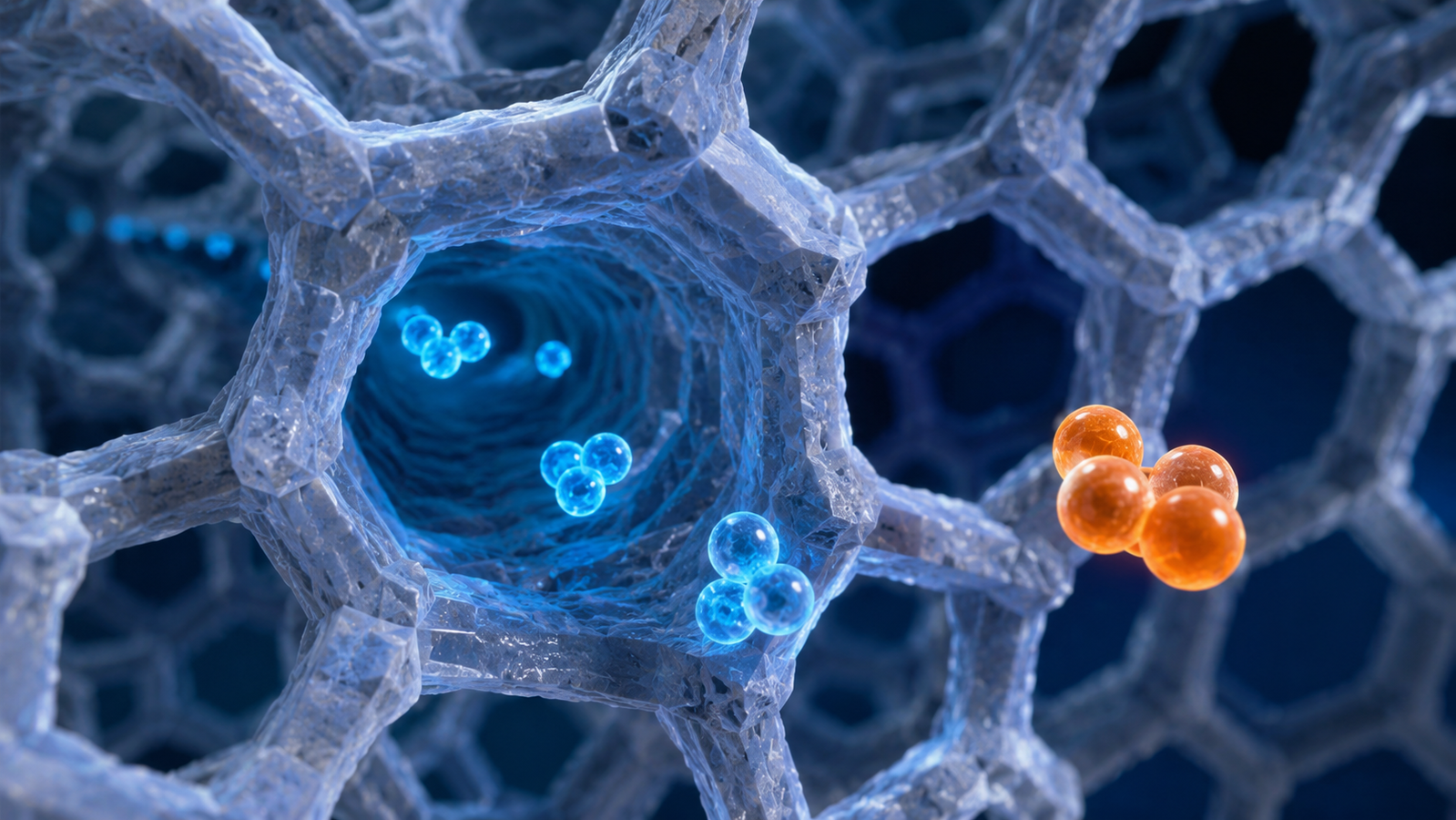
A molecular-scale gatekeeper: the ~5.5 Å channels of ZSM-5 admit slim molecules such as linear paraffins and para-xylene while excluding bulky branched and polycyclic species. The simulator below makes the geometry concrete. Four probe molecules approach a 10-ring opening drawn to scale; their fates differ only because their cross-sections differ.
A caution on the numbers: kinetic diameters are derived quantities, and molecules are flexible, vibrating objects rather than rigid balls. Ortho-xylene is not strictly forbidden from MFI — it is merely so slow that on practical timescales it might as well be. The right mental model is strong kinetic discrimination, not an absolute sieve. That subtlety is exactly what makes shape selectivity tunable: crystal size, surface modification, and operating temperature all shift where the effective cutoff lies.
Acidity by Design: Dialing the SiO2/Al2O3 Ratio
Geometry decides which molecules meet; acidity decides what happens when they do. Every aluminum atom substituted into the silica framework carries one negative charge, and when that charge is balanced by a proton the result is a bridging hydroxyl group — Si–(OH)–Al — that behaves as a strong Brønsted acid site. In a landmark 1984 study, Haag, Lago, and Weisz showed that the hexane-cracking activity of H-ZSM-5 is directly proportional to its framework aluminum content down to aluminum levels of a few parts per million, with turnover rates that bear comparison with enzymes.9 Few results in heterogeneous catalysis are as clean: in ZSM-5, framework aluminum is the active site, and counting one is counting the other. It is this clarity that has made ZSM-5 a favorite model system in the broader study of solid-acid catalysis.10
Because commercial and research ZSM-5 grades commonly span SiO2/Al2O3 molar ratios from roughly 23 to effectively infinite, acid site density becomes a true design parameter. With 96 T-sites per unit cell the arithmetic is simple: a molar ratio R corresponds to 192/(R + 2) aluminum atoms per unit cell, so R = 23 gives nearly eight acid sites per cell, R = 280 gives fewer than 0.7, and silicalite gives essentially none. Low ratios maximize activity for demanding reactions such as cracking and methanol conversion. High ratios trade raw activity for properties that often matter more: greater hydrothermal stability, slower coke formation, more isolated — and arguably more uniform — acid sites, and a progressively water-repellent interior that prefers organics over moisture. Acid density and hydrophobicity sit on the same dial, and turning it is the single most consequential specification choice when selecting a ZSM-5 grade.
Sweep that dial yourself below and watch both consequences move at once.
Two practical notes. First, commercial ZSM-5 is normally supplied in the sodium or ammonium form; the catalytically active H-form is generated by calcining NH4-ZSM-5, which releases ammonia and leaves the bridging protons behind. Second, the nominal ratio on a label is not the whole story: steaming and severe thermal treatment can expel aluminum from the framework, and such extra-framework aluminum species modify — sometimes enhance, sometimes mask — the intrinsic Brønsted chemistry. Careful activation matters as much as composition.
The Diffusion Problem — and the Rise of Hierarchical ZSM-5
Everything described so far happens inside channels about half a nanometer wide, and that is also ZSM-5’s structural weakness. Molecules must diffuse along narrow, sometimes single-file paths to reach acid sites and escape again, and the characteristic diffusion time scales with the square of the crystal size. In a conventional micron-sized crystal, sites near the center can be effectively unreachable, while products that linger too long react onward into heavier species. The end stage of that chain is coke — polyaromatic deposits whose formation chemistry was mapped in detail by Guisnet and Magnoux — which poisons sites and blocks pore mouths.11 ZSM-5’s narrow intersections suppress coke formation inside the crystal, so deposits accumulate disproportionately at the outer surface and pore mouths; Schulz’s studies of methanol conversion showed how this external coking gradually seals the crystal off even while the interior remains nominally active.12
The remedy is to shorten the diffusion path, and a whole field — hierarchical zeolites — has grown up around doing exactly that. One route is post-synthetic: controlled desilication in alkaline media carves mesopores into existing crystals, an approach systematized by Pérez-Ramírez and co-workers.13 The other route is direct synthesis of nanosized or ultrathin crystals; in a celebrated 2009 result, Choi and colleagues grew MFI nanosheets just one unit cell (about 2 nm) thick that resisted deactivation in methanol-to-gasoline service dramatically longer than conventional crystals.14 The principle is general: more external surface, shorter paths, longer life — at some cost in mechanical robustness and, occasionally, in the very shape selectivity that interior channels provide.
The simulator below races a large single crystal against an ensemble of nanocrystals with the same total volume. Watch where coke accumulates and how the activity curves diverge.
Where ZSM-5 Works: From FCC Units to Methanol Plants
FCC additive for propylene and octane. The single largest use of ZSM-5 by tonnage is as an additive to fluid catalytic cracking catalysts — the application first trialed commercially in 1983 and chronicled by Degnan and colleagues at Mobil.3 Blended at a few percent into a Y-zeolite-based FCC inventory, ZSM-5 selectively cracks low-octane gasoline-range olefins into propylene and butylenes while leaving the branched, high-octane molecules alone. The refinery gets two prizes at once: more light olefins for the petrochemical market and a higher-octane gasoline pool. Systematic studies such as Zhao and Roberie’s showed how additive level and operating conditions tune that balance, and an extensive literature now exists on modifying ZSM-5 — with phosphorus, rare earths, or tailored crystal sizes — to push light-olefin yields further, as reviewed by Rahimi and Karimzadeh.15,16 With propylene demand persistently outgrowing what steam crackers supply, this remains a growth application four decades on.
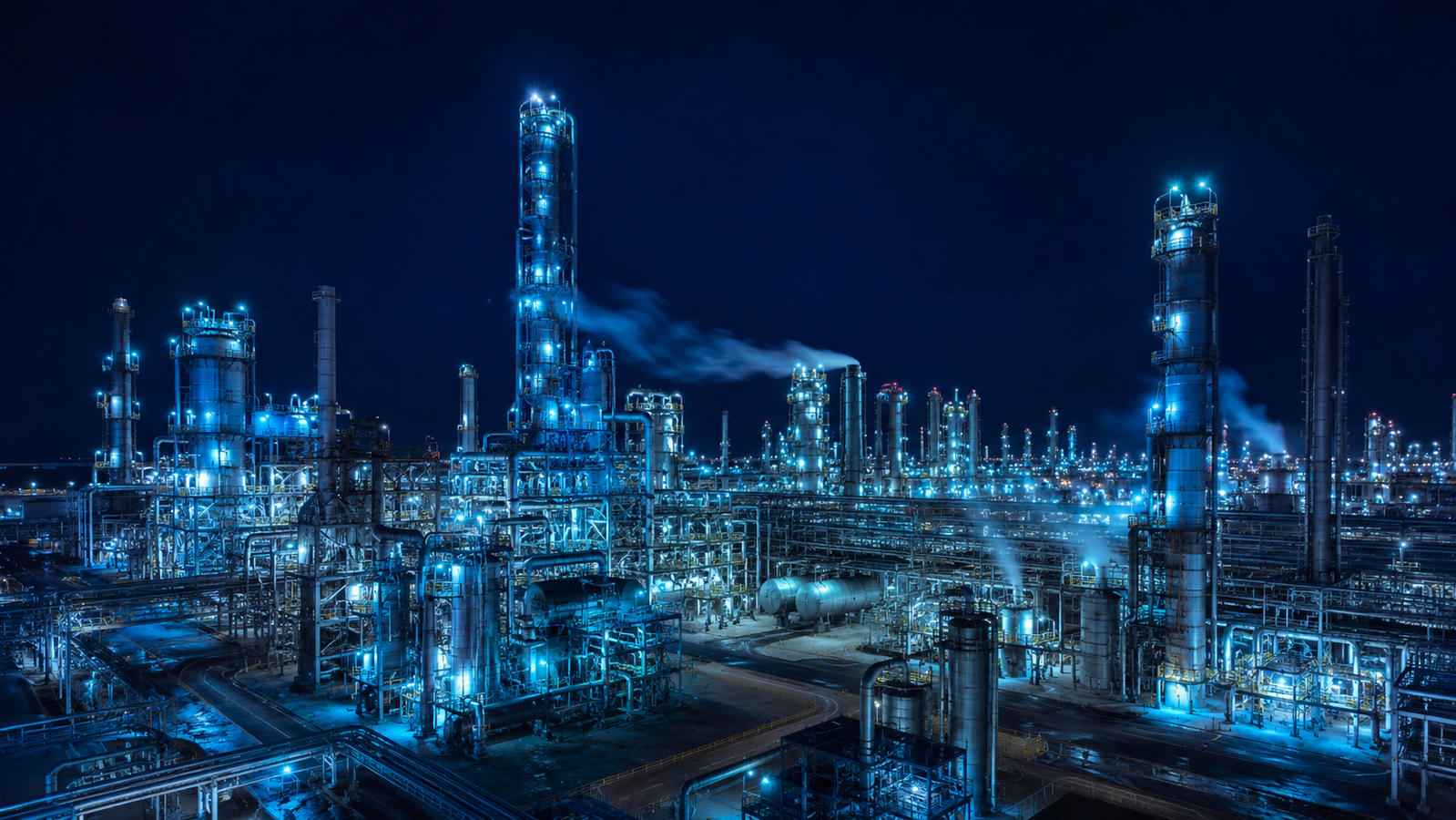
From FCC additives to methanol conversion and dewaxing, ZSM-5 upgrades molecules at world scale inside units like these. Catalytic dewaxing. The same reactant selectivity that admits linear paraffins and excludes branched ones makes ZSM-5 a natural dewaxing catalyst. Straight-chain waxes that would crystallize at low temperature are cracked out of diesel and lubricant fractions inside the pores, dramatically improving pour point and cold-flow behavior without hydrogenating away the valuable branched components outside. This was among the earliest shape-selective processes commercialized on ZSM-5 and remains a textbook illustration of geometry doing the work of chemistry.
Methanol to gasoline, propylene, and aromatics (MTG/MTP/MTA). In 1977 Chang and Silvestri reported that methanol passed over ZSM-5 emerges as a hydrocarbon mixture squarely in the gasoline range — a discovery made inside Mobil in the shadow of the oil crises and arguably the most consequential new hydrocarbon reaction of its era.17 It scaled fast: the Motunui plant in Taranaki, New Zealand produced its first gasoline on October 17, 1985, ran at about 14,500 barrels per day, and at its peak supplied roughly one-third of the country’s gasoline from natural gas via methanol. The plant later switched to selling methanol itself when crude prices made synthetic gasoline uneconomic, around 1997 — economics retired the process, not the chemistry, and the chemistry has since been revived in new MTG and methanol-to-propylene (MTP) plants, particularly in coal-rich regions.18
Mechanistically, methanol-to-hydrocarbons is now understood through the hydrocarbon-pool picture introduced by Dahl and Kolboe: methanol does not couple directly but methylates a resident pool of organic species inside the pores, which then splits off light olefins.19 On H-ZSM-5 this resolves into a dual cycle, demonstrated elegantly by Svelle and co-workers with isotope labeling — ethylene is born mainly from a cycle running through methylated aromatics, while propylene and heavier olefins come mainly from repeated olefin methylation and cracking.20 The mechanistic literature is rich and still active; the reviews by Olsbye and colleagues and by Ilias and Bhan are the standard entry points.18,21 The industrial punchline is a beautiful structure–function story: medium-pore ZSM-5 channels favor the olefin cycle and aromatics formation, yielding gasoline (MTG) or propylene (MTP), whereas the small-pore cages of SAPO-34 trap aromatics and let only ethylene and propylene escape — the basis of the methanol-to-olefins (MTO) process, commercialized at world scale beginning with the 600,000 ton-per-year DMTO unit started up in Baotou, China in 2010. Same feed, different pore architecture, different product slate; Tian and colleagues’ review tells that commercialization story in full.22
Para-xylene and aromatics processing. Product shape selectivity finds its highest-value expression in para-xylene, the precursor to terephthalic acid and thus to PET bottles and polyester fiber. In 1979 Chen, Kaeding, and Dwyer showed that suitably modified ZSM-5 steers toluene methylation overwhelmingly toward the para isomer — far beyond thermodynamic equilibrium — because para-xylene escapes the crystal before the slower isomers can.23 Surface modification with phosphorus or silica deposition narrows pore mouths and silences unselective external sites, pushing para-selectivity higher still. ZSM-5 catalysts built on the same principles serve in xylene isomerization, toluene disproportionation, and ethylbenzene synthesis; Vermeiren and Gilson’s survey of zeolites in the petroleum and petrochemical industry gives a panoramic view of how deeply these processes are embedded in modern aromatics complexes.24
Emerging frontiers. Three directions stand out. In renewable carbon, catalytic fast pyrolysis routes biomass vapors over ZSM-5 to make aromatics directly: Carlson, Huber, and co-workers demonstrated carbon yields of aromatics around 14 percent from pine sawdust in a fluidized bed at about 600 °C, and gallium-modified ZSM-5 raises that selectivity further, as shown by Cheng and colleagues.25,26 In small-molecule activation, copper-exchanged ZSM-5 performs one of chemistry’s hardest tricks — converting methane to methanol under mild conditions: Groothaert and co-workers reported selective oxidation over Cu-ZSM-5 at temperatures near 125 °C, and Woertink and colleagues identified the working active site as a bent [Cu2O]2+ core hosted in the 10-ring channels.27,28 And in environmental catalysis, Cu-ZSM-5 was the material that launched the modern study of zeolite-based NOx reduction in the 1990s; today’s commercial diesel SCR catalysts have largely moved to the more hydrothermally durable small-pore Cu-SSZ-13, but the design language — isolated copper in a shape-selective framework — was written on ZSM-5 first. Beyond catalysis, high-silica ZSM-5 and silicalite serve as hydrophobic adsorbents that strip volatile organics from humid air and water, where conventional desiccant-like zeolites would simply fill up with moisture.
Practical Outlook: Living with Deactivation
For all its coke resistance relative to large-pore zeolites, ZSM-5 in service still deactivates, and managing that reality is where process design earns its keep. The standard remedy is regeneration: a controlled burn in air or dilute oxygen removes coke and restores activity, and ZSM-5 tolerates many such cycles — FCC additives are regenerated continuously, and MTP units swing between reaction and regeneration as a matter of routine. The genuine enemy is not coke but steam at high temperature, which hydrolyzes aluminum out of the framework and permanently erodes acidity. Phosphorus modification is the workhorse defense, stabilizing framework aluminum against hydrothermal attack while usefully tempering the strongest acid sites, and it is near-universal in FCC-additive and MTP formulations.
Selection, in practice, is a four-variable problem. Choose the SiO2/Al2O3 ratio for the acid density the reaction needs and the hydrothermal severity it must survive. Choose crystal size — conventional, nano, or hierarchical — for the diffusion and lifetime profile, especially in coking-prone service like methanol conversion or biomass upgrading. Choose the cation form: ammonium as the standard precursor, hydrogen for ready-to-use acidity, sodium for adsorption or as an exchange platform. And choose the physical form, powder for fundamental studies and screening, shaped extrudates with binder for fixed beds. No single ZSM-5 is best at everything, which is precisely why it is supplied as a family.
ZSM-5 at ACS Material: Powders, Nanocrystals, Catalysts, and Adsorbents
ACS Material supplies ZSM-5 across that full selection space, in research quantities through bulk, with the SiO2/Al2O3 ratio, cation form, and morphology options the applications above call for:
- ZSM-5 Series Zeolite (MFI) Powder — research-grade MFI powders spanning a wide range of SiO2/Al2O3 ratios and cation forms, the natural starting point for catalyst screening, acidity studies, and ion-exchange platforms such as Cu- or Ga-ZSM-5.
- Nano H-ZSM-5 — nanosized H-form crystals that shorten intracrystalline diffusion paths and extend time-on-stream in coking-prone reactions, well suited to methanol conversion, aromatization, and biomass pyrolysis studies.
- ZSM-5 Catalyst — shaped, binder-containing ZSM-5 ready for fixed-bed and pilot evaluation, bridging the gap between powder studies and process conditions.
- ZSM-5 Adsorbent Series — high-silica, hydrophobic MFI grades engineered for selective adsorption of organics from humid air and aqueous streams, where moisture would saturate conventional polar adsorbents.
Because zeolite selection is comparative by nature, it helps to evaluate ZSM-5 alongside its neighbors: small-pore SAPO-34 and SSZ-13 for MTO and SCR chemistry, large-pore Beta, Y-type, and Ultrastable Y for bulkier feeds, one-dimensional Mordenite, titanium-substituted TS-1 for selective oxidation, and the other pentasil and 10-ring family members ZSM-11, ZSM-22, ZSM-23, ZSM-35, and ZSM-48 — all available in the ACS Material molecular sieves collection.
Frequently Asked Questions
What does ZSM-5 stand for, and what is MFI?
ZSM stands for Zeolite Socony Mobil, the naming series Mobil used for its synthetic zeolites, and 5 is the designation within that series. MFI is the three-letter framework code assigned by the International Zeolite Association to the underlying crystal structure, which ZSM-5 shares with its all-silica analog, silicalite.
Which SiO2/Al2O3 ratio should I choose?
As a rule of thumb: low ratios (roughly 23–50) give the highest Brønsted acid density for demanding cracking and methanol chemistry; intermediate ratios (roughly 50–300) balance activity against hydrothermal stability and slower coking; very high ratios (above ~300, toward silicalite) give dilute, isolated sites and a hydrophobic interior suited to adsorption. The conversion is 192/(R + 2) aluminum atoms — and thus potential acid sites — per 96-T-site unit cell at molar ratio R.
What is the difference between NH4-ZSM-5 and H-ZSM-5?
The ammonium form is the stable storage and shipping form. Calcining it in air, typically around 500–550 °C, drives off ammonia and leaves the proton (H) form whose bridging hydroxyls are the catalytically active Brønsted sites. Sodium-form material must first be ion-exchanged with ammonium salts before this activation.
Why does ZSM-5 coke more slowly than zeolite Y?
Mainly transition-state selectivity: the bulky polycyclic intermediates that grow into coke cannot assemble inside ZSM-5’s ~9 Å intersections, whereas the ~12 Å supercages of zeolite Y accommodate them readily. Coke on ZSM-5 therefore tends to deposit on the external surface and pore mouths, deactivating the crystal more slowly and burning off more cleanly during regeneration.
When should I use ZSM-5 versus SAPO-34 for methanol conversion?
Pore architecture sets the product slate. ZSM-5’s medium-pore channel network yields gasoline-range hydrocarbons, aromatics, and propylene-rich olefins (MTG, MTP, MTA), with long cycle times between regenerations. SAPO-34’s small-pore cages confine the chemistry so that essentially only ethylene and propylene escape (MTO), at the cost of faster coking that demands continuous fluidized-bed regeneration.
How is spent ZSM-5 regenerated, and how many cycles can it take?
Coked ZSM-5 is regenerated by a controlled oxidative burn, typically around 500–600 °C in air or dilute oxygen, and well-formulated material survives many such cycles. The cumulative risk is hydrothermal dealumination — steam generated during the burn slowly removes framework aluminum — which is why phosphorus-stabilized formulations and careful temperature control are standard practice in commercial service.
References
1Argauer, R. J. & Landolt, G. R. Crystalline Zeolite ZSM-5 and Method of Preparing the Same. US Patent 3,702,886 (1972). patents.google.com/patent/US3702886A2Kokotailo, G. T. et al. Structure of Synthetic Zeolite ZSM-5. Nature 272, 437–438 (1978). DOI: 10.1038/272437a03Degnan, T. F. et al. History of ZSM-5 Fluid Catalytic Cracking Additive Development at Mobil. Microporous and Mesoporous Materials 35–36, 245–252 (2000). DOI: 10.1016/S1387-1811(99)00225-54Olson, D. H. et al. Crystal Structure and Structure-Related Properties of ZSM-5. The Journal of Physical Chemistry 85, 2238–2243 (1981). DOI: 10.1021/j150615a0205Kokotailo, G. T. et al. Synthesis and Structure of Synthetic Zeolite ZSM-11. Nature 275, 119–120 (1978). DOI: 10.1038/275119a06Flanigen, E. M. et al. Silicalite, a New Hydrophobic Crystalline Silica Molecular Sieve. Nature 271, 512–516 (1978). DOI: 10.1038/271512a07Weisz, P. B. & Frilette, V. J. Intracrystalline and Molecular-Shape-Selective Catalysis by Zeolite Salts. The Journal of Physical Chemistry 64, 382 (1960). DOI: 10.1021/j100832a5138Chen, N. Y. & Garwood, W. E. Some Catalytic Properties of ZSM-5, a New Shape Selective Zeolite. Journal of Catalysis 52, 453–458 (1978). DOI: 10.1016/0021-9517(78)90350-09Haag, W. O., Lago, R. M. & Weisz, P. B. The Active Site of Acidic Aluminosilicate Catalysts. Nature 309, 589–591 (1984). DOI: 10.1038/309589a010Corma, A. Inorganic Solid Acids and Their Use in Acid-Catalyzed Hydrocarbon Reactions. Chemical Reviews 95, 559–614 (1995). DOI: 10.1021/cr00035a00611Guisnet, M. & Magnoux, P. Organic Chemistry of Coke Formation. Applied Catalysis A: General 212, 83–96 (2001). DOI: 10.1016/S0926-860X(00)00845-012Schulz, H. “Coking” of Zeolites during Methanol Conversion: Basic Reactions of the MTO-, MTP- and MTG-Processes. Catalysis Today 154, 183–194 (2010). DOI: 10.1016/j.cattod.2010.05.01213Pérez-Ramírez, J. et al. Hierarchical Zeolites: Enhanced Utilisation of Microporous Crystals in Catalysis by Advances in Materials Design. Chemical Society Reviews 37, 2530–2542 (2008). DOI: 10.1039/b809030k14Choi, M. et al. Stable Single-Unit-Cell Nanosheets of Zeolite MFI as Active and Long-Lived Catalysts. Nature 461, 246–249 (2009). DOI: 10.1038/nature0828815Zhao, X. & Roberie, T. G. ZSM-5 Additive in Fluid Catalytic Cracking. 1. Effect of Additive Level and Temperature on Light Olefins and Gasoline Olefins. Industrial & Engineering Chemistry Research 38, 3847–3853 (1999). DOI: 10.1021/ie990179q16Rahimi, N. & Karimzadeh, R. Catalytic Cracking of Hydrocarbons over Modified ZSM-5 Zeolites to Produce Light Olefins: A Review. Applied Catalysis A: General 398, 1–17 (2011). DOI: 10.1016/j.apcata.2011.03.00917Chang, C. D. & Silvestri, A. J. The Conversion of Methanol and Other O-Compounds to Hydrocarbons over Zeolite Catalysts. Journal of Catalysis 47, 249–259 (1977). DOI: 10.1016/0021-9517(77)90172-518Olsbye, U. et al. Conversion of Methanol to Hydrocarbons: How Zeolite Cavity and Pore Size Controls Product Selectivity. Angewandte Chemie International Edition 51, 5810–5831 (2012). DOI: 10.1002/anie.20110365719Dahl, I. M. & Kolboe, S. On the Reaction Mechanism for Hydrocarbon Formation from Methanol over SAPO-34. Journal of Catalysis 149, 458–464 (1994). DOI: 10.1006/jcat.1994.131220Svelle, S. et al. Conversion of Methanol into Hydrocarbons over Zeolite H-ZSM-5: Ethene Formation Is Mechanistically Separated from the Formation of Higher Alkenes. Journal of the American Chemical Society 128, 14770–14771 (2006). DOI: 10.1021/ja065810a21Ilias, S. & Bhan, A. Mechanism of the Catalytic Conversion of Methanol to Hydrocarbons. ACS Catalysis 3, 18–31 (2013). DOI: 10.1021/cs300658322Tian, P. et al. Methanol to Olefins (MTO): From Fundamentals to Commercialization. ACS Catalysis 5, 1922–1938 (2015). DOI: 10.1021/acscatal.5b0000723Chen, N. Y. et al. Para-Directed Aromatic Reactions over Shape-Selective Molecular Sieve Zeolite Catalysts. Journal of the American Chemical Society 101, 6783–6784 (1979). DOI: 10.1021/ja00516a06524Vermeiren, W. & Gilson, J.-P. Impact of Zeolites on the Petroleum and Petrochemical Industry. Topics in Catalysis 52, 1131–1161 (2009). DOI: 10.1007/s11244-009-9271-825Carlson, T. R. et al. Production of Green Aromatics and Olefins by Catalytic Fast Pyrolysis of Wood Sawdust. Energy & Environmental Science 4, 145–161 (2011). DOI: 10.1039/C0EE00341G26Cheng, Y.-T. et al. Production of Renewable Aromatic Compounds by Catalytic Fast Pyrolysis of Lignocellulosic Biomass with Bifunctional Ga/ZSM-5 Catalysts. Angewandte Chemie International Edition 51, 1387–1390 (2012). DOI: 10.1002/anie.20110739027Groothaert, M. H. et al. Selective Oxidation of Methane by the Bis(μ-oxo)dicopper Core Stabilized on ZSM-5 and Mordenite Zeolites. Journal of the American Chemical Society 127, 1394–1395 (2005). DOI: 10.1021/ja047158u28Woertink, J. S. et al. A [Cu2O]2+ Core in Cu-ZSM-5, the Active Site in the Oxidation of Methane to Methanol. Proceedings of the National Academy of Sciences USA 106, 18908–18913 (2009). DOI: 10.1073/pnas.0910461106This article is provided by ACS Material LLC for educational purposes. Structural dimensions, kinetic diameters, and yields cited are representative values from the referenced literature; exact figures depend on composition, crystal size, activation, and measurement conditions. ACS Material products are supplied for research and industrial development use.